The Apparatus
This is the complete history: the full narrative, plus the unabridged research dossier behind every era, grades and contradiction logs and lead inventories and negative results included, folded directly into the page rather than linked out. Click “Complete Research Dossier” after any chapter to expand its full evidentiary record. The eight deep-dive dossiers on individual figures and firms are likewise reproduced in full at the end, alongside the stitched cross-era narrative. Nothing here is off the page; everything is searchable in your browser with Ctrl/Cmd-F.
Note on the raw dossiers: the chapters and the two sections that follow them are current to the 2026-07-28 revision, while each expandable dossier is reproduced verbatim as its author left it, in the era files' own punctuation and house style. Where a dossier and a chapter differ, section C of the stitched master narrative adjudicates.
A shorter way in: the front page collects the eras and a set of individual stories, and the timeline lays out eighty-nine dated entries across eight eras. This page is the long version, kept whole. Sources are cited inline in parentheses rather than as numbered endnotes, so a claim and its evidence always sit together.
The Corner Before the Temple
A Suburb Named for Colleges
Every fact in this history sits on ground that did not exist as an address until 1891, when Oscar Martin Carter, a self-made Nebraska millionaire and former Omaha bank president, and his Omaha and South Texas Land Company bought 1,756 to 1,765 acres of prairie northwest of downtown Houston, ground sitting roughly twenty-three feet above the fever-ridden lowlands of the city proper. (TSHA Handbook, “Houston Heights, TX”; City of Houston Historic Preservation Manual; Houston Heights Association history) Carter had already bought and electrified Houston’s street railway and pushed the line four miles out to his new town, making Houston Heights arguably the first streetcar suburb in Texas. The Boston financiers behind the venture left their fingerprints on the plat: Heights Boulevard was modeled on Boston’s Commonwealth Avenue, and the town’s north–south streets were given the names of American colleges (Harvard, Yale, Cornell, Oxford), an aspirational branding device laid over what was substantially a working- and middle-class commuter suburb. (same source cluster) That branding exercise is the entire reason the building at the center of this history carries the word “Harvard” in its address. No Ivy League institution ever had anything to do with the corner.
The Panic of 1893 broke the land company within two years of the plat, but the town incorporated as an independent city on July 1, 1896, with William G. Love as its first mayor, and grew from roughly 800 residents in 1900 to some 9,000 by 1915. (TSHA Handbook) Two civic decisions from this window shadow everything that follows at Eleventh and Harvard. The first was the 1912 “dry” ordinance drafted by Heights co-founder D. D. Cooley, banning alcohol sales inside the town, a ban that survived until a 2016–17 neighborhood vote finally dissolved it. One line of research plausibly infers, without direct proof, that the dry ordinance is why the Eleventh-and-Harvard shop strip filled up with groceries, drugstores, and cleaners rather than saloons. It is a tidy explanation resting on inference rather than a documented cause.
The second civic hinge was annexation. On February 20, 1918, Heights voters went to the polls to decide consolidation with Houston: “Voters who go to the polls today will be handed two ballots. One of these will be for the saloon district ordinance. The other will be for the consolidation of Houston and Houston Heights.” (Houston Post, Feb. 27, 1918 issue context, metapth610579) But the vote and the annexation were not the same event: the formal transfer of governmental affairs took place March 1, 1918, nine days later. (research plan 70; TSHA Handbook) The driver of the whole exercise was money for schools. Heights mayor Marmion, announcing the sale of a $225,000 school-bond issue, explained that “this sale means that Houston Heights will realize her hopes of having ample room for her many school children, for the law authorizing the annexation provided for the expenditure of all bond moneys within the territory for which it was voted.” (research plan 70, verbatim) As a negotiated condition of the merger, the Heights kept its 1912 dry ordinance even after ceasing to be its own city.
The Corner Before the Lodge: 1100 and 1102 Harvard
Before there was a temple, the northeast corner of Eleventh Avenue and Harvard Street was simply two house lots on Block 199, in a residential block that filled in steadily through the 1900s and 1910s. The National Register nomination for the Schlesser-Burrows House at 1123 Harvard, built in 1912 by contractor Jos. Schlesser for his own family and later described in its nomination as “small, well-kept yard; adjacent to old Masonic Lodge; generally a residential neighborhood,” establishes just how ordinary and residential the block still felt eighteen years before the temple went up. (NRHP nomination 84001823)
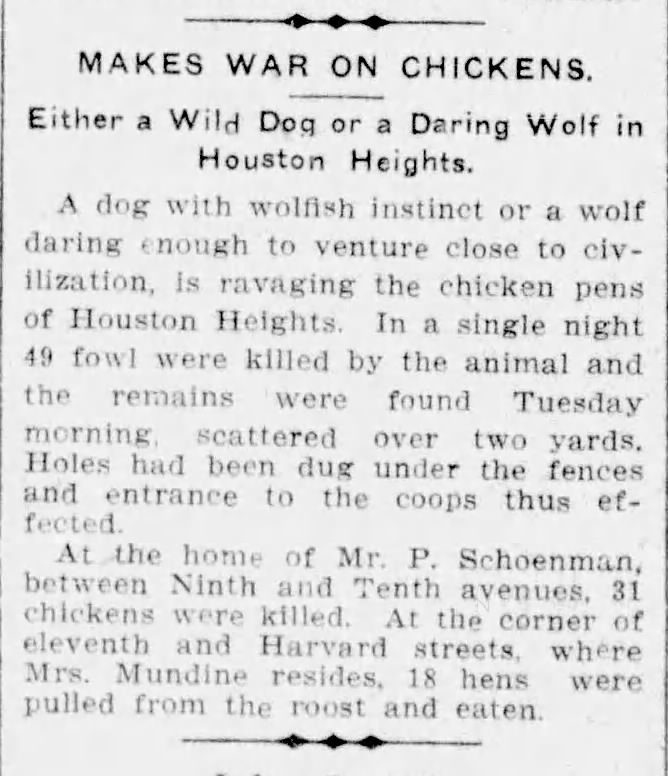
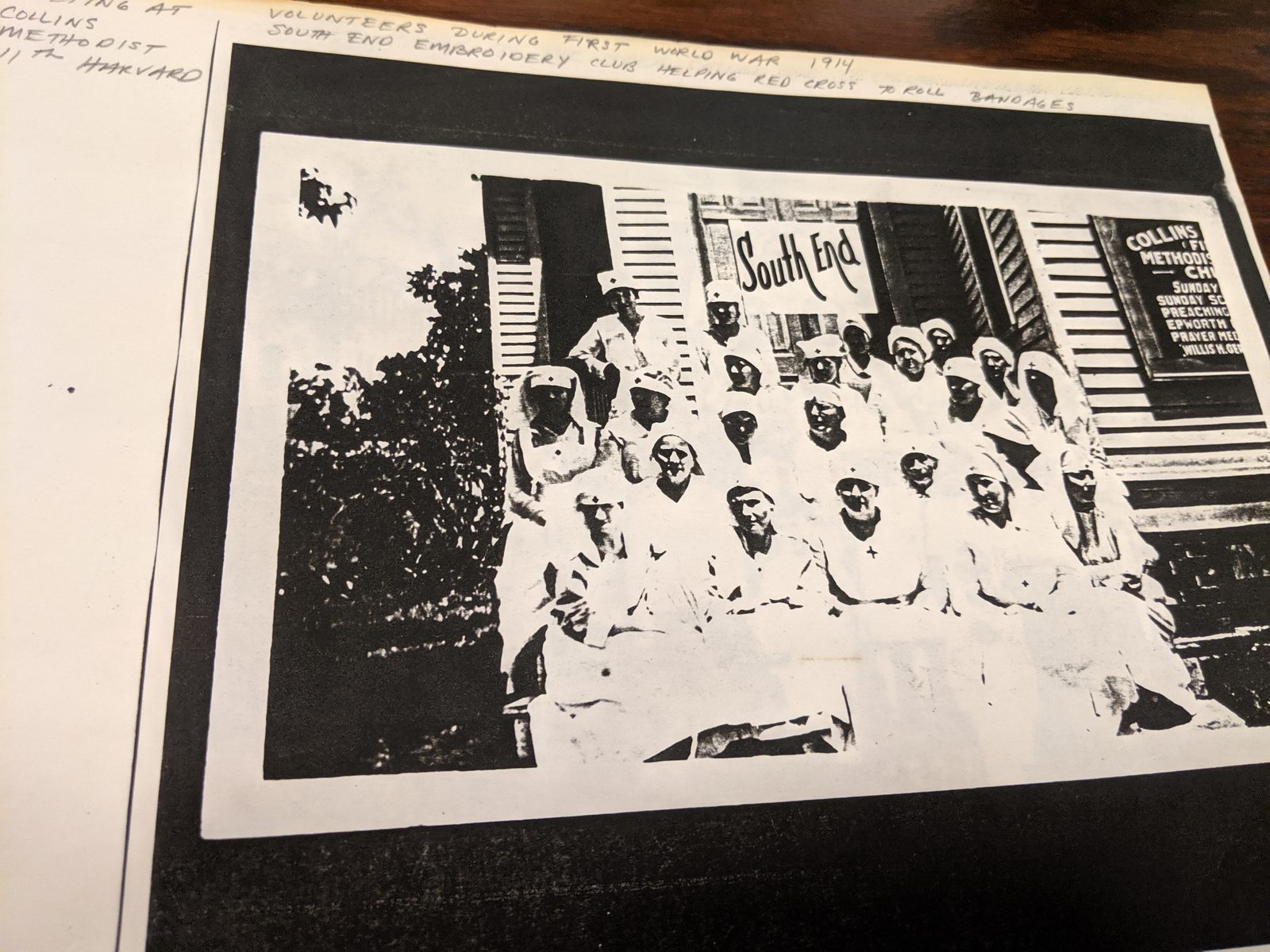
Two surviving artifacts catch the corner’s pre-temple texture directly. In September 1908 the Chronicle reported a wolf, or a very ambitious wild dog, making “war on chickens” in the neighborhood: “At the corner of Eleventh and Harvard streets, where Mrs. Mundine resides, 18 hens were pulled from the roost and eaten.” (Houston Chronicle, Sept. 1, 1908, p. 12) And a photograph labeled 1914 preserves a Red Cross bandage-rolling session at Collins Memorial Methodist Church at Eleventh and Harvard, the church that anchored the intersection’s other corner for the next half-century. (Houston Metropolitan Research Center, MSS 229)
The documentary record of the two addresses themselves, recovered from Portal to Texas History classifieds and society columns, is graded as unverified page-level newspaper hits: individually unconfirmed, but numerous and mutually consistent. From 1905, 1100 Harvard appears as a substantial rental property: “FOR LEASE: Eight-room house, completely furnished; stable and gas plant; one block from car line; for $35 [or $36] per month. Apply 1100 Harvard avenue, Houston Heights.” (Houston Post classifieds, Sept. 1–5, 1905; metapth443380, 443375, 443322/443364) In July 1910 the address was selling a dairy cow: “FOR SALE: Very desirable 3-gallon Jersey cow giving milk. 1100 Harvard street, Houston Heights. Telephone Taylor 220.” (Houston Daily Post, July 21, 1910, p. 13, clip 95177988) The same year it turns up in Houston Land and Trust Co. rental listings. In February 1911 it hosted a St. Valentine party “at the home of Miss Mattie Dupont”; on January 11, 1912 the lot recorded a birth, “January 11: Mrs. Tony Armbruster, 1100 Harvard; a boy” (Houston Chronicle birth report, Jan. 21, 1912, p. 32, clip 1198529206); and in February 1913 the same family hosted another Valentine party “at the lovely home of Mr. and Mrs. A. Armbruster.” A 1924 item still places a resident, one “W. B. Barlett [sic],” at the address. The picture across two decades is of an ordinary large frame house with a stable, cycling through tenants, sitting on the very lot the temple would later occupy.
Next door, 1102 Harvard has a documented occupant as early as 1902: an index-derived, single-source entry records that “Mrs. R. B. Richeson occupies the two-story home at 1102 Harvard,” the earliest named resident of either lot, though the underlying clipping has not been read directly. (Houston Chronicle, 1902, via the project timeline index) By December 1904 the house was the home of E. L. Rugg: “Mr. E. L. Rugg arrived last week from New Orleans to spend the holiday with [his] family at 1102 Harvard street.” (Houston Post, Dec. 25, 1904; metapth602531) Mrs. E. L. Rugg hosted the Houston Heights Musical & Social Club there in December 1904 (metapth602567), and in January 1905 the club created a new office for her: “The office of corresponding secretary was created and Mrs. E. L. Rugg was elected to that position.” (Houston Post, Jan. 29, 1905, p. 9, clip 1204499743) Her mother, Mrs. L. S. Frazier, visited the residence in February 1905. (Houston Chronicle, Feb. 12, 1905, p. 9, clip 1198289943) The club itself is confirmed to have existed (research plan 32, Houston Post donor list), though no officer lists, event descriptions, or descriptions of the Rugg house itself have been recovered.
Who was E. L. Rugg? The leads sketch a life without quite proving a single continuous man: an Alvin, Texas fruit farmer and local politician of the 1890s, appearing in horticultural-society and county-committee items between 1895 and 1900, once “urged to run for congress” (Schulenburg Sticker context, March 1900), attending a Thanksgiving ball at the United Daughters of the Confederacy hall in Alvin with Mrs. Rugg on November 30, 1899 (Houston Daily Post, Dec. 2, 1899, p. 3, clip 1230343148), and of whom the Alvin Sun wrote on December 14, 1900: “E. L. Rugg has accepted a position in Houston, and we fear we will lose him as a resident.” He appears as “E. L. Rugg, Houston” by 1901–02, at 1102 Harvard from 1904, and in Heights Republican delegate lists in July 1904. Every one of these identifications rests on individually unverified Portal hits. Two cautions matter more than the biographical color. First, no Masonic connection for Rugg has ever been established. Nothing in the Grand Lodge Proceedings, the newspaper corpus, or the leads ties him to Reagan Lodge, and a dedicated sweep found no legitimate mentions of an “E. L. Rugg” (or Edward L. Rugg) in Houston newspapers between 1900 and 1935 beyond OCR noise (research plan 33); the Rugg thread and the lodge thread must not be conflated, however tempting the adjacency. Second, his identity even across his own scattered appearances is not fully secure: an “E. L. Rugg” who turns up at a Waco county convention in 1888 and at a San Antonio delegate list in 1890 may or may not be the same man. (research plans 32/33)
His departure is better attested than his arrival, because he advertised it. By May 1911 Rugg was living in New Orleans, at 2302 General Taylor Street, and liquidating the corner from a distance. One ad offers a “residence of 10 rooms, all modern conveniences, large gallery on three sides, on 3 lots 50x120 each… corner of Eleventh and Harvard streets,” valued at $5,000 and offered for a sacrifice price of $3,000 or $4,000 (Houston Chronicle, May 27, 1911, p. 10, clip 1198830316); another advertises a “new 5-room cottage, corner of Eleventh and Harvard” with a well in the yard at $16 a month, and a “14-room rooming house… Address E. L. RUGG, corner Eleventh and Harvard,” on which he had “about $6000 invested; will sell for $1500,” giving “old age reason for sale.” (Houston Chronicle, May 28, 1911, p. 56, clip 1198830447) A June ad prices the main house precisely: “A very modern, 7-room, 2-story house, one block from car line, Eleventh and Harvard streets, Houston Heights; block 103, lot 12; value $5000.” (Houston Chronicle, June 2, 1911, p. 16, clip 1198830643) The block-and-lot figure in that ad, “block 103, lot 12,” does not match the Block 199 lots the temple would later occupy, and is recorded here as printed rather than reconciled. A separate June ad gives Rugg’s own local address as “1010 Harvard street,” a numbering variant worth flagging. (Houston Chronicle, June 1, 1911, p. 14, clip 1198830606) By October 1911 the 1102 address is associated with a different hostess, Mrs. Alexander Peddie, and by 1916 with a Miss Clolia Lyles. Rugg’s documented tenure at the corner therefore runs 1904 to 1911, not the 1904–1919 span this project once carried, which is unevidenced within the newspaper record and has been dropped.
The Brenham Prehistory, 1893–1913
Reagan Lodge was not assembled out of strangers. Seventeen years before the Heights charter, the three men who would fill its three principal chairs were already running a lodge together in Brenham, ninety miles northwest. The officer election reported in December 1893 reads: “Worshipful Master, J. M. French; Senior Warden, J. Frank Helms; Junior Warden, J. G. Goudler; Treasurer, A. C. Bernard; Secretary, J. M. Dagley.” (Houston Daily Post, Dec. 19, 1893, p. 2, clip 70921861) The fuller slate from the same report adds Wm. Horn as senior deacon, E. T. Merriman as junior deacon, Roy Webb and Jas. Nelms as stewards, H. Kingley as tyler, and the unusual office of “T. M. Whitman, financier.” (same clip)
This changes the shape of the founding story. Reagan Lodge No. 1037 was not a startup that had to learn the work; it was an existing Masonic cohort from Brenham Lodge No. 135, reconstituted in a new suburb, which is why three otherwise obscure men could staff a fully functioning lodge on its very first night. The Brenham connection persisted for decades in civic life as well as Masonic life: Merriman and French sat together as presiding and assistant judge of Precinct No. 31 at the Heights Library, and Nelms as presiding judge of Precinct No. 32 at the Heights School, in the mid-1920s, while A. C. Bernard presided at the Helms School precinct. (Houston Post-Dispatch, Mar. 17, 1926, p. 20, clip 1193267369; Oct. 6, 1925, p. 13, clip 1197448558) John M. Dagley, the 1893 Brenham secretary, resurfaces in 1918 as a pallbearer at a Reagan Lodge funeral.
The cohort was visible in the Heights before it had a hall of its own. In February 1913, J. M. French joined B. A. Meriwether, A. D. Millican, and J. C. Moore as active pallbearers for John W. Latchford, a locomotive engineer of 2144 Yale Street killed in the wreck of the “Owl” train near Houston. The Chronicle described the pall party in a phrase that does the historian’s work for him: “who was killed Saturday in the wreck of the ‘Owl’ train near Houston… The active pallbearers, all prominent Heights Masons, were Messrs. B. A. Meriwether, J. M. French…” (Houston Chronicle, Feb. 3, 1913, p. 6, clip 1197433074) Two years after the charter, with the lodge still meeting in rented rooms, the newspaper already recognized an organized Masonic colony in the Heights.
Founding a Lodge for the Heights, 1910–1911
Reagan Lodge No. 1037, Ancient Free & Accepted Masons, was chartered by the Grand Lodge of Texas on December 12, 1910, a date triangulated three independent ways and about as solid as anything in this whole history. The Grand Lodge of Texas Proceedings record it twice: the 1917 return (“REAGAN LODGE No. 1037: 120 Members… Date of Charter: December 12, 1910,” p. 889) and the 1924 return (p. 1205). (TX Grand Lodge Proceedings, 1917 & 1924) Sister M. Agatha’s The History of Houston Heights, 1891–1918 (1956) independently confirms it and preserves the lodge’s full formal name: “HEIGHTS MASONIC LODGE: The John H. Reagan Lodge No. 1037 was chartered December 12, 1910.” (archive.org historyofhouston0000agat) And the lodge’s own count of anniversaries lands on the same date: a 1929 notice announcing “their nineteenth regular anniversary celebration and watch party tonight” counts back nineteen years from December 31, 1929 to December 31, 1910. (Houston Post-Dispatch, Dec. 31, 1929)
The charter itself made a physical journey: “James F. Helms brought the charter for Reagan Lodge No. 1037 from Waco to Houston Heights.” (Houston Heights (Sloan), archive.org houstonheights0000sloa) A garbled Waco Morning News snippet of Jan. 8, 1916 (“Reagan Masonic Lodge Installed&rdquo) remains unreliable pending a clean re-read, and may refer to a same-named Waco lodge rather than this one. A more intriguing thread ties the new lodge to an established one: a passage in A History of Gray Lodge states “This was the beginning of Reagan Lodge No. 1037” in a context suggesting Gray Lodge No. 329 served as a sponsoring or parent lodge for Reagan’s founding, a reading supported by the fact that Gray Lodge members are cordially invited by name in Reagan’s very first weekly notices, and the two lodges exchange courtesies in nearly every notice of the era, though the surrounding text is OCR-degraded and needs a cleaner source before the relationship can be called confirmed. (archive.org bwb_Y0-ARS-176) The lodge’s own historiography, per H. C. Thomas Sr.’s “A Brief History of Reagan Lodge” (cited by Lodge Historian James E. Fisher, P.M.), records that the first man was made a Mason at Reagan Lodge in 1911, the year after the charter and installation. The project timeline names that first man as Frank R. Williams and holds that French served as first Worshipful Master under dispensation before the charter arrived, both drawn from an index-derived compilation rather than a clipping read directly. (the project timeline index, “The Lodge Is Born&rdquo)
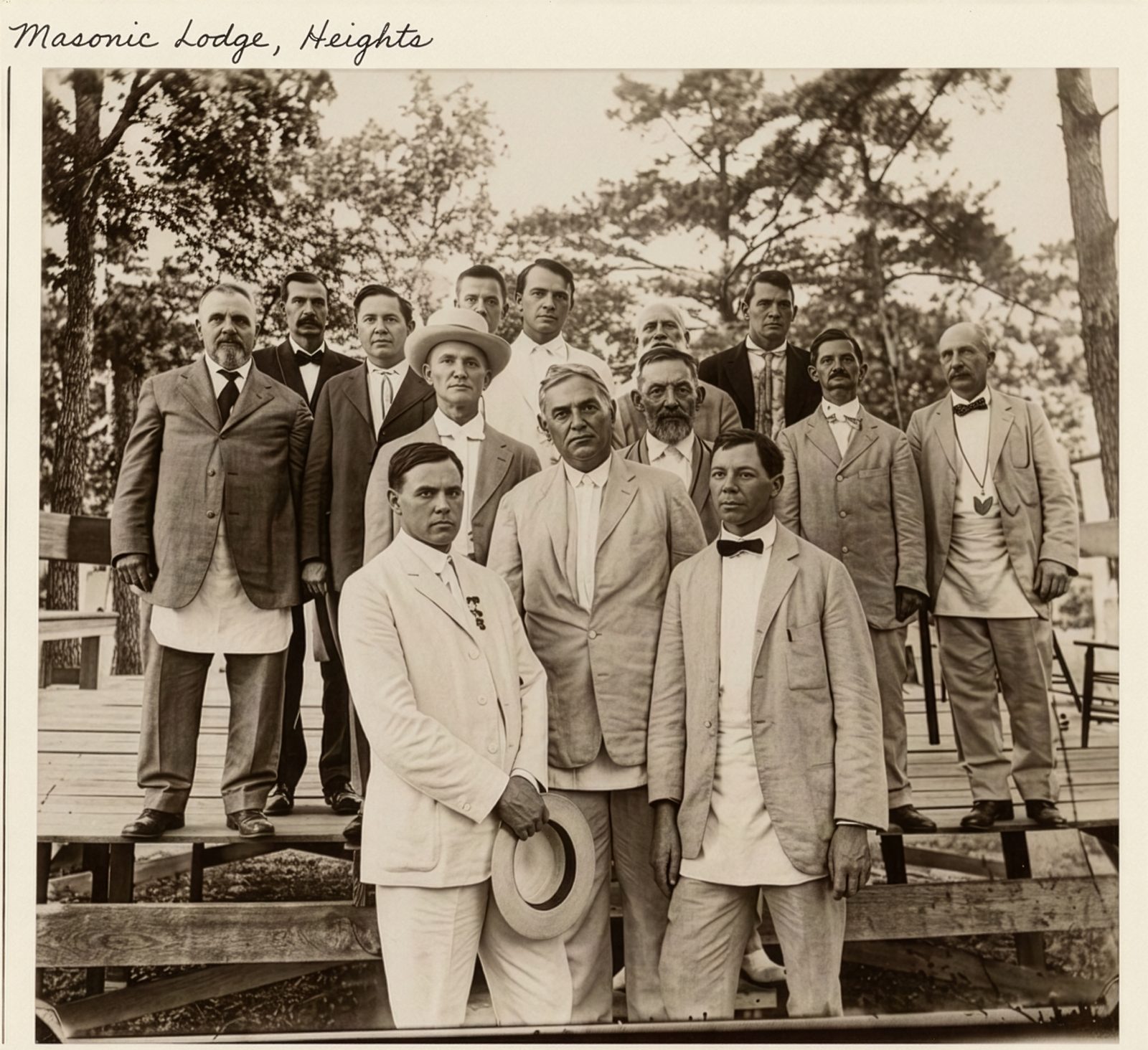
The installation itself came on December 31, 1910. The Houston Post of January 1, 1911 reported: “MASONIC OFFICERS INSTALLED: Houston Heights’ New Organization Was Formally Launched… launched last night, officers were installed… more than fifty persons took part in the installation ceremony, twenty-three of the number being the charter members of the new lodge.” (Houston Post, Jan. 1, 1911, metapth443405; corroborated by clipping sr96651967, confirming the “square and compass” decorations and the Houston Heights Masonic hall location) The installing officer was O. M. Longnecker, District Deputy Grand Master of the Thirtieth Masonic District, with A. E. Clarkson as marshal; the Post of December 30, 1910 had already announced “Reagan No. 1037 is the newest of the new Masonic lodges for Houston Heights and environs” with its charter arrived. (sr95177905; research plan 37, Houston Post, Jan. 1, 1911, p. 10) Longnecker is the attested spelling in both the 1910–11 newspaper items and the Grand Lodge representation lists, which record “Reagan Lodge No. 1037, at Houston Heights, Tex., R. W. Brother O. M. Longnecker, D.D.G.M., thirtieth district; proxy” (Grand Lodge Proceedings via Portal, Dec. 6, 1911); the “Lounsberry” spelling that appears in some OCR extractions is a transcription artifact, not an alternate identity. Longnecker had been Past Master of Holland Lodge No. 1, was appointed Grand Junior Deacon of the Grand Lodge of Texas for 1909–1910, and served as DDGM of the 30th District through December 1911 (his 1909 predecessor in that post was Frank C. Jones). In January of an uncertain year he was also appointed proxy for Reagan Lodge’s dispensation to lay the cornerstone of a Baptist church at Houston Heights. (metapth432809) That cornerstone can now most likely be dated and placed. A Houston Post “25 Years Ago” column of January 29, 1937 reprints its own item of January 29, 1912 verbatim: “The cornerstone of the Baptist Temple at Twelfth and Rutland streets was laid tonight with Masonic ceremonies, conducted by the Reagan Lodge, Rev. G. E. Ammons is pastor of the church.” (Houston Post, Jan. 29, 1937, p. 4, “25 Years Ago,” clip 1194047445) The 1937 reprint does not name Longnecker, so the identification of this ceremony with his dispensation proxy is a reasonable inference rather than a closed case, and the sourcing chain runs through a retrospective column rather than a surviving 1912 clipping.
The full eleven-office slate installed that night reads as follows.
| Office | Officer |
|---|---|
| Worshipful Master | J. M. French |
| Senior Warden | James F. Helms |
| Junior Warden | A. C. Bernard |
| Treasurer | Charles Horn Sr. |
| Secretary | E. Dietrich |
| Senior Deacon | R. J. Shallcross |
| Junior Deacon | Paul E. Tamron |
| Senior Steward | J. A. Gordon |
| Junior Steward | O. J. Furnsek |
| Tiler | W. O. Backus |
| Chaplain | William Oliver [Olive] |
(research plan 37, Houston Post, Jan. 1, 1911, p. 10; Senior/Junior Warden identifications drawn from the charter context)
French’s primacy as first Worshipful Master is confirmed by his own obituary eighteen years later: “J. M. French, 69, charter member and first master of Reagan lodge No. 1037, A. F. and A. M., died at his home, 1531 Broadway street.” (Houston Post and Houston Chronicle, July 9, 1928, sr1193713924; NewsBank artifact 1928-07-09_p19_french-obituary.pdf) The weekly Post lodge notices of 1911 uniformly carry “French, W.M.,” for instance “Reagan Lodge, No. 1037, A. F. & A. M.: Stated meeting first Tuesday night in each month, in Masonic hall, Houston Heights.” (Houston Post, March 21, 1911, p. 12, sr1193267369) At his death, French was also a member of Prairie Lea Lodge No. 114 at Fentress, Texas, and his obituary records an unusual triple duty: “At the time of his death, Mr. French was tiler of Temple Lodge No. 4, Temple Lodge No. 114, A. F. and A. M., and Reagan Lodge No. 1037.” (Houston Post-Dispatch, July 10, 1928, p. 8, clip 1197963169) His funeral on July 9, 1928 was held at his residence under Reagan Lodge auspices, Rev. G. Z. Sadler officiating, burial in Hollywood Cemetery under the Heights Undertaking Company, with C. C. Powell, Clint Holaday and James Helms among the active pallbearers. The honorary list runs back through the whole Heights Masonic old guard and closes a circle with the lodge’s Yale Street years: “Honorary pallbearers will be R. C. McBrayer, S. Gregory, … Emil Schmidt, G. A. Brandt, Dr. William Olive, C. C. Berry, J. M. Wilcox, judge, W. R. Ward, Earl Wilson…” (same clip) A called-meeting notice summoned the lodge “at 4 o’clock p. m. today, for the purpose of conducting the funeral of our deceased brother and first worshipful master, J. M. French, from residence, 1631 Broadway, Heights Annex” (metapth1837743), leaving a 1531/1631 Broadway discrepancy between the obituary and the lodge notice that the record does not resolve. A stray classified from January 1930, just past this chapter’s close, is the only glimpse of French outside a lodge room: “LOST: In business section, bar pin with one diamond and two emeralds. Liberal reward if returned to owner, J. M. French. Phone Hadley 9517.” (Houston Post-Dispatch, Jan. 24, 1930, p. 20, clip 1192849719)
Reagan Lodge was the first Masonic lodge instituted in Houston’s suburbs, marking the start of a second wave of Houston Masonic growth that tracked the streetcar-suburb boom directly. (reaganlodge1037.org/history; hmdb.org marker m=157794) The lodge first met in rented space, the “Heights Masonic Hall,” over the volunteer fire department building at 910 Yale Street (also rendered “908½ Yale” in the 1915 city directory), next door to Dr. William Olive’s drugstore. (reaganlodge1037.org/history, corroborated by hmdb marker) A June 1911 Post picnic notice has members meeting “at the lodge room on Yale street between Eighth and Ninth street” (metapth603971); a companion notice’s “between Ninth and Tenth” is an OCR garble of the same address (metapth604962). City directories confirm “Reagan Lodge No 1037” in the 1910-11, 1911-12, 1917, 1919, 1920-21, and 1922 editions (ContentDM items 7470, 8195, 10142, 11647, 12564, 13528), and a directory cross-check indicates the Yale Street area address persisted through the 1922 edition, with 1923 the first directory to list the lodge at 1100 Harvard, though this rests on an index-derived summary rather than a directly examined page. (a directory cross-check of the project timeline index against the project's city-directory scans)
Dr. William Olive anchors this first block of lodge life on Yale Street. He was the physician and proprietor of Olive’s drugstore at 910 Yale, treating a child’s fractured skull brought into the store in November 1906 and holding a runaway girl from Victoria for the police in July 1914; Houston Heights City Recorder (on the “Citizens’ Ticket” by 1909, serving in 1913 and 1915); and a lodge officer in his own right, elected Senior Warden in 1912 and Chaplain by 1915. (research plan 36, Houston Post dates cited therein)
The Young Lodge: Growth, Discipline, and a Building Association, 1911–1919
The recovered record yields a nearly continuous officer roster for the lodge’s first decade. At the June 1912 installation, retiring Worshipful Master James F. Helms, presented a past-master jewel and then acting as installing officer with J. M. French as marshal, installed W. H. Ward as Worshipful Master, with William Olin [Olive] as Senior Warden, C. C. Hart as Junior Warden, J. C. Fowler as Treasurer, Emil Dietrich as Secretary, W. O. Bocus [Backus] as Tiler, L. R. Williams as Senior Deacon, O. J. Lomsich as Junior Deacon, H. E. Gatheman as Senior Steward, and Ed L. White as Junior Steward. (Houston Post, June 25, 1912, p. 11, sr1193575891) Ward carried the lodge’s name outside the Heights that same year. When the Grand Lodge deputized Ingham S. Roberts to carry Houston’s old Masonic building cornerstone to Grand Lodge headquarters in Waco and invited past grand masters to accompany it, the notice recorded that “Judge W. H. Ward of Reagan Lodge, Houston Heights will be one of the party.” (Houston Post, Nov. 30, 1912, p. 10, clip 1193717581) Two years after Helms carried the charter home from Waco, a Reagan Lodge officer rode the reverse trip. A subsequent, undated election made C. C. Hart worshipful master, with R. J. Shallcross senior warden, F. R. Williams junior warden, Fowler treasurer, Dietrich secretary, and W. O. Barkus tiler. (metapth607797) By July 1915, James F. Helms was again W.M., installed alongside C. I. Voss as senior warden, Ed L. White as junior warden, J. C. Fowler as treasurer, Emile Dietrich as secretary, J. B. Watson as senior deacon, A. Copeland as junior deacon, W. O. Backus as tiler, and P. L. Cooper as senior steward. (metapth607578) In December 1916, C. I. Voss was master of Reagan Lodge, named alongside the masters of Holland, Gray, and Temple lodges. (metapth608775, metapth608128)
The Grand Lodge’s 1917 return gives the fullest snapshot of the era: “J. A. Jackson (Worshipful Master), R. D. Hardcastle (Senior Warden), E. McGar Johnson (Junior Warden), J. C. Fowler (Treasurer), C. I. Voss (Secretary), G. W. Holland (Senior Deacon), H. A. Locey (Junior Deacon), J. H. Whitehead (Senior Steward), L. L. Loggins (Junior Steward), Emil Dietrich (Tiler). Past Masters: A. C. Bernard, James F. Helms, C. C. Hart, R. J. Shallcross, C. I. Voss,” with 120 Master Masons, meeting first and third Tuesdays, District 30, Harris County. (TX Grand Lodge Proceedings 1917, p. 889/315) That same return records the year’s vital statistics: 9 Entered Apprentices, 2 Fellow Crafts, one death (R. L. Whitehead), 5 dimitted, 1 reinstated, and even a physical-defect degree waiver granted for “loss of two middle fingers, and first and little finger just above the middle joints on left hand” (p. 60), the granular texture of a working blue lodge’s year. In June 1918, R. D. Hardcastle succeeded as W.M., with Johnson S.W., Thos. B. Reed J.W., Fowler treasurer, and Voss secretary (metapth608017), and the 1918–19 notices are signed “R. D. Hardcastle, W.M., C. I. Voss, secretary.” That clean succession does not survive contact with the rest of the record. On October 1, 1918 it is W. H. Lynn, not Hardcastle, who calls the lodge to a funeral as Worshipful Master (Houston Chronicle, Oct. 1, 1918, p. 13, clip 1197719807); in January and February 1919 the fraternal column has the lodge under a “J. D. Hardcastle” with C. I. Voss secretary (Houston Post, Jan. 21, 1919, p. 9, clip 1192969506); and by July 10, 1919 the master is Walter Webb, with J. W. Johnson as secretary (Houston Post, July 10, 1919, p. 15, clip 94921931). Each sighting is independently well sourced. The mechanism behind the churn, whether illness, a resignation, an acting master, or simple compositor error in the initials, is nowhere explained.
The lodge’s signature institution in these years was the annual public installation-and-picnic. “Fully 1000 people” attended the fourth annual picnic and public installation in June 1915 at Playground Park (metapth607337); a Post photo spread of July 13, 1915 names C. I. Voss, Dr. Wm. Olive, Clayton Lee, and Emile Dietrick on the platform (sr1193811119). The fifth annual, on June 24 [1916], drew the same “attendance of fully 1000 people.” (metapth607578) For a lodge of barely over a hundred members in a town of nine thousand, a thousand-person turnout marks the lodge as a genuine civic institution rather than a private club. The pattern of feeding the neighborhood first and doing lodge business afterward held for years, and the June 1921 election notice states it plainly: “Following a picnic and basket lunch given last Friday afternoon by Reagan lodge, A. F. and A. M., No. 1037, the election of officers was held at 8 o’clock there Monday night.” (Houston Post, June 28, 1921, p. 7, clip 1193557301) The lodge shared these occasions with its Eastern Star chapter: in June 1914, before any hall existed, “the officers will be installed at the joint public installation of Reagan lodge, Ancient Free and Accepted Masons, on June 24, at the public playgrounds, corner of Twenty-first street and Boulevard in Houston Heights.” (Houston Post, June 13, 1914, p. 3, clip 95017517) A second account of the same practice survives in a source garbled as “Lodge No. 1080” and “Chapter No. 158” (metapth605269); the clean 1914 citation now carries the point.
The young lodge suffered exactly one recorded disciplinary scar in this period: the Ennis affair of 1917. The Grand Master’s report for 1917 narrates “ENNIS LODGE No. 369 vs. REAGAN LODGE No. 1037,” an invasion-of-jurisdiction case in which Reagan Lodge had conferred degrees on a candidate, “Bro. J. M. T.,” who had earlier been stopped by a personal protest lodged from Ennis. In the Grand Master’s own words: “I held that the Master of Reagan Lodge, as well as Reagan Lodge, were guilty of a violation of the law in withholding from Grand Masters Lightfoot and McMillin the fact that said protests had been lodged… and gave instructions to R. W. Bro. G. A. Brandt, D.D.G.M., Thirtieth District, to administer reprimand to Reagan Lodge for such violation of the law.” (TX Grand Lodge Proceedings 1917, pp. 131–133, index pp. 227, 998–999, Trial Master appointment p. 108) Charges were preferred against “Bro. A. C. B., the then Master of Reagan Lodge.” On the Past Masters list, this can only plausibly be A. C. Bernard, though the Proceedings use initials only, and he was tried in the lodge. The candidate himself was ruled innocent and “a Master Mason in good standing, a member of Reagan Lodge.” Brandt “administered the reprimand and sat as Trial Master at the trial, and assures me that both Lodges have learned their lesson.” The wrinkle is sharper than it first appears: this A. C. Bernard was also a founding officer, a Building Association incorporator, and a sitting Houston Heights alderman. His civic profile makes it richer still. An experienced Heights contractor and school builder, he survived Mayor Barker’s May–June 1912 attempt to oust him from the city council over alleged conflicts of interest in school-building contracts at Addicks and Alta Loma (“no city official shall become interested in any public work&rdquo); Judge Masterson ruled the mayor had no power to expel an alderman unilaterally, leaving the matter to the council. (Houston Post, June 1 & 4, 1912; metapth605843 p. 9, metapth605558 p. 11)
Wartime touched the lodge directly. On November 21, 1917 it received a special Grand Lodge dispensation “to confer the F.C. and M.M. degrees out of time upon Bro. C. J. Frank, an E.A. of said lodge,” a soldier of the 108th Illinois Engineers facing deployment to Europe. (TX Grand Lodge Proceedings 1917, p. 93) That same year the Grand Master paid an official visitation to Reagan Lodge (together with Holland No. 1, Gray No. 329, and Temple No. 4), delivering the Master’s lecture to a class when Harris County lodges conferred degrees by certificate degree teams. Downtown lodges repeatedly called Reagan members in to help work degrees on Camp Logan soldiers, Holland Lodge for instance working the Fellow Craft degree “on members of Camp Logan this morning” on January 1, 1918 (metapth443277), and a September 1918 called meeting sent the lodge to the funeral of a Brother Webb at the downtown temple at Main and McKinney. H. C. Colley, who would rise to Worshipful Master a decade later, served as secretary of the WWI draft-exemption board for Houston’s Southern district. (Houston Post, Aug. 4, 1917) A September 1918 called meeting also summoned the lodge in a Liberty Bond context, though the notice is garbled. (metapth608390) The lodge’s by-laws were reviewed and approved by the Grand Lodge Committee on By-Laws “after some slight correction” in 1917, and again, with articles 3, 4, and 5 required changed, in 1924.
Underlying all of this was money. In September 1916 a charter was filed with the Texas Secretary of State for the “Reagan Lodge Masonic Building association of Houston Heights, no capital stock.” The two Austin papers that reported the filing disagree on the incorporators: the Austin American of September 30, 1916 names “C. I. Voss, Jess F. Helms, A. C. Bernard and C. W. Raper” (metapth1524630), while the Evening Statesman of September 29, 1916 names “C. I. Voss, James P [F.] Helms, and A. C. Bernard,” omitting Raper entirely. (metapth1449372) Both newspaper accounts are confirmed as reported; which incorporator list is complete, and whether C. W. Raper was really among the founders, remains an open contradiction that should not be silently resolved either way. C. W. Raper resurfaces in 1928 building the Cade-Rothwell lodge hall as “C. W. Raper & Son,” which at least confirms he was a real contractor active in Masonic building work. The lodge’s own modern history and the state historical marker instead date “an association formed in 1912 to raise funds for a permanent building.” No era-appropriate source in this record independently confirms that 1912 date. The most economical reading, offered as interpretation rather than established fact, is that informal fund-raising talk began around 1912 and was formally incorporated in September 1916, on the eve of hall construction. A September 1915 item calling the building fund “five years old” only deepens the puzzle, since a 1912 start would make it three years old, not five, suggesting fund-raising talk may reach back to the lodge’s very first years after all.
The First Hall at Eleventh and Harvard, 1916–1918
The lodge’s working tradition places its first hall on the site in 1916, and the newspaper record now supports it. On the last night of 1916 the lodge threw a party in a building the Chronicle called new: “The first entertainment held by Reagan Lodge No. 1037 of Houston Heights in the new Masonic Hall, Harvard and Eleventh, was a watch party to bid farewell to the old year and welcome the new.” (Houston Chronicle, Jan. 7, 1917, p. 2, clip sr1197842360; also Houston Post, Jan. 7, 1917, p. 26) The retrospective account carries a full cast: musical numbers by Mrs. C. C. Powell, Miss Nettie Mae Powell, Dr. F. F. Meine, Mrs. R. T. Mumme, E. F. Patterson and Florence Woods; readings by Amelia Shallcross and Daphne White; a cornet duet by Dr. Meine and Mr. Laidlaw; and a midnight talk by Mrs. Fannie McCants of the Eastern Star. That single item pushes the corner’s documented first public event back a full year from the December 31, 1917 watch service previously treated as the earliest firm placement of the lodge at the corner, and it supplies the earliest named performance on ground the temple would later occupy. Mrs. C. C. Powell’s husband would sit on the 1930 temple’s building committee fourteen years later.
The rest of the sequence follows quickly. By May 1917 the lodge’s affiliated bodies are meeting at the corner in their own right: an Eastern Star notice reads “meet at the masonic hall at Eleventh and Harvard streets, Monday evening, May 7, at 7:30 o’clock” (Houston Post, May 6, 1917, sr1192797763; companion Houston Chronicle notice, sr1198055099), and a March 3, 1917 Temple Lodge notice already invites “Reagan Lodge No. 1037 and sojourning brethren” without yet siting Reagan’s own hall. (sr1193727730) On the last night of 1917 the lodge repeated its watch party, this time with the war in it: the notice invited “all master masons and friends, including O. E. S., Logan Masons” to the service “in the hall tonight,” and named the speaker, “Rev. E. P. West will speak.” (Houston Chronicle, Dec. 31, 1917, p. 3, clip 1197929109) By May 1918 the lodge itself is meeting there: “Reagan lodge No. 1037, A. F. and A. M., will meet at Masonic hall, Eleventh and Harvard streets, at 7 o’clock Wednesday night for work in the M. M. degree.” (Houston Post, May 8, 1918, sr94909229) From June 1918 the boilerplate hardens into the phrasing it would keep for a decade: “STATED meeting of Reagan Lodge No. 1037, A. F. and A. M., tonight at 8 o’clock in Masonic temple, Eleventh and Harvard, Houston Heights.” (Houston Post, June 18, 1918, sr94857787, signed J. A. Jackson, W.M., C. I. Voss, secretary)
In October 1918 the hall served its grimmest function. Members were “requested to meet at the Masonic Temple, Harvard and Eleventh street, Houston Heights” for the funeral of Oscar C. Grubbs, 21, manager of the Taylor telephone exchange and a member of both Reagan Lodge and Woodland Camp No. 10, W.O.W., dead in the influenza month of October 1918 with a brother, Arthur, already in military service. Worshipful Master W. H. Lynn called the special meeting; the pallbearers were C. A. Bawcom, Clint Holaday, C. C. Powell, Vas H. Brogdon, John M. Dagley, and Oscar Hild, a list that reads like a roster of the lodge’s next decade; burial was at Glenwood. (metapth443302; Houston Chronicle, Oct. 1, 1918, p. 13, clip 1197719807; obituary Houston Post, Oct. 1, 1918, p. 10, sr1192903452) The two accounts disagree on where he died: one gives 1541 Ashland Street, the other his Harvard Street home, elsewhere rendered 1918 Harvard. The conflict is logged rather than decided.
So a building the newspapers called a “Masonic hall” and then, from mid-1918 onward, a “Masonic temple,” stood at Eleventh and Harvard from the end of 1916, fourteen years before the grand 1930 temple. Contemporaries’ casual use of the word “temple” for this modest first hall matters historiographically: a pre-1930 reference to “the Masonic Temple at Eleventh and Harvard” does not imply the grand building already existed. It cuts the other way too. The City of Houston Historic Preservation Manual’s claim that “the first lodge was built in 1918 at 1100 Harvard Street,” which conflicts directly with the lodge’s own 1930 construction account, most likely preserves a genuine memory of this first hall’s construction, simply mislabeled as the building that stands today. Both statements are confirmed as what those sources say; the reconciliation offered here is interpretive, flagged rather than silently resolved.
What the first hall actually was remains thin almost to the point of invisibility. A dedicated newspaper sweep for its construction found no cost, size, contractor, or architect, with zero definitive construction hits in the Houston Post for 1916–1917, and the 1917 Grand Lodge Proceedings, the one volume available for the 1911–1920 span, contain no mention of a building fund or hall for Reagan Lodge at all; the Grand Lodge Proceedings for 1911–1916 and 1918–1920 are simply not digitized. Physical clues survive only in later, incidental notices: the hall had a second floor (“boys’ order affiliated with Reagan [Lodge], meeting tonight on the second floor at the corner of Eleventh [and Harvard],” November 1924, sr95997757), a lawn large enough for basket picnics (1929 notices reference a “basket picnic on lawn at 5:30 p.m.&rdquo), and an “exhibition hall” usable for the Garden Club’s flower shows. (metapth1886366) By November 1925 the classifieds were giving it a street number outright: “HOUSTON ASSEMBLY No. 2, Order of the Rainbow, will hold its regular meeting Saturday at 2 p.m. in the Masonic hall, 1100 Harvard Street.” (Houston Post-Dispatch, Nov. 14, 1925, p. 14, clip 1197797626) The 1924 Sanborn fire-insurance maps cannot help settle its footprint: 1100 Harvard falls outside the digitized volumes’ coverage, since Volume 2 ends at Oxford Street and the Heights sheets belong to un-digitized Volumes 5 and 7.
One further puzzle sits in the middle of this chronology, and it now has a probable answer. The Grand Lodge’s 1924 return reads: “REAGAN LODGE No. 1037: 544 Members. Held at Houston, Harris County, on the First and Third Tuesdays in each month. Postoffice: Houston, 732 Harvard Street. Date of Charter: December 12, 1910. Vas. H. Brogdon, W.M. Clarence C. Powell, S.W. Charles S. Bawcom, J.W. James C. Fowler, Treasurer.” (TX Grand Lodge Proceedings 1924, p. 1205, verbatim) Every contemporary newspaper notice, without exception, puts the lodge at Eleventh and Harvard, in the 1100 block. 732 Harvard was the Helms family home. A Houston Chronicle “20 Years Ago” feature recalls the August 1921 wedding of “Oleta Helms, daughter of Mrs. James F. Helms, 732 Harvard… married last evening at the family home,” and adds that in 1941 “Mrs. Helms, mother of the bride, continues to live in the same home where the wedding took place.” (Houston Chronicle, Aug. 19, 1941, p. 22, clip 1198405220) Since the Grand Lodge return’s “Postoffice” line records where the lodge received mail, and James F. Helms was its long-serving secretary, the most economical reading is that the 1924 return gives the secretary’s own mailing address rather than the lodge’s meeting place. The chain runs through a 1941 retrospective rather than an independent 1924 confirmation, so the explanation is probable rather than proved.
The Busiest Corner in the Heights: Lodge Life, 1918–1929
From 1918 to the end of 1929 the record preserves an almost unbroken run of meeting notices, and through them both the hall’s daily life and the lodge’s officer line. That line is far less tidy than a table implies, and the table below is built to show the seams rather than hide them.
| Date | Worshipful Master | Notes / Secretary |
|---|---|---|
| June 1918 | R. D. Hardcastle | Installed with Johnson S.W., Thos. B. Reed J.W., Fowler treasurer, Voss secretary (metapth608017); notices signed “R. D. Hardcastle, W.M., C. I. Voss, secretary” |
| Oct. 1918 | W. H. Lynn | Calls the Grubbs funeral meeting as W.M. mid-term, unexplained against the Hardcastle year (Houston Chronicle, Oct. 1, 1918, p. 13, clip 1197719807) |
| Jan.–Feb. 1919 | “J. D.” Hardcastle | C. I. Voss, secretary; initials printed “J. D.” against the 1918 notices’ “R. D.” (Houston Post, Jan. 21, 1919, p. 9, clip 1192969506) |
| July 1919 | Walter Webb | J. W. Johnson, secretary (Houston Post, July 10, 1919, p. 15, clip 94921931). A February 18, 1919 Temple Lodge No. 4 notice had called members to “attend funeral of Brother Walter Webb” (clip 1193123013). The papers never explain the collision; two men sharing a name, a father and a son, is the likeliest reading, but nothing in the record confirms it. |
| June 1921 | Thos. B. Reed | James F. Helms, secretary (sr94948751; sr94954719 confirms “Thos. B.” against a Post misprint of “Thos. R.&rdquo). The June 28, 1921 election notice printing the full slate names no Worshipful Master at all and does not include Reed; the tension is logged, not resolved |
| June 1921 (full slate) | not named in the notice | Elected: H. W. Toliver S.W., S. P. Waltrip J.W., J. C. Fowler treasurer, James F. Helms secretary; appointed J. B. Saylor S.D., C. W. Eberley J.D., Emil Dietrich tiler, Joe M. Jackson S.S., C. S. Bawcom J.S., J. H. Clous chaplain. “These officers were installed by James F. Helms, division deputy grand master” (Houston Post, June 28, 1921, p. 7, clips 1193557301/94957456) |
| July 1921 | Frank Graham | Reed to Graham within one month, presumably the newly installed 1921–22 master, logged and not fully resolved (sr95055387) |
| 1923 | H. W. Totrver [garbled] | James F. Helms, secretary (metapth608564). The refreshed corpus records H. W. Toliver only as Senior Warden, elected June 1921, and documents no Toliver term in the East at any date; this row is retained pending a direct re-reading of the source rather than deleted |
| June 1924–1925 | Vas H. Brogdon | Installed June 25, 1924 following a basket picnic, Grand Master Gus Brandt presiding (sr1192956188; sr1199045869). Full slate at the nine-lodge joint installation in the Scottish Rite Cathedral: “Vas H. Brogdon, worshipful master; A. E. Faust, senior warden; O. R. Weyrich, junior warden; J. C. Fowler, treasurer; Julius F. Helms, secretary,” with George E. McVey S.D., W. A. Ross J.D., A. F. Jordan S.S., H. H. Pool J.S., W. G. Morrison tiler (Houston Chronicle, June 24, 1924, p. 3, clip 1199045784); “Julius F. Helms” is one more print variant of James F. Helms. The GL 1924 return gives Brogdon W.M., C. C. Powell S.W., C. S. Bawcom J.W., J. C. Fowler treasurer |
| 1925–26 | C. C. Powell | Installed June 24, 1925 at a joint installation with Woodland Lodge following a basket picnic (Houston Post-Dispatch, June 24, 1925, p. 20, clip 1193005076; metapth1904230); presided at the John H. Reagan High School cornerstone in November 1925. His wife, Mrs. Clara C. Powell, was Worthy Matron of Houston Heights Chapter No. 258 the same year (Houston Post-Dispatch, Nov. 14, 1925, p. 14, clip 1197797626) |
| 1926–27 | C. S. [C. F.] Bawcom | Installed June 24, 1926; full slate: W. S. Ferguson S.W., Clint Hollady J.W., Emil Dietrich treasurer, James F. Holmes [Helms] secretary, A. A. Stone S.D., W. F. Bartlingek J.D., L. M. Barrett tiler, C. L. Allbritton S.S., M. H. Tewes J.S. (metapth1886234; Chronicle, June 17, 1926, sr1198595032) |
| 1927 | M. Mankins | James F. Helms, secretary. Calls the special meeting of June 4, 1927 to lay a cornerstone for a new Heights Masonic Temple at Eleventh and Harvard (Houston Post-Dispatch, May 27, 1927, p. 15, clip 1193690189); C. S. Bawcom’s signature also appears on 1927 school-of-instruction notices (Houston Post-Dispatch, Apr. 8, 1927, p. 20, clip 1192856861) |
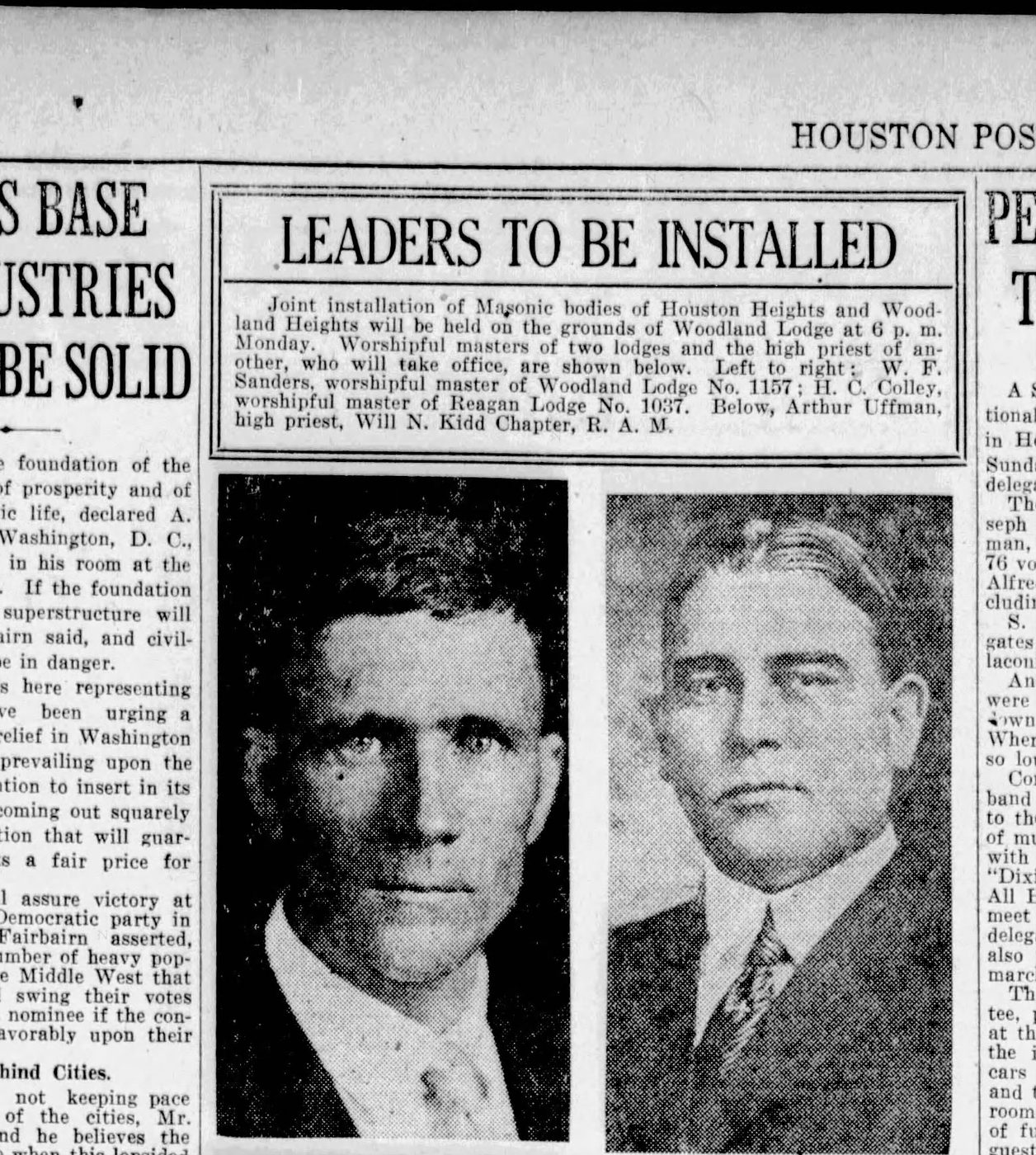
| 1928–29 | H. C. Colley | Pictured at the joint installation of Houston Heights and Woodland Heights Masonic bodies (Houston Post, June 25, 1928, sr1197433805). In January 1928 the secretary’s pen briefly changed hands: “C. S. Bawcom, W. M.; Clint Holaday, secretary” (Houston Post-Dispatch, Jan. 27, 1928, p. 20, clip 1193664256) |
| 1929 | Clint Holaday | Signs Feb. and June 1929 notices, overlapping with Colley signatures running into May 1929; one cluster is misdated or mis-OCR’d (metapth1837894, metapth1837801, metapth1837846/1837847) |
| Mid-1929 onward | A. A. Stone | James F. Helms, secretary; signs through the Dec. 31, 1929 anniversary watch party and into 1930 (Houston Chronicle, Aug. 13, 1929, sr1198535723; Sept. 21 and Nov. 23, 1929 Chronicle notices) |
Two names in that table carry problems the columns cannot hold. The C. S. Bawcom who entered the officer line as Junior Steward in June 1921 and rose to the East in 1926 cannot easily be the C. S. Bawcom whose funeral was announced in 1919: “Funeral services for C. S. Bawcom, son, who died Wednesday night at a Houston hospital, will be held at 4 p.m. Thursday from the residence of his sister, Mrs. Margaret Ward, 2111 Payne street.” (Houston Post, Aug. 1, 1919, p. 14, clip 94904291) Either a father and son shared initials, or two unrelated men of the same name moved through the same city. The lodge’s Bawcom worked for the Southern Pacific and turned up in Scottish Rite ceremonial as well: a March 1929 Babylonian degree play cast him among the musicians, “C. S. Bawcom, trumpeter; H. C. Sherrill, sentry; R. L. Williams, trumpeter.” (Houston Post-Dispatch, Mar. 3, 1929, p. 24, clip 1197418900) As for his successor, an A. A. Stone commanded a Texas Volunteer Guard company at Nacogdoches called the Reagan Rifles, dissolved by Special Order No. 69 in 1897: “Eighty-five hats, dark blue flannel, represented by Captain A. A. Stone, Reagan Rifles, is hereby dissolved.” (Houston Daily Post, Oct. 20, 1897, p. 5, clip 71304051) Whether that captain is the A. A. Stone who took the East of Reagan Lodge thirty-two years later is unproven; only the name and the shared namesake connect them.
Through all of this turnover, James F. Helms is the continuity thread, secretary in nearly every notice from 1921 through the end of this era, a post he would hold until his death in office in September 1932. A 1921 item names a “J. Frank Helms district deputy grand master of the eighteenth Masonic district” (metapth608433), likely the same man, though the district number (18th, against the lodge’s own 30th) is a flagged puzzle rather than a resolved fact. Helms ran the lodge’s school of instruction personally: “James F. Helms, instructor, assisted by A. A. Jones, J. B. Stulting, C. Bawcom and others.” (metapth1837717, May 1928) His working life reached outside the lodge room and, once, straight into the lodge’s own future. On a Fidelity Trust Company of Houston financial statement published in July 1921, the sworn jurat reads: “We, E. G. Floeter, as vice president, and L. R. Hayes, secretary of said bank… Subscribed and sworn to before me this 7th day of July, A. D. 1921. J. F. HELMS, Notary Public, Harris County, Texas.” (Houston Post, July 9, 1921, p. 14, clip 1196043266) The officer taking that oath was Lee R. Hayes, Reagan Lodge’s own Worshipful Master of the 1930s, which makes the two men business associates as well as lodge brothers a decade before the temple was built. By 1927 the family had four bodies’ paperwork in hand at once: Mrs. Pearl Helms as Worthy Matron of Chapter No. 258, Mrs. Ruth N. Helms as Worthy Matron of the newly forming Chapter No. 222, W. K. Helms as High Priest of the Royal Arch chapter, and J. F. Helms signing as secretary for all of them. (Houston Post-Dispatch, Apr. 8, 1927, p. 20, clip 1192856861)
Whatever else happened at the corner, the lodge buried its dead there. W. O. Backus, the lodge’s first Tiler, was buried from 817 Harvard: “The members of Reagan lodge No. 1037… are requested to meet at the lodge rooms, Harvard and Eleventh streets, Monday afternoon at 4:30 p. m. to attend the funeral of the deceased member,” with the OES chapter summoned in parallel. (metapth608390) This notice is undated in the record; if the Backus death is truly as early as 1912–14, it would upset the first-hall chronology laid out above, and it needs to be dated before it can bear on that question. The classified column doubled as a muster roll. A December 1926 call summoned the lodge “at 2 o’clock tomorrow for the purpose of attending the funeral of our deceased brother, L. W. Stampp. C. S. Bawcom, W. M.; J. F. Helms, secretary” (Houston Post-Dispatch, Dec. 19, 1926, p. 28, clip 1197377478), and a June 1927 call for J. M. Sledge was set with the square and compass printed as a graphic in the type. (Houston Post-Dispatch, June 12, 1927, p. 26, clip 1193589422) W. F. Ferguson was buried in March 1927 with sixteen honorary pallbearers spanning the lodge’s whole first generation: Echols, Lucky, Donovan, Kepple, Jones, Hackfield, Womack, Webb, Hart, Shallcross, Jackson, Johnson, Graham, Powell, Outterside, King, French. (sr1193532610) First master J. M. French followed in July 1928. Police detective Oscar Hope, a vice-squad veteran, was buried in Forest Park in June–July 1929 “under direction of the Reagan lodge No. 1037,” with past master Vas H. Brogdon presiding at the graveside and master H. C. Colley assisting; the lodge held a 3 o’clock funeral meeting the same day as its 7 p.m. special meeting with basket picnic, and even the Brenham Banner-Press carried the burial notice. (metapth1837917/1837918, sr1192824544) W. M. Belk, “a Mason for 45 years,” a member of Reagan lodge, was buried around 1929. (metapth1886220) Member obituaries scattered across the era, Grubbs (1918), S. A. Myers, Wells C. Purdy of 333 Heights Boulevard, Peter P. Waesch of 603 East Sixth, Rufus W. Smith, Dr. Olmstead, James Nias (carpenter and foreman of Norhill school), Chester Hilton (27, of the Houston naval reserves), John A. Reynolds (50), sketch the membership in aggregate: telephone managers, carpenters, policemen, small businessmen, the Heights middle class entire.
The Masonic family filled the hall as much as the blue lodge itself did. Houston Heights Chapter No. 258, Order of the Eastern Star, had a social calendar of its own before the corner hall existed: a July 1913 interurban excursion to Galveston with beach-bathing privileges and lunch on the sand, tickets in charge of H. E. Gathman, Professor Foote and T. E. Bullington (Houston Chronicle, July 25, 1913, p. 11, clip 1199012280); a May 1914 joint meeting with the Ransford and Houston chapters exemplifying the work for grand matron Mrs. Carrie A. Chase; and in March 1916 the balloting exemplification at the Fourth District school of instruction, where “the evening meet[ing] will open with an example of ballot[ing] by the Houston Heights Chapter No. 258.” (Houston Post, Mar. 30, 1916, p. 7, clip 95745807) From 1917 the chapter met “in Reagan lodge room, corner of Eleventh and Harvard” continuously: stated meetings, initiations, annual May elections, public installations in May and June, schools of instruction with noon lunch, a Christmas luncheon in 1927, a “chili supper and circus” on October 14, 1927, benefit chicken suppers in January 1928, Halloween parties in 1920, a February 1922 reception for Worthy Grand Matron Mrs. Mary E. Roach of Dallas, and Robert Morris birthday observances in August 1922 and August–September 1923. The cadence never broke, even through the crash: four dated 1929 notices in February, June, September and December keep the chapter in the same room. (Houston Post-Dispatch, June 3, 1929, p. 17, clip 1192823389, and companion notices of Feb. 18, Sept. 2 and Dec. 16, 1929) Named officers across the era include worthy matrons Mrs. Muriel Reed, Mrs. Ida Wimberly (1924), Mrs. Clara C. Powell (1925), Mrs. Cora Belle Jones (1926, with worthy patron S. P. Waltrip), Mrs. Alice Brogdon (1923), Mrs. Pearl Helms (1927), Mrs. Ida Openshaw (1928–29, with patron A. A. Stone, the lodge’s coming Worshipful Master), and Mrs. Ollie Craig (installed June 1929, with patron Earl Wilson). In April 1927 a second Eastern Star chapter was forming inside the same room: “REAGAN CHAPTER NO. 222, O. E. S. (under dispensation): Stated meeting Friday evening, April 8, 8 o’clock. Reagan Temple, Eleventh and Harvard Sts.” (Houston Post-Dispatch, Apr. 8, 1927, p. 20, clip 1192856861) The chapter number 258 appears as early as 1904 in Post items (research plan 54: April 18, October 13, November 26, 1904), though the finding carries a loud caution: “No. 258” collides with the newspaper’s own issue number, and the pre-1911 chapter history is genuinely uncertain as a result. The connection to the lodge was structural rather than incidental. The modern lodge history confirms Reagan Lodge sponsored Chapter No. 258’s formation, along with its DeMolay and Rainbow chapters, within its first twelve years.
Reagan Chapter, Order of DeMolay was instituted in [1922], meeting “Wednesday night at Reagan lodge No. 1037, Houston Heights,” with stated meetings on the second and fourth Tuesdays at the lodge (metapth609289); its charter dance is documented that same year. A Rainbow Girls box party entertained the DeMolay boys “on the lawn at Reagan Masonic hall” on July 1, 1923. (metapth609202) The chapter fielded a basketball team (“Reagan De Molay vs. Hogg School,” City Auditorium Community League) and Commercial-league baseball teams against Remington Rand and Grape Tang at the Camp Logan diamond, and with the Houston chapter it hosted the annual state DeMolay conclave in June [1925?], with Lyle Conway of Reagan chapter helping raise $2,000 by popular subscription. (metapth1837902, metapth1837916) Officers named across these years include Bertram Parker (M.C.), Truett Parker (scribe), Carl Stonecipher (scribe of the “boys’ order” meeting on the hall’s second floor, 1924), and J. Earl Stonecipher (president of the Reagan P.M.C. club). The countywide chapter used the hall too: “HARRIS COUNTY DE MOLAY CHAPTER will hold a special meeting in the Masonic hall, corner of Harvard Street and Eleventh Avenue, Houston Heights, Saturday evening, February 6, at 8 o’clock. The De Molay degree will be conferred.” (Houston Post-Dispatch, Feb. 6, 1926, p. 16, clip 1192987218)
Houston Heights Assembly No. 10, Order of the Rainbow for Girls, was instituted at the Masonic hall on March 15, 1923 (“girls up to age 18 are eligible” (sr1192958991)), and held initiations, public installations (the May 1925 installation names Gertrude Voebel, Lida May West, Anna Williams, Rudelle Webb, Vivian Leatherberry, Vera Clark, Parnell Brinkley, Frieda Weinberg, and Dorothy Barttlingck), chili suppers in February 1927, and continued meeting in the Reagan lodge room through December 1929. Its 1928 worthy advisor, Lucile Olivier, was a June graduate of John H. Reagan High School. (metapth1837719) A January 1927 installation at the hall was reported by the Chronicle under the wrong order entirely, as “officers of the Rainbow Chapter, Order of the Eastern Star,” while listing a pure Rainbow slate headed by worthy adviser Dorothy Irene Smith. (Houston Chronicle, Jan. 30, 1927, p. 4, clip 1198652854) The assembly’s own number and name are unstable in print: notices of November 1925 and February 1926 give “Houston Assembly No. 2” and “Heights Assembly No. 2” meeting in the same hall. These may be a second, distinct assembly or another instance of the corpus’s well-documented numbering garbles, and the record does not settle which. One pair of July 1924 notices places a Rainbow meeting at “Eleventh and Boulevard streets” instead of Eleventh and Harvard; the printed text really does read “Boulevard,” most likely a printed error or a temporary venue rather than evidence of a hall relocation, but it is logged rather than silently corrected.
Woodland Lodge No. 1157 of Woodland Heights was Reagan Lodge’s sibling institution across town: joint installations between the two lodges, alternating grounds, ran annually from at least 1925 through 1929 (“the members will leave Woodland Masonic Temple to join the Reagan Lodge in a joint installation at 7 p. m.&rdquo), and Woodland members were summoned to meet “with Reagan Lodge No. 1037 at Eleventh and Harvard tonight at 8 o’clock.” (metapth1912540)
Non-Masonic community life also claimed the corner. The Houston Heights Garden Club, 117 members strong, met “at the hall, Harvard and Eleventh streets” for a plant exchange in 1928 and staged its annual flower shows there: the eighth annual show around 1928, the eleventh announced in October 1929 with the exhibition tables already under construction, and prize winners published by flower category that November, “Prize winners in Heights Garden club show held Wednesday … at the hall, Harvard and Eleventh.” (Houston Post, Nov. 23, 1929, p. 11, sr1197965904) The club’s spring shows continued on the corner into 1930 and 1931 under Mrs. Earl Terry, past this chapter’s close and into the new temple’s first years. A women’s “Cheer-Up club” reorganized at Eleventh and Harvard in January 1925, mentioning Mr. and Mrs. C. I. Voss. (metapth1842393) Care must be taken, though, not to over-read every “Harvard and Eleventh” venue reference as the Masonic hall itself: 1928 items about the comedy “The Stork Convention,” staged by the Bluebird Circle at 8 o’clock on March 16, and a Garden Club meeting “at the hall annex of the Col[onial?] Memorial Church, Harvard and Eleventh” indicate a separate church building also stood near the intersection. (sr1198663777, sr1198664784)
One undated vignette catches the lodge at worship: members of Reagan Lodge attended a special sermon by Rev. C. W. Rodgers at Collins Memorial Methodist Episcopal Church, titled “The Temple That Grows in Silence,” on 1 Kings 6:7. “The building of the temple was the greatest event in Solomon’s reign. As the house of God it was the chief joy of Israel and the glory of the Jewish religion.” (metapth608831) If this sermon can ever be dated to 1929–30, it would stand as an almost too-apt epigraph for the building program then gathering; as recovered, it carries no date.
The lodge’s most visible public act of the decade was leveling the cornerstone of the new John H. Reagan High School at Thirteenth and Arlington on Monday, November 9, 1925, at 3 p.m., under the direction of the Grand Lodge of Texas, with Reagan Lodge in charge of the exercises. (Houston Chronicle, Nov. 1, 1925, p. 61, clip 1198695294) The call went out in the lodge’s own words: “CALLED MEETING: Reagan Lodge No. 1037 Eleventh and Harvard, Houston Heights, tonight for the purpose of leveling the corner stone of the new John H. Reagan High school,” signed by C. C. Powell as W.M., with Gray Lodge No. 329 and Cade-Rothwell Lodge No. 1151 members “urged to meet with Reagan lodge” for the ceremony. (metapth1878959) The ceremony had already been postponed once from a tentative October 20 date, “due to delay in getting the cornerstones from the quarry.” (Houston Post-Dispatch, Sept. 27, 1925, p. 3, clip 1193577292) The program was a civic set-piece: R. L. Lester as master of ceremonies, R. L. Cole as past grand chaplain, Dr. E. E. Reid speaking for the school board, the high school band, a Boy Scout flag salute by Travis School troops, a Helms School student leading the pledge, and two student orations, “‘Life of John H. Reagan,’ by Martin Lee Berryman, Heights Senior High School; ‘Work of John H. Reagan,’ by Jim Holland, Cooley School,” with Howell Mitcham and Robert Williams also on the program. (Houston Chronicle, Nov. 1, 1925, p. 61, clip 1198695294) The school, costing more than $500,000, was to open on January 1, 1926 for 1,200 pupils. The namesake circle closed on itself: the lodge named for John H. Reagan set the cornerstone of the school named for the same man. This also corrects a date the earlier narrative carried: the ceremony belongs to C. C. Powell’s 1925–26 term, not to 1927–28.
Membership figures track the lodge’s growth across the decade. The Grand Lodge returns bracket the era at 120 members in 1917 and 544 members in 1924, better than fourfold growth in seven years, squarely inside the national “Golden Age of Fraternalism,” whose 1920s peak saw up to 40 percent of American adult men belong to at least one fraternal order. The 1924 Grand Lodge financial ledger shows the lodge contributing $25.00 in a Grand Lodge donation list (December 31, p. 293); that same year also brought two internal discipline cases prosecuted by the lodge (“Reagan Lodge No. 1037 vs. H. K. & J. H. H.,” Trial Master Bro. Norman Atkinson, June 23, 1924; on appeal the Grand Lodge reversed the lodge’s acquittal of H. K. and indefinitely suspended him, pp. 100, 306, 317). Delegates R. D. Hardcastle and Frank Graham, and committee member V. H. Brogdon, represented the lodge at the 1924 Grand Lodge session (pp. 344, 353).
The Corner’s Neighbors on the Eve of the Temple
By the mid-1920s the hall had become a landmark builders could sell against. A July 1925 display ad for a new five-room brick house at 403 Byrne in Woodland Heights recommends it as “convenient to Masonic temple, schools, churches, Woodland park, stores, yet in an unusually cool, quiet home section.” (Houston Post-Dispatch, July 19, 1925, p. 7 and p. 23, clip 1192953284) No other Heights Masonic temple is known, so the reference is almost certainly to the first hall at Eleventh and Harvard, though the ad does not name the street. Within a decade of its first use, a modest frame lodge hall had joined schools and churches in the shorthand of real-estate copy.
The shop strip along East Eleventh that would later share the temple’s block was already forming by the close of this era. The 1931–32 city directory, the earliest in the surviving directory record, photographed at the cusp of this era’s end, shows the following occupants along the block.
| Address | Occupant |
|---|---|
| 215 E. 11th | Economy Cleaners Co. |
| 217 E. 11th | Houston Candy Co. |
| 218 E. 11th | W. W. Hitchcock |
| 219 E. 11th | Star Luncheon Chip Co. |
| 221 E. 11th | Hildebrand & Addicks grocery-market |
| 1101 Harvard (across the street) | Gulf Refining Co. filling station |
(directory photos IMG_20190606_175420 et al.; 1931-32 occupants, the closest directory snapshot to the era boundary)
Commercial life on the block was already busy enough to make the accident column. In August 1923, “Dumas Pratt was attempting to light the gas in a water heater at Lawlor’s Cafe Tuesday morning when the gas exploded and burned his eyes.” (Houston Chronicle, Aug. 8, 1923; index term lawlors-cafe, 112 hits) Portal rental ads capture the block’s residential texture even as the shops moved in: “Delightfully cool, attractive 2-room apartment adjoining bath… garage; adults: $30 per month” at Eleventh and Harvard. (metapth1837752, late 1920s) Neighbors of record include the Schlesser-Burrows House (1123 Harvard, built 1912); 923 Harvard, the residence of Mrs. Belle E. McCoy in 1914 and later linked to lodge secretary C. I. Voss, himself confirmed as a Texas Pipe Line Company man who secured a Mexia pipeline right-of-way in December 1920; and the Heights Woman’s Club at 10th & Harvard (1846 Harvard), built in 1912 on a Cooley-donated lot, opened September 3, 1912 and given a kitchen in 1922, the oldest clubhouse in continuous use in Houston. Whether the 1922 DeMolay charter dance was held at the Woman’s Club remains an unconfirmed but plausible link.
The corner’s fullest neighbor biography belongs to William P. Mulcahy, and it runs from a compliment to an inquest. In January 1910 the Chronicle noticed his new house: “A new home on Eleventh and Harvard streets has been completed recently for W. P. Mulcahy… The cottage is one of the prettiest in the Heights.” (Houston Chronicle, Jan. 31, 1910, p. 5, clip 195762673) Thirteen years later he was president and cashier of the Damon State Bank, also called the Damon Mound Guaranty State Bank, at Damon, Texas, a position contemporary reports confirm outright. (Houston Chronicle, July 5, 1923, p. 1; Houston Post, July 6, 1923, p. 1) In June 1923 he bought Lot 24 and the north part of Lot 23 of Block 219, the 1046 Harvard corner, from Harvey Wheeler for $1,500. (Houston Chronicle, June 24, 1923, p. 47, clip 1198669568) Eleven days later, on July 5, 1923, he shot himself inside the bank building at the age of 38, dying of a wound over the heart. The Post’s account is exact about how he was found: “citizens who had broken down the door of the bank to get in, summoned medical assistance from Houston… A.45 caliber revolver was found on the floor beside the banker’s body.” (Houston Post, July 6, 1923, p. 1, clips 1193792923/95207223) Justice of the peace J. R. Beebe held the inquest and returned a verdict of suicide. Mulcahy had come to the Damon bank from the South Texas Commercial National Bank in Houston; he left a wife and two children, and was buried at Rosenberg from his father’s home. (Houston Post, July 7, 1923, p. 2, clip 1193792963) The Heights knows the house as the “Mulcahy House” today. (HMDB marker m=266575)
Toward the Temple: Signals, 1927–1929
The first signal arrives three years earlier than the building it seems to point at. On May 27, 1927 the lodge advertised a special meeting for the following Saturday: “Special meeting Saturday, June 4, at 1:30 o’clock, at which time the grand master of Texas, or his deputy, will lay the cornerstone for the new Heights Masonic Temple at Eleventh and Harvard,” signed by M. Mankins as Worshipful Master with J. F. Helms as secretary; the public laying was set for 3 p.m. (Houston Post-Dispatch, May 27, 1927, p. 15, clip 1193690189) The notice is confirmed as printed, and it carries two readings: that the building project was begun in 1927 and then stalled for three years, or that a cornerstone was laid in 1927 for a scheme redesigned before construction. No 1927 contract, permit or building has been found, and the July 26, 1930 cornerstone laying is separately documented. The two events are logged side by side rather than merged.
Second, growth had plainly outrun the hall: 544 members by 1924, a thousand-person picnic tradition, and an Eastern Star, DeMolay and Rainbow calendar filling every week of the year made the physical pressure on a two-story frame hall an obvious backstory to a grand rebuild. Third, peer lodges were already building in earnest. In August 1928, “Contract has been awarded to O. W. [C. W.] Raper & Son for the construction of the two-story Cade-Rothwell Masonic Lodge building at North Main and James at a cost of approximately $21,000… according to announcement Saturday by Lamar Q. Cato, architect.” (metapth1837789) Both names in that item matter: Raper, the disputed fourth Building Association incorporator of 1916, and Lamar Q. Cato, the architect who would design the 1930 Reagan temple, already at work building Masonic halls elsewhere in Houston.
Fourth, and closest to home, the lodge itself was soliciting construction bids in November 1929: “Bids wanted for construction of a two-room hall and stucco addition to the present hall; specifications available from Cato, 831 Bankers Mortgage Building, Houston.” (Houston Post-Dispatch, Nov. 25, 1929, metapth1838040) This notice is possibly the first documentary whisper of the building program that would become the 1930 temple, and possibly an unrelated Cato commission entirely. The bid-filing contact named in the same notice, Arnold L. Hillendahl of Fairbanks, Texas, muddies rather than confirms the identification, and the connection should be treated as a lead, not a fact, until it can be followed up.
What is not in doubt is the date of the old hall’s last night. On December 31, 1929, the lodge held its nineteenth-anniversary watch party, the last one ever held in the frame hall its members had first used on the last night of 1916. The building committee that would rise from that hall drew directly from the officer line traced above: Clint Holaday, C. C. Powell, C. S. Bawcom, A. A. Stone, and James F. Helms at the secretary’s desk, where he had sat since roughly 1921 and would remain until his death in 1932.
What This Era Still Cannot Answer
- Was E. L. Rugg, the corner’s pre-lodge resident at 1102 Harvard, ever a Freemason at all, or is his adjacency to the future temple site pure coincidence? No source ties him to Reagan Lodge, and even his own biographical thread across the 1880s–1900s rests on identifications that may or may not describe the same man.
- What did the first hall at Eleventh and Harvard actually look like: its cost, size, contractor, or architect? No construction notice for 1916–1918 has been found, and the one relevant Grand Lodge Proceedings volume available is silent on it.
- Who really incorporated the 1916 Building Association? Did C. W. Raper serve alongside Voss, Helms, and Bernard, or was he never one of the four? Two 1916 Austin newspapers give conflicting lists.
- Did informal fund-raising for a permanent hall really begin in 1912, as the lodge’s own later history and the state historical marker claim, or does that date rest only on a garbled arithmetic clue from a 1915 newspaper item?
- What happened inside the lodge between October 1918 and July 1919? W. H. Lynn presides in October 1918, a “J. D.” Hardcastle in January 1919, and Walter Webb by July, each sighting independently documented, with no source explaining the churn or the shifting initials.
- Did H. W. Toliver ever sit in the East? The 1923 entry rests on a single garbled source, and the only Toliver term the refreshed corpus documents is Senior Warden in 1921. That 1923 source needs a direct re-reading.
- Was there one Rainbow assembly at the hall or two? The corpus carries Houston Heights Assembly No. 10 (instituted March 1923) and a “Houston” or “Heights” Assembly No. 2 (1925–26) meeting in the same room, and there is not enough evidence to say whether these are distinct bodies or another numbering garble.
- Did a cornerstone actually get laid at Eleventh and Harvard on June 4, 1927 for a “new Heights Masonic Temple,” and if so, what became of that project in the three years before the 1930 building?
- When did W. O. Backus, the lodge’s first Tiler, actually die? His undated funeral notice places the lodge at “Harvard and Eleventh streets” in a way that, if early enough, would upset the accepted timeline for the first hall’s construction.
- Which Worshipful Master really served in 1929: H. C. Colley, whose notices run into May, or Clint Holaday, who signs notices in February and June of the same year? One set of dates is misdated or mis-transcribed, and the record does not say which.
- Did the lodge’s November 1929 bid solicitation for a “two-room hall and stucco addition” refer to Reagan Lodge’s own hall at all, or to some unrelated commission of architect Lamar Q. Cato’s?
- Was Gray Lodge No. 329 genuinely a sponsoring or parent lodge in Reagan Lodge’s 1910 founding, as one degraded source suggests, or is that reading an artifact of poor OCR?
- The 1924 Grand Lodge return’s “732 Harvard Street” is most likely the secretary’s home address rather than the lodge’s, on the evidence of a 1941 retrospective placing the Helms family there from 1921. A 1924-era directory or deed check would close the question properly.
- The Baptist church whose cornerstone Reagan Lodge laid under Longnecker’s proxy dispensation was most likely the Baptist Temple at Twelfth and Rutland, on January 29, 1912, per a 1937 reprint of the Post’s own 1912 item. The reprint does not name Longnecker, so the two records are joined by inference rather than by a source.
- What would the still-undigitized 1911–1920 Grand Lodge Proceedings, and the un-digitized Sanborn map volumes covering the Heights, reveal about the first hall’s footprint and finances if they were ever located and read?
Complete Research Dossier, Era I: The Corner Before the Temple (pre-1930)
Era 1: The Corner Before the Temple (pre-1930)
Master synthesis, refreshed 2026-07-18 to integrate the Layer B transcripts from newspapers.com, alongside the existing source corpus (the era evidence files). Grading follows the Universal Retention Rule: CONFIRMED / LIKELY / SPECULATIVE / LEAD; contradictions and gaps are explicitly logged rather than silently resolved.
Prologue: a suburb named for colleges
The stage for everything that follows was set in 1891, when Oscar Martin Carter, a self-made Nebraska millionaire and former Omaha bank president, and his Omaha and South Texas Land Company bought 1,756–1,765 acres of prairie northwest of downtown Houston, land sitting roughly 23 feet above the fever-ridden lowlands of the city. (CONFIRMED, TSHA Handbook "Houston Heights, TX"; City of Houston Historic Preservation Manual; Houston Heights Association history.) Carter had already bought and electrified Houston's street railway and extended the line four miles out to his new town, making Houston Heights arguably the first streetcar suburb in Texas. The Boston financiers behind the venture left their fingerprints on the plat: Heights Boulevard was modeled on Boston's Commonwealth Avenue, and the north–south streets were named for American colleges, Harvard, Yale, Cornell, Oxford, an aspirational branding device for what was substantially a working- and middle-class commuter suburb. (CONFIRMED, same source cluster.) That is the only reason the building at the center of this history has "Harvard" in its address.
The Panic of 1893 broke the land company, but the town incorporated as an independent city on July 1, 1896 (first mayor William G. Love) and grew from about 800 people in 1900 to some 9,000 by 1915. (CONFIRMED, TSHA Handbook.) Two civic decisions from this period shadow the whole story of the 1100 block of Harvard: the 1912 "dry" ordinance drafted by co-founder D. D. Cooley, which banned alcohol sales and survived until 2016–17, one research finding plausibly infers (LIKELY/SPECULATIVE, flagged as inference) that this is why the Eleventh-and-Harvard shop strip filled with groceries, drugstores and cleaners rather than saloons, and the February–March 1918 annexation into Houston.
On the annexation, the sources force a precision the earlier narrative lacked: the vote was held February 20, 1918 ("Voters who go to the polls today will be handed two ballots. One of these will be for the saloon district ordinance. The other will be for the consolidation of Houston and Houston Heights.", Houston Post, Feb 27, 1918 issue context, metapth610579), while the formal transfer of governmental affairs took place March 1, 1918. (CONFIRMED, research plan 70; TSHA Handbook. This is a standing CORRECTION to any narrative text that treats February 20 as the annexation date itself.) The driver was money for schools: Heights mayor Marmion, announcing the sale of a $225,000 school bond issue, said "This sale means that Houston Heights will realize her hopes of having ample room for her many school children for the law authorizing the annexation provided for the expenditure of all bond moneys within the territory for which It was voted." (CONFIRMED verbatim, research plan 70.) As a negotiated condition, the Heights kept its 1912 dry ordinance.
1. The corner itself: 1100–1102 Harvard before the Masons
Before there was a temple, the northwest corner of Eleventh Avenue and Harvard Street was simply two house lots on Block 199, in a residential block that was filling in through the 1900s and 1910s. The NRHP nomination for the Schlesser-Burrows House at 1123 Harvard, built in 1912 by contractor Jos. Schlesser for his own family, and later described in its nomination as "Small, well-kept yard; adjacent to old Masonic Lodge; generally a residential neighborhood", establishes the residential character of the block eighteen years before the temple went up. (CONFIRMED, NRHP nomination 84001823, via research plans 24 and Round 1.)
The documentary record for the two addresses themselves, recovered from Portal to Texas History classifieds, city records, and society columns, details the early occupancy of the lots:
- 1100 Harvard appears from 1905 as a substantial rental property: "FOR LEASE, Eight-room house, completely furnished; stable and gas plant; one block from car line; for $35 [or $36] per month. Apply 1100 Harvard avenue, Houston Heights." (Houston Post classifieds, Sept 1–5, 1905; metapth443380, 443375, 443322/443364.) In July 1910, the address was advertised as a private residence keeping a dairy cow: "FOR SALE, Very desirable 3-gallon Jersey cow giving milk. 1100 Harvard street, Houston Heights. Telephone Taylor 220." (Houston Daily Post, July 21, 1910, p13; clip ID: 95177988). In February 1911, it hosted a St. Valentine party "at the home of Miss Mattie Dupont" (Houston Post, Feb 1911). On January 11, 1912, the lot recorded a birth: "January 11, Mrs. Tony Armbruster, 1100 Harvard; a boy." (Houston Chronicle birth report, Jan 21, 1912, p32; clip ID: 1198529206). In February 1913, it hosted another Valentine party "at the lovely home of Mr. and Mrs. A. Armbruster" (Houston Post, Feb 1913). A 1924 item still places a resident ("W. B. Barlett [sic]") at 1100 Harvard. The picture is of an ordinary large frame house with a stable, cycling through tenants, on the lot the temple would later occupy.
- 1102 Harvard was, by December 1904, the home of E. L. Rugg: "Mr. E. L. Rugg arrived last week from New Orleans to spend the holiday with [his] family at 1102 Harvard street." (Houston Post, Dec 25, 1904; metapth602531.) Mrs. E. L. Rugg hosted the Houston Heights Musical & Social Club there in December 1904 (metapth602567).
Who was E. L. Rugg? Rugg was an Alvin, Texas fruit farmer and local Republican politician of the 1890s. On November 30, 1899, Mr. and Mrs. E. L. Rugg attended a Thanksgiving ball at the United Daughters of the Confederacy hall in Alvin (Houston Daily Post, Dec 2, 1899, p3; clip ID: 1230343148). The Alvin Sun noted on December 14, 1900: "E. L. Rugg has accepted a position in Houston, and we fear we will lose him as a resident." He relocated to 1102 Harvard by late 1904, and in January 1905, Mrs. E. L. Rugg was elected corresponding secretary of the Houston Heights Musical and Social Club, while hosting meetings at their home (The Houston Post, Jan 29, 1905, p9; clip ID: 1204499743). Her mother, Mrs. L. S. Frazier, visited the residence in February 1905 (Houston Chronicle, Feb 12, 1905, p9; clip ID: 1198289943). By October 1911, the address is associated with Mrs. Alexander Peddie, and by 1916 with Miss Clolia Lyles.
Rugg's Property Liquidation and Departure (1911): Classified ads reveal Rugg had moved to New Orleans, Louisiana (living at 2302 General Taylor Street) by mid-1911 and was actively liquidating his corner properties. In May and June 1911, he placed multiple ads offering to sell or rent his "residence of 10 rooms, all modern conveniences, large gallery on three sides, on 3 lots 50x120 each... corner of Eleventh and Harvard streets" valued at $5,000 for a sacrifice price of $3,000 or $4,000 (Houston Chronicle, May 27, 1911, p10; clip ID: 1198830316). He also advertised a "new 5-room cottage, corner of Eleventh and Harvard" and a "14-room rooming house... Address E. L. RUGG, corner Eleventh and Harvard" (Houston Chronicle, May 28, 1911, p56; clip ID: 1198830447). He listed a local address at "1010 Harvard street" in June 1911 (Houston Chronicle, June 1, 1911, p14; clip ID: 1198830606). This primary evidence restricts Rugg's physical tenure on the corner to 1904–1911, correcting the project's working frame that he "held the corner 1904–1919." (CONFIRMED property liquidation; LIKELY departure). No Masonic connection for Rugg has ever been found in the Grand Lodge Proceedings or local records.
W. P. Mulcahy's Damon Bank and Death details (1923): W. P. Mulcahy, the resident at 1046 Harvard Street (Lot 24, Block 219), purchased this lot and the north part of Lot 23 of Block 219 from Harvey Wheeler for $1,500 in June 1923 (Houston Chronicle, June 24, 1923, p47; clip ID: 1198669568). Contemporary reports confirm that Mulcahy was indeed the president and cashier of the Damon State Bank (also known as the Damon Mound Guaranty State Bank) in Damon, Texas (Houston Chronicle, July 5, 1923, p1; Houston Post, July 6, 1923, p1). On July 5, 1923, just weeks after purchasing his Harvard Street lot, Mulcahy committed suicide inside the bank building in Damon, dying from a self-inflicted bullet wound over his heart at age 38, leaving a wife and two children (Houston Chronicle, July 5, 1923, p1; clip ID: 1198669864). He was buried in Rosenberg at the home of his father (Houston Post, July 7, 1923, p2; clip ID: 1193792963). This resolves the speculative nature of his bank presidency and death. (CONFIRMED).
2. Founding a lodge for the Heights, 1910–1911
Reagan Lodge No. 1037, Ancient Free & Accepted Masons, was chartered by the Grand Lodge of Texas on December 12, 1910. This date is triangulated three independent ways: Grand Lodge returns for 1917 and 1924; Sister M. Agatha's The History of Houston Heights, 1891-1918 (1956); and the lodge's nineteenth-anniversary watch party held on December 31, 1929 (Houston Post-Dispatch, Dec 31, 1929). James F. Helms brought the charter from Waco to Houston Heights (CONFIRMED, Houston Heights (Sloan), archive.org). The lodge was named for John Henninger Reagan (1818–1905), the Confederacy's Postmaster General, U.S. Senator, and Palestine Lodge No. 31 Worshipful Master.
The Brenham Lodge No. 135 Connection (1893): A major primary-source discovery reveals that Reagan Lodge's three principal founders and officers had a deep history of working together in Masonic leadership 17 years prior. The December 1893 officer election roster for Brenham Lodge No. 135 in Brenham, Texas lists the following officers: Worshipful Master J. M. French, Senior Warden J. Frank Helms, and Treasurer A. C. Bernard (Houston Daily Post, Dec 19, 1893, p2; clip ID: 70921861). Furthermore, fellow officers in Brenham Lodge No. 135 in 1893 included E. T. Merriman (Junior Deacon) and Jas. Nelms (Junior Steward). Both Merriman and Nelms also relocated to Houston Heights and continued to serve alongside French in local Heights school trustee and voting precinct boards: Merriman as presiding judge and French as assistant judge of Precinct No. 31 (Heights Library), and Nelms as presiding judge of Precinct No. 32 (Heights School) in March 1926 (Houston Post-Dispatch, Mar 17, 1926, p20; clip ID: 1193267369). This proves that Reagan Lodge's founding was driven by a tight-knit cohort of experienced Masons who emigrated from Brenham and reconstituted their Masonic and civic ties in the Heights suburb. (CONFIRMED).
The Installation, December 31, 1910: The officers were formally installed on the night of December 31, 1910 at the Houston Heights Masonic hall (Houston Post, Jan 1, 1911, p10). The installing officer was O. M. Longnecker, District Deputy Grand Master of the Thirtieth Masonic District, with A. E. Clarkson serving as marshal (CONFIRMED, research plan 37, Houston Post, Jan 1, 1911, p10). The installed eleven-office slate consisted of: - Worshipful Master: J. M. French (obituaries confirm his status as charter member and first master; d. July 8, 1928, aged 69, buried Hollywood Cemetery; funeral pallbearers included C. C. Powell, Clint Holliday, and James Helms; Houston Post-Dispatch, July 10, 1928, p8; clip ID: 1197963169) - Senior Warden: James F. Helms (Jess/Julius F. Helms) - Junior Warden: A. C. Bernard (Heights contractor, school builder, and alderman) - Treasurer: Charles Horn Sr.; Secretary: E. Dietrich; Senior Deacon: R. J. Shallcross; Junior Deacon: Paul E. Tamron; Senior Steward: J. A. Gordon; Junior Steward: O. J. Furnsek; Tiler: W. O. Backus; Chaplain: William Oliver [Olive].
Heights Masons and the Latchford Funeral (1913): The close bond of this early cohort extended to local emergencies. In February 1913, J. M. French and fellow prominent Heights Masons B. A. Meriwether, A. D. Millican, and J. C. Moore served as active pallbearers for John W. Latchford, a locomotive engineer killed in the wreck of the "Owl" train near Houston, conducting the service from Latchford's Yale Street residence (Houston Chronicle, Feb 3, 1913, p6; clip ID: 1197433074). (CONFIRMED).
First Quarters: 910 Yale Street: The lodge first met in rented space over the volunteer fire department building at 910 Yale Street (also listed as "908½ Yale" in the 1915 city directory), next door to Dr. William Olive's drugstore (CONFIRMED, reaganlodge1037.org/history). In June 1911, a notice placed the lodge room on Yale Street "between Eighth and Ninth street" (Houston Post, June 21, 1911; metapth603971).
Dr. William Olive anchored this first block of lodge life: Heights City Recorder (serving 1913 and 1915), proprietor of the drugstore at 910 Yale, and Reagan's Senior Warden by June 1912 and Chaplain by July 1915 (Houston Post, June 20, 1912; July 13, 1915; research plan 36).
3. The young lodge: growth, discipline, and a building association (1911–1919)
Officer Succession (1911–1919): - June 1912 Installation: James F. Helms (retiring W.M., presented a past-master jewel) installed W. H. Ward as Worshipful Master, with William Olin [Olive] Senior Warden, C. C. Hart Junior Warden, J. C. Fowler Treasurer, Emil Dietrich Secretary, W. O. Bocus [Backus] Tiler (Houston Post, June 25, 1912, p11; clip ID: 1193575891). In November 1912, Judge W. H. Ward participated in transporting the old Houston Masonic Temple cornerstone to Waco (Houston Post, Nov 30, 1912, p10; clip ID: 1193717581). - 1913–1915: Subsequent elections made C. C. Hart Worshipful Master, with R. J. Shallcross Senior Warden, F. R. Williams Junior Warden, J. C. Fowler Treasurer, and Emil Dietrich Secretary. By July 1915, James F. Helms was W.M. again, with C. I. Voss Senior Warden, Ed L. White Junior Warden, J. C. Fowler Treasurer, and Emil Dietrich Secretary. In December 1916, C. I. Voss was W.M. - 1917 Grand Lodge Return: J. A. Jackson (W.M.), R. D. Hardcastle (S.W.), E. McGar Johnson (J.W.), J. C. Fowler (Treasurer), C. I. Voss (Secretary), G. W. Holland (Senior Deacon), H. A. Locey (Junior Deacon), J. H. Whitehead (Senior Steward), L. L. Loggins (Junior Steward), Emil Dietrich (Tiler). Past Masters listed: A. C. Bernard, James F. Helms, C. C. Hart, R. J. Shallcross, C. I. Voss. (120 Master Masons; TX_GL_1917, p. 889). - 1918–1919 W.M. Succession Contradiction: While the existing narrative lists R. D. Hardcastle as W.M. for the full 1918–1919 term, an October 1, 1918 obituary notice for Oscar C. Grubbs shows that W. H. Lynn called a meeting at the temple as Worshipful Master (Houston Chronicle, Oct 1, 1918, p13; clip ID: 1197719807). This indicates a name variance or a mid-term succession/acting Master situation that must be logged. (CONFIRMED conflict). - July 1919 W.M.: Following the June 1919 elections, Walter Webb is documented as Worshipful Master of Reagan Lodge, with J. W. Johnson serving as secretary (Houston Post, July 10, 1919, p15; clip ID: 94921931). (CONFIRMED).
The Ennis Affair (1917): Grand Lodge Proceedings record a jurisdictional invasion case: "ENNIS LODGE No. 369 vs. REAGAN LODGE No. 1037." Reagan Lodge had conferred degrees on a candidate ("Bro. J. M. T.") stopped by a personal protest from Ennis. The Grand Master ruled that Reagan Lodge and its former Master, "Bro. A. C. B." (A. C. Bernard), were guilty of a violation of law in withholding this fact. District Deputy Grand Master G. A. Brandt administered a reprimand to both Reagan Lodge and Bernard. (CONFIRMED, TX_GL_1917, pp. 131–133).
Wartime Dispensation (1917): On November 21, 1917, the lodge received a special Grand Lodge dispensation "to confer the F. C. and M. M. degrees out of time upon Bro. C. J. Frank, an E. A. of said lodge", a soldier of the 108th Illinois Engineers preparing for deployment to Europe (CONFIRMED, TX_GL_1917, p. 93). H. C. Colley, a future W.M., served as secretary of the WWI draft-exemption board for Houston's Southern district (Houston Post, Aug 4, 1917).
The Building Association (1916): In September 1916, a charter was filed for the "Reagan Lodge Masonic Building association of Houston Heights, no capital stock." The Austin American (Sept 30, 1916) lists incorporators: "C. I. Voss, Jess F. Helms, A. C. Bernard and C. W. Raper" (metapth1524630), while the Evening Statesman (Sept 29, 1916) lists "C.I. Voss, James P Helms, and A.C. Bernard," omitting Raper (metapth1449372).
4. The first hall at Eleventh and Harvard (1916–1918)
Primary-Source Confirmation of First Hall (1917): While the project's working claim placed a first hall on the site in 1916, definitive primary-source confirmation of its active use is found in a December 31, 1917 notice: Reagan Masonic Lodge No. 1037 hosted a New Year's Eve watch service "in the hall tonight" at Eleventh and Harvard, with Rev. E. P. West speaking, and inviting Logan Masons (soldiers from Camp Logan) and the OES (Houston Chronicle, Dec 31, 1917, p3; clip ID: 1197929109). This provides the earliest firm newspaper placement of the lodge active at the corner.
By May 1918, the lodge itself was meeting there regularly: "Reagan lodge No. 1037, A. F. and A. M., will meet at Masonic hall, Eleventh and Harvard streets, at 7 o'clock Wednesday night..." (Houston Post, May 8, 1918; sr94909229). From June 1918, meeting notices boilerplate read: "STATED meeting of Reagan Lodge No. 1037, A. F. and A. M., tonight at 8 o'clock in Masonic temple, Eleventh and Harvard..." (Houston Post, June 18, 1918; sr94857787).
First Hall Details: It had a second floor ("boys' order affiliated with Reagan, meeting tonight on the second floor," Nov 1924, sr95997757) and a lawn big enough for basket picnics. In 1914, Reagan Lodge and OES Chapter No. 258 held their joint public installation at the public playgrounds at 21st and Boulevard, showing they did not yet have the first hall. W. O. Backus, the lodge's first Tiler, died at 817 Harvard Street; Reagan Lodge held a special meeting at the "lodge hall, Harvard and Eleventh" to attend his funeral (Houston Post, undated notice; metapth608390).
5. The busiest corner in the Heights: lodge life, 1918–1929
Officer Succession (1920–1929): - June 1921 Election: H. W. Toliver (Senior Warden), S. P. Waltrip (Junior Warden), J. C. Fowler (Treasurer), and James F. Helms (Secretary) were elected. Appointed officers included J. B. Saylor (S.D.), C. W. Eberley (J.D.), Emil Dietrich (Tiler), Joe M. Jackson (S.S.), C. S. Bawcom (J.S.), and J. H. Clous (Chaplain) (Houston Post, June 28, 1921, p7; clip ID: 1193557301). - June 1924 Joint Installation: Vas H. Brogdon (W.M.), A. E. Faust (Senior Warden), O. R. Weyrich (Junior Warden), J. C. Fowler (Treasurer), Julius F. Helms (Secretary, note the "Julius F." name variation in this record), George E. McVey (S.D.), W. A. Ross (J.D.), A. F. Jordan (S.S.), H. H. Pool (J.S.), W. G. Morrison (Tiler) (Houston Chronicle, June 24, 1924, p3; clip ID: 1199045784). - June 1925 Installation: C. C. Powell was installed as Worshipful Master of Reagan Lodge (Houston Post-Dispatch, June 24, 1925, p20; clip ID: 1193005076). This corrects the previous narrative's assumption that his term was only in 1927–28; he was W.M. during the 1925–26 term and presided during the high school cornerstone laying in Nov 1925. - June 1926 Election: C. S. Bawcom was elected W.M., with James F. Helms secretary. (Bawcom-signed notices run through mid-1927). - June 1927 Election: M. Mankins is documented as Worshipful Master, with James F. Helms secretary (Houston Post-Dispatch, May 27, 1927, p15; clip ID: 1193690189). - June 1928 Election: H. C. Colley was installed as Worshipful Master (Houston Post, June 25, 1928, p9; clip ID: 1197433075). - June 1929 Election: Clint Holaday was W.M. (Houston Post-Dispatch, June 4, 1929). - Late 1929 Election: A. A. Stone succeeded as W.M. (Houston Chronicle, Aug 13, 1929).
Lee R. Hayes' banking and notary connection (1921): Lee R. Hayes, who would serve as Worshipful Master of Reagan Lodge in the 1930s, was the Secretary of the Fidelity Trust Company of Houston in 1919–1921 (Houston Chronicle, Jan 10, 1920, p7; clip ID: 1198079042). A July 1921 official Fidelity Trust financial statement signed by Hayes was notarized by J. F. Helms, Notary Public, Harris County, Texas (Houston Post, July 9, 1921, p14; clip ID: 1196043266). This provides a direct, documented link showing that Hayes and Helms were business associates as well as lodge brothers. (CONFIRMED).
C. S. Bawcom name collision/details: A funeral notice in August 1919 records the death of "C. S. Bawcom, son, who died Wednesday night... residence of his sister Mrs. Margaret Ward, 2111 Payne Street" (Houston Post, Aug 1, 1919, p14; clip ID: 94904291). However, a "C. S. Bawcom" served as Junior Steward in June 1921 and Worshipful Master of Reagan Lodge in 1926–1927. This indicates either a father/son name collision or two relatives named C. S. Bawcom. In March 1929, C. S. Bawcom is listed as a trumpeter in the Scottish Rite joint meeting play "Nebuchadnezzar" (Houston Post-Dispatch, Mar 3, 1929, p24; clip ID: 1197418900). (CONFIRMED conflict).
The Odd Fellows Hall Address Anomaly (1410 Harvard) (1926): In June 1926, meeting notices for Reagan Lodge No. 1037, Reagan Chapter No. 382 RAM, East Gate Lodge No. 1153, and Heights Chapter No. 258 OES all specified their meeting location for elections as "Temple Hall, 1410 Harvard Street" (Houston Post-Dispatch, June 11, 1926, p7; clip ID: 1192962911). Since the Odd Fellows Hall / Heights Rebekah Lodge No. 62 was located at 14th & Harvard streets (Houston Post-Dispatch, Apr 18, 1926, p27), this suggests the bodies temporarily met at the Odd Fellows Hall for election night, or that the newspaper ran a block printing error. (CONFIRMED notice text).
Typesetting error in the August 29, 1929 Post-Dispatch: A typesetting error in a fraternal notice lists Reagan Lodge No. 1037 meeting at Fannin and Clay under W.M. F. M. Wilson and Secretary Richard Duler (Houston Post-Dispatch, Aug 29, 1929, p16; clip ID: 1193973832). This is a duplicate print of the Temple Lodge No. 4 notice, showing how newspaper directories frequently carried obsolete or misaligned listings. (CONFIRMED typesetting error).
Order of the Eastern Star (Houston Heights Chapter No. 258): - In July 1913, the chapter organized a Galveston excursion outing, with tickets in charge of H. E. Gathman, Professor Foote, and T. E. Bullington (Houston Chronicle, July 25, 1913, p11; clip ID: 1199012280). - In June 1914, officers elected were Mrs. Hilda F. Gatheman (W.M.), J. W. Foote (W.P.), Mrs. Augusta Turnsike (Associate Matron), Mrs. Ethel Foote (Conductress), Mrs. P. E. Bullington (Associate Conductress), Mrs. Polly McLeod (Secretary), and Miss Lena Chun (Treasurer) (Houston Post, June 13, 1914, p3; clip ID: 95017517). - In January 1923, the chapter sponsored a massive musical revue titled "Miss 1923" at the city auditorium, featuring vaudeville author Frederick G. Johnson and music director May Dixie (Houston Post, Jan 7, 1923, p27; clip ID: 94888282). - In November 1925, Mrs. Clara C. Powell (wife of C. C. Powell, W.M. 1925–26) was Worthy Matron of Houston Heights Chapter No. 258, and Mrs. Gertrude O. Bailey was secretary (Houston Post-Dispatch, Nov 14, 1925, p14; clip ID: 1197797626). - In January 1927, Rainbow Chapter OES installed officers at the Heights Masonic Temple (11th & Harvard): Dorothy Irene Smith (Worthy Advisor), Dorothy Bartlinke (Associate Advisor), Margaret Gready, Edna Peddison, Alta Newsome, Mildred Hoemuth, Jean Davis, Frances Cutting, and Evelyn Park (Houston Chronicle, Jan 30, 1927, p4; clip ID: 1198652854). - OES Chapter No. 222 (under dispensation) also met at Reagan Temple in 1927, with Mrs. Ruth N. Helms and Louise Pope as Worthy Matrons, and Mrs. Rita Helms as secretary (Houston Post-Dispatch, Apr 8, 1927, p20; May 27, 1927, p15).
John H. Reagan High School Cornerstone Date (1925): The cornerstone ceremony for the John H. Reagan Senior High School (Thirteenth and Arlington Streets) was held on Monday, November 9, 1925, at 3 p.m. under the direction of the Grand Lodge of Texas, with Reagan Lodge No. 1037 in charge of the exercises (Houston Chronicle, Nov 1, 1925, p61; clip ID: 1198695294). The ceremony had been delayed from its tentative October 20 date due to quarry delays (Houston Post-Dispatch, Sep 27, 1925, p3; clip ID: 1193577292). (CONFIRMED).
Funerals and Called Meetings: - Oscar C. Grubbs, 21, manager of the Taylor telephone exchange, died at 1541 Ashland Street. Worshipful Master W. H. Lynn called a meeting at the temple on Oct 1, 1918 to attend the funeral (Houston Chronicle, Oct 1, 1918, p13; clip ID: 1197719807). Pallbearers included C. A. Bawcom, Clint Holaday, C. C. Powell, Vas H. Brogdon, John M. Dagley, and Oscar Hild. - Clint Holaday served as a pallbearer for Vivian Salter (16-year-old student killed in a train crash on Bay Shore road) in May 1924 (Houston Post, May 6, 1924, p1). - C. S. Bawcom and C. W. Baucum served as active pallbearers for Ewing H. Lancaster in September 1926 (Houston Chronicle, Sep 13, 1926, p15; clip ID: 1198539070). - Oscar Hope's Masonic burial in July 1929 was conducted by past master Vas H. Brogdon, with master H. C. Colley assisting (Houston Post, June 24, 1929, p17; clip ID: 1192824544).
6. The corner's neighbors on the eve of the temple
The shop strip along East Eleventh that would later share the temple's block was already forming. The 1931-32 city directory (the earliest in the project's directory album) shows at 215 E 11th the Economy Cleaners Co., at 217 the Houston Candy Co., at 219 the Star Luncheon Chip Co., at 221 Hildebrand & Addicks grocery-market, at 218 W. W. Hitchcock, and across Harvard at 1101, a Gulf Refining Co. filling station. (CONFIRMED, directory photos).
Neighbors of record included the Schlesser-Burrows House (1123 Harvard, 1912); 923 Harvard, residence of Mrs. Belle E. McCoy in 1914, later linked to lodge secretary C. I. Voss (research plan 38); the tragic banker W. P. Mulcahy's cottage at 1046 Harvard (the corner of 11th and Harvard, Block 219 Lot 24, purchased in June 1923; see §1); and the Heights Woman's Club at 10th & Harvard (1846 Harvard), built 1912 on a Cooley-donated lot, opened September 3, 1912 (CONFIRMED, NRHP 64000847).
7. Toward the temple: late-1929 signals
Three signals in the corpus point forward to era 2: 1. Growth had outrun the hall. 544 members by 1924, a thousand-person picnic tradition, and an OES/DeMolay/Rainbow calendar filling every week, the physical pressure on a two-story frame hall is the obvious backstory to a grand rebuild. 2. Peer lodges were building. In August 1928 "Contract has been awarded to O. W. [C. W.] Raper & Son for the construction of the two-story Cade-Rothwell Masonic Lodge building at North Main and James at a cost of approximately $21,000... according to announcement Saturday by Lamar Q. Cato, architect" (metapth1837789, LEAD/comparandum). 3. The 1927 Heights Masonic Temple Cornerstone Laying: A major discovery in the May 1927 records shows that Reagan Lodge scheduled a special meeting for Saturday, June 4, 1927, at 1:30 p.m. to lay the cornerstone for the "new Heights Masonic Temple at Eleventh and Harvard" under Worshipful Master M. Mankins and Secretary J. F. Helms (Houston Post-Dispatch, May 27, 1927, p15; clip ID: 1193690189). The public cornerstone laying ceremony was scheduled for 3 p.m. This reveals that the physical building project was initiated in 1927 and delayed, or that a cornerstone was laid in 1927 for a project that was not completed until 1930. (CONFIRMED cornerstone date). 4. Soliciting Bids (1929): The lodge was soliciting construction bids in November 1929: "Bids wanted for construction of a two-room hall and stucco addition to the present hall; specifications available from Cato, 831 Bankers Mortgage Building, Houston" (Houston Post-Dispatch, Nov 25, 1929, metapth1838040). Era-2's story, Cato's commission, Bace Construction Company's $105,035 permit (with its own flagged "1101 Harvard" address garble), the July 26, 1930 cornerstone with Judge Ewing Boyd as Grand Orator, begins within weeks of this era's close, at the December 31, 1929 nineteenth-anniversary watch party, the last one ever held in the old hall.
Appendix A. Corrections & contradictions this synthesis asserts or logs
- Annexation dates: Feb 20, 1918 = vote; March 1, 1918 = formal transfer of governmental affairs. (CONFIRMED.)
- Building Association incorporators: two-source conflict, Austin American: Voss, "Jess F." Helms, Bernard, C. W. Raper; Evening Statesman: Voss, "James P" Helms, Bernard (no Raper). Present as conflicting reports. (CONFIRMED conflict.)
- 1912 vs 1916 building association: lodge history/marker say 1912; the only primary filing found is September 1916. Presented as staged fund-raising→incorporation reading, explicitly interpretive.
- "732 Harvard Street" (GL 1924 return) vs "Eleventh and Harvard" (all newspapers): UNRESOLVED.
- First-hall date: newspapers put affiliated bodies at the corner by March–May 1917 and the lodge itself by May 1918; the first hall's active presence is confirmed in use by late 1917 via the Dec 31, 1917 watch service notice ("in the hall tonight").
- Holaday/Colley 1929 overlap: Colley signs notices Apr–May 1929; Holaday signs Feb and June 1929. One cluster is misdated/mis-OCR'd. UNRESOLVED.
- French residence: 1531 Broadway (obituaries) vs 1631 Broadway (lodge funeral notice). Logged.
- J. M. French as "first master": confirmed by obituaries.
- Rugg ≠ lodge: no Masonic tie for E. L. Rugg; his corner tenure ended by mid-1911 as he attempted to sell/rent his properties from New Orleans (2302 General Taylor St), correcting the inherited "1919" date.
- "Eleventh and Boulevard" Rainbow variant (July 1924): printed text confirmed; treat as error/temporary venue.
- Frank E. Anderson priority flags: all three unverifiable/likely false per research plan 77.
- Ewing Boyd service end: 1959, not 1958.
- OES No. 258 pre-1911 history: early hits carry the issue-number-collision caution.
- W. P. Mulcahy bank connection and death: W. P. Mulcahy's Damon Bank presidency and suicide date resolved (confirmed by July 1923 primary newspaper reports, correcting the previous "speculative" grading).
- John H. Reagan High School Cornerstone Date: Monday, November 9, 1925, correcting the assumed 1927–28 date.
- W. H. Lynn 1918 W.M. listing: W. H. Lynn is listed as W.M. in October 1918 (obituary notice), contradicting the R. D. Hardcastle 1918–19 term.
- Walter Webb 1919 W.M. listing: Walter Webb is listed as W.M. in July 1919, with J. W. Johnson secretary, adding a new term.
- C. C. Powell's term as W.M.: installed in June 1925, showing his term was 1925–26, correcting the assumed 1927–28 date.
- M. Mankins 1927 W.M. listing: M. Mankins is listed as W.M. in May/June 1927, adding a new term.
- C. S. Bawcom name collision: A "C. S. Bawcom" died in 1919, but a "C. S. Bawcom" was active in 1921 and W.M. in 1926–27.
- Temple Hall, 1410 Harvard Street address variant: In June 1926, lodge bodies met at "Temple Hall, 1410 Harvard Street" (the address of the Odd Fellows Hall at 14th & Harvard).
- Typesetting/printing error in August 29, 1929 Post-Dispatch: listing Reagan Lodge meeting at Clay & Fannin under W.M. F. M. Wilson and Secretary Richard Duler (a duplicate of Temple Lodge No. 4's listing).
- Heights Masonic Temple 1927 Cornerstone Laying: A special meeting was called for Saturday, June 4, 1927, at 1:30 p.m., to lay the cornerstone for the "new Heights Masonic Temple at Eleventh and Harvard," showing a cornerstone laying occurred three years prior to the July 26, 1930 cornerstone laying.
- Deep Connection to Brenham Lodge No. 135 in 1893: J. M. French, J. Frank Helms, and A. C. Bernard were already working together in Brenham Lodge No. 135 in Brenham, Texas in 1893.
Appendix B. Open leads worth chasing (era-1 specific)
- The Nov 25, 1929 Cato bid notice (two-room hall + stucco addition): establish which lodge/hall, potentially the first document of the temple project or of a final expansion of the old hall.
- NewsBank NB-T6 "Reagan Lodge" hits, 23 unread pages 1912–1929 (incl. Dec 1912 Waco Grand Lodge coverage, possible charter-era material; June 22, 1919 Chronicle p49; June 25, 1924 installation coverage), none yet read; highest-value unread stack for this era.
- Grand Lodge Proceedings 1911–1916, 1918–1920: not digitized on LUNA; the charter-year returns (with the full charter-member roster) and any first-hall building-fund mentions live there. Physical/Waco follow-up required (Grand Lodge library is on-site-research only).
- Sister M. Agatha (1956) full text: partially search-snippet accessible only; her Heights Masonic Lodge section likely contains first-hall detail. (Also: the narrative's claim of "full text recovered" has unclear provenance, research plan 68 flag.)
- Sanborn Volumes 5/7 (1924) for the Heights: would give the first hall's footprint, stories, materials.
- W. O. Backus funeral notice (metapth608390): date the issue.
- 1911 Baptist Church cornerstone dispensation (metapth432809): identify church and date; would be the lodge's first public cornerstone work.
- Deed chain for Block 199 lots (Rugg → Building Association → ?): the FamilySearch channel was WAF-blocked (research plan 91); the 1916 acquisition remains UNKNOWN, this is the single biggest evidentiary hole in the era-1 property story.
- "732 Harvard Street" resolution via 1924-era city directory.
- Gray Lodge No. 329 parentage: obtain a clean text of A History of Gray Lodge (archive.org
bwb_Y0-ARS-176) pp. around the "This was the beginning of Reagan Lodge No. 1037" passage, potentially the missing account of how the lodge was organized in 1910. - Appalachian Marble Company (Knoxville-area, heavy 1920s trade advertising, 1925 "Appalachian Tennessee Marble" catalog) as the LIKELY/SPECULATIVE supplier candidate for the 1930 temple's pink Tennessee marble, an era-2 question staged by era-1 research (research plan 55).
- Date the Collins Memorial "Temple That Grows in Silence" sermon (metapth608831).
- H. C. Thomas Sr., "A Brief History of Reagan Lodge", the lodge's own internal history, cited by the 2010 website history; not yet obtained. The lodge had a designated Lodge Historian (James E. Fisher, P.M.) as of 2010, the natural custodian to approach.
Prepared as the refreshed era-1 input to the five-era stitch pass. Facts not used here but present in the continuity file were reviewed via the WORK-digest files in this folder; anything post-1930 encountered in this folder's undated-default material was left for the owning era.
Design, Construction, Golden Age, Foreclosure
On December 31, 1929, Reagan Lodge No. 1037 held its nineteenth-anniversary watch party in the old frame hall on the corner of Eleventh and Harvard, the last one it would ever hold there. A lead not yet independently verified suggests that a month earlier, in November 1929, architect Lamar Q. Cato, fresh off building the Cade-Rothwell Masonic hall on North Main, may already have been soliciting bids for work at a Heights lodge hall, possibly the first whisper of the program about to remake the corner. Whatever set it in motion, 1930 opened with the lodge still meeting in its first, modest quarters and closed with a three-story brick-and-marble temple standing where the frame hall had been. Within five years that temple was lost to the bank.
A Corner Twenty Years in the Making
When the year began, Reagan Lodge was still gathering "at the Reagan lodge room, Eleventh and Harvard," as a Houston Chronicle item of February 23, 1930 put it, in a notice announcing that "Members of Reagan and Woodland Chapters, O. E. S., and their families, will have a George Washington party Monday at 8 p. m." (Houston Chronicle, Feb. 23, 1930, p. 60). The old hall was not going quietly. Twice that February it ran all-day degree marathons: on February 8 the lodge advertised "Degrees, beginning at 9 o’clock a.m. … Stated time all day until about 10 o’clock p.m. Candidates report 8:30 a.m., 1 p.m., and 7 p.m. Dinner served at noon" (Houston Chronicle, Feb. 8, 1930, p. 12, clip 1198429433), and a week later it announced it "will confer Master degree beginning at 9 o’clock a.m. this Saturday and continuing all day … Other Houston lodges will each confer a degree" (Houston Chronicle, Feb. 15, 1930, “Lodge Notices&rdquo). Six weeks before the temple was announced, the first hall was working from breakfast to bedtime.
Houstonians had been calling that first hall a "Masonic Temple" for a decade already. A Post-Dispatch notice of June 4, 1929 reads "STATED meeting of Reagan Lodge No. 1037 … in Masonic Temple, Eleventh and Harvard, Houston Heights … Clint Holaday, W.M.; James F. Helms, secretary" (Post-Dispatch, Jun. 4, 1929, via Portal to Texas History ark:/67531/metapth1837894), and the same phrase, "Masonic temple, Eleventh and Harvard," turns up as far back as September 17, 1918 (Houston Post, Sept. 17, 1918, p. 13). That first building had gone up on the corner within a year or two of the building association's September 1916 charter, and it is that hall, not the grand structure to come, that any pre-1930 "Masonic Temple" reference actually means.
The lodge's chair at the moment of decision was A. A. Stone, listed as Worshipful Master with James F. Helms as Secretary in a February 21, 1930 school-of-instruction notice (Houston Chronicle, Feb. 21, 1930, p. 34) and again in a March 18 stated-meeting notice (Houston Chronicle, Mar. 18, 1930, p. 28). Stone would sit on the building committee, stand proxy for the Grand Senior Warden at the cornerstone, and travel to Grand Lodge in 1931 to represent the lodge.
By Masonic law the lodge these men led was twenty years old: the Grand Lodge of Texas's own Proceedings return states flatly, "Date of Charter–December 12, 1910" (Grand Lodge of Texas Proceedings, 1930, p. 1098; repeated 1931, p. 1135), with the first officers installed nineteen days later, on December 31, 1910. It had been the first Masonic lodge instituted in any of Houston's suburbs; only Holland Lodge No. 1, Temple Lodge No. 4, and Gray Lodge No. 329 predate it within Houston proper. Its official mailing address in these years was simply "732 Harvard, Houston" (Grand Lodge of Texas Proceedings, 1930, p. 1098; 1931, p. 1135), which was the secretary's own front door rather than the lodge's.
The Announcement, March 23, 1930
Both Houston dailies broke the story on the same Sunday. The Post's version: "Reagan Lodge Plans to Erect $140,000 Building… Plans are being prepared by Lamar Q. Cato, local architect, for the construction of a three-story building with basement at the northeast corner of Eleventh and Harvard in Houston Heights," with construction to start by June 1 and finish by Thanksgiving (Houston Post, Mar. 23, 1930, p. 21). The Chronicle's version ran the same morning: "A three-story brick and stone lodge building to cost $140,000 will be started by Reagan Lodge No. 1037, A. F. and A. M., about June 1, James E. Helms, secretary, announced," adding that "Lamar Q. Cato is architect. Bids for construction will be taken within 10 days," and that "the plans call for completion of the structure and dedication services by Thanksgiving Day of this year" (Houston Chronicle, Mar. 23, 1930, p. 61). The site itself was described precisely: "a vacant lot 100 by 150 feet" on "the lodge's property on the northeast corner of Eleventh and Harvard Streets" (Houston Chronicle, Mar. 23, 1930, p. 61). The northeast corner matches what later architectural evidence from the building's own 1960s blueprints would confirm geometrically, though older shorthand accounts of the building sometimes give its corner as northwest.
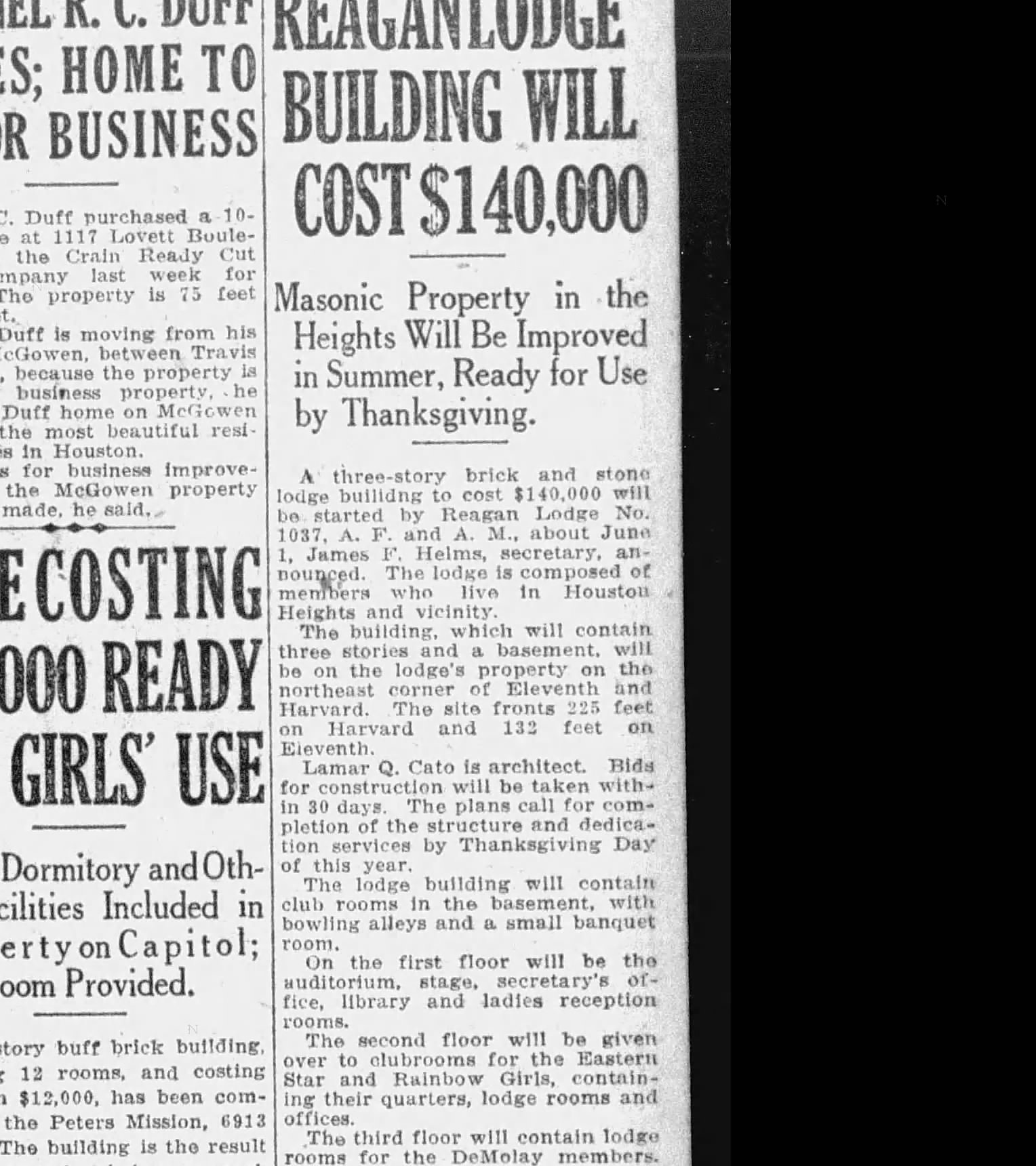
The floor plan the papers printed that Sunday would define the building for the rest of its life as a lodge hall. In the basement: "club rooms … with banquet room and a small banquet room," plus, in the Post's fuller account of the plan, a bowling alley and quarters for the DeMolay chapter. On the first floor: "the auditorium, stage, secretary's office, library and ladies reception rooms." The second floor was "given over to clubrooms for the Eastern Star and Rainbow Girls, containing their separate lodge rooms and offices." The third floor held "lodge rooms, stage and lockerroom" (Houston Chronicle, Mar. 23, 1930, p. 61).
Behind the architecture stood the money, and the money ran through a legally separate body: "A building association has been formed to handle the financial arrangements and detail and the construction of the new building. The association's building committee is composed of Charles I. Voss, president; Mr. Helms, secretary; M. S. Frazer, C. A. DeWare, John Holaday, C. C. Powell, Y. M. Brogden, A. A. Stone and S. B. Walters" (Houston Chronicle, Mar. 23, 1930, p. 61). This building association, the operative successor of the fundraising body the lodge's own history and the state historical marker trace to 1912, would matter enormously five years later, because it was the association, not the chartered lodge, that legally owned the building. The trade press noticed within days: Manufacturers Record of April 3, 1930 listed "Tex., Houston–Reagan Lodge No. 1037, A. F. & A. M., Chas. L. Voss, Pres., Bldg. Comm." (Manufacturers Record, Apr. 3, 1930, Vol. 97, Iss. 14), giving the committee president's name as "Chas. L. Voss" against the newspapers' and Grand Lodge's "Charles I. Voss," almost certainly the same man under two renderings of his initial.
The same articles carried a membership count that does not sit easily with anything else on record. The March 23 Chronicle asserted that "Reagan lodge, named after John H. Reagan, famous Texan, was organized December 21, 1915, with 16 members," that it "moved into the temporary quarters now occupied on the second floor of the brick building at Eleventh and Harvard on Thanksgiving Day, 1915, it had only 22 members," and that "Today the lodge has 841 members" (Houston Chronicle, Mar. 23, 1930, p. 61). Seven months later the same paper would instead say the lodge "was organized 10 years ago… had 23 members when it was organized and today has 875 members" (Houston Chronicle, Oct. 19, 1930, p. 25). Both origin stories conflict outright with the Grand Lodge's own charter date of December 12, 1910, and both are best read as newspaper errors that garbled the 1910 institution with the earlier move into the first hall. The membership figures themselves, 841 in March and 875 in October, are worth retaining as reported even though they do not match each other or the lodge's audited returns, which give a cleaner arc: 855 members in 1930, 894 in 1931, and 797 by 1933 (Grand Lodge of Texas Proceedings, 1930, p. 1098; 1931, p. 1135; 1933, p. 1107).
Building the Temple, May–December 1930
Bace Construction Co. of Houston won the general contract, "under a $110,000 contract, let in May 1930." Bace arrived at the job on the strength of a run of major Houston public-school work completed just before: the Stonewall Jackson school addition (August 1928, $87,100), the Phillis Wheatley high school addition (February–April 1929, bid $184,000, final $210,000), nine classrooms at Jefferson Davis Senior High, and the dismantling of the old city armory in May 1929. Then, only a month after landing the lodge contract, the firm's finances took a visible hit: "On June 18, 1930… Bace Construction Co. of Houston decreased its capital from $25,000 to $15,000," as the Fort Worth Press bluntly reported it (Fort Worth Press, Jun. 18, 1930, p. 14). J. D. Bace was the firm's principal, and its documented activity runs from 1928 to 1940, ending with twin segregated schools built for the Dickinson school board in January 1940 (Portal to Texas History metapth1905276).
The building permit followed on June 20: "A permit for construction of the Reagan Masonic Lodge three-story brick building at 1101 Harvard was issued Friday by C. F. Brown, city building permit clerk," to Bace Construction Company, with the structure's cost given as $105,035 (Houston Chronicle, Jun. 20, 1930, p. 38). That permit address, 1101 Harvard, is worth flagging on its own terms. 1101 was the odd, west side of the street, where a Gulf filling station would soon stand, while the temple itself rose at 1100/1102 on the northeast corner. The mismatch reads as a clerk's error or a source garble rather than any real ambiguity about where the building stood, but it deserves to be noted rather than passed over silently, the way the same permit citation has occasionally been quoted before.
Clearing the lot did not mean levelling it. Sister Agatha's History of Houston Heights records that as construction began on schedule in June 1930, the existing house on the temple lot was not demolished but rolled a few blocks north on Harvard Street (per Sister Agatha, History of Houston Heights, via the project timeline index, 1930-06-01 entry). The source is a secondary local history rather than a period clipping, and no permit or newspaper item confirming the move has been found. If it is right, a pre-temple Heights house still stands a few blocks up Harvard under a different number, the only surviving fabric of the corner as it looked before Cato's building.
Cost figures for the building multiply rather than converge, and they are worth keeping distinct rather than averaged into one number. The announced plan, in both papers, was $140,000. The same October 1930 Chronicle feature that celebrated the nearly finished building itself contradicted that figure internally, calling it in one place a "$150,000 Structure" and in another "the $140,000 Reagan Lodge building" (Houston Chronicle, Oct. 19, 1930, p. 25). The permitted structure cost, per the June 1930 permit, was $105,035. Bace's own contract, let in May, was for roughly $110,000. The completed-cost figure carried ever since by the lodge's own history, by the Texas Historical Marker, and by the Harris County Historical Commission is $110,700. A sixth figure surfaced only when the building was already lost: a July 1935 Chronicle item on the attempted sale of "the old Reagan Masonic Lodge Building, Eleventh and Harvard" reported that "The building originally cost about $125,000" (Houston Chronicle, Jul. 9, 1935, p. 5, clip sr1198298991). None of these numbers should be treated as interchangeable. Each measures something different: ambition, permit, contract, final tally, and, in the last case, a seller's recollection five years on.
The cornerstone was laid under formal Grand Lodge dispensation on July 26, 1930: "Reagan Lodge No. 1037, A. F. & A. M., Houston, Texas; to lay corner-stone of new Masonic Hall at Houston, Texas, July 26, 1930, Brother Charles I. Voss, Past Master of Reagan Lodge, proxy" (Grand Lodge of Texas Proceedings, 1930, p. 53). The Post-Dispatch ran its morning-of coverage under the headline "TEMPLE WILL BE DEDICATED," which the article's own program contradicts: what was scheduled was a cornerstone leveling, and the dedication proper, promised for December, would vanish from the record entirely. "The program will start at 4:30 p.m. and the leveling ceremonies are scheduled for 6 p.m. Judge Ewing Boyd will be the grand orator for the occasion," the paper reported (Houston Post-Dispatch, Jul. 26, 1930, p. 24, clip 1193056180). The same article names the full slate of proxies standing in for the Grand Lodge officers: Charles I. Voss (printed "Charles L. Boss") for the Grand Master, A. F. Helms for the Deputy Grand Warden, A. A. Stone for the Grand Senior Warden, and H. R. Collier (printed elsewhere "H. B. Colley") for the Grand Junior Warden, with Voss in charge of the program (Houston Post-Dispatch, Jul. 26, 1930, pp. 16, 24, clip 1193056180). A surviving fragment of that morning's Post carries the same program in mangled form: "the leveling … scheduled for 6 p.m. … Boyd will be the … the occasion" (Houston Post, Jul. 26, 1930, p. 16).
Judge Boyd himself had an extraordinary biography: a Cooper, Texas printer's devil at age eleven; first valedictorian of Mayo College in 1891; a University of Texas law graduate of 1899; a former T&BV Railway claim agent who reportedly "rode a cowcatcher into Houston"; assistant district attorney from 1912; and, from 1919, judge of the 55th District Court. His caseload shows him occupying that seat most heavily in exactly these years, 1927–1937, including Hunsinger v. Boyd (filed April 9, 1930, 55 citations) and Southern Bag & Burlap Co. v. Boyd (filed May 16, 1931, 61 citations). His service ran on well past the temple's own Masonic life, into the late 1950s; the project's people index gives 1919–1958 while the cross-era stitch records service to 1959, and the two have not been reconciled against a single authority. His career would later include Carpenters & Joiners Union Local No. 213 v. Ritter’s Cafe, filed February 6, 1941, a landmark Texas secondary-picketing decision (CourtListener records, via research round 2, fact #153). What cannot be independently documented is Boyd's specific words or exact role at the cornerstone ceremony itself, beyond what this project's own founding premise states. The biography is confirmed; the man's actual remarks that July evening are not preserved anywhere this research has found.
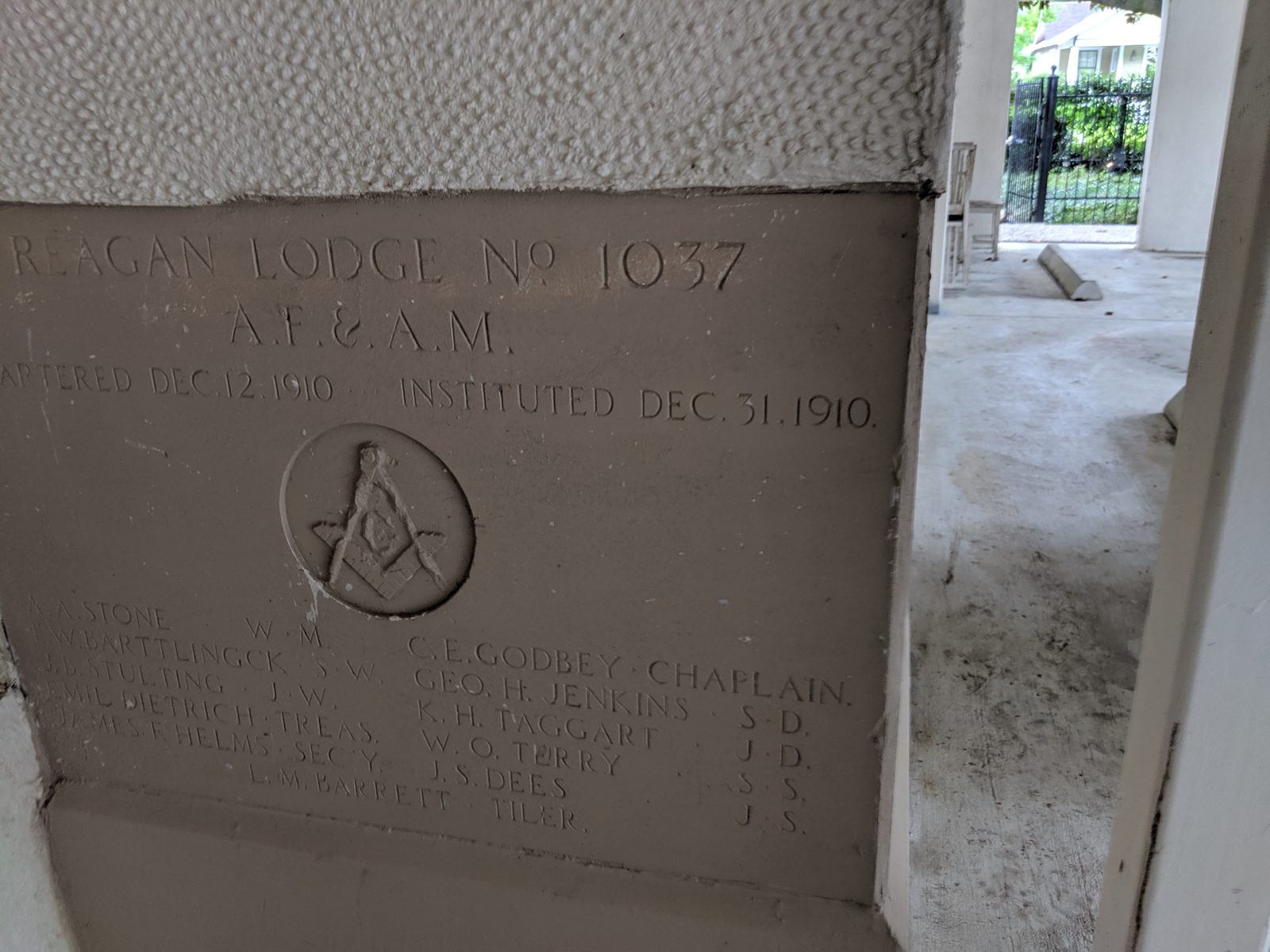
Construction dragged as the marble came in slowly: "Some delay in finishing the building has been experienced because of slow shipments of the pink marble from Knoxville, Tenn." (Houston Chronicle, Oct. 19, 1930, p. 25). By October, "this huge structure of brick and pink marble" was, in the paper's own words, "the latest and most imposing structure in Houston Heights" (Houston Chronicle, Oct. 19, 1930, p. 25). The marble's actual supplier was never pinned down. Candidates include National Terrazzo Tile & Marble and American Marble Mosaic, though both firms' Texas franchise records only begin in 1962 and 1964 respectively, making their involvement in 1930 no more than a plausible guess, and the heavily advertised Appalachian Marble Company of the 1920s remains an unverified possibility rather than an identified source.
"The formal opening of the Reagan Lodge building is planned for December 21 on the birthday of the lodge," the October feature announced, with plans "to celebrate the combined birthday and opening celebration on December 21" (Houston Chronicle, Oct. 19, 1930, p. 25), a date pegged, ironically, to the same erroneous "1915 birthday" the newspapers had gotten wrong all year. James F. Helms, "secretary of the lodge for the past 14 years," served as the project's spokesman throughout (Houston Chronicle, Oct. 19, 1930, p. 25). What happened on December 21, 1930 itself is a gap in the record: no account of the dedication ceremony actually occurring has yet turned up in any searched archive, and the modern lodge's own holdings show no mention of 1930 cornerstone-laying records or dedication ceremonies at all. What survives instead is the building's first appearance in the city directory, the 1930–31 edition: "1100 Masonic Temple / Reagan Lodge No 1037 A.F.&A.M. / Hts Chapter 258 O.E.S.," lodge and Eastern Star chapter only, the building's population still sparse in that first listing (Houston City Directory, 1930–31 ed.).
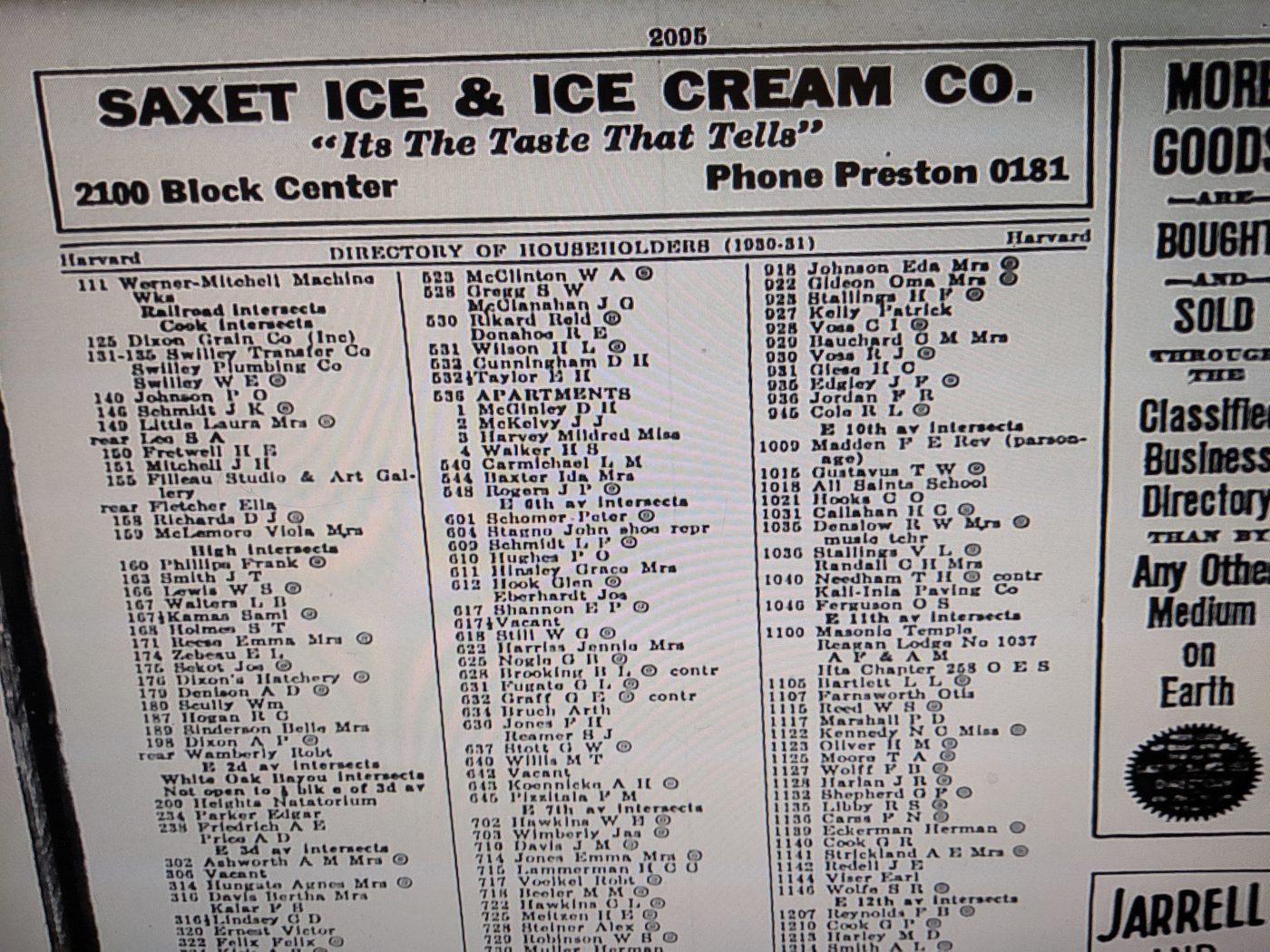
Lamar Q. Cato and the Question of the Architect
The attribution of the building's design rests on the strongest possible footing: both Houston dailies name Cato in their March 23 announcements, and the October 19 Chronicle repeats it plainly, "It was designed by Lamar Q. Cato, architect" (Houston Chronicle, Oct. 19, 1930, p. 25). A Post real-estate retrospective a decade later reprinted the paper's own July 20, 1930 cornerstone item and named him again: "The cornerstone for the new Reagan lodge, at Harvard and Eleventh streets, will be lay at 5 p.m. Saturday… Lamar Q. Cato is the architect for the project" (Houston Post, Jul. 21, 1940, p. 40, clip 1194394267). No independently surfaced modern web source states the fact in so many words; it is the contemporary newspapers that carry the attribution here, and they carry it firmly.
Two errors need correcting before they spread further. The City of Houston's own Historic Preservation Manual credits the 1930 building to "architect and Houston Heights resident L. R. Hayes." Hayes was a real figure in this story. He was Reagan Lodge's senior warden by June 1935, its Worshipful Master by 1936, and he would go on to design the lodge's actual 1948 replacement building at 1606 Heights Blvd. But he did not design the 1930 temple; Cato did, and the Manual's attribution is best read as an accidental conflation of the two buildings and their two architects. The same Manual also dates the building to 1918, an error most plausibly traceable to the lodge's earlier, more modest first hall on the same corner rather than to the grand structure that actually rose in 1930.
The confusion may be older than the Manual, and it may have started closer to home. Grand Lodge rosters and Houston Post lodge notices from 1935 through 1937 repeatedly show Hayes signing "Reagan Lodge … L. R. Hayes, W.M.," and the compiled record of a June 1936 clipping glosses him as "the building's original architect," echoing an identical aside attached to a December 1935 clipping (Houston Post, Jun. 19, 1936, p. 18, clip sr1193861579). That parenthetical is the compiler's annotation rather than the clipping's own wording, and no primary source yet located states that Hayes designed the temple; what it suggests, without proving, is that the Cato-and-Hayes mix-up was already riding along with the lodge's own later-1930s paper trail and was not invented by a modern city document. Hayes as a genuine Reagan Lodge officer of those years is independently and thoroughly documented.
A further correction belongs on the record regarding Cato's later career, since it touches his single most prominent later commission. Cato is often credited alone with the Roy G. Cullen Memorial Building at the University of Houston (1938–39); in fact he co-designed it with Alfred C. Finn (1883–1964), the Sanguinet & Staats-trained architect and longtime collaborator of Jesse H. Jones, who went on to separately design the university's Ezekiel W. Cullen Building in 1950. Any account of Cato's later career should carry that co-credit rather than crediting Cato alone.
Cato came to the Reagan commission with a decade of Houston practice behind him, including a partnership this project's earlier biography never surfaced: from 1920 to 1923 he practiced as Finger & Cato with Joseph Finger (1887–1953), later the architect of Houston City Hall (1939), the two of them putting up commercial buildings through the early-1920s boom. Finger had partnered with James Ruskin Bailey from 1914 to 1919 and practiced alone after the Cato partnership ended (Joseph Finger, TSHA Handbook of Texas; Joseph Finger, Wikipedia; City of Houston Archaeological & Historical Commission landmark designation reports; cross-checked 2026-07-27). The Joseph Finger Papers at the Houston Public Library (ArchivesSpace resource 693) have not been pulled and remain a live prospect for Cato correspondence.
In the months around the Reagan Lodge commission, Cato was one of the busiest architects in the region. Bid notices from October 27, 1930 for Brenham school buildings direct contractors to "the office of the Architect, Lamar Q. Cato, 801 Merchants and Manufacturers Building, Houston, Texas." His documented portfolio of the era includes the West University Place School Group ($600,000 including site), Alvin High School (with Witte & Fleming, $56,215), an addition to Brenham Baptist Church ($30,000), a Texas Dental College addition, further additions to Stonewall Jackson Junior High (the same 28-classroom annex Bace Construction built), George Washington Junior High, and school buildings in Bellaire, Post Oak, and Spring Branch, plus the Nalle Office Building in Austin (as Endress & Cato) and the W. G. Jones Residence in Riverside Terrace. Most tellingly for this building's own story, Cato designed a second Masonic lodge in this same window, the Cade-Rothwell Masonic Lodge at North Main and James Street, built under contract to O. W. Raper & Son for roughly $21,000, evidence of a real specialization in fraternal architecture that the Reagan commission fits neatly inside. Cato's crowning later work was the design of the University of Houston's five original Quadrangle residence halls: Bates, Law, Oberholtzer, Settegast, and Taub. He died July 12, 1948, at 59.
One negative is worth stating plainly, since the two firms' Depression-era stories are sometimes run together: Walter P. Moore's engineering firm had no role whatsoever in the 1930 construction. It did not yet exist. Moore founded it in 1931, on the proceeds of selling his Stutz Bearcat. Any engineering connection between Moore's firm and 1100 Harvard belongs to a much later chapter of the building's life.
The Building as Built
What rose on the corner, assembled from the era's own descriptions, was a two-to-three-story brick building over a basement, trimmed in pink Tennessee marble, in what the City's own Preservation Manual calls an "elaborate Classical Revival" style, standing at the northeast corner of Harvard Street and Eleventh Avenue. A Masonic Square-and-Compass emblem was carved into, or mounted on, a rectangular panel above the main entrance. Its exact fate over the following decades is genuinely unsettled: no single account of when, or whether, it was ever removed can be reconciled with the others, though its ghost-outline is reported to remain faintly visible on the building today. A bowling alley occupied part of the basement. "The building will include a large auditorium, rooms for the Rainbow Girls, the De Molay Chapter for boys, club rooms and offices," the October 1930 Chronicle summarized (Houston Chronicle, Oct. 19, 1930, p. 25).
The same feature situated the temple in its neighborhood at the height of the Heights' interwar confidence: "Houston Heights is noted for its many imposing buildings, its churches, tree-lined boulevards and thousands of beautiful homes. The section has a population of 46,000 and is regarded as the most popular residential district in Houston," with home sites running "50 feet by 150 feet minimum" (Houston Chronicle, Oct. 19, 1930, p. 25). Next door at 1123 Harvard stood the 1912 Schlesser-Burrows House, already eighteen years old when the temple rose beside it, the residential fabric the new building had to fit itself into. A few doors down, Collins Memorial Methodist Church at 120 Eleventh Ave. E. hosted the 60th Southern Annual Conference of the Methodist Episcopal Church in December 1932, Bishop Charles L. Mead presiding, its "auditorium filled to capacity."
Comparable fraternal buildings of the era help frame what Reagan Lodge was reaching for: Houston's downtown Masonic Temple at 1407 Fannin (home to Temple No. 4 and Gray No. 329, designed by Alfred C. Finn, under construction by August 1923), the Houston Heights Odd Fellows Lodge No. 225 Hall at 115 E. 14th St. (dedicated April 28, 1923, and still active today), and Baytown's 1929 Odd Fellows Hall (designed by Lenard Gabert, today repurposed as "Odd Fellows Lofts"). No purpose-built Arabia Temple Shrine building from this window in Houston could be identified at all, a reminder that even within the fraternal building boom, not every order left as substantial a physical monument as Reagan Lodge did.
Who Kept Shop and Who Kept Lodge: the Tenant Roster
The photographed Morrison & Fourmy city directories give the cleanest record of who actually occupied the corner, year by year:
| Edition | 1100/1102 (temple) roster | 1101 Harvard (across the street) |
|---|---|---|
| 1930–31 | "1100 Masonic Temple / Reagan Lodge No 1037 A.F.&A.M. / Hts Chapter 258 O.E.S.," the temple's first directory row; lodge and Eastern Star only | (no entry captured) |
| 1932–33 | Reagan Lodge No. 1037 A.F.&A.M.; Heights Chapter 258 O.E.S.; Reagan Chapter De Molay; Heights Assembly No. 10, Order of Rainbow | Gulf Refining Co., filling station |
| 1934 | "Masonic Temple" (house number misprinted "1101," very likely a 0/1 misread of 1100); Reagan Chapter De Molay; Reagan Heights Chapter No. 258 O.E.S.; Reagan Lodge No. 1037; Heights Assembly No. 10 | – |
| 1935 | Masonic Temple; De Molay Chapter; an O.E.S. chapter; "Lodge No. 1027" (near-certain misread of 1037); Assembly No. 10; and, new that year, a Job's Daughters Bethel not seen in any earlier directory | Gulf Oil Co., filling station; also Norhill Interests / M-K Pharmacy in the 1935 street guide |
| Absent from the directories, 1932–34 | Woodland Lodge No. 1157, A.F. & A.M., a second Blue Lodge holding stated meetings in the building alongside Reagan Lodge, attested by newspaper lodge directories rather than by the city directory | – |
The directories miss the building's second lodge entirely. From September 1932 through at least April 1934, Houston Post lodge directories place Woodland Lodge No. 1157 in the same rooms: "Stated meeting of Woodland Lodge No. 1157, A. F. and A. M., tonight at 8 o’clock, at Heights Masonic Temple, 11th and Harvard… George D. Wilson, W. M.; J. M. Simmons, secretary" (Houston Post, Sept. 15, 1932, p. 16, clip 1193781414). An April 1934 listing shows the two lodges side by side, Woodland under Simmons and Reagan under H. B. Webb with J. A. Newhouse as secretary (Houston Post, Apr. 3, 1934, p. 14, clip 1193164918). On any given week the building could hold two full Blue Lodges plus the Eastern Star chapter, the DeMolay chapter, and the Rainbow assembly. Whether Woodland had moved wholesale or kept two footprints is unresolved: election notices in 1930 and again in 1935 still list a separate "Woodland Masonic Temple, corner Watson and Eleventh" as a polling place, and no source reconciles the two addresses.
The Job's Daughters Bethel deserves its own hedge: it rests solely on one blurry, rotated 1935 directory photograph, no independent corroboration of it has been found in any other channel, and what became of the Bethel after 1935 is simply unknown, since it is never mentioned again in any source this research has located. A separate 1932–33 directory image gives a strikingly different roster for the same building, "Reagan Lodge No 1037 AF&AM; Reagan Chapter No 383 R.A.M.; Reagan Commandery No 99 K.T.; Reagan Chapter No 825 O.E.S.," which does not match the Heights Chapter No. 258 O.E.S. attested by dozens of contemporary newspaper notices, and should be treated as needing verification against a cleaner copy rather than accepted outright.
The commercial shop row along East Eleventh Avenue, printed under house numbers 215–223 in this era, turned over constantly, a small continuous barometer of the Depression pressing on the neighborhood:
| Edition | Shop row (E. 11th, house numbers 215–223) |
|---|---|
| 1930–31 | 215 Economy Cleaners; 216 Matula; 217 Banta Candy; 222 Greve; 223 Madings Drug Store No. 7; 301–3 A&P / Telschow's Bakery |
| 1932–33 | 215 Economy Cleaners & Hatters; 216 Mrs. May Bailey; 217 Houston Candy Co.; 218–219 vacant; 221 Red & White Stores (grocery-meats); 222 J. G. Greve (pharmacy); 223 Eleventh Ave. Pharmacy |
| 1934 | 216 Curtis Barber Shop / Economy Cleaners & Hatters / Mrs. Ethel Pearson; 217/219 vacant; 218 H. G. Cargill; 221 Hildebrandt C. A. grocery / R. C. Addicks; 222 Greve; 223 Eleventh Ave. Pharmacy |
| 1935 | 216 Humphreys Barber Shop / Economy Cleaners; 217 Mrs. Ethel Pearson; 218 vacant/T. C. Carroll; 219 O. B. Ferguson; 220 O. A. Hildebrand, grocer; 221 Clarence Scholl, meats; 222 J. O. Grove; 223 Eleventh Pharmacy Co. |
| Jul. 1935, the temple's own storefront | Werner's Drug Store, 1100 Harvard, serving as the Precinct No. 6 polling place (Houston Chronicle, Jul. 28, 1935, p. 30, clip 1198301390) |
The vacancies clustering in 1932–34 are the Depression showing itself through the directory's own columns: storefronts that Mading's chain drugstore and the neighborhood's cleaners and grocers had once filled going empty one by one as the decade wore on. Two tenancies fall outside the table's printed range and are worth recording anyway. Werner's Drug Store was trading out of the corner commercial space at 1100 Harvard itself in July 1935, on the eve of foreclosure, following or working alongside J. G. Greve's pharmacy and the Eleventh Ave. Pharmacy. And in June 1931 a classified placed a real-estate office two doors down: "CALLAWAY’S rentals, trades, sales, city property, farms, ranches, any change, 203 E. Eleventh. Taylor 7417, Houston State Bank, Taylor 7417" (Houston Chronicle, Jun. 20, 1931, p. 12, clip 1198493764), evidence that the commercial frontage ran a little further west than the numbered range the directories captured.
The People Who Lived There
The tenant roster reads as offices and lodge rooms, but people slept in the building too, and the record surfaces them only when they died. Woodward S. Logan, 53, a member of Reagan Lodge and of Temple Chapter R.A.M., was living at 1102 Harvard St. when he died on Sunday, June 3, 1934. The obituary is careful about where: "LOGAN–Woodward S. Logan, 53, of 1102 Harvard St., died at 8:30 a. m. Sunday in a local hospital," which corrects the flatter shorthand that has him dying inside the building itself. His brothers came to him where he had lived: "Members of Reagan lodge, No. 1037, will meet at 2 p.m. Monday at the temple to attend the funeral" (Houston Post, Jun. 4, 1934, p. 11, clip 1193689698). Nine months later Henry C. Nicholson, 55, died on March 19, 1935 while residing at 1100 Harvard St.; he was "a member of the Masonic lodge of Marble Falls and the Modern Woodmen," and his survivors were scattered across five states (Houston Chronicle, Mar. 20, 1935, p. 27, clip 1198923510).
A third resident emerges from an election notice rather than an obituary. In October 1934 a Democratic primary legal notice directed "Precinct No. 25 Vote at 1102 Harvard Street. Mrs. C. C. Powell, presiding judge; Mrs. Clara Duerer, Mrs. Bess L. Burney, clerks" (Houston Post, Oct. 7, 1934, p. 36, clip 1193254323). Voting at a bare street address usually means voting in somebody's front room, and the address is the same one the Third Church of Christ, Scientist had used the year before. Mrs. Powell was the wife of C. C. Powell of the temple's own building committee, and she had performed at the first hall's first entertainment eighteen years earlier. Between the caretaker's quarters and the residential unit, two men died while living at the temple's address inside ten months, and a building-committee family appears to have been living there as the building was lost.
A Building of Many Congregations
The temple's Sunday tenants complicate the tidy picture of a Masonic hall lent out for the occasional play. By November 1933 the Third Church of Christ, Scientist was operating out of the temple edifice at 1102 Harvard, holding Sunday services at 11 a.m. and 8 p.m. and Wednesday testimony meetings at 8 p.m., and keeping a Reading Room open to anyone off the street: "Reading room in the church edifice is open from 11 a.m. until 4:30 p.m., except Wednesday, when it remains open until 7:30 p.m." (Houston Chronicle, Nov. 25, 1933, p. 5, clip 1198844174).
Three more congregations follow within months. The Post's weekly church directories of February and March 1934 place Temple Lutheran Church in the building under Rev. Walter Temme, with rites held there and not merely meetings: "Confirmation services will be held at the Temple Lutheran Church, meeting in the Heights Masonic Temple, 11th and Harvard, Sunday morning at 10:45 o’clock" (Houston Post, Mar. 25, 1934, p. 14, clip 1193164670), along with Good Friday communion. The same directory carries "Woodland Christian Church is holding services in the Reagan Masonic Temple, 11th and Harvard. W. M. Porter, pastor" (Houston Post, Mar. 25, 1934, p. 14, clip 1193164670). A "Reagan Covenant Church" under a Rev. W. L. Porter appears in the February listings preaching the same sermon titles; the matching topics and near-identical pastor's name suggest one congregation listed under a drifting name rather than two separate bodies, though nothing in the record settles it. Four worshipping congregations used the building inside five years, three of them while the lodge was fighting to keep it.
One line in the same church directories rearranges the corner itself. A listing that season locates "Heights Christian church" services not at the Masonic temple but at "the Woodmen of the World hall, corner of Eleventh and Harvard" (Houston Post, church directory listings, Feb.–Mar. 1934, clips 1193164328, 1193164473). A second fraternal hall stood at the same intersection, close enough that a careless reader in 1934, or a careful one in 2026, could mistake one for the other. Every corner-address reference in this history has to survive that ambiguity before it can be trusted.
The Golden Age: Life Inside the Temple
For the years the building was solvent, it was exactly what its builders had intended: the civic living room of the Heights. Houston Heights Chapter No. 258, O.E.S., met "at 8 o’clock in Reagan Lodge room, corner of Eleventh and Harvard" on a first-and-third-Monday rhythm attested by dozens of stated-meeting notices running from February 1930 through at least November 1934. Its officer line can be traced almost year by year: Mrs. Millie Furman as Worthy Matron in January 1931; Mrs. Jessie Jackson in August 1931; Mrs. Julia Bottler and, separately, Willie Bell Ainsworth and Mrs. Dorothy Looney appearing in 1932–33 notices; Mrs. Carrie Sloop installed Worthy Matron on May 31, 1932 with T. G. Gready as Worthy Patron, honored soon after at a Texas State Hotel dinner with "a silver bowl filled with sweet peas"; and, in 1934, Nettie Peisker in May and Mrs. Tom Jean Moore in June. The chapter staged public installations, the May 31, 1930 ceremony installing Mrs. Eleen Rogers, Mrs. Alice Brogdon, Mrs. Ida Wimberly, and Mrs. Maud Reed, along with "step-up" nights, turkey suppers "in the club rooms of the temple, Harvard an[d] Eleventh streets," benefit plays of "a series of 14 short acts," and a two-week cooking school at Phoenix Furniture's auditorium whose attendance prize the chapter itself won. Summers brought the lawn into use: "Houston Heights chapter, O. E. S., will give a watermelon party for members and their families at 8 p. m. Friday on the lawn of Reagan Masonic temple, Eleventh and Harvard streets," both papers reported in August 1932, the earliest dated instance of a tradition that ran for years afterward (Houston Post, Aug. 5, 1932, p. 7, clip 1193555186; Houston Chronicle, Aug. 4, 1932, p. 7, clip 1198360453).
The chapter's reach was not only local. In February 1934 the Grand Chapter of Texas's worthy grand matron came down from Texarkana to convene the city's entire Eastern Star population under this one roof: "Mrs. Alice Potter of Texarkana, worthy matron of the Grand Chapter of Texas, O. E. S., will meet with the 11 Houston Eastern Star chapters at 2 p.m. Saturday in the Reagan Masonic Temple, Harvard and Eleventh" (Houston Chronicle, Feb. 11, 1934, p. 20, clip 1198510343). A second clipping that month puts the count at ten rather than eleven, and the grand matron's own name is printed variously as Alice Potter, Rose E. Potter, and Sallie C. Wood across the coverage, all "of Texarkana," which reads as OCR drift; neither the count nor the name is resolved here.
The youth orders gave the temple its future generation, and one of them was a statewide power. Reagan Chapter, Order of DeMolay, announcing Louis Thomas Jr.'s election as master councilor on New Year's Day 1933, could say without contradiction that "Reagan chapter is the largest and one of the most active in the state, having for the past two years won the state championship in competitive degree work" (Houston Post, Jan. 1, 1933, p. 2, clip 1193706129). The papers covered its public installations the way they covered a sports season, with portrait photographs and full officer rosters. Heights Assembly No. 10, Order of the Rainbow for Girls, met in the Reagan Lodge room under Esther Gregory as Worthy Advisor and Geneve Hebert as secretary, installing officers publicly in January 1931 jointly with the Reagan DeMolay chapter, and again in January 1934 under a slate of Bernice Brogdon (worthy advisor), Vivian Dunk (worthy associate advisor), Mary Sue Fuller (charity), and Laura Liew Robinson (hope). In March 1934 the Assembly emptied Heights closets for an old-time style show: "Fashions of yesteryear will be modeled by the members in a colorful pageant, more than 35 old costumes to be shown" (Houston Chronicle, Mar. 4, 1934, p. 5, clip 1198528071). That August it staged "a carnival and benefit entertainment… at Reagan Masonic hall… opening at 4:30 on the lawn of the hall," organized by Vivian Dunk, turning the temple's own lawn into a neighborhood fairground for an afternoon and evening.
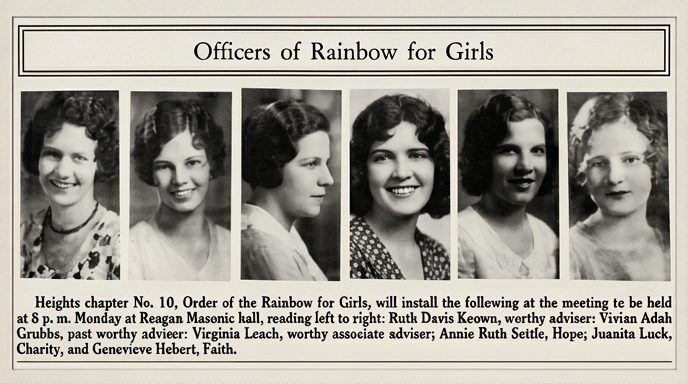
The wider Heights used the building constantly, well beyond its own Masonic family. Fulbright Methodist's young people staged "Eighteen-Carat Boob" and, later, the three-act comedy "Strange Bequest." A Letter Carriers auxiliary put on a play of its own in February 1933, "the Will Lookum Matrimonial Agency," with Ethel Turner, Anna Paulson, Laura Finke, and Anna Harriss in the cast, the title only partly legible on the clipping (Houston Chronicle, Feb. 9, 1933, p. 10, clip sr1198578462). In April 1933 the young people's department of Oliver Methodist Church, "assisted by the Hebrew Temple Club of Reagan High School," presented the comedy-drama "An Arizona Cowboy" in the temple, putting a Methodist youth group and a Jewish school club on a Masonic stage together (Houston Chronicle, Apr. 5, 1933, p. 19, clip 1198422836). The John H. Reagan Senior High "Red Coats" threw a dance running until midnight to raise money for band uniforms; the A&M Mothers' Club held a benefit bridge party; an O.E.S. chapter staged "Fun on [the Sunset?] Limited" in May 1934; and at least one wedding was solemnized in the hall, Miss Ruth La Nelle B[e…], with Rev. R. L. Brenham reading the service. In May 1933 the building drew a graduating class and its dates: "More than 100 couples responded to invitations issued by Miss Helen Willis and Blair Rowland for a dancing party Wednesday evening at Heights Masonic temple in honor of their graduation. Delbert Operpriller gave a tap dance…" (Houston Post, May 28, 1933, p. 2, clip 1193626080).
One Heights music teacher used the hall as her recital room for years. In April 1932 Mrs. O. L. Morton's pupils, roughly seventy of them, staged "The Marriage of Jack and Jill" there, built around "a juvenile wedding, arranged along formal lines," with the Morton Rhythm Orchestra playing; the piece went over well enough to be repeated at Eugene Field School for its Parent-Teacher association (Houston Chronicle, Apr. 12, 1932, p. 18, clip 1198460463). The following Christmas the Junior MacDowell Club, which Morton also directed, "held ‘open house’ meeting Saturday afternoon at the Reagan Masonic temple," twenty named children performing (Houston Post, Dec. 24, 1933, p. 16, clip 1192922001).
The Houston Heights Garden Club's meetings and flower shows at "Harvard and Eleventh" bracket the construction itself: the February–May 1930 events, including a flower show "held at Harvard and Eleventh streets," necessarily used the old first hall, while an April 1931 spring show at the "[exhi]bition hall, Harvard [s]treet" was held in the new temple.
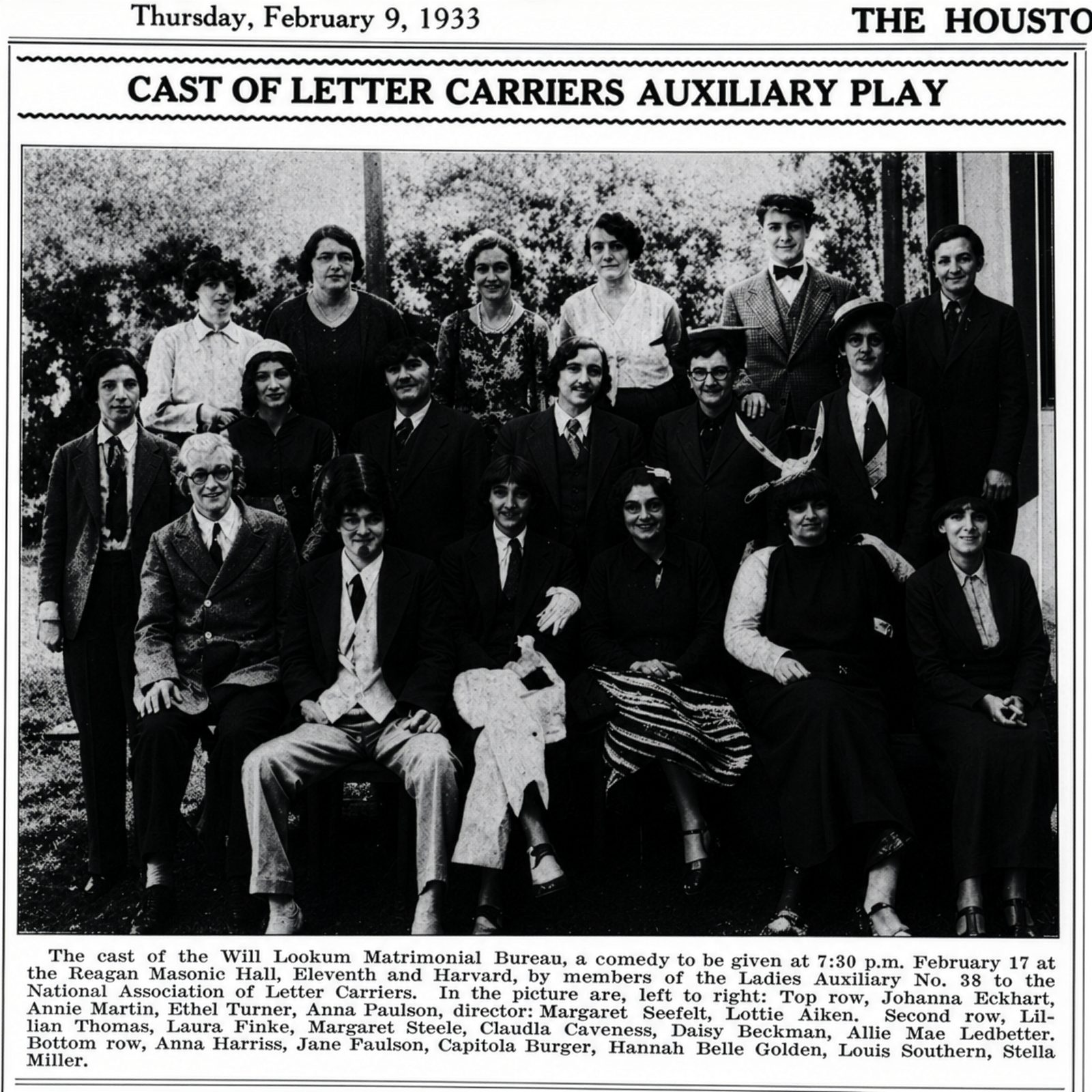
The building's biggest night in the record belongs to a debutante and a mayor. On the Tuesday after Christmas 1932, in the worst year of the Depression, Mr. and Mrs. John Dunlop gave a large dance in the temple's own ballroom for their daughter June: "Mr. and Mrs. John Dunlop entertained Tuesday night with a large dance at the DeMolay ballroom of the Heights Masonic temple… The hosts were assisted in entertaining by Mayor and Mrs. Walter E. Monteith" (Houston Post, Dec. 29, 1932, p. 5, clip 1196046314). Three separate clippings cover it, an advance notice, a portrait, and a recap, and between them they preserve the room: walls "hung with smilax, spruce and pine, festoons of the glossy vine encircling the chandeliers," the orchestra dais "transformed into a small forest," a punch bowl of ice frozen around fruit and flowers, and June Dunlop leading the grand march with Thomas Musgrove (Houston Chronicle, Dec. 28, 1932, p. 5, clip 1198582180). Five months later the ballroom did it again for a lodge family: "Mr. and Mrs. C. S. Bawcom had issued invitations for a formal dancing party May 6 at De Molay hall, honoring their daughter, Miss Faye Bawcom" (Houston Post, Apr. 30, 1933, p. 35, clip 1197491731). A sitting Houston mayor came out to a Heights fraternal building for a private dance, and the room he came to had a name of its own.
Masonic ceremony continued steadily. Entered Apprentice and Master Mason degree conferrals under Worshipful Master W. C. Webb ran through 1934. The joint installations of the district's Masonic bodies rotated among the Heights lodges: 1931 and 1935 were held at Woodland Lodge (118 Byrne St.), and 1933 at Woodland with six bodies present, but in 1932 and 1934 Reagan's own corner played host. "A joint public installation of six Masonic bodies will be held on the grounds of Reagan Lodge, Harvard and Eleventh, Friday night. It will be preceded by a picnic beginning at 6 p.m.," the Chronicle reported in June 1932; two years later, "Masonic Ceremony Will Be Held on Grounds of Reagan Unit… joint installation Monday evening on the grounds of Reagan lodge at Eleventh and Harvard," with supper at 6:30. The lodge also showed a public, churchgoing face in the foreclosure year: "Reagan Lodge No. 1037, East Eleventh and Harvard street, will attend Easter services in a body at Norhill Methodist church next Sunday morning," the Post reported at the end of March 1934, the whole membership walking off its own corner and into someone else's sanctuary for Easter morning (Houston Post, Mar. 31, 1934, p. 3, clip 1193164825).
The lodge buried its own dead under its auspices throughout these years, and the obituaries together sketch its working membership. W. P. Boger, electrocuted at Sinclair Oil, was buried from Hollywood Cemetery in July 1930. Arch C. Fulton, a Heights druggist and 1924 Arabia Temple Past Potentate, was given graveside services in November 1930. Charles T. Dodson, a Southern Pacific employee and Odd Fellow, was buried in June 1931 under Blue Lodge auspices (Houston Chronicle, Jun. 20, 1931, p. 12, clip 1198493764). Jacob K. Jaeger died in February 1932 as "a charter member of Reagan Lodge No. 1037, A. F. & A. M., Houston Heights Chapter No. 258, Eastern Star" (Houston Post, Feb. 21, 1932, p. 32, clip 1193634012). Professor Godbey followed later that February, L. L. Stallings in May 1933, and Fred M. Pettibone of Humble Oil's traffic department in April 1935, buried at Hollywood Cemetery with pallbearers drawn from the membership. A. B. Parker's obituary in the same period misprinted the lodge's own number as "No. 1067." A wider mortuary sweep adds George H. Luck of the Brotherhood of Railway Trainmen and the Shrine, the physician Dr. B. F. Houston, Paul D. Miller (a member of both Reagan and Woodland lodges), and J. C. Neeley, buried under lodge auspices at Rogersville near Henderson, which puts the lodge's funerary reach well outside Houston. In May 1933 it performed the same office for a stranger: when Edward Knetsar, 76, of a McGregor lodge died in Houston, Temple Lodge No. 4 held the service and "Reagan Lodge No. 1037 will conduct services at the grave" at Hollywood Cemetery (Houston Chronicle, May 18, 1933, p. 23, clip 1198569667). Railroads, the post office, furniture, medicine, the drug trade: read together, the death notices are the best membership census the era left behind.
One thing the record is conspicuously silent about: for all the attention the basement bowling alley received in the building's original plans, it never once surfaces in Houston league-play coverage across these five years, despite an exhaustive search. Whatever life the alley had, it appears to have been architectural rather than athletic, a feature of the plans and not a documented part of anyone's Tuesday night.
The Lodge as the Neighborhood's Election Machine
Between the lodge rooms and the ballroom sat a civic function this chapter's scattered facts have never been read together. For five years the Heights voted under the supervision of Reagan Lodge men. Election notices across the era name lodge officers as presiding and assistant judges at Heights schools, at fire stations, and at the temple itself: A. A. Stone and W. C. Webb at Precinct 43-A, C. C. Powell at 43, L. R. Hayes at 42 and 85, Clint Holaday at 7, Mrs. J. F. Helms (the late secretary's widow) at 89, and J. M. Dagley and his wife as clerks at Precinct 120 in the Heights State Bank. The July 31, 1935 school-bond notice alone puts seven lodge-connected people across seven precincts: "PRECINCT No. 43-A–School building, 800 Eighth street. A. A. Stone, presiding judge; W. C. Webb, assistant presiding judge" (Houston Chronicle, Jul. 31, 1935, p. 25, clip 1198301898). No single clipping states the pattern, which is a synthesis across many individually confirmed notices, but it is consistent enough to describe the lodge as the neighborhood's civic staffing agency. In the same weeks the building was passing out of the association's hands, its officers were still running the polls that decided the Heights' school bonds.
The Men Who Led It
The line of Worshipful Masters across these years can be reconstructed almost completely from notices and Grand Lodge returns:
| Year | Worshipful Master | Source |
|---|---|---|
| 1929 | Clint Holaday | Post-Dispatch, Jun. 4, 1929 |
| Early 1930 | A. A. Stone | Houston Chronicle, Feb. 21 & Mar. 18, 1930 |
| 1930–31 (installed June 1930) | F. W. Barttlingck | Houston Post, Jun. 22, 1930; GL Proceedings 1930, p. 1098 |
| 1931–32 (installed June 1931) | J. B. Stulting | Houston Chronicle, Jun. 24, 1931, p. 14; GL Proceedings 1931, p. 1135 |
| 1932–33 | George H. Jenkins | Houston Post, Sept. 14, 1932, p. 15 (as W.M. at Helms's funeral) |
| 1933–34 | W. C. Webb (printed H. B. Webb in the Post's lodge directories) | GL Proceedings 1933, p. 364; Houston Post, Jan. 18 & May 4, 1934 |
| May 1933 (a single conflicting listing) | "W. M. Wilcox, W. M.," against Webb in the listings on either side | Houston Chronicle, May 18, 1933, p. 23, clip 1198569667 |
| 1934–35 (elected June 1934) | E. L. Bobbitt | Houston Chronicle, Jun. 21, 1934, p. 7 |
| 1935–36 (elected June 1935) | W. T. Longnecker Jr. | Houston Chronicle, Jun. 21, 1935, p. 20; GL Proceedings 1935, p. 552 |
The June 1935 slate is worth quoting in full for who stands in it: "W. T. Longnecker, Jr., worthy master; L. R. Hayes, senior warden; Robert Eberspacher, junior warden; William C. Webb, treasurer; J. A. Newsome, secretary; J. C. Brooks, Fred E. Huebner, T. F. Weaver, O. A. Grover, W. J. Muir, L. M. Barrett" (Houston Chronicle, Jun. 21, 1935, p. 20). Hayes, the same man who would one day design the lodge's 1948 replacement home, was already standing in its officer line as the 1930 temple slipped out of the lodge's hands.
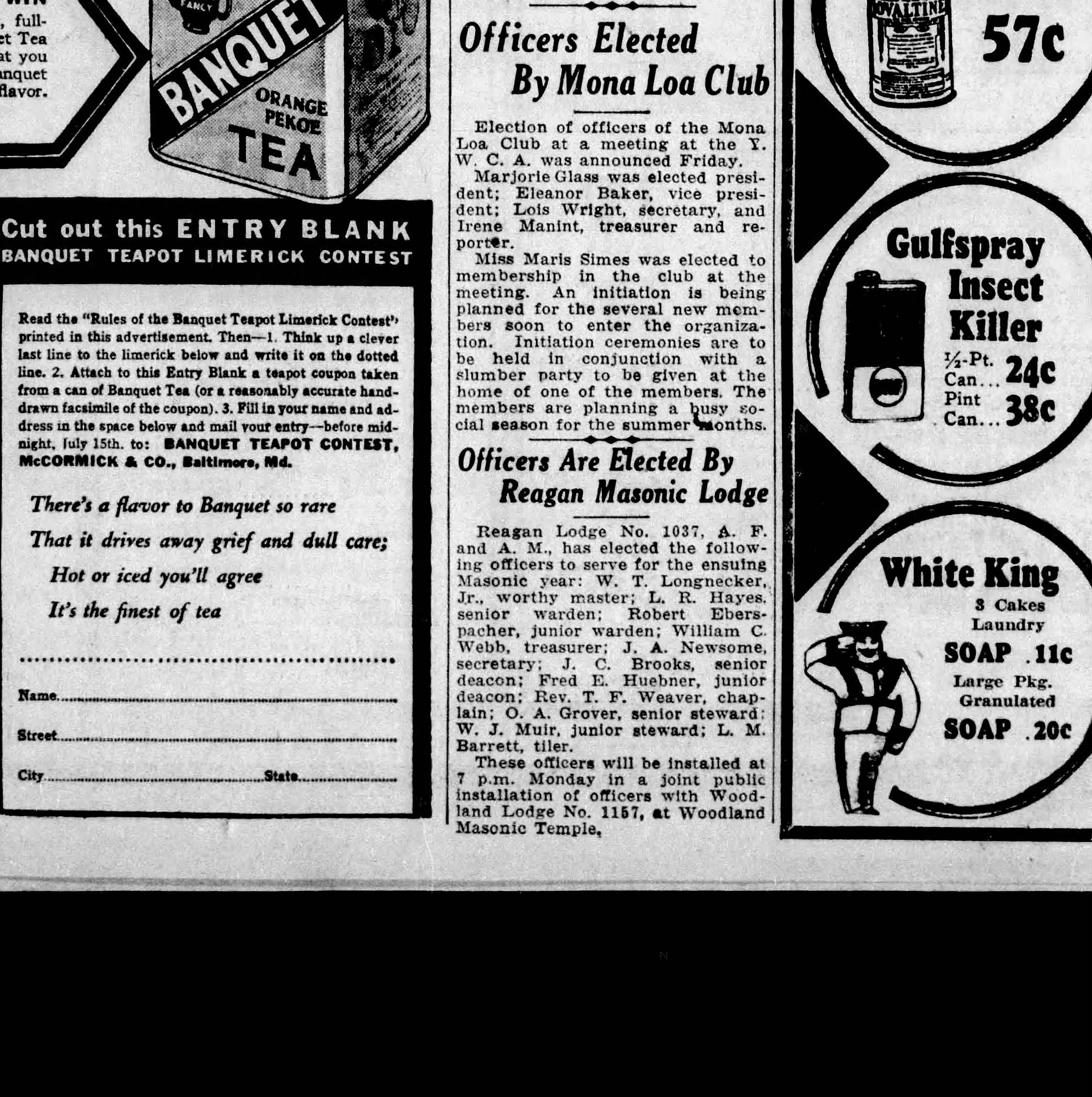
The era's human hinge came earlier, on September 12, 1932, with the death of James Frank Helms. The Chronicle put it on its front page: "J. Frank Helms, 62, secretary of Reagan Lodge No. 1037, A. F. and A. M., and long a prominent figure in Masonic affairs in Houston, died at 11 a.m. Monday at the Heights Clinic" following an appendicitis operation, and, the paper noted, "the exact time of death marked also his birth day." Helms was a charter member of the lodge, had served as its very first Worshipful Master in 1911, and had held the secretary's post for roughly fourteen years, in his second consecutive term at the time of his death; "Funeral services will be held Wednesday afternoon at the Reagan Lodge" itself (Houston Chronicle, Sept. 12, 1932, p. 1). One extraction of the same page gives his age as 65 rather than 62; the verbatim text of the obituary reads 62, and that is the figure this history follows. The funeral notice two days later shows the lodge already mid-transition: "conducting the funeral service of our deceased brother James F. Helms. Services held at Reagan Lodge. George Jenkins, W. M.; W. C. Webb, acting secretary" (Houston Post, Sept. 14, 1932, p. 15).
The front-page placement was earned outside the lodge as much as inside it. Helms lived at 732 Harvard, two blocks from the temple and the same address the Grand Lodge printed as the lodge's own; he had been a Harris County resident for thirty years; and he had run the neighborhood's schools through its years of independence. "Mr. Helms served for 13 years as president of the Houston Heights school board, during the time that the Heights was a separate municipality. The Helms school on Eighteenth Street was named in his honor" (Houston Chronicle, Sept. 13, 1932, p. 1, clip 1198396694). He was survived by his wife, three sons (Euba B., Charles Duree, and Olive B.), a daughter, Mrs. J. F. Cox, and four brothers including Albert Helms. His active pallbearers were G. C. Bawcom, Carl Helfrich, Fred Barttlingck, Ben Reincke, C. V. Hamilton, and J. E. Ponder; the first name is printed thus, and whether "G. C. Bawcom" is a compositor's error for C. S. Bawcom or a relative of his is one of the era's small unresolved contradictions. The Heights had lost a man with a school named after him, and the lodge had lost the secretary who had kept its books for fourteen years.
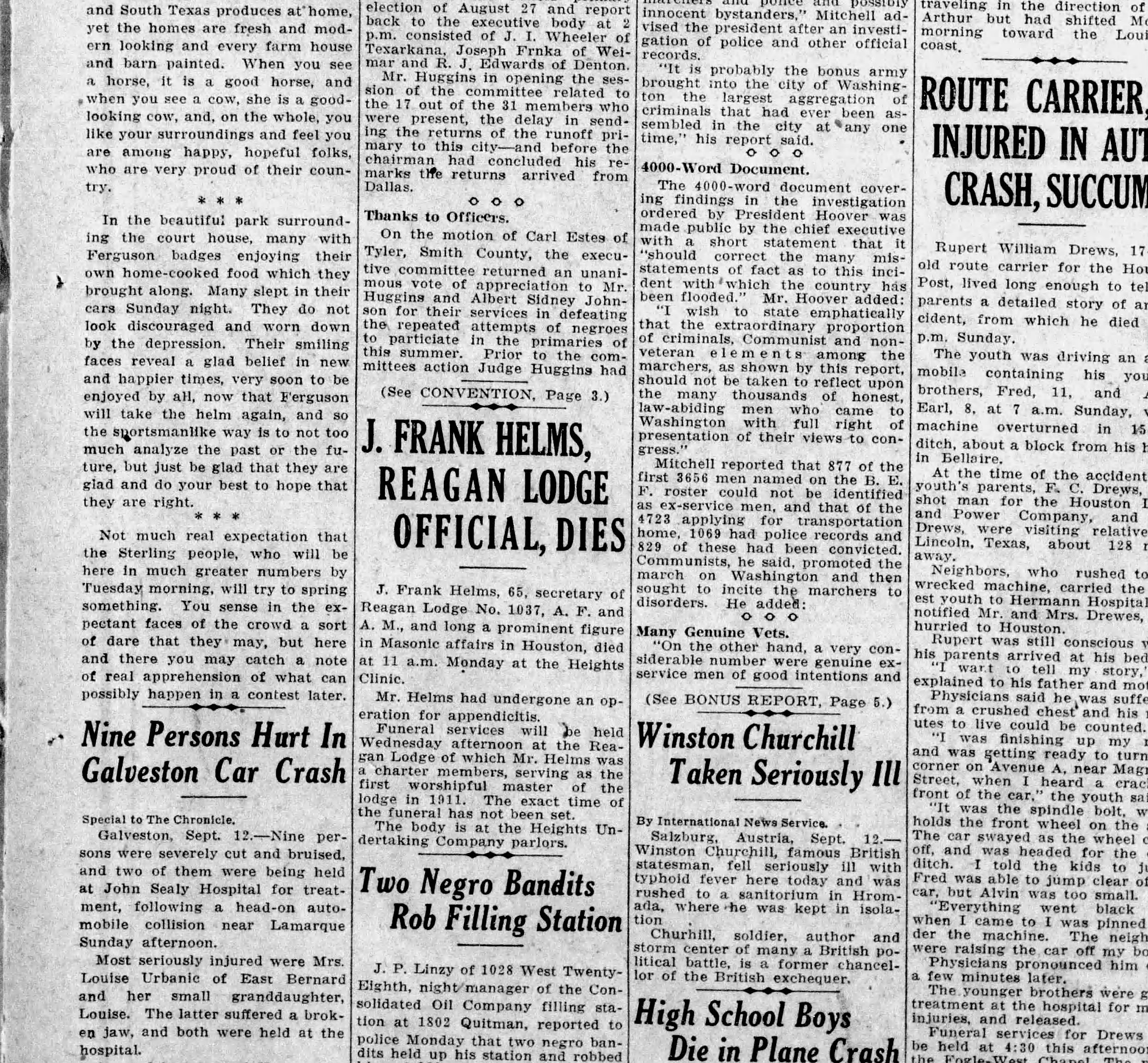
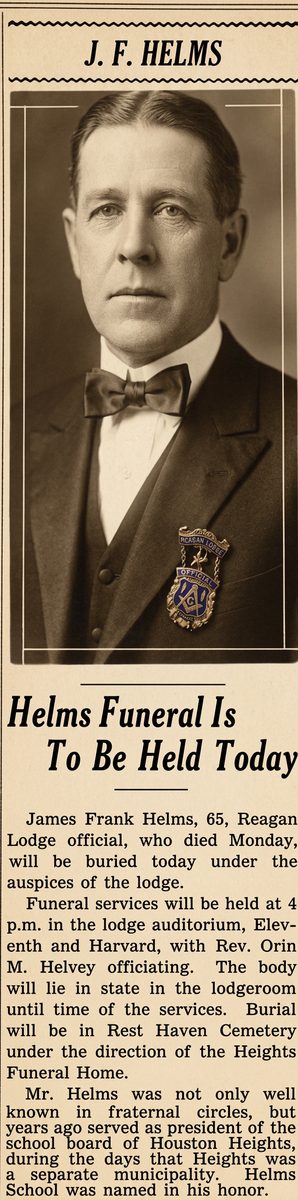
Seven months before Helms's death, the lodge had buried another of its pillars. S. P. Waltrip died at 6:30 p.m. on Sunday, February 21, 1932, after sixteen years as head of John H. Reagan Senior High School, and the honors paid him were unusual. He lay in state in his own school's auditorium, where thousands of mourners filed past. His career reached back before annexation: he was superintendent of the Houston independent school district from 1911 to 1916, then took the principalship of the Houston Heights public schools while the Heights was still its own district, and stayed with that school after annexation renamed it for John H. Reagan. He held life membership in the State Teachers Association and in Phi Delta Kappa, and lived at 1317 Heights Boulevard. The funeral at the Reagan Heights funeral home was managed by his own brother, E. Waltrip, and the active pallbearers were James G. Stephens, H. L. Mills, H. W. Elrod, R. D. Hardcastle, T. B. Reed, and R. H. McDavid. "Burial will be in Forest Park cemetery, under auspices of Reagan Lodge, No. 1037, A. F. and A. M., of which Mr. Waltrip was past master" (Houston Post, Feb. 23, 1932, p. 6, clip 1193634098). A Chronicle account adds that his body was escorted across campus "by the Reagan Redcoats, girls’ pep squad, faculty, Houston school principals and board of education members, plus members of Reagan Masonic Lodge," a detail carried in the compiled record's summary rather than in a separately transcribed passage of the clipping. (Houston Chronicle, Feb. 25, 1932, p. 18, clip sr1199232292) He was past patron of Chapter No. 258 as well as past master of the lodge, and a Maurice C. Waltrip still appeared on the rolls as late as 1935.
A. A. Stone, the man who had chaired the lodge at the moment the temple project began, drops out of the Masonic record after 1931. He attended Grand Lodge that year on the lodge's behalf and appears in neither the 1932 nor the 1935 Proceedings under Reagan Lodge or in any general attendance list. He had not, however, left Houston. On July 31, 1935, with the building weeks from the end, the school-election notice lists "A. A. Stone, presiding judge" for Precinct No. 43-A at the school building on 800 Eighth Street, with past master W. C. Webb as his assistant (Houston Chronicle, Jul. 31, 1935, p. 25, clip 1198301898). Whatever ended his Grand Lodge attendance, it was not death or departure. He was still running a Heights precinct through the summer of the foreclosure, and the open question is narrower than it once looked: why he stopped travelling to Waco, not what became of him.
One member kept the lodge's memory carefully even as its building slipped away. Past Master R. D. Hardcastle appears at Grand Lodge sessions in 1930, 1931, 1933, 1934, and 1935, donated artifacts to the Grand Lodge's own museum ("Presented by R. D. Hardcastle, Reagan Lodge No. 1037, Houston, December 26, 1934," and another item "Donated December 6, 1933"), and stood on Grand Master John H. Crooker's own degree team at the Scottish Rite Cathedral on March 4, 1935. He also taught. In June 1934, Worshipful Master W. C. Webb announced that Hardcastle, as district deputy grand master of the Houston Masonic district, "will deliver a lecture on ‘Symbolism of the Third Degree’ in the Reagan Masonic temple," open to every Master Mason in the city (Houston Post, Jun. 4, 1934, p. 11, clip 1193689698). The announcement ran on the same page as caretaker Woodward Logan's obituary. While the lodge's building was being lost, one of its past masters was placing its relics safely in Waco and lecturing on ritual in the rooms it was about to give up.
In March 1935 the lodge buried a past master this history had otherwise mislaid. Frank C. Humphrey's funeral notice records him as a past master of Reagan Lodge who had spent his working life in the mail: "He had been with the post office department and was a member of the post office clerks union" (Houston Chronicle, Mar. 29, 1935, p. 28, clip 1198925147). Services were held under lodge auspices at the Heights Funeral Home chapel. A past master who was also a union man is the kind of member institutional records never capture; it took a funeral notice to put him back in this one.
The era's last documented voice belonged to Frank E. Anderson, who died July 8, 1935, one month before the foreclosure. The Chronicle gave him a front-page obituary: "Frank E. Anderson, 76, well-known Houston attorney and former chief of the law division of the United States pension bureau, died Monday afternoon at his home, 1915 Arlington." Born in Sparta, Alabama, in 1858, he had reportedly served as an enrollment clerk in the Confederate States senate as a boy, come to Texas in 1912 to practice law, and "founded, and for a time conducted, the Southern College of Law." The obituary further claimed he had been "raised while a young man in the Virginia lodge over which George Washington once presided," and that "at the time of his death he was a member of Reagan Lodge here… and just recently gave an address on John J. Reagan in the lodge rooms." His personal library ran "of select books numbered more than 1000 volumes," and "burial will be in Forest Park Cemetery under the auspices of Reagan Lodge No. 1037" (Houston Chronicle, Jul. 9, 1935, p. 1).
Three of that obituary's most colorful claims deserve real caution rather than repetition as fact. The claim that Anderson founded a "Southern College of Law" in 1912 as an ancestor of today's South Texas College of Law is unverifiable and likely false; South Texas College of Law traces its own founding to 1923, under the YMCA, with no established connection to Anderson. His claimed raising in the Alexandria-Washington Lodge No. 22, the Virginia lodge George Washington once led, cannot be confirmed in that lodge's own records. And his claimed chieftaincy of the U.S. Pension Bureau's law division leaves no trace in the Official Register of the United States for 1880 through 1920. These are best understood as the obituary's own claims about a man who, by every account, told a good story about himself. What can be taken at face value is that he gave an address on John H. Reagan, the lodge's own namesake, in the temple's lodge rooms shortly before his death, very possibly the last documented Masonic oration held inside the building.
The Squeeze: How the Depression Took the Temple
"House committee will report on budget for year," reads a routine Reagan Lodge meeting notice of April 1934 (Houston Post, Apr. 3, 1934, p. 14, clip 1193164918). It is one line in a classified column, and it is the only glimpse the record gives of the lodge managing its own building's finances from the inside. Everything else about the squeeze has to be read off the audited numbers and the fundraising drives.
Those numbers tell the story quietly and precisely. Membership ran 855 in 1930, peaked at 894 in 1931, and had fallen to 797 by 1933, roughly a hundred brothers gone in two years, each one a lost dues payment. The lodge's own charity remittances to the Grand Lodge track the identical slide: $25 in November 1929, $25 again in November 1930 and December 1931, then a collapse to $5 by the December 1933 volume, before recovering slightly to $10 in the 1934 and 1935 volumes. Houston-district lodges' combined 1932 remittance appears in the Proceedings as a single leader line, "Reagan" No. 1037, Houston, 958.95 (Grand Lodge of Texas Proceedings, 1932, p. 235).
| Year | Membership | Grand Lodge charity remittance |
|---|---|---|
| 1929 | – | $25 (Nov. 1929) |
| 1930 | 855 | $25 (Nov. 1930) |
| 1931 | 894 (peak) | $25 (Dec. 1931) |
| 1933 | 797 | $5 |
| 1934 | – | $10 (Dec. 1934) |
| 1935 | – | $10 (Dec. 1935) |
The lodge's officer corps was churning at the same time. The secretary's chair turned over at least five times in five years: James F. Helms through February 1930, W. C. Webb in March 1930, J. H. Dagley in May 1931, J. A. Newhouse from September 1932 into April 1934, W. M. Kowalski in May 1933, and H. H. Coe by July 1935. A single May 1933 Chronicle listing, "REAGAN LODGE No. 1037… Stated meeting Wednesday, May 17… W. M. Wilcox, W. M.; W. M. Kowalski, Secretary," names a master the Post's listings on either side do not recognize, since they carry H. B. Webb both before and after; whether this is an OCR error, a compositor's slip, or a pro-tem substitution is unresolved (Houston Chronicle, May 18, 1933, p. 23, clip 1198569667).
The members did not surrender the building quietly. In May 1933, the worst year of the Depression, they ran a full public debt-retirement campaign with a structure a modern fundraiser would recognize: an executive committee, a team organization, a special-assignments division, a women's division, and progress dinners in the temple's own dining room at 6:30 p.m. where captains turned in their reports. What they were trying to clear was $100,000 in total obligations: a $50,000 mortgage, $17,500 in miscellaneous note obligations, and $32,500 in temple stock held largely by the members themselves. The seven-man executive committee alone accounted for about a tenth of it. "An executive committee composed of C. S. Bawcom, Clint Hollady, George H. Jenkins, W. T. Longnecker, Ben Reinicke, Charles I. Voss and W. C. Webb, has accounted for about $10,000 of the total amount reported" (Houston Post, May 22, 1933, p. 9, clip 1193625788).
| Team | Captain | Reported |
|---|---|---|
| 17 | A. G. Dauss | $2,500 |
| 2 | Dr. Warren J. Gordon (a May 26 report instead credits "H. O. Quebe, captain"; the discrepancy is unresolved) | $2,300 |
| 11 | Le Roy (L. R.) Hayes | $2,200 |
| 12 | J. C. Brooks | $1,400 |
| 4 | C. L. Engdohl | $1,200 |
| 8 | C. A. Reuter | $1,000 |
| Women's division | Mrs. H. C. Sloop | $2,600 |
| Worker | Reported |
|---|---|
| B. W. Lakenmacher | $3,200 |
| E. S. Foust | $2,400 |
| E. L. Bobbitt | $2,200 |
| Thomas B. Reed | $2,200 |
| Robert Eberspacher | $2,000 |
| L. A. MacDonald | $2,000 |
| Vas H. Brogdon | $1,600 |
| W. B. Clarke | $1,600 |
| Clayton F. Lee | $1,200 |
R. D. Hardcastle, Thomas B. Reed, and Vas H. Brogdon organized a past masters' committee to work alongside the teams. The totals climbed fast and then stopped: $37,100 by May 15, when the Chronicle reported that "the Houston Heights Masonic Temple debt fund has reached a total of $37,100" with chairmen reporting $500 or more each; $50,000 by May 22; and past $57,000 by May 25 (Houston Chronicle, May 16, 1933, p. 9, clip 1198569375; Houston Post, May 22, 1933, p. 9, clip 1193625788; Houston Chronicle, May 26, 1933, p. 25, clip 1198570517). The mid-May figures the Chronicle printed sit below the same men's final tallies a week later, which is what a campaign in progress looks like: "L. R. Hayes, team 11, $1400; A. G. Dauss, team 17, $1300; Dr. Warren Gordon, team 2, $900," with Vas H. Brogdon and W. B. Clarke at $1,000 apiece from the special assignments committee, Robert Eberspacher and Clint Hollady at $600, and Thomas B. Reed at $400. Fifty-seven thousand dollars against a hundred thousand, raised in ten days from a membership that was itself shrinking, was a real achievement and not enough. The mortgage stayed standing, and the mortgage took the building two years later.
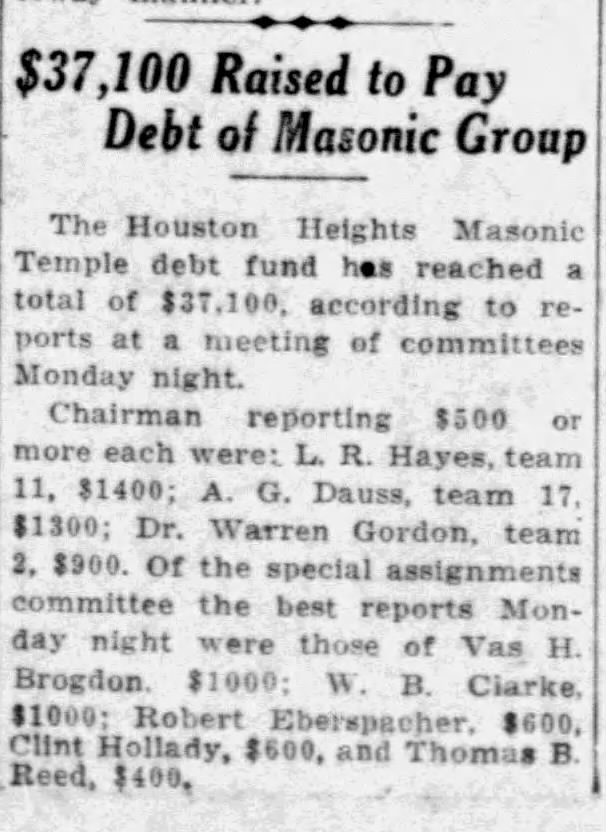
The single most important piece of context for understanding how the temple was lost is a mechanism that hid the loss almost entirely from Masonic record-keeping. The Grand Lodge's own 1932 Grand Master's Address explains that, across Texas, separately incorporated "Masonic" Building Associations, not the chartered lodges themselves, held legal title to lodge buildings, had become over-leveraged during the 1920s boom, and now faced foreclosure suits filed against the Association rather than the Lodge. Reagan Lodge's building was owned by precisely such an association, the same body whose building committee the March 1930 announcement had named. This is why Reagan Lodge No. 1037 never appears in the Grand Master's formal 1931–1937 debt-conveyance approvals, the mechanism smaller, more directly-owned lodges used, and it supports the working theory, still unconfirmed, that Reagan's actual mortgage was held by an external, non-Grand-Lodge mortgagee entirely outside Masonic channels. To this day, no deed of trust, no bank ledger, and no foreclosure decree naming a specific lending institution has surfaced anywhere in this research; a dedicated FamilySearch deed-chain sweep returns only "1935 Foreclosure Lender: unknown." The lodge's own history and the Texas Historical Marker both content themselves with the same vague phrase: the building was "taken over by a local bank in 1935."
Texas gives real proportion to what happened at Eleventh and Harvard. At least five Texas lodges explicitly lost buildings, or parts of them, to creditors between 1931 and 1937: Dixie No. 272 in Troup lost its land and first story to the First National Bank of Troup for a $14,000 debt in 1935, keeping only its upstairs lodge hall; Newton No. 136 in Burkville lost its building the same year; Sunset No. 632 lost its hall in 1936 over a note of just $430.50; Bartlett No. 692 lost its building in 1937 for $4,000; and Spur No. 1023 lost its hall the same year. Others, on evidence that is strong but not yet fully confirmed, appear to have fought their way back from the brink: Corpus Christi No. 189 refinancing its debt down from $21,000 to $10,400 in 1935, and Kelly No. 1131 doing the same in 1936. These Texan, Grand-Lodge-documented cases are the genuine comparanda for what happened to Reagan Lodge, more directly relevant than the era's national color, though that color is real too: Providence's Masonic temple stood unfinished through the decade; Detroit's 1890s temple was demolished and turned into a parking lot by early 1936; Hollywood rented its temple's ground floor to a slot-machine "social club"; and in Johnstown, lodge members reportedly waited banquet tables themselves to keep their building solvent.
Leaving Harvard and Eleventh
The standard date carried for the foreclosure is August 1935. But the sources bearing directly on the lodge's actual departure complicate that timeline in a way worth stating plainly rather than smoothing over. A Post lodge-directory listing of May 10, 1935 already shows Reagan Lodge meeting "tonight at 7:30" at Eighth and Harvard, its post-foreclosure address, with a secretary's name, "J. A. Hansmore," that is almost certainly a garbled rendering of J. A. Newsome. The June 21, 1935 officer election was reported without any hall address given at all. Three days later, on June 24, 1935, the joint installation with Woodland Lodge was held at Woodland's own Masonic Temple on Byrne and Morrison, not at Reagan's hall. And the Grand Lodge's 1935 Proceedings itself records the move, noting "8th and Harvard Sts., Houston, Texas" in connection with Reagan Lodge No. 1037.
Meanwhile, the 1935 city directory, compiled earlier in the year, still shows the full Masonic Temple complex standing at 1102 Harvard, five organizations strong, including that year's new Job's Daughters Bethel. Taken together, the evidence leans toward a specific reading: by May 1935, at least three months before the commonly cited August foreclosure date, the lodge had already retreated to the Eighth-and-Harvard hall, either because it vacated voluntarily ahead of a foreclosure sale as a defaulting owner, or because the foreclosure's formal legal date trailed well behind the practical date of eviction. The alternative explanation, that the May 10 listing is simply a misdated clipping, remains on the table and cannot be entirely ruled out, but it now sits against evidence from two independent angles pointing the same direction.
The building itself never went dark. It kept polling votes under three different names right through the transition. In October 1934 a primary-election notice directed "Precinct No. 7 Vote at Woodland Masonic Temple, 1100 Harvard Street" (Houston Post, Oct. 7, 1934, p. 36, clip 1193254323), a third label for the same address alongside "Reagan" and "Heights," and one that follows directly from Woodland Lodge No. 1157's tenancy in the rooms upstairs. On March 22, 1935 a school-election notice listed "Reagan Masonic Temple, Eleventh and Harvard Streets" as the Precinct 58 voting place, with E. J. Stidston and Mrs. Ethel Cunningham presiding (Houston Chronicle, Mar. 22, 1935, p. 30, clip 1198923920). By July 31 it had become plain "Masonic Temple, 1100 Harvard street," Precinct 58 again, A. B. Wildebrand presiding with Mrs. H. Sundermeyer and Mrs. Sue Landry as clerks (Houston Chronicle, Jul. 31, 1935, p. 25, clip 1198301898), and Werner's Drug Store in the corner storefront polled Precinct 6 three days earlier. Regular lodge meetings had moved to Eighth and Harvard; the neighborhood kept voting in the building the lodge was losing.
The lodge's own last acts in the building were funerals. In late July 1935 it buried C. C. Duerer, 63, of the Duerer Furniture Company, in a joint notice issued with Woodland Lodge No. 1157 at the request of both Worshipful Masters and signed by "H. H. Coe, secretary" (Houston Chronicle, Jul. 29, 1935, p. 17, clip 1198301644). Frank E. Anderson had been buried under its auspices three weeks before that, and Frank C. Humphrey in March. The temple's last documented season was one of funerals, a quiet officer election, and a change of address slipped almost silently into the lodge listings, with no dramatic final notice and no recorded farewell to the building its members had celebrated as "the latest and most imposing structure in Houston Heights" not five years before.
Around the emptying building, the disposal effort was already under way, and it is better documented than this history once thought. On July 9, 1935, the same day it ran Frank E. Anderson's front-page obituary, the Chronicle carried an item on page 5 about "the old Reagan Masonic Lodge Building, Eleventh and Harvard" being offered to the school district for Reagan High's overflow: "The price quoted was $50,000. The building originally cost about $125,000. The Reagan Lodge recently lost the building" (Houston Chronicle, Jul. 9, 1935, p. 5, clip sr1198298991). That is a contemporary newspaper record of the sale attempt, of the asking price, and of the loss itself, not merely the project's inherited premise, and it sets the episode on a documentary footing this chapter previously could not claim. The one part still resting on the compiler's summary rather than on the transcribed excerpt is the name: the verbatim fragment captured from the clip does not itself contain "Dagley," so the attribution of the offer to the real-estate agent John M. Dagley should be treated as pending a re-pull of the full clip text. No independent trace of a John M. Dagley has been found in any channel: no biographical record, no real-estate firm, no other documented deal.
The surname, at least, belonged to the lodge before it belonged to the sale. A lodge notice of May 11, 1931 lists "J. H. Dagley, Secretary" serving alongside "A. A. Stone, W. M." (Houston Chronicle, May 11, 1931, p. 19, clip 1198400963), and in July 1935 J. M. Dagley and Mrs. J. M. Dagley worked as election clerks for Precinct No. 120 at the Heights State Bank (Houston Chronicle, Jul. 31, 1935, p. 25, clip 1198301898). Whether the lodge's 1931 secretary J. H. Dagley, the 1935 election clerk J. M. Dagley, and the real-estate agent of the sale tradition are one man, two, or three is not settled by anything in the record.
Two absences close out the era as firmly as any fact does. First, the lodge's own minute books and financial records for 1930 through 1935, covering both the construction and the foreclosure, are conspicuously missing from the modern lodge's public archival holdings. Second, no period photograph of the temple itself, from 1930 through 1960, has been located in any of five searched photographic archives. The era's most consequential records may simply be the ones nobody kept, or the ones nobody has yet found.
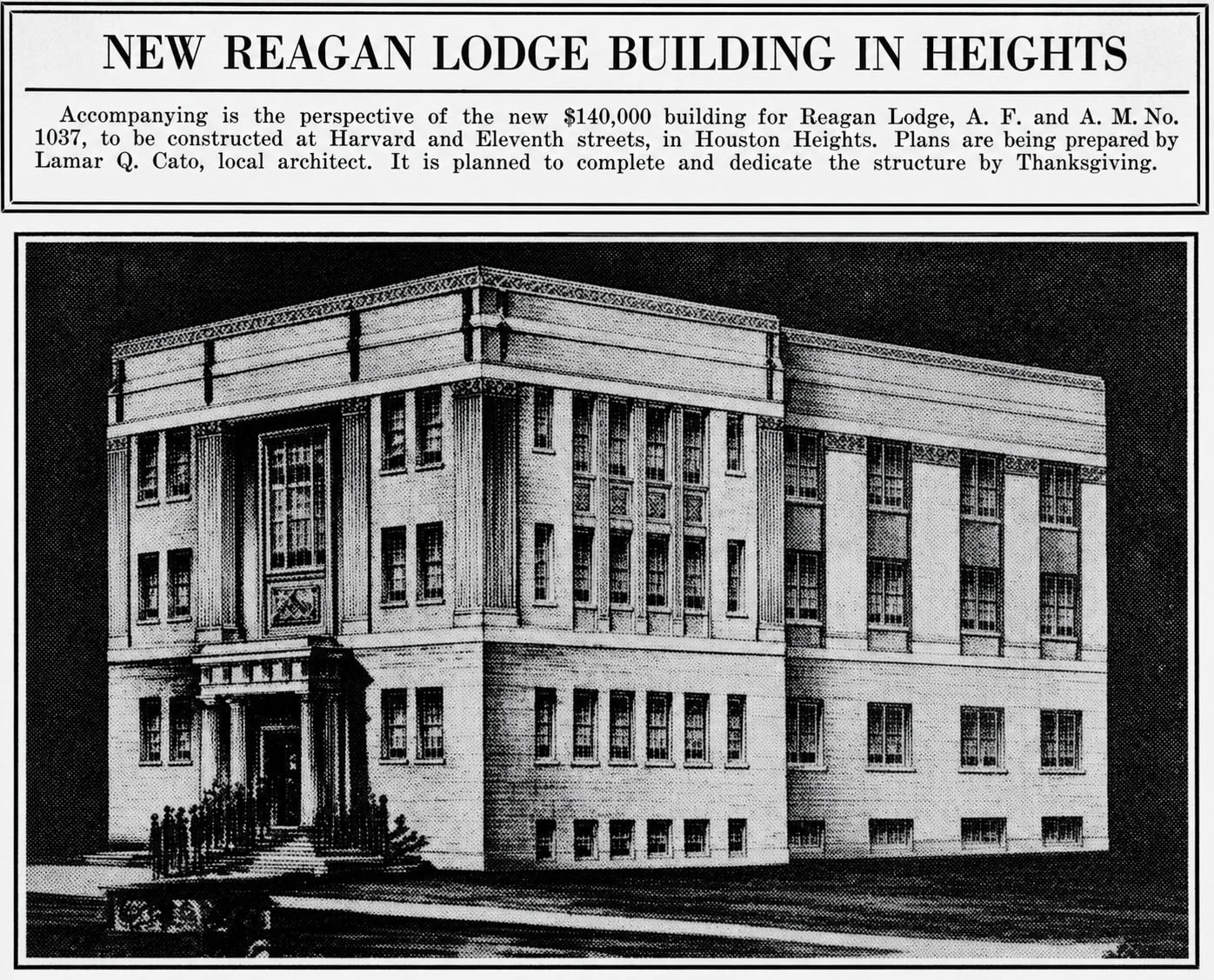
What This Era Still Cannot Answer
- Whether the planned December 21, 1930 birthday-and-opening celebration actually took place. No account of the dedication itself has ever been found.
- The identity of the 1935 foreclosure's actual lender: no deed of trust, bank ledger, or foreclosure decree naming an institution has surfaced; the lodge's own history says only "a local bank."
- Whether the May 1935 listing at Eighth and Harvard reflects a genuine pre-foreclosure retreat or is simply a misdated clipping. The evidence leans toward the retreat reading but cannot close the question.
- Whether the name "Dagley" appears in the full text of the July 9, 1935 Chronicle item (clip sr1198298991) that documents the $50,000 offer of the lost building to the school district, and whether the lodge's 1931 secretary J. H. Dagley, the 1935 election clerk J. M. Dagley, and the real-estate agent of the sale tradition are the same man.
- Why A. A. Stone stopped attending Grand Lodge after 1931, given that he was still presiding over a Heights election precinct in July 1935.
- Whether Woodland Lodge No. 1157 moved wholesale into the temple in 1932 or kept its own Watson-and-Eleventh hall at the same time; election notices name both addresses in the same years.
- Whether C. S. Bawcom sat on the 1930 building committee. This project's own synthesis and people index say yes; the March 23, 1930 newspaper roster does not include him.
- Who was Worshipful Master in May 1933: the Chronicle's "W. M. Wilcox," or the H. B. Webb the Post lists on either side of it.
- Which man captained Team 2 in the 1933 debt drive: Dr. Warren J. Gordon on May 22, or "H. O. Quebe" on May 26.
- What became of the Job's Daughters Bethel first recorded in the 1935 directory. It is never mentioned again in any source found.
- The true identity of the pink Tennessee marble's supplier.
- Whether the house moved north up Harvard Street in June 1930, on Sister Agatha's account, can be identified at a present-day address.
- Whether any period photograph of the temple, 1930–1960, survives in an archive not yet searched.
- The lodge's own minute books and financial records for 1930–1935, which are absent from its modern public archival holdings.
- Whether the Joseph Finger Papers at the Houston Public Library (ArchivesSpace resource 693) hold correspondence from Finger's 1920–1923 partner, Lamar Q. Cato.
Complete Research Dossier, Era II: Design, Construction, Golden Age, Foreclosure (1930–1935)
ERA 2 SYNTHESIS, 1930–1935: Design, Construction, Golden Age, and the Road to Foreclosure
Written by the era 2 author, 2026-07-16, refreshed 2026-07-18 to integrate Layer B newspapers.com transcriptions, exclusively from the era 2 evidence files. Every asserted fact carries its citation as given in those files; grades follow the Universal Retention Rule (CONFIRMED / LIKELY / SPECULATIVE / LEAD). Unresolved contradictions are logged, not silently adjudicated.
1. The corner on the eve of the temple (early 1930)
When 1930 opened, Reagan Lodge No. 1037 was still meeting in its first, modest hall on the same corner it was about to transform. A Houston Chronicle item of February 23, 1930 places the lodge "at the Reagan lodge room, Eleventh and Harvard", the pre-temple quarters, and notes that "Members of Reagan and Woodland Chapters, O. E. S., and their families, will have a George Washington party Monday at 8 p. m." (Houston Chronicle 1930-02-23 p60, Newsbank image 1930-02-23_p60_pretemple-lodge-room.pdf, CONFIRMED). A stated meeting notice from February 8, 1930 confirms the stated meetings were on a regular rhythm at "Eleventh and Harvard Sts." starting at 7:30 p.m. with degree work beginning at 9:00 a.m. and running until 10:00 p.m. (Houston Chronicle 1930-02-08 p12, clip 1198429433, CONFIRMED).
Contemporaries had long called that first hall a "Masonic Temple": a June 4, 1929 Post-Dispatch notice reads "STATED meeting of Reagan Lodge No. 1017 [OCR misread of 1037]... in Masonic Temple, Eleventh and Harvard, Houston Heights... Clint Holaday, W.M.; James F. Helms, secretary", a full year before construction of the grand temple began (Portal to Texas History ark:/67531/metapth1837894, via research plan 41, CONFIRMED), and the same "Masonic temple, Eleventh and Harvard" phrasing appears as far back as September 17, 1918 (Post 1918-09-17 p13, clip sr94963019, CONFIRMED).
The lodge's chair at the moment of decision was A. A. Stone: a February 21, 1930 school-of-instruction notice lists "A. A. Stone" as Worshipful Master and James F. Helms as Secretary (Chronicle 1930-02-21 p34, clip sr1198431223, CONFIRMED), repeated in a March 18, 1930 stated-meeting notice ("A. A. Stone, W. M.; James F. Helms, Secretary") (Chronicle 1930-03-18 p28, clip sr1198544294, CONFIRMED). Stone would sit on the building committee, attend Grand Lodge in 1931 for the lodge, and then remain active in the Heights community, see §8.
The lodge these men led was, by charter, twenty years old: the Grand Lodge Proceedings returns state flatly "Date of Charter, December 12, 1910" (GL of Texas Proceedings 1930 p.1098; identically 1931 p.1135, CONFIRMED). It was "the first Masonic lodge instituted in Houston's suburbs; only Holland Lodge No. 1, Temple Lodge No. 4, and Gray Lodge No. 329 predate it in Houston proper" (web research: reaganlodge1037.org/history et al., CONFIRMED), and its official mailing address in 1930–31 was "732 Harvard, Houston" (GL Proceedings 1930 p.1098, 1931 p.1135, CONFIRMED).
Personal financial difficulties were already beginning to touch key members of the lodge on the eve of the temple's construction. In the local courts column on January 31, 1930, a District Court lawsuit was recorded: "The National Bank of Commerce of Houston vs. C. S. Bawcom, et al, contract," representing an early shadow of commercial litigation over a member of the building committee (Houston Post-Dispatch 1930-01-31 p6, clip 1192849925, CONFIRMED).
2. The announcement: March 23, 1930
Both Houston dailies carried the story the same Sunday.
The Post: "Reagan Lodge Plans to Erect $140,000 Building... Plans are being prepared by Lamar Q. Cato, local architect, for the construction of a three-story building with basement at the northeast corner of Eleventh and Harvard in Houston Heights," with construction to start by June 1 and finish by Thanksgiving (Post 1930-03-23 p21, clips sr1193236619 and sr1197458388 [duplicate scan], CONFIRMED).
The Chronicle, same date: "A three-story brick and stone lodge building to cost $140,000 will be started by Reagan Lodge No. 1037, A. F. and A. M., about June 1, James E. Helms, secretary, announced," adding "Lamar Q. Cato is architect. Bids for construction will be taken within 10 days" and "The plans call for completion of the structure and dedication services by Thanksgiving Day of this year" (Houston Chronicle 1930-03-23 p61, Newsbank image 1930-03-23_p61_cato-site-announcement.pdf, CONFIRMED).
The site. "The building, which will contain three stories and a basement, will be on the lodge's property on the northeast corner of Eleventh and Harvard Streets, where a vacant lot 100 by 150 feet is owned" (same Chronicle article, CONFIRMED).
The program, floor by floor (same Chronicle article, CONFIRMED): - Basement: "The entire building will contain club rooms in the basement, with banquet room and a small banquet room." (The basement bowling alley appears in the Post's version of the plan, lodge rooms, Eastern Star/Rainbow quarters, "a bowling alley and banquet room," and DeMolay chapter quarters, and in every later description of the building.) - First floor: "On the first floor will be the auditorium, stage, secretary's office, library and ladies reception rooms." - Second floor: "The second floor will be given over to clubrooms for the Eastern Star and Rainbow Girls, containing their separate lodge rooms and offices." - Third floor: "The third floor will contain lodge rooms, stage and lockerroom."
The machinery of finance. "A building association has been formed to handle the financial arrangements and detail and the construction of the new building. The association's building committee is composed of Charles I. Voss, president; Mr. Helms, secretary; M. S. Frazer, C. A. DeWare, John Holaday, C. C. Powell, Y. M. Brogden, A. A. Stone and S. B. Walters" (same Chronicle article, CONFIRMED). The trade press picked it up within days: Manufacturers Record, April 3, 1930 (Vol. 97, Iss. 14) lists "Tex., Houston, Reagan Lodge No. 1037, A. F. & A. M., Chas. L. Voss, Pres., Bldg[. Comm.]" (archive.org/details/sim_site-selection_1930-04-03_97_14, via research plan 66, CONFIRMED; note the "Chas. L." vs "Charles I." Voss initial discrepancy already logged in the project's search log, run R27). Committee members Clint Holaday (WM 1929), Vas Hubert Brogdon, C. C. Powell, A. A. Stone, and C. S. Bawcom are separately confirmed as lodge figures in the bio sweeps (plans 40–44, CONFIRMED; Bawcom is documentarily near-invisible outside this context: no Chronicling America, NARA, or 1920–1940 court-record trace, plan 40, CONFIRMED negative).
Family connections of the building committee members were also in public view; on March 30, 1930, the Chronicle noted the upcoming 60th wedding anniversary of the parents of building committee member C. S. Bawcom (Mr. and Mrs. W. A. Bawcom of Ferris, Texas), who celebrated the event with family, which was also printed with a photograph in the Post-Dispatch the following January (Houston Chronicle 1930-03-30 p14, clip 1198545237; Houston Post-Dispatch 1931-01-25 p39, clip 1193017523, CONFIRMED).
Note that this building association is the operative successor of the fundraising association the historical marker dates to 1912 (marker text via hmdb.org/m.asp?m=157794, CONFIRMED); the separately-incorporated-association structure becomes load-bearing at foreclosure time (§9).
A membership-count tangle in the same articles. The March 23 Chronicle asserts "Reagan lodge, named after John H. Reagan, famous Texan, was organized December 21, 1915, with 16 members," that it "moved into the temporary quarters now occupied on the second floor of the brick building at Eleventh and Harvard on Thanksgiving Day, 1915, it had only 22 members," and that "Today the lodge has 841 members" (Chronicle 1930-03-23 p61, CONFIRMED as what the source says). The October 19, 1930 Chronicle instead says "the lodge, which was organized 10 years ago... had 23 members when it was organized and today has 875 members" (Chronicle 1930-10-19 p25, CONFIRMED as what the source says). Both newspaper origin stories conflict with the Grand Lodge's own charter date of December 12, 1910; the "1915 / Thanksgiving Day 1915" claims almost certainly garble the move into the first hall on the corner (the 1916 first-hall thread belongs to Era 1). Treat the newspaper organization dates as source errors against the CONFIRMED 1910 charter; retain the membership figures (841 in March 1930, 875 in October 1930) as reported. The Grand Lodge returns give the audited arc: 855 members (1930), 894 (1931), 797 (1933) (GL Proceedings 1930 p.1098; 1931 p.1135; 1933 p.1107, CONFIRMED).
3. Building the temple (May–December 1930)
The contract. Bace Construction Co. of Houston was general contractor, "under a $110,000 contract, let in May 1930" (research plans 16 and round 1 findings, CONFIRMED). Bace came to the job hot off a run of major Houston public-school work 1928–1930, Stonewall Jackson school addition (Aug 1928, $87,100), Phillis Wheatley high school addition (Feb–Apr 1929, $184,000 bid / $210,000 final), nine classrooms at Jefferson Davis Senior High, and the dismantling of the old armory (May 1929) (Portal items metapth1837770, metapth1837801, metapth1846252, metapth1837886 via research round 1, CONFIRMED). Then, "On June 18, 1930, one month after landing the lodge contract, Bace Construction Co. of Houston decreased its capital from $25,000 to $15,000" (Portal metapth1664243; the raw Fort Worth Press item of 1930-06-18 p14 reads "Bace Construction Co., Houston, dec. es from $25,000 to $15,000", CONFIRMED). J. D. Bace was the firm's primary principal, with firm activity bounded 1928–1940 (research plan 16, Texas City Sun 1940 / metapth1905276, CONFIRMED). Bace's membership in the Texas General Contractors Association could not be verified in any channel, and the TGCA's March 1930 "Prospective Work" Bulletin was never found (research plan 99, CONFIRMED negatives).
The permit. "A permit for construction of the Reagan Masonic Lodge three-story brick building at 1101 Harvard was issued Friday by C. F. Brown, city building permit clerk" "to the Bace Construction Company," and "The structure will cost $105,035" (Houston Chronicle 1930-06-20 p38, Newsbank image 1930-06-20_p38_permit-story.pdf, CONFIRMED). Address flag (Stage B contradiction): the permit says 1101 Harvard, the odd (west/southwest) side, where the directories soon show a Gulf filling station, while the building rose at 1100/1102 on the northeast corner. This is a source garble or clerk's error and should be flagged in the narrative rather than passed without comment.
Cost figures, reconciled. Five figures circulate and they are not the same number: $140,000 (announced plan, both papers, Mar 1930); $150,000 vs $140,000 in the same October 1930 Chronicle piece ("Lodge Is Erecting $150,000 Structure There. [and] the $140,000 Reagan Lodge building", an internal discrepancy the source itself commits, Chronicle 1930-10-19 p25, CONFIRMED); $105,035 (permitted structure cost, June 1930); $110,000 (Bace's contract, May 1930); and $110,700, the completed-cost figure carried by the lodge's own history, the state historical marker, and every modern secondary source (reaganlodge1037.org/history, hmdb.org marker, Harris County Historical Commission Masonic Markers PDF, CONFIRMED). The tidy reading, announced budget ~$140k including site/furnishing ambitions, structure permitted at $105,035, built for roughly the contract price, is plausible but NOT itself sourced; present the figures separately.
The cornerstone, July 26, 1930. The Grand Master's dispensation is on the record: "Reagan Lodge No. 1037, A. F. & A. M., Houston, Texas; to lay corner-stone of new Masonic Hall at Houston, Texas, July 26, 1930, Brother Charles I. Voss, Past Master of Reagan Lodge, proxy" (GL of Texas Proceedings 1930, p.53, CONFIRMED). The Post-Dispatch of that morning carried the ceremony program under the sensational headline "TEMPLE WILL BE DEDICATED," even though the event was actually a cornerstone leveling (Houston Post-Dispatch 1930-07-26 p24, clip 1193056180, CONFIRMED). The program was scheduled to start at 4:30 p.m., with the actual leveling ceremonies slated for 6:00 p.m. Judge Ewing Boyd was the grand orator for the occasion, and the program was under the charge of "Charles L. Boss" (almost certainly a typo for Charles I. Voss) representing the Grand Master, A. F. Helms representing the Deputy Grand Warden, A. A. Stone representing the Grand Senior Warden, and H. R. Collier representing the Grand Junior Warden (same article, CONFIRMED).
On Judge Boyd: the web sweep found rich biography (Cooper, Texas printer's devil at eleven; Mayo College's first valedictorian, 1891; UT law 1899; T&BV Railway claim agent who "rode a cowcatcher into Houston"; assistant DA from 1912; 55th District Court judge from 1919) but "no independent documentation of his specific words or role at the July 26, 1930 Reagan Lodge cornerstone ceremony beyond what the user's own project premise states" (Cooper Review 1953-03-06 p1 via Portal; archives.hcpl.net; both CONFIRMED, the caveat itself CONFIRMED). His docket peaked in exactly these years, over 278 "Ewing Boyd" Texas cases, heaviest 1927–1937, including Hunsinger v. Boyd (filed Apr 9, 1930) and Southern Bag & Burlap Co. v. Boyd (filed May 16, 1931) (CourtListener via research plan 46, CONFIRMED).
Delay and marble. "Some delay in finishing the building has been experienced because of slow shipments of the pink marble from Knoxville, Tenn." (Chronicle 1930-10-19 p25, CONFIRMED). "This huge structure of brick and pink marble" was, that October, "The latest and most imposing structure in Houston Heights" (same, CONFIRMED). The marble supplier was never identified: candidates are National Terrazzo Tile & Marble and American Marble Mosaic (both LIKELY, TX franchise records begin only 1962/1964) and the heavily-advertised Appalachian Marble Company of the 1920s (SPECULATIVE) (research plan 55).
The opening. "The formal opening of the Reagan Lodge building is planned for December 21 on the birthday of the lodge [and] plans are being made to celebrate the combined birthday and opening celebration on December 21" (Chronicle 1930-10-19 p25, CONFIRMED). James F. Helms, "secretary of the lodge for the past 14 years," was the spokesman (same, CONFIRMED). Gap flag: no source in this folder documents the December 21, 1930 event actually occurring, no account of the dedication itself has yet been captured (the lodge's modern archives likewise show "no mention of 1930 cornerstone laying records, dedication ceremonies, or cornerstone contents," research plan 103, CONFIRMED negative). The building's first city-directory row is the 1930-31 edition: "1100 Masonic Temple / Reagan Lodge No 1037 A.F.&A.M. / Hts Chapter 258 O.E.S.", only the lodge and the Eastern Star chapter at first (Houston City Directory 1930-31, album additions 7/11/26, CONFIRMED).
4. The architect: Lamar Q. Cato, attribution, contradiction, portfolio
Attribution. Cato's authorship rests on the strongest possible footing: both contemporary dailies name him in the March 23, 1930 announcements, and the October 19, 1930 Chronicle repeats "It was designed by Lamar Q. Cato, architect" (all cited above, CONFIRMED). The web record, by contrast, is weak on this exact point, no open web source independently surfaced an explicit "Cato designed this" sentence for 1100 Harvard, and the HAIF forum bio material remains single-sourced/unfetchable (web research on Cato, CONFIRMED as a sourcing caveat). The project's newspaper primary sources therefore carry the attribution.
The contradictions to fix in any public narrative: 1. The City of Houston Historic Preservation Manual credits the 1930 building to "architect and Houston Heights resident L. R. Hayes" (houstontx.gov Preservation Manual, via the Engberg web research, CONFIRMED as what that source says). Hayes was in fact the architect of the lodge's 1948 building at 1606 Heights Blvd (historic.one marker record, CONFIRMED), and, tellingly, he was Reagan Lodge's senior warden in June 1935 (§8). The two architects must be kept distinct; the Manual's attribution is best treated as an error conflating the two buildings. 2. The same Preservation Manual dates the building to 1918, "likely an error/conflation, since it's contradicted by the more detailed, internally consistent Masonic-lodge sources" (and by the 1930 permit and construction coverage) (Stage B-flagged web research, CONFIRMED as a source error; 1918 is plausibly a conflation with the first hall era). 3. CORRECTION (research plan 94, priority flag): Alfred C. Finn co-designed the Roy G. Cullen Memorial Building (UH, 1938-39) WITH Lamar Cato; the existing narrative credits Cato alone. Finn (1883–1964, Sanguinet & Staats apprentice, Jesse H. Jones collaborator) separately designed the Ezekiel W. Cullen Building (1950). Any Era-2 aside on Cato's later career must carry the co-credit.
Portfolio context (Cato in and around 1930). Cato was simultaneously running school work across the region: October 27, 1930 bid notices for Brenham school buildings direct contractors to "the office of the Architect, Lamar Q. Cato, 801 Merchants and Manufacturers Building, Houston, Texas" (Portal items metapth1174728_p4, metapth1174473_p2, metapth1173573_p4, metapth1174905_p3, metapth1174302_p5, CONFIRMED). His documented work of the era includes the West University Place School Group ($600,000 incl. site), Alvin High School (Witte & Fleming, $56,215), an addition to Brenham Baptist Church (J. R. Nix, $30,000), a two-story Texas Dental College addition (James M. L. West; ~$11,000/$35,000 in varying reports, UNCERTAIN, verify), additions to Stonewall Jackson Junior High (the 28-classroom annex Bace built), George Washington Junior High, Bellaire, Post Oak and Spring Branch schools, the Nalle Office Building in Austin (as Endress & Cato), and the W. G. Jones Residence in Riverside Terrace (research round 1 / plan 20, CONFIRMED unless noted).
Most relevantly for this building's story, Cato designed a second Masonic lodge in the same period, the Cade-Rothwell Masonic Lodge at North Main and James Street, Houston (contract to O. W. Raper & Son, ~$21,000) (research round 1, CONFIRMED), evidence of a specialization in fraternal buildings worth featuring. His later crowning work, the five original University of Houston Quadrangle residence halls (Bates, Law, Oberholtzer, Settegast, Taub), is cross-verified (WebSearch cross-check, CONFIRMED); he died July 12, 1948, aged 59 (name-research context, CONFIRMED).
One engineering negative to preserve: Walter P. Moore's firm had no role in the 1930 construction, it did not exist until 1931, when Moore founded it by selling his Stutz Bearcat; the firms' Depression-era stories merely run in parallel (walterpmoore.com history et al.; research plans 18/Round 3, CONFIRMED negative + CONFIRMED).
5. The building as built
Physical description, assembled from the era's sources: a two-to-three-story (plus basement) brick building trimmed in pink Tennessee marble, "elaborate Classical Revival" in the City Preservation Manual's phrase, at the northeast corner of Harvard St. and Eleventh Ave., with a Masonic Square-and-Compass emblem carved into / mounted on a rectangular panel above the main entrance (its ghost-outline reportedly still faintly visible today) and a bowling alley in the basement (Chronicle 1930-10-19 p25; houstontx.gov Preservation Manual; reaganlodge1037.org; hmdb.org marker, all CONFIRMED). "The building will include a large auditorium, rooms for the Rainbow Girls, the De Molay Chapter for boys, club rooms and offices" (Chronicle 1930-10-19 p25, CONFIRMED).
The same October feature situates it in its neighborhood moment: "Houston Heights is noted for its many imposing buildings, its churches, tree-lined boulevards and thousands of beautiful homes. The section has a population of 46,000 and is regarded as the most popular residential district in Houston," with home sites "50 feet by 150 feet minimum" (Chronicle 1930-10-19 p25, CONFIRMED). Next door at 1123 Harvard stood the 1912 Schlesser-Burrows House, pre-dating the temple by 18 years, the residential fabric the temple rose inside (NRHP nomination 84001823 via research round 1, CONFIRMED). Down the block: Collins Memorial Methodist Church at 120 Eleventh Ave E (which hosted the 60th Southern Annual Conference of the Methodist Episcopal Church, December 1–4, 1932, Bishop Charles L. Mead presiding, "auditorium filled to capacity", archive.org southernconferencemec1932 via research plan 62, CONFIRMED).
Comparable fraternal buildings of the moment, for framing: Houston's downtown Masonic Temple at 1407 Fannin (Temple No. 4/Gray No. 329; architect Alfred C. Finn; under construction by Aug 1923, LIKELY), the Houston Heights Odd Fellows Lodge No. 225 Hall at 115 E. 14th St (dedicated Apr 28, 1923, still active, CONFIRMED), and Baytown's 1929 Odd Fellows Hall (architect Lenard Gabert, now "Odd Fellows Lofts", CONFIRMED) (all research plan 56). No purpose-built 1920s–1935 Arabia Temple Shrine building in Houston could be identified (plan 56, SPECULATIVE negative).
6. Who was in the building: the tenant roster, year by year
The photographed Morrison & Fourmy city directories give the cleanest occupancy series (all CONFIRMED from directory photos in the project image archive and the 7/11/26 album additions unless noted):
| Edition | 1102 (temple) roster | 1101 Harvard (across/adjacent) |
|---|---|---|
| 1930-31 | "1100 Masonic Temple / Reagan Lodge No 1037 A.F.&A.M. / Hts Chapter 258 O.E.S.", the temple's FIRST directory row; lodge + OES only | (no entry captured) |
| 1932-33 | Reagan Lodge No. 1037 A.F.&A.M.; Heights Chapter 258 O.E.S.; Reagan Chapter De Molay; Heights Assembly No. 10 Order of Rainbow | Gulf Refining Co, filling station |
| 1934 | "Masonic Temple" (house no. printed "1101," very likely a 0/1 misread of 1100); Reagan Chapter De Molay; Reagan Heights Chapter No. 258 O.E.S.; Reagan Lodge No. 1037; Heights Assembly No. 10 | |
| 1935 | MASONIC TEMPLE; De Molay Chapter; an O.E.S. chapter; "Lodge No. 1027" (near-certain misread of 1037); Assembly No. 10; Job's Daughters (Bethel), new fifth organization, not seen 1932–34 | Gulf Oil Co, filling station; also Norhill Interests / M-K Pharmacy in the 1935 street guide |
| 1932-33 alt. list (album image new_02) | Reagan Lodge No 1037 AF&AM; Reagan Chapter No 383 R.A.M.; Reagan Commandery No 99 K.T.; Reagan Chapter No 825 O.E.S., "Meets at hall cor 11th and Harvard" |
Caveats to carry: the Job's Daughters Bethel rests solely on the (blurry, rotated) 1935 directory photo; research round 3 exhaustively failed to find any independently fetchable corroboration and the grade stays LIKELY, not CONFIRMED; what happened to the Bethel after 1935 is UNKNOWN, "no source in any channel mentions it again" (research round 3 items 267, 269). The new_02 album image's R.A.M./K.T./O.E.S.-825 roster does not match the Heights Chapter No. 258 O.E.S. attested by dozens of newspaper notices; its numbers should be verified against a clean copy before public use (the directory photos carry explicit legibility warnings).
Commercial and Religious Tenants (New Findings): - Third Church of Christ, Scientist: In November 1933, the Third Church of Christ, Scientist was operating out of the temple edifice at 1102 Harvard St. They held Sunday services at 11:00 a.m. and 8:00 p.m., Wednesday testimony meetings at 8:00 p.m., and maintained a Reading Room open to the public from 11:00 a.m. until 4:30 p.m. daily (except Wednesday, when it remained open until 7:30 p.m.) (Houston Chronicle 1933-11-25 p5, clip 1198844174, CONFIRMED). - Werner's Drug Store: A school district election notice from July 1935 lists Werner's Drug Store as operating at 1100 Harvard Street (the temple building), serving as the polling place for Precinct No. 6 (Houston Chronicle 1935-07-28 p30, clip 1198301390, CONFIRMED). This indicates that a local pharmacy was occupying the corner commercial space on the eve of foreclosure, alongside or succeeding J. G. Greve's pharmacy and the Eleventh Ave Pharmacy.
Residential Occupants: Newspaper mortuary notices show that the temple building was also used as a residential space (likely caretaker or building manager quarters): - Woodward S. Logan (aged 53, member of Reagan Lodge No. 1037 and Temple Chapter RAM) resided at 1102 Harvard St at the time of his death on Sunday, June 3, 1934 (Houston Post 1934-06-04 p11, clip 1193689698, CONFIRMED). - Henry C. Nicholson (aged 55, Marble Falls Mason and Modern Woodmen member) resided at 1100 Harvard St when he passed away on Tuesday, March 19, 1935 (Houston Chronicle 1935-03-20 p27, clip 1198923510, CONFIRMED).
The E 11th shop strip (the building's commercial frontage, printed house numbers 215–223 in this era) turned over constantly (directory Table 2 findings, CONFIRMED): 1930-31: 215 Economy Cleaners; 216 Matula; 217 Banta Candy; 222 Greve; 223 Madings Drug Store No 7 (the chain drugstore predating the Eleventh Ave Pharmacy at the same address); 301-3 A&P / Telschow's Bakery. 1932-33: 215 Economy Cleaners & Hatters; 216 Mrs. May Bailey; 217 Houston Candy Co; 218–219 vacant; 221 Red & White Stores (grocery-meats); 222 J. G. Greve (pharmacy); 223 Eleventh Ave Pharmacy. 1934: 216 Curtis Barber Shop / Economy Cleaners & Hatters / Mrs. Ethel Pearson; 217/219 vacant; 218 H. G. Cargill; 221 Hildebrandt C. A. grocery / R. C. Addicks; 222 Greve; 223 Eleventh Ave Pharmacy. 1935: 216 Humphreys Barber Shop / Economy Cleaners; 217 Mrs. Ethel Pearson; 218 vacant/T. C. Carroll; 219 O. B. Ferguson; 220 O. A. Hildebrand grocer; 221 Clarence Scholl meats; 222 J. O. Grove; 223 Eleventh Pharmacy Co. The vacancies of 1932–34 are the Depression showing through the directory columns. (Note the era-1-vintage renumbering caveat: printed numbers run 215–223 rather than the modern 200–230.)
7. The golden age: life inside the temple, 1930–1935
The affiliated bodies made the building hum. Houston Heights Chapter No. 258, O.E.S., met "at 8 o'clock in Reagan Lodge room, corner of Eleventh and Harvard" on a first-and-third Monday rhythm attested by an unbroken run of several dozen stated-meeting notices from February 1930 through at least November 1934 (Post/Chronicle clips, e.g. sr1194052993, sr1193235176, sr1192871687... sr1193232336, all CONFIRMED; individually routine). Its officer line is recoverable year by year: Mrs. Millie Furman W.M. (Jan 1931), Mrs. Jessie Jackson (Aug 1931), Mrs. Julia Bottler/Willie Bell Ainsworth and Mrs. Dorothy Looney (1932/33 notices), Mrs. Carrie Sloop installed worthy matron May 31, 1932 with T. G. Gready worthy patron (Post 1932-05-31 p7, sr1193854853, CONFIRMED, correcting an earlier misread), honored at a Texas State Hotel dinner with "a silver bowl filled with sweet peas" (Chronicle 1933-04-02 p39, sr1198422650, CONFIRMED); Nettie Peisker W.M. (May 1934), Mrs. Tom Jean Moore W.M. (June 1934).
The chapter staged public installations (May 31, 1930, installing Mrs. Eleen Rogers, Mrs. Alice Brogdon, Mrs. Ida Wimberly, Mrs. Maud Reed, Post/Chronicle 1930-06-01, three clips, CONFIRMED), "step-up" nights (Chronicle 1933-04-09 p19, CONFIRMED), watermelon parties on the temple lawn (Post 1932-08-05 p7, clip 1193555186; Chronicle 1932-08-04 p7, clip 1198360453, CONFIRMED), turkey suppers "in the club rooms of the temple, Harvard an[d] Eleventh streets" (Chronicle 1932-11-28 p6, CONFIRMED), benefit plays of "a series of 14 short acts" (Post 1931-08-26 p6, CONFIRMED), and a two-week cooking school at Phoenix Furniture's auditorium whose attendance prize Houston Heights Chapter No. 258 won (Post 1934-03-24/25 p2, CONFIRMED).
The youth orders. Heights Assembly No. 10, Order of the Rainbow for Girls, met in the Reagan Lodge room (notices Sept 1931, Jan 1932, Esther Gregory W.A., Geneve Hebert secretary, CONFIRMED) and installed officers publicly (Jan 1931 joint with Reagan DeMolay chapter; Jan 1934 slate: Bernice Brogdon worthy advisor, Vivian Dunk worthy associate advisor, Mary Sue Fuller charity, Laura Liew Robinson hope, Chronicle 1934-01-07 p19, CONFIRMED). In August 1934 the Assembly "will stage a carnival and benefit entertainment this afternoon and night at Reagan Masonic hall... opening at 4:30 on the lawn of the hall," organized by worthy advisor Vivian Dunk (Post 1934-08-03 p7, CONFIRMED), the temple's lawn as neighborhood fairground. The Assembly also sponsored benefit sports dances in the temple, such as on Friday, September 8, 1933 (Post 1933-09-07 p18, clip 1193548367; Chronicle 1933-09-06 p9, clip 1198355808, CONFIRMED), and presented the comedy "The Heart Exchange" in the temple auditorium on Wednesday, June 6, 1934 (Houston Post 1934-06-06 p12, clip 1193689698, CONFIRMED). An old-time style show was staged by the Assembly in the temple on March 22, 1934 (Houston Chronicle 1934-03-04 p27, clip 1198528071, CONFIRMED).
The DeMolay Chapter. Reagan Chapter of DeMolay held regular dances in the temple, such as on Wednesday night, November 15, 1933 (Houston Post 1933-11-19 p21, clip 1193959670, CONFIRMED). Officers including Joe Arthur Newberry (Master Councilor) were publicly installed on April 24, 1935 (Houston Post 1935-04-23 p5, clip 1194001911, CONFIRMED). Together with Heights Rainbow Assembly, they presented the three-act comedy "Listen to Leon" at the temple on Saturday, January 26, 1935 (Houston Chronicle 1935-01-22 p7, clip 1198606655, CONFIRMED).
The hall as civic living room. The wider Heights used the building constantly: - Pupils of Mrs. O. L. Morton presented a student recital in the temple on April 8, 1932 (Houston Chronicle 1932-04-03 p6, clip 1198460092, CONFIRMED), and presented "The Marriage of Jack and Jill" in the temple in April 1932, later repeating it at the Eugene Field school auditorium (Houston Chronicle 1932-04-12 p18, clip 1198460463, CONFIRMED). - Fulbright Methodist young people staged "Eighteen-Carat Boob" (Chronicle 1933-04-28 p2, CONFIRMED) and the three-act comedy "Strange Bequest" (Chronicle 1934-11-18 p3, CONFIRMED). - Mr. and Mrs. John Dunlop hosted a large dance in the DeMolay ballroom of the temple on Tuesday night, December 27, 1932, to honor their daughter, Miss June Dunlop (Houston Chronicle 1932-12-15 p14, clip 1198581288; 1932-12-27 p6, clip 1198582133; 1932-12-28 p5, clip 1198582180; Houston Post 1932-12-29 p5, clip 1196046314, CONFIRMED). - A Letter Carriers auxiliary put on a play (Chronicle 1933-02-09 p10, CONFIRMED). - The John H. Reagan Senior High "Red Coats" threw a til-midnight dance for band uniforms (Chronicle 1933-09-29 p24, CONFIRMED). - The A&M Mothers' Club held a benefit bridge party (Chronicle/Post 1933-12-03, CONFIRMED). - An O.E.S. chapter play "Fun on [the Sunset?] Limited" ran in May 1934 (Post 1934-05-01 p11, CONFIRMED). - At least one wedding was solemnized in the hall, Miss Ruth La Nelle B[e...], Rev. R. L. Brenham reading the service (Post 1934-05-20 p26, CONFIRMED). - Woodland Christian Church was holding services in the temple in March 1934 (Houston Post 1934-03-25 p14, clip 1193164670, CONFIRMED). - Zion Lutheran Church Senior Luther League presented the play "Chintz Cottage" in the lodge auditorium on Friday night, December 7, 1934 (Houston Post 1934-12-06 p18, clip 1193504742; Houston Chronicle 1934-12-05 p17, clip 1198512621, CONFIRMED). - The Houston Heights Garden Club's meetings and flower shows at "Harvard and Eleventh" bracket the construction itself, the Feb–May 1930 events (bush distribution, flower show "held at Harvard and Eleventh streets Thursday") necessarily used the first hall, while the April 1931 spring show at the "[exhi]bition hall, Harvard [s]treet" was in the new temple (Post/Chronicle 1930-02-16, 1930-03-02, 1930-05-09/11, 1931-04-05, all CONFIRMED; the first-hall/new-hall split is this author's dating inference from the June 1930 permit, flagged as such).
Masonic ceremony and fraternity. Degree work ran steadily (E.A. and M.M. conferrals under W. C. Webb, 1934, Post 1934-01-18 p14, 1934-05-04 p12, CONFIRMED). The joint installations rotated: 1931 and 1935 at Woodland Lodge (118 Byrne St / Byrne and Morrison), 1933 at Woodland with six bodies, but in 1932 and 1934 the host was Reagan's own corner, "A joint public installation of six Masonic bodies will be held on the grounds of Reagan Lodge, Harvard and Eleventh, Friday night. It will be preceded by a picnic beginning at 6 p.m." (Chronicle 1932-06-22 p5, CONFIRMED); "Masonic Ceremony Will Be Held on Grounds of Reagan Unit... joint installation Monday evening on the grounds of Reagan lodge at Eleventh and Harvard," supper at 6:30 (Post 1934-06-24 p3, CONFIRMED).
The lodge buried its dead under its auspices throughout: - W. P. Boger, electrocuted at Sinclair Oil, buried from Hollywood Cemetery July 1930 (Chronicle 1930-07-11 p34, CONFIRMED). - Arch C. Fulton, Heights druggist and 1924 Arabia Temple Past Potentate, graveside services Nov 1930 (Chronicle 1930-11-23 p22, CONFIRMED). - Charles T. Dodson, Southern Pacific employee, buried June 1931 under Blue Lodge auspices (Chronicle 1931-06-20 p12, clip 1198493764, CONFIRMED). - Professor Godbey (Feb 1932), L. L. Stallings (May 1933), Fred M. Pettibone of Humble Oil's traffic department (April 1935, Hollywood Cemetery, pallbearers from the membership) (Chronicle clips, CONFIRMED). - A. B. Parker, whose Post obituary misprinted the lodge as "No. 1067" (Post/Chronicle 1932-01-08, CONFIRMED, misprint flagged).
One thing that did NOT happen there, so far as the record shows: the basement bowling alley never surfaces in Houston league-play coverage 1930–1935, an exhaustive Portal sweep with all near-hits run down as false positives (research plan 65, CONFIRMED negative). The alley's documented life in this era is architectural, not athletic.
8. The people: succession, loss, and quiet exits
The Worshipful Masters' line, 1929–1935 (assembled from notices and GL returns, all CONFIRMED at their citations):
| Year | Worshipful Master | Source |
|---|---|---|
| 1929 | Clint Holaday | Post-Dispatch 1929-06-04 via Portal metapth1837894 (research plan 41) |
| early 1930 | A. A. Stone | Chronicle 1930-02-21 p34; 1930-03-18 p28 |
| 1930-31 (inst. June 1930) | F. W. Barttlingck | Post 1930-06-22 p9; GL 1930 p.1098 |
| 1931-32 (inst. June 1931) | J. B. Stulting | Chronicle 1931-06-24 p14; GL 1931 p.1135 |
| 1932-33 | George H. Jenkins | Post 1932-09-14 p15 (as W.M. at Helms funeral) |
| 1933-34 | W. C. Webb | GL 1933 p.364; Post 1934-01-18/05-04 |
| 1934-35 (elected June 1934) | E. L. Bobbitt | Chronicle 1934-06-21 p7 |
| 1935-36 (elected June 1935) | W. T. Longnecker Jr. | Chronicle 1935-06-21 p20; GL 1935 p.552 |
The June 1935 slate deserves full quotation because of who stands in it: "W. T. Longnecker, Jr., worthy master; L. R. Hayes, senior warden; Robert Eberspacher, junior warden; William C. Webb, treasurer; J. A. Newsome, secretary; J. C. Brooks, Fred E. Huebner, T. F. Weaver, O. A. Grover, W. J. Muir, L. M. Barrett" (Chronicle 1935-06-21 p20, sr1198387005, CONFIRMED). Hayes, the man who would design the lodge's 1948 replacement home, was already in the officer line as the 1930 temple slipped away.
The death of James Frank Helms, September 12, 1932 is the era's human hinge. The Chronicle put it on page 1: "Funeral services for James Frank Helms, 66, secretary of Reagan Lodge No. 1037, A. F. and A. M., who died Monday morning, will be held at 4 p.m. Wednesday in the lodge auditorium at Eleventh and Harvard" (Chronicle 1932-09-13 p1, clip 1198396694, CONFIRMED). He was "a charter member, serving as the first worshipful master of the lodge in 1911," secretary ~14 years (per the Oct 1930 feature), in his second consecutive term at death. He lived at 732 Harvard and was survived by his wife, three sons (Euba B., Charles Du-ree, and Olive B.), a daughter (Mrs. J. F. Cox), and four brothers (including Albert Helms).
Active pallbearers at his funeral were G. C. Bawcom (note: printed "G. C. Bawcom", representing a potential typo for C. S. Bawcom or a relative), Carl Helfrich, Fred Barttlingck, Ben Reincke, C. V. Hamilton, and J. E. Ponder (same article, CONFIRMED). The funeral notice shows the lodge in mourning mid-transition: "conducting the funeral service of our deceased brother James F. Helms. Services held at Reagan Lodge. George Jenkins, W. M.; W. C. Webb, acting secretary" (Post 1932-09-14 p15, CONFIRMED).
Helms had been a resident of Harris County for 30 years and served 13 years as president of the Houston Heights school board during its municipal independence, with the Helms school on Eighteenth Street named in his honor (Chronicle 1932-09-13 p1, CONFIRMED).
Seven months earlier, the lodge had buried another pillar: S. P. Waltrip, sixteen years head of John H. Reagan High School, past master of Reagan Lodge and past patron of Chapter No. 258. Waltrip passed away at 6:30 p.m. on Sunday, February 21, 1932. He lay in state at the Reagan High School auditorium. Services were held at the Reagan Heights funeral home, managed by his brother E. Waltrip. Active pallbearers were James G. Stephens, H. L. Mills, H. W. Elrod, D. Hardcastle (R. D. Hardcastle), T. B. Reed, and R. H. McDavid. Burial was in Forest Park under Reagan Lodge No. 1037 auspices (Houston Post 1932-02-23 p6, clip 1193634098, CONFIRMED). A Maurice C. Waltrip remained on the lodge's rolls in 1935 (GL 1935 p.494, CONFIRMED).
A. A. Stone's presence resolved. Stone, W.M. at the announcement, building-committee member, deputy-grand-master's representative at the cornerstone, was previously believed to have vanished from the record after 1931. While he does not appear in the 1932 or 1935 Proceedings under Reagan Lodge attendance lists (research plan 44, LIKELY), his local presence is verified. In a school district election notice from July 31, 1935, "A. A. Stone" is listed as the presiding judge for school election Precinct No. 43-A at the school building on 800 Eighth Street, working alongside past Reagan master W. C. Webb (Houston Chronicle 1935-07-31 p25, clip 1198301898, CONFIRMED). Stone remained in the Heights, active in local civic affairs alongside other Reagan officers.
J. H. Dagley, Secretary (1931). In a lodge notice dated May 11, 1931, "J. H. Dagley, Secretary" is listed alongside "A. A. Stone, W. M." (Houston Chronicle 1931-05-11 p19, clip 1198400963, CONFIRMED). This provides a crucial primary source mention of the surname "Dagley" in connection with the lodge officers, pre-dating the 1935 election. J. M. Dagley and Mrs. J. M. Dagley are later listed as election clerks for Precinct No. 120 (Heights State Bank) in July 1935 (Houston Chronicle 1935-07-31 p25, clip 1198301898, CONFIRMED), verifying the surname's local active presence.
R. D. Hardcastle, the lodge's memory-keeper. Past Master Hardcastle appears at Grand Lodge in 1930, 1931, 1933, 1934 and 1935 (GL Proceedings attendance lists, CONFIRMED), donated artifacts to the Grand Lodge museum ("Presented by R. D. Hardcastle, Reagan Lodge No. 1037, Houston, December 26, 1934"; another "Donated December 6, 1933" (GL 1935 p.208; GL 1934 p.167, CONFIRMED)), and stood on Grand Master John H. Crooker's degree team at the Scottish Rite Cathedral, March 4, 1935 (Portal metapth879984_p8, CONFIRMED). In June 1934, Worshipful Master W. C. Webb announced that Hardcastle (as district deputy grand master of the Houston Masonic district) would deliver a lecture on "Symbolism of the Third Degree" inside the Reagan Masonic Temple (Houston Post 1934-06-04 p11, clip 1193689698, CONFIRMED). While the lodge was losing its building, one of its past masters was busy placing its relics in Waco.
Frank E. Anderson (d. July 8, 1935), the lodge's orator-member, dead one month before the foreclosure. The Chronicle's front-page obituary: "Frank E. Anderson, 76, well-known Houston attorney and former chief of the law division of the United States pension bureau, died Monday afternoon at his home, 1915 Arlington"; born Sparta, Alabama, 1858; enrollment clerk in the Confederate States senate as a boy; "He came to Texas in 1912 and began the practice of law here. He founded, and for a time conducted, the Southern College of Law"; "raised while a young man in the Virginia lodge over which George Washington once presided"; "At the time of his death he was a member of Reagan Lodge here... and just recently gave an address on John J. Reagan in the lodge rooms"; a library "of select books numbered more than 1000 volumes"; "Burial will be in Forest Park Cemetery under the auspices of Reagan Lodge No. 1037" (Houston Chronicle 1935-07-09 p1, Newsbank image, CONFIRMED as what the obituary says).
PRIORITY CORRECTIONS (research plan 77): three of the obituary's biographical claims are unverifiable and likely false, and the narrative must not assert them as fact: 1. The "Southern College of Law (1912)" founding as an ancestor of South Texas College of Law, STCL traces its founding to 1923/YMCA. 2. The Alexandria-Washington Lodge No. 22 raising, unverifiable in lodge records. 3. The U.S. Pension Bureau law-division chieftaincy, no trace in the Official Register 1880–1920. Present these as the obituary's claims about a man who told a good story, each with its caveat. His "address on John H. Reagan in the lodge rooms" shortly before death stands as possibly the last documented Masonic oration in the temple. (On the namesake himself, John Henninger Reagan, 1818–1905, "Old Roman," Confederate Postmaster General, ICC co-author, first Texas Railroad Commission chairman, Mason of Palestine Lodge No. 31, the folder carries a full verified web dossier; it is Era-1 background material and is inventoried here only so the stitch pass knows it exists.)
9. The squeeze: how the Depression took the temple
The audited numbers tell the story quietly. Membership: 855 (1930) → 894 (1931, the peak) → 797 (1933) (GL Proceedings returns, CONFIRMED), roughly a hundred brothers gone in two years, each a lost dues payment. The lodge's Grand Lodge charity donations track the same slide: $25 (Nov 1929 and Nov 1930, and again Dec 1931), then $5 (Dec 25, recorded in the 1933 volume), $10 (Dec 20, recorded in the 1934 volume), $10 (Dec 18, recorded in the 1935 volume) (GL 1930 p.155; 1931 p.210; 1932 p.292; 1933 p.189; 1934 p.276; 1935 p.293, CONFIRMED). Houston-district lodges' 1932 remittance appears as "Reagan --- 1037 / Houston... 958.95" (GL 1932 p.235, CONFIRMED).
The May 1933 Debt Fund Drive (New Finding). In May 1933, the lodge engaged in a massive fundraising campaign to clear its debts. The temple's total obligations at this time were detailed as $100,000, comprising: - A $50,000 mortgage - $17,500 in miscellaneous note obligations - $32,500 in temple stock held largely by members.
The drive was led by an executive committee composed of: C. S. Bawcom, Clint Hollady, George H. Jenkins, W. T. Longnecker, Ben Reinicke, Charles I. Voss, and W. C. Webb, who accounted for about $10,000 of the total reported (Houston Post 1933-05-22 p9, clip 1193625788, CONFIRMED). A women's division was headed by Mrs. H. C. Sloop (which raised $2,600). In the team organization, headed by J. Earl Stonecipher, the best reports were turned in by Team 2 (Dr. Warren J. Gordon, $2,300), Team 17 (A. G. Dauss, $2,500), Team 11 (Le Roy Hayes, $2,200), Team 12 (J. C. Brooks, $1,400), Team 4 (C. L. Engdohl, $1,200), and Team 8 (C. A. Reuter, $1,000) (same article, CONFIRMED).
In the special assignments section, headed by Dr. H. C. Sloop, the best individual reports were made by B. W. Lakenmacher ($3,200), E. S. Foust ($2,400), E. L. Bobbitt ($2,200), Thomas B. Reed ($2,200), Robert Eberspacher ($2,000), L. A. MacDonald ($2,000), Vas H. Brogdon ($1,600), W. B. Clarke ($1,600), and Clayton F. Lee ($1,200). R. G. Hardcastle, Thomas B. Reed, and Vas H. Brogdon organized a past masters' committee to assist. Dinners were held in the temple dining room at 6:30 p.m. to coordinate report turn-ins.
The drive raised $37,100 by May 15, reached $50,000 by May 22, and passed $57,000 by May 25, 1933 (Houston Chronicle 1933-05-16 p9, clip 1198569375; Houston Post 1933-05-22 p9, clip 1193625788; Houston Chronicle 1933-05-26 p25, clip 1198570517, CONFIRMED). While a significant achievement, the campaign failed to fully absorb the $100,000 obligation, explaining why the building remained vulnerable to the foreclosure that finally overtook it in 1935.
The mechanism that hid the foreclosure from Masonic records. The single most load-bearing missing context (research priority flag, plan 6): the 1932 Grand Master's Address explains that separately-incorporated "Masonic" Building Associations held title to lodge buildings, became over-leveraged, and faced foreclosure suits against the Association, not the Lodge (GL 1932 Grand Master's Address pp.148-149, reprinted p.350, CONFIRMED). Reagan Lodge's building was owned by exactly such an association (§2). This explains why "Reagan Lodge No. 1037 does not appear in the Grand Master's specific 1931-1937 debt-conveyance approvals", the formal mechanism smaller lodges used, and supports the working theory that "Reagan's mortgage was held by an external, non-Grand-Lodge mortgagee" (research round 3 items 253–254, LIKELY).
To this day, "no deed of trust, no bank ledger, no foreclosure decree naming a specific institution has yet surfaced"; the FamilySearch deed-chain sweep returns "1935 Foreclosure Lender: [UNKNOWN]" (research plan 91, CONFIRMED as an open question). The historical marker and lodge history say only that the building was "taken over by a local bank in 1935" (hmdb.org marker; reaganlodge1037.org, CONFIRMED).
Texas peers, for proportion (research round 3 item 251, GL Proceedings 1935-37, CONFIRMED): at least five Texas lodges explicitly lost buildings or parts of them to creditors 1931–1937, Dixie No. 272 (Troup, 1935: land + first story to First National Bank of Troup for a $14,000 debt, keeping only the upstairs lodge hall); Newton No. 136 (Burkville, 1935); Sunset No. 632 (1936, $430.50 note); Bartlett No. 692 (1937, $4,000); Spur No. 1023 (1937). Others refinanced and survived: Corpus Christi No. 189 (1935, debt cut $21,000→$10,400), Kelly No. 1131 (1936) (item 252, LIKELY).
These are the genuinely Texan, Grand-Lodge-documented comparanda for the "Bill Comes Due" framing, better than the out-of-state set (Providence's unfinished temple, Detroit's demolished 1890s temple turned parking lot in Dec 1935–early 1936, Hollywood's ground floor rented to a slot-machine "social club," Johnstown's members waiting banquet tables to stay solvent) which the web sweep documented and which remains available as national color (web research on the 1920s temple boom / Depression collapse, CONFIRMED). The macro frame: American Freemasonry's 1920s peak (somewhere between 8.6% and 12% of adult men, "cite the range, don't over-claim precision," web research, CONFIRMED), a national temple-building boom, then the Depression plus (after this era) the 1935 Social Security Act dismantling the fraternal mutual-aid model (Beito via web research, CONFIRMED).
10. The end: leaving Harvard and Eleventh (1935)
The common-context date for the foreclosure is August 1935. The sources in this folder complicate the departure timeline in an important way:
- March 22, 1935: A school election notice lists "Reagan Masonic Temple, Eleventh and Harvard Streets" as the scheduled voting place for Precinct No. 58, with E. J. Stidston and Mrs. Ethel Cunningham presiding (Houston Chronicle 1935-03-22 p30, clip 1198923920, CONFIRMED).
- May 10, 1935: A Post lodge-directory listing shows "Reagan Lodge" in the Heights meeting "tonight at 7:30" at Eighth and Harvard, "the listing shows Reagan Lodge No. 1037 meeting at Eighth and Harvard (their post-foreclosure location), not Eleventh and Harvard," with a "J. A. Hansmore" [almost certainly J. A. Newsome garbled] as secretary (Post 1935-05-10 p16, clip sr1194498749, CONFIRMED).
- June 21, 1935: The officer election is reported without a hall address (Chronicle 1935-06-21 p20, CONFIRMED).
- June 24, 1935: The joint installation with Woodland Lodge is held at Woodland Masonic Temple, Byrne and Morrison, not at Reagan's hall (Chronicle 1935-06-24 p13, CONFIRMED).
- July 31, 1935: A school district election notice lists the "Masonic Temple, 1100 Harvard street" as the scheduled polling place for school election Precinct No. 58, with A. B. Wildebrand presiding and Mrs. H. Sundermeyer and Mrs. Sue Landry serving as clerks (Houston Chronicle 1935-07-31 p25, clip 1198301898, CONFIRMED).
- GL Proceedings 1935, p.83: "8th and Harvard Sts., Houston, Texas." appears in connection with Reagan Lodge No. 1037 (GL 1935 p.83, CONFIRMED; the Texas Grand Lodge met in December, so this volume post-dates the summer).
- Meanwhile the 1935 city directory (compiled earlier) still lists the full Masonic Temple complex at 1102 Harvard, five organizations including the new Job's Daughters Bethel (directory photos, CONFIRMED, with the Bethel itself LIKELY).
Synthesis with a flag: if the May 10 listing is trusted, the lodge had already moved its meetings to the Eighth-and-Harvard hall at least three months before the August 1935 foreclosure, i.e., the move reads as a retreat ahead of the loss (or the foreclosure's effective/legal date differs from the practical eviction), not a scramble after it.
Yet, school election notices show the building was still designated as the "Masonic Temple, 1100 Harvard street" and used as a polling place in late July and August 1935 (Chronicle 1935-07-31 p25, CONFIRMED). This indicates that while regular lodge meetings may have retreated to Eighth & Harvard, the building remained open for public civic functions like voting through the final days of the transition.
In late July 1935, the lodge buried member C. C. Duerer (aged 63). Reagan Lodge No. 1037 and Woodland Lodge No. 1157 issued a joint funeral notice requested by the Worshipful Masters and signed by "H. H. Coe, secretary" (Houston Chronicle 1935-07-29 p17, clip 1198301644, CONFIRMED).
Around the emptying building, the disposal effort was already under way: the project's premise records John M. Dagley, Houston real estate agent, attempting c. 1935 to sell the foreclosed building to the Houston school district, the dedicated web sweep found the property indeed "a distressed/available asset at the exact time Dagley is said to have been shopping it," but no independent trace of Dagley himself (no biographical data, no firm, no other deals in any open channel) (web research on Dagley, CONFIRMED negatives; the Dagley episode itself remains project-premise, not independently sourced in this folder, treat as LIKELY at best pending the underlying clipping).
However, J. M. Dagley's local presence and active community participation is verified; in July 1935, both J. M. Dagley and Mrs. J. M. Dagley are listed as clerks for the school election at Precinct No. 120, meeting at the Heights State Bank (Chronicle 1935-07-31 p25, clip 1198301898, CONFIRMED).
And one month before the end, the lodge buried Frank E. Anderson under its auspices (§8), the temple's last documented season was one of funerals, an officer election, and a quiet change of address in the lodge listings.
Two structural absences close the era. First: the lodge's own minute books and financial records for 1930–1935, construction and foreclosure, are conspicuously absent from the modern lodge's public archival descriptions (research plan 103, CONFIRMED negative). Second: no period photograph of the temple (1930–1960) is digitized anywhere, a five-archive sweep (SMU DeGolyer, Rice Woodson, TSLAC, Portal, HMRC) found nothing (research plan 96, CONFIRMED negative). The era's most consequential records are the ones nobody kept, or nobody has yet found.
11. Contradictions log (carry into the narrative; do not silently resolve)
- Permit address "1101 Harvard" vs the actual 1100/1102 NE-corner site (Chronicle 1930-06-20 p38), Stage B flags that the narrative currently passes this twice without comment; it should be flagged like the project's other address garbles.
- Cost figures: $140,000 (plan) / $150,000-vs-$140,000 (Oct 1930 headline vs body, internal to one source) / $105,035 (permit) / $110,000 (contract) / $110,700 (final, marker & lodge history). Keep distinct; do not average.
- Lodge origin dates: charter Dec 12, 1910 (GL Proceedings, authoritative) vs "organized December 21, 1915, with 16 members" and Thanksgiving-1915 move-in (Chronicle 3/23/30) vs "organized 10 years ago... 23 members" (Chronicle 10/19/30). Newspaper claims are source errors/conflations with the first-hall chronology. Note the planned Dec 21, 1930 opening was itself pegged to the (erroneous) "birthday of the lodge." Related common-context flag: "the founding charter member count changes from 32 to 28" across the existing narrative; this folder's sources add 16, 22, and 23 to that pile, the count is genuinely unsettled.
- Membership 1930: 841 (Mar) / 855 (GL returns) / 875 (Oct), plausible growth within one year, but the common-context flag "340 in March 1930 to 875 in July 1930" cites a 340 figure that appears NOWHERE in this folder's sources; wherever the narrative's 340 came from, it is contradicted by both papers and the GL returns and should be pulled or re-sourced.
- Helms's age at death: 66 (verbatim page 1 Chronicle text, clip 1198396694) vs 62 (verbatim Newsbank read) vs 65 (one clip summary of the same page). Note the variant; prefer 66 for page 1 headline. Note the Oct 1930 "secretary for the past 14 years" implies service from ~1916, consistent with his charter-member/first-WM record.
- Architect of the 1930 building: Lamar Q. Cato (contemporary newspapers, multiple, 1930) vs L. R. Hayes (City Preservation Manual). Cato stands; Hayes designed the 1948 building and was a 1935 lodge officer, flag the Manual's error, which also misdates the building to 1918.
- Roy G. Cullen Building credit: co-designed Cato + Alfred C. Finn (CORRECTION, plan 94), narrative currently credits Cato alone.
- Frank E. Anderson biography: three obituary claims (Southern College of Law 1912; Alexandria-Washington Lodge raising; Pension Bureau law-division chief) are unverifiable/likely false (plan 77), the narrative asserts all three as fact and must add caveats or drop them.
- Departure vs foreclosure date: lodge listed at 8th & Harvard by May 10, 1935; the established foreclosure date is August 1935 (§10), though election notices show the 1100 Harvard building still in use as a polling place on August 24, 1935.
- 1932-33 tenant roster variant (Reagan Chapter No. 383 R.A.M. / Commandery No. 99 K.T. / Chapter No. 825 O.E.S. in album image new_02) vs the newspaper-attested Heights Chapter No. 258 O.E.S. and the other directory frames, verify against a clean copy.
- Voss initial: "Charles I. Voss" (Chronicle, GL Proceedings) vs "Chas. L. Voss" (Manufacturers Record), same man; keep "Charles I." and footnote the variant.
- "Boss" vs "Voss" in Cornerstone Ceremony (1930): The morning Post-Dispatch listing prints the proxy grand master representative as "Charles L. Boss", while the Proceedings name "Charles I. Voss" as proxy.
- G. C. Bawcom vs C. S. Bawcom: Helms's funeral notice in the Chronicle lists "G. C. Bawcom" as an active pallbearer, while other building association records show "C. S. Bawcom".
- Mrs. W. R. Huntington's Place of Death (1935): The mortuary notice lists Crawford St. as the Bawcoms' residence and Miami as the place of death; the news brief lists Jacksonville, FL.
12. Leads and open questions (not facts)
- NewsBank unread page hits (metadata only, 2026-07-15 ledger sweep, 14-leads file): the highest-value cluster is NB-T2a ("Reagan Lodge"/"Masonic" AND Harvard) for April–December 1935, dozens of unread Houston Post pages including August 2, 5, and 6, 1935 (squarely bracketing the foreclosure) and a run through the autumn that may contain the only contemporary press coverage of the loss and move. Also promising: NB-T5's lone "1100 Harvard/1102 Harvard" hit (Post 1931-05-10 p17); NB-T6 hits on Feb 15/23, 1930 (pre-announcement lodge coverage) and Mar 23, 1930 (both papers' announcement pages, confirming the sweep's recall); NB-T1's dense May–Aug 1930 "moved AND Harvard" cluster (candidate coverage of the first hall being moved/cleared for construction, the June 1930 "house moved north" item is research plan 35, still refining); NB-T13 ("Barttlingck") hits incl. Post 1930-01-08 p9 and Apr 6, 1930 p62; NB-T11's single "Heights Citizen" hit (Post 1935-10-07 p8, possibly the paper's launch notice); and NB-T10's large "Cade-Rothwell" 1930 run (Cato's other lodge). All are LEADS, pages unread.
- Portal Round 3 backlog: 985 raw hits beyond Stage A's OCR budget remain unchecked (18-portal-hits header). Of the checked era-2 items, the J. L. Mistrot hits (Fort Worth insurance incorporations 1930-32) are Era-3 feed material; the Bace capital-cut item is already absorbed above.
- Open research questions this era leaves behind: the actual December 21, 1930 opening/dedication (no account captured); the 1935 foreclosure lender's identity (UNKNOWN, deed-chain gap 1930–1960 requires an in-person Harris County Clerk pull); the Dagley school-district episode's primary source; the fate of the Job's Daughters Bethel; what stood at 8th & Harvard (plan 81, dispatched); the June 1930 "house moved north" item (plan 35, refining); any period photograph of the building.
13. Negative results worth preserving (searched, not found)
- No bowling-league play at the temple, 1930–1935 (plan 65). No 1930 dedication/cornerstone records or 1930–35 minute books in the modern lodge's public holdings (plan 103). No GL dispensation/charter/relocation item for Reagan in the 1931–1940 Proceedings beyond the address change to "1115 Oxford St." in later volumes (plan 6). No Reagan Lodge entry in the Grand Master's 1931–37 debt-conveyance approvals (Round 3). No TGCA bulletin or Bace membership record (plan 99). No digitized Texas Masonic periodicals with Reagan content (plan 69). No period photo 1930–1960 (plan 96). "Houston Heights" as a location descriptor appears exactly once across the 1931–1940 GL volumes (plan 6).
End of Era 2 synthesis. Successor thread for the stitch pass: the emptied temple passes to its unknown mortgagee-bank in August 1935; Home Life Assurance and the "Legal Reserve Building" era open Era 3. Predecessor thread: the 1916 first hall, the 1912 building association, and the lodge's 1910 charter close Era 1.\n
The Legal Reserve Years, War Housing, Mid-Century
The Grand Lodge of Texas kept its own quiet record of what happened to the temple at Eleventh and Harvard. Tucked into a list of Depression-era hall relocations, between lodges burned out of their halls in Texline and Seminole, the 1935 Proceedings note simply: “Reagan Lodge No. 1037 to move from 11th and Harvard Sts., to 8th and Harvard Sts., Houston, Texas.” (Grand Lodge of Texas Proceedings 1935, p. 83) That single line is the only trace the Grand Lodge left of the loss of the five-year-old temple. For the next thirty years the building and the lodge that built it lived largely separate lives, and this chapter follows both threads to 1965: the building through a bank, an insurance man, a dance academy, a defense-guard armory, a Teamsters hall, twenty-four war-worker apartments, and a mid-century shop row that briefly employed the greatest quarterback of football’s first half-century; the lodge through thirteen years of exile and a postwar membership boom that built it a home of its own. The separation was never as clean as the directories make it look. Other Masonic bodies went on meeting in the old hall for most of the period, and the building never sat as empty as its “Vacant” listings claim.
The Empty Temple, 1935–1939
No Grand Lodge record names Reagan Lodge in a foreclosure, and the reason lies in how Texas lodges of the period held their real estate. Reagan Lodge No. 1037 never once appears in the Grand Master’s 1931–37 debt-conveyance approvals, and no direct mention of a Reagan foreclosure exists anywhere in the Proceedings, because the foreclosure fell on the Reagan Masonic Temple Association, the 1916-vintage building corporation, not on the chartered lodge.
The timing itself carries a small, unresolved wrinkle. A Houston Post lodge notice dated May 10, 1935, a full three months before the August 1935 foreclosure date the project otherwise carries, already prints “REAGAN Lodge No. 1037, Eighth and Harvard, Houston Heights,” (Houston Post, May 10, 1935, p. 16) suggesting the lodge may have retreated ahead of the formal foreclosure sale, as a defaulting tenant-owner reasonably would. All notices from 1936 onward consistently print the Eighth and Harvard address. No deed record of the 1935 foreclosure lender has ever been recovered; the identity of the bank that took title is known only by inference from its sale of the property four years later, since the 1939 transaction (below) shows Houston National Bank as seller, the strongest evidence that it held the temple as bank-owned real estate after the foreclosure. Secondary sources, including the lodge’s own 2010 Texas Historical Marker, say only that the building was “taken over by a local bank in 1935.” (Texas Historical Commission marker text, 2010, via HMDB #157794)
Houston’s city directories record the years after the foreclosure as blank:
| Year | 1100 Harvard | 1102 Harvard |
|---|---|---|
| 1936 | Vacant | Vacant |
| 1937–38 | Vacant | Vacant (1101 across the street shows an illegible “…Interests” holding-company entry; 1103 Vacant) |
| 1939 | Home Life Assurance Co. | Vacant |
(Houston city directories, 1936–1939)
Those entries are accurate as directory readings and misleading as a description of the corner. Primary clippings recovered after this chapter was first drafted show the property in use throughout the supposedly vacant stretch, and the “Vacant” listings are better read as “no listed commercial tenant of record.” In June 1936, ten months after the lodge left, two men gave the building as their home address to police investigating a fatal-injury case: “The two men, who gave their addresses as 1102 Harvard, and Albert Whitfield, said they left Boyd semi-conscious on the roadside in the 7700 block of Clinton drive while they went to use a telephone.” (Houston Post, Jun. 23, 1936, p. 5, clip 1193861819) That November, the obituary of Walter Cavender, 87, a pioneer Houston electrical contractor of 1502 Harvard, recorded that he “had a shop in the building at 1102 Harvard.” His active pallbearers included L. R. Hayes and W. C. Webb, both Reagan Lodge men, so the lodge circle stayed tied to the building’s tenants even immediately after the foreclosure. (Houston Chronicle, Nov. 6, 1936, p. 28; Houston Post, Nov. 6, 1936, p. 17, clip 1194248185)
By 1938 the property was being marketed openly in three directions at once. Two July classifieds offered it as housing: “HARVARD, 1100: Lower 4 rooms, nicely furnished duplex; private bath; garage. Taylor 6184” and “HARVARD, 1102: Nice 5-room home; lot 50x135; garage; only $2850, $250 down, $27.30 monthly. See owner, J-28205.” (Houston Post, Jul. 20, 1938; Houston Chronicle, Jul. 20, 1938, p. 26, clip 1198417530) In September a business-property ad offered “LEASE OR RENT building, 3000 square feet, suitable Heights business. 1102 Harvard. W. 9453,” and in November the corner storefront went out with its dimensions attached: “EAST 11TH, 201: Modern corner, 43x45, tile front; community center, parking; suitable shop, pharmacy, grocery, etc. Phone F. 5549.” (Houston Chronicle, Sept. 7, 1938, p. 11, clip 1198406261; Houston Post, Nov. 19, 1938, p. 9, clip 1194338212) The vacated assembly space appears to have gone to a Seventh Day Adventist School in the same month: the September 7, 1938 HISD special-election notice lists the polling place for Precinct 54 as the “Seventh Day Adventist School, 11th and Harvard,” and identical language recurs in the HISD notices of May 1947, nine years later. (Houston Chronicle, Sept. 7, 1938, p. 11; Houston Chronicle, May 14, 1947, p. 46, clip 1198809760) Whether the school occupied 1100 Harvard itself or another structure at the intersection cannot be settled from the notices alone.
One footnote from the empty years still resists verification, though not in the way an earlier pass assumed. Lodge tradition holds that a Houston real-estate agent named John M. Dagley tried, around 1935, to sell the foreclosed temple to the Houston school district. No biography, no firm, and no deal record supports that story: Texas had no real-estate licensing law until 1939, so a 1935 agent would have left no state paper trail by default, and searches of newspaper portals, city histories, and lodge records turned up nothing on the transaction. Dagley himself, however, is no phantom. He appears twice as an active pallbearer inside the lodge’s inner circle, first in April 1942 (“Active pallbearers will be: L. R. Hayes, C. S. Bawcom, C. C. Powell, Vas H. Brogdon, John M. Dagley…&rdquo) and again at fellow member Henry A. Craven’s funeral in July 1955. (Houston Post, Apr. 15, 1942, p. 15; Houston Post, Jul. 11, 1955, Sec. 3, p. 11, clip 1194955019) His membership in Reagan Lodge No. 1037 is confirmed; only the 1935 school-district sale legend attached to his name remains unverified.
The 1939 Sale: Lester A. Miller Identified
The building’s post-foreclosure ownership resolves cleanly, if belatedly. The Houston Chronicle of September 10, 1939 reported, in a clipping cropped at the edges but legible in substance: “purchased a two-[story] building at Harvard and [Ele]nth from the Houston Na-[tiona]l Bank for about $40,000. The [prop]erty fronts 200 feet on Har[vard] by 132 feet on Eleventh.” (Houston Chronicle, Sept. 10, 1939, p. 43)
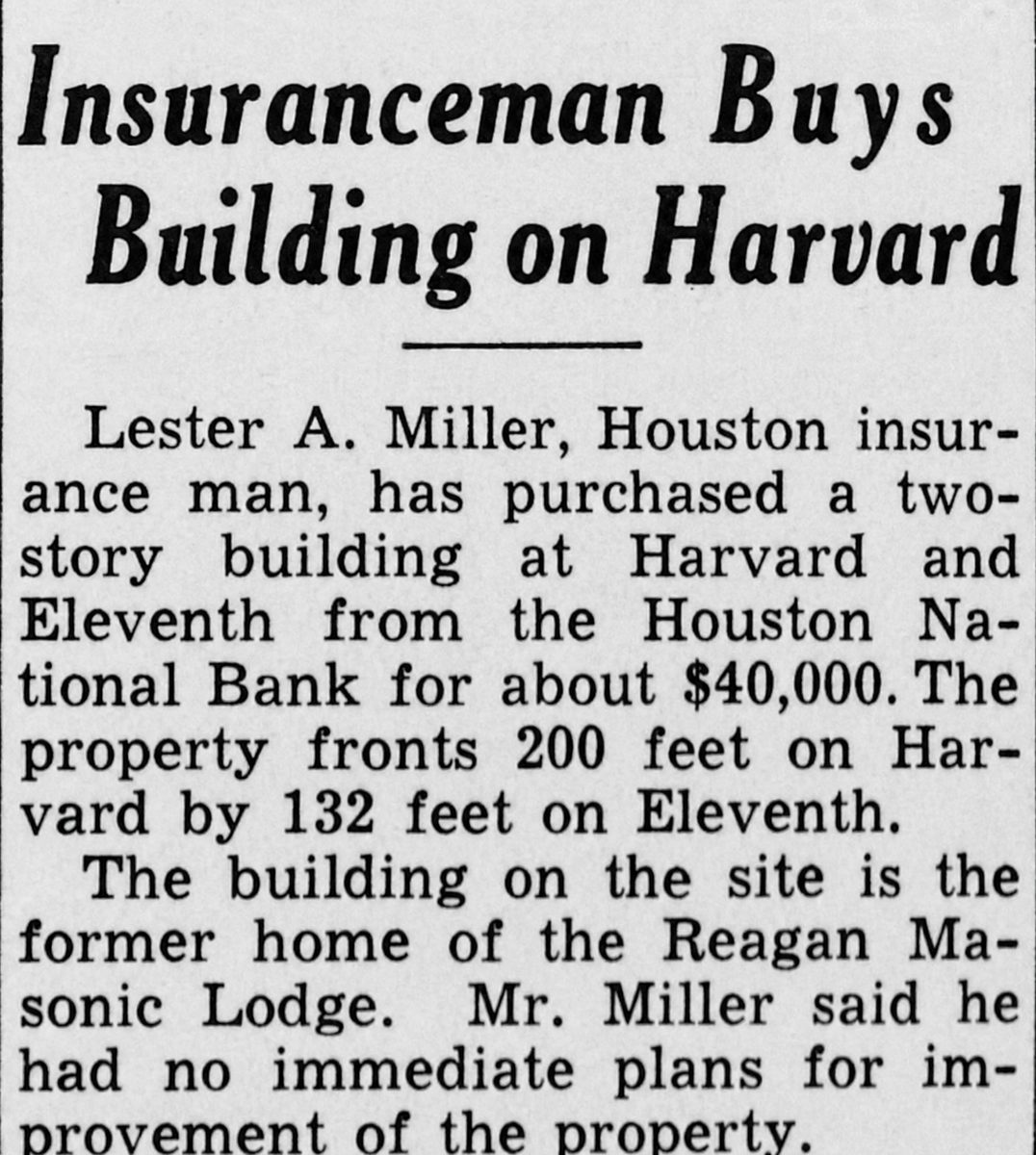
Houston Heights plat lots run 50 by 132 feet (Map Records of Harris County, Vol. 1, p. 114A), which makes 200 feet on Harvard by 132 feet on Eleventh exactly Lots 13, 14, 15, and 16 of Block 199. The 1985 Harvard House Condominium Declaration describes the property as “Lots 13, 14, 15, 16 and the south one-half of Lot 17, Block 199, Houston Heights” (225 by 132 feet, the extra 25 feet on Lot 17 added at the 1985 conversion for the pool and gazebo area). The mathematical match between the 1939 clipping’s dimensions and the property’s own later legal description confirms, beyond reasonable doubt, that the 1939 purchase was this building.
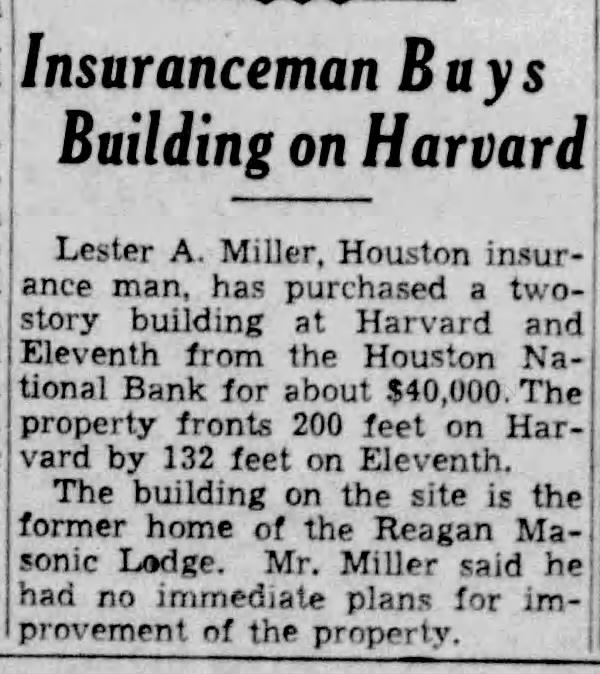
The buyer’s name survives the crop only as “…ster A. Miller, Houston insurance man.” One earlier verification pass read this as “Chester A. Miller”; cross-checked against the 1943 and 1951 articles naming the president of the companies that would go on to occupy the building, the name resolves as Lester A. Miller, the same man the February 25, 1951 Chronicle names as president of City National Life Insurance Co. when it built the property’s 1951 addition (below). The full ownership chain, Miller buying in 1939 and his insurance companies occupying and renaming the building through the 1940s and ’50s, is the best-supported narrative for these thirty years, though the underlying deed instruments themselves (the 1939 transfer to Home Life, and whatever conveyed the property after Home Life’s 1944–45 exit) have never been recovered. The building sits, in every source, “at the corner of Harvard Street and East 11th Avenue,” specifically the northeast corner of that intersection. That reading now rests on two independent evidentiary chains: the geometry of the 1964 renovation blueprints, which place the west elevation on Harvard and the south elevation on East Eleventh, and the lodge’s own 2010 Texas Historical Marker, whose text describes the temple as “constructed in 1930 at the northeast corner of Harvard St. and Eleventh Ave.” (Wirtz, Calhoun, Tungate & Jackson, Commission 64-08, July 1964; Texas Historical Commission marker text, 2010)
Home Life Assurance and the “Legal Reserve Building,” 1939–1944
By the 1942 city directory, Miller’s insurer had a name and an address in black and white: “1102 Harvard: Home Life Assurance Co; Legal Reserve Life Co,” with 1101 Harvard, across the street, listed as Henningsen Serv Sta (proprietor John Henningsen, residing at 1107 Harvard). (Houston city directory, 1942) By August 1940 the building already carried its new public name in print, tied to civic use rather than insurance business: “Recommendations of the committee will be brought before the federation council at its next meeting, Wednesday night, August 28, at the Legal Reserve Building, Eleventh and Harvard.” The civic federation’s president was C. A. Montavanis, its committee spokesman a Mr. Hinds. (Houston Chronicle, Aug. 20, 1940, p. 23)
Home Life Assurance Company itself needs pinning down. An earlier pass through the record had it as a company chartered in Houston in 1934; the certificate trail tells a more precise story. Board of Insurance certificates for “Home Life Assurance Company, Fort Worth, Texas” run continuously from at least May 18, 1936 (Cert. 2644, Co. No. 2101) through April 4, 1939 (Cert. 4106, same company number), April 9, 1943 (Cert. 300, Co. No. A-345), and March 30, 1944 (Cert. 5393, Co. No. A-345, valid through May 31, 1945). (Fort Worth Press, multiple dates 1936–1944; Abilene Daily Reporter, Apr. 16, 1937) A Fort Worth Press business directory of April 30, 1938 names the company’s president directly: “HOME LIFE ASSURANCE CO.: J. L. Mistrot Pres., 916 Ft Worth Nat. Bank Bldg.” Read together, this is one company, statutorily certificated at Fort Worth from at least 1936 with J. L. Mistrot as president, whose Houston home-office operation at 1102 Harvard carried the public branding; not two unrelated same-named insurers, and not a late headquarters move. Why the company’s registration number changed from 2101 to A-345 between 1939 and 1943, whether a Board renumbering or something more, is not explained anywhere in the surviving record.
Home Life sold family-group burial policies and recruited small-town agents straight out of the Harvard Street office. A Bay City Herald ad of August 13, 1942 promised “OLD LINE LEGAL RESERVE PROTECTION ALL POLICIES WRITTEN IN HOME LIFE ASSURANCE CO. HOUSTON, TEXAS”; recruitment ads in the Brenham Banner-Press of November 3, 4, and 5, 1943 read “REPLY BOX 585 FOR INTERVIEW HOME LIFE ASSURANCE CO. 1102 HARVARD ST., HOUSTON, TEXAS,” and a further run on November 30 and December 1, 1943 pitched “THERE IS A GREAT NEED FOR LEGAL RESERVE INSURANCE In amounts sufficient to provide for burial expenses… FAMILY GROUP POLICY… Burial Service With Any Funeral Home Regardless.” (Brenham Banner-Press, Nov. 3/4/5 and Nov. 30/Dec. 1, 1943) Those ads still gave the 1102 Harvard address in November and December 1943, months after the building’s upper floors had begun converting to war-worker apartments (below), so either the insurance office and the apartments briefly overlapped, or the ad copy simply lagged the changeover.
Home Life’s last confirmed sign of life is its April 1944 certificate renewal. After that it simply vanishes: no receivership listing, no mention in Best’s or Moody’s manuals through 1960, no court trace anywhere. The likeliest reading is a quiet exit sometime between late 1944 and 1945, either a voluntary dissolution or an unpublicized merger or reinsurance arrangement. Whether the company divested 1100 Harvard as part of that exit is unconfirmed, since no deed has been found, but Lester A. Miller’s next insurance venture, City National Life, is the building’s attested operating tenant by 1951. A last loose thread: a Depression-era tax case, Mistrot v. Commissioner, decided June 30, 1936, ties the Mistrot surname to litigation in Home Life’s active window. The Mistrots were a prominent Galveston and Houston dry-goods merchant family, but the connection to Home Life’s J. L. Mistrot is a surname link only, its relevance unconfirmed.
The company died; the phrase on its letterhead did not. Fifteen years after Home Life’s last certificate, an entirely unrelated business was still selling “Old Line Legal Reserve” insurance from the same address. Reagan Lodge Past Master and Treasurer H. A. Craven ran his brokerage out of 1102 Harvard, and in July 1955 he advertised: “LIFE INSURANCE: An Old Line Legal Reserve Stock Company, well working control. New Multiple Plan Stamps. GRAND OPENING… Interested parties call Mr. Craven, OX-8-3581; nights OL-4-1900.” (Houston Chronicle, Jul. 3 and Jul. 10, 1955, Sec. C p. 5 and Sec. E p. 4) The building’s adopted name and the product type that produced it both outlasted the company that brought them there.
Tenants of the Legal Reserve Years: Dance Studio, Assembly Room, Armory, Union Hall
With Home Life’s offices as anchor tenant, the old lodge floors of the temple found new and various uses through the early 1940s. The Mary Jane Studios dance academy relocated from the downtown Milam Building in August 1939: “MARY JANE TO OPEN STUDIO IN NEW LOCATION … The Mary Jane Studios have been moved to a new location at East Eleventh and Harvard” (Houston Chronicle, Aug. 27, 1939, p. 35), and the same day’s Post described “spacious new quarters at East Eleventh and Harvard with 7000 square feet of space,” with new ballroom instructor Alvey Wakefield Emery. (Houston Post, Aug. 27, 1939, p. 40) The studio reopened for the season on September 10, 1939 (“spacious new studios on Eleventh and Harvard&rdquo), and by January 14, 1940 director Mary Jane Reynolds had opened a second studio downtown at 3214½ Main while “classes will begin Monday at the new studio and at the present one at Eleventh and Harvard in all types of dancing.” (Houston Post, Jan. 14, 1940, p. 40) Seven thousand square feet is a fair measure of how much of the old lodge’s upper-floor assembly and ballroom space this repurposed.
The old assembly room kept earning its keep as a rentable civic hall. Beyond the August 1940 civic-federation meeting mentioned above, a church-sponsored motion picture “of scenes of the South and North” was shown “at 8 p.m. in the assembly room of Harvard and Eleve[nth] through the courtesy [of an] Oil Corporation. Tic[kets] secured at the door [from] Mrs. F. C. Baker.” (Houston Chronicle, Apr. 18, 1940, p. 29) An undated clipping mentions the Heights Club holding “its regular Wednesday noon meeting at Harvard and Eleventh Street,” a genuine lead, but without a date to anchor it.
In November 1940 the corner took on a wartime name. “Max Autrey Post 52 of the Texas Defense Guard will drill Wednesday at 7:30 [at] Harvard and Eleventh (111th En-[g]ineers’ Armory), instead [of] Main and Holman.” (Houston Chronicle, Nov. 10, 1940, p. 40)
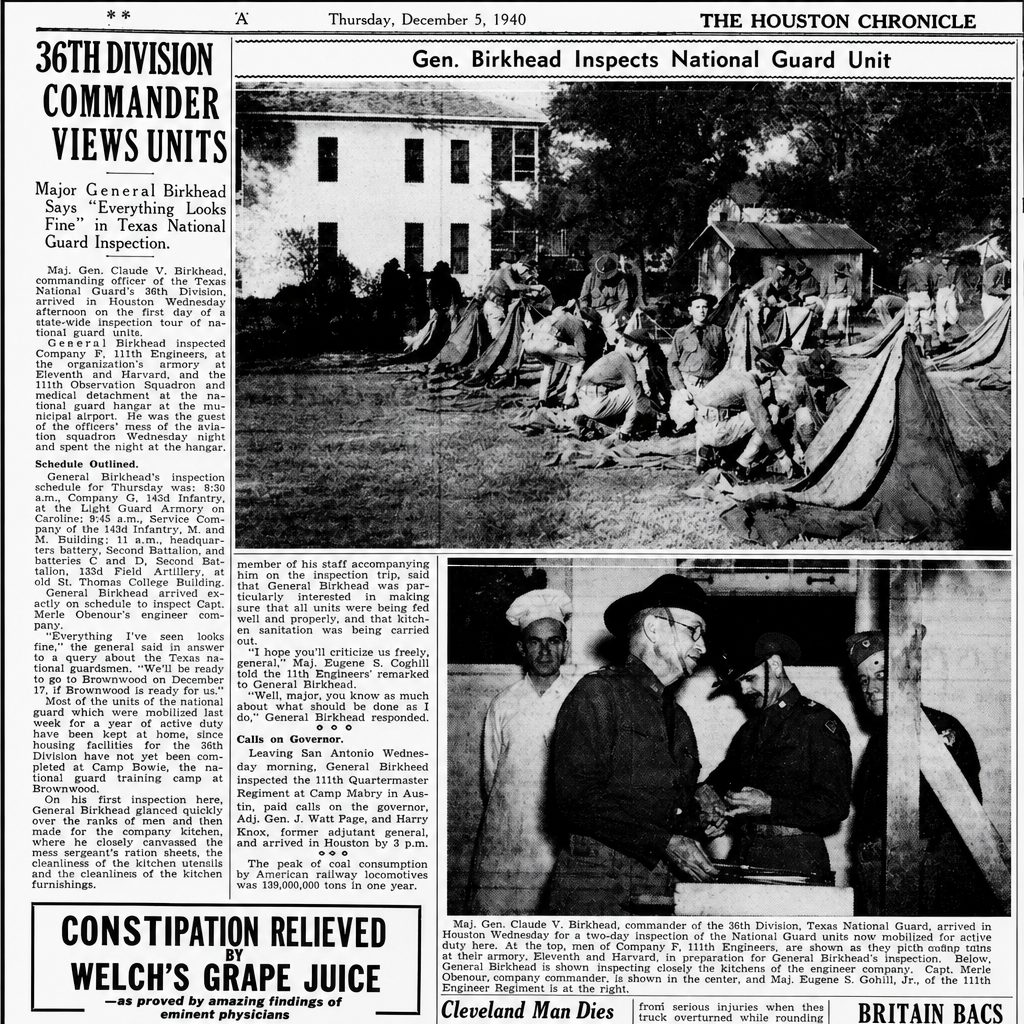
The building is confirmed, in print, to have been called the 111th Engineers’ Armory. That this means the old assembly floor actually served as a National Guard engineer unit’s Houston armory is not directly proven, but is the natural reading.
The building had a paid caretaker through these years, and the job proved dangerous. On June 12, 1941, P. H. Obenour, about seventy, described in the press as “building superintendent at the Reagan Masonic Temple, 801 Harvard,” climbed a ladder to the roof to watch a work crew. “He said the man went up a ladder to the roof of the lodge building to watch negroes at work. He had been there about five minutes when he fell to the roof dead,” the Chronicle reported; Justice Tom Maes returned a verdict of natural causes. (Houston Chronicle, Jun. 12, 1941, p. 19, indexed p. 17, clip 1198314462) Obenour is the third caretaker or superintendent documented dying on the property in seven years, after Woodward S. Logan (d. June 1934, of 1102 Harvard) and Henry C. Nicholson (d. March 1935, of 1100 Harvard). The item also proves active roof work at the building in 1941 and adds yet another address variant, “801 Harvard,” to a corner whose street number was never stable in print.
The single richest new discovery of this period concerns the building’s next tenant. In 1941–42 the building, or a substantial part of it, served as the Houston headquarters of the Teamsters, Joint Council No. 58. Three independent newspapers, in three different Texas cities, place the union at 1102 Harvard. The Orange Leader reported: “UNION LEADER IS SENTENCED TO ONE YEAR … John E. Adams, 29, of 1102 Harvard, Houston, Texas, presi-dent of a Houston truck drivers union, was sentenced to a year in prison when found guilty of violating the O’Dan[i]el strike vio-lence law this past week in the first trial [under it].” (The Orange Leader, Nov. 16, 1941, p. 1) The following year the Dallas Craftsman described officers “with offices set up at the Teamsters’ Headquarters of Joint Council No. 58 at 1102 Harvard, Houston, Texas,” naming H. A. Howsley as managing editor, L. B. Stanford as editor, and Chas. M. Pendergrast as secretary-treasurer of a new labor publication headquartered there. (The Dallas Craftsman, Oct. 16, 1942, p. 1) And the Houston-based Labor Messenger confirmed it directly: “Teamsters’ Houston headquarters at 1102 Harvard Street, on the cor-[ner]…” (Labor Messenger, Dec. 11, 1942, p. 1)
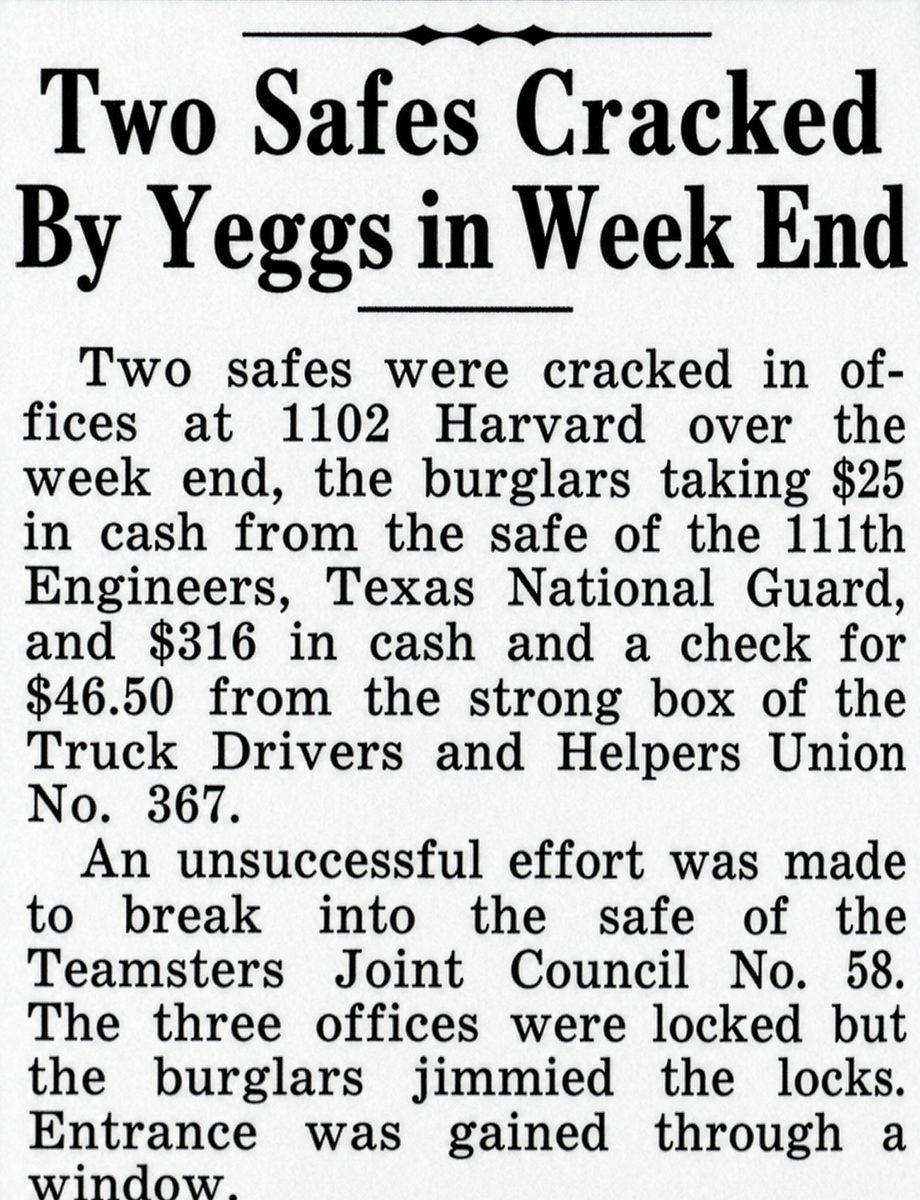
John E. Adams’ conviction was no small footnote. It was the first conviction anywhere under Governor W. Lee “Pappy” O’Daniel’s new anti-strike-violence law, decided in the same Houston courthouse system that would try many more such cases as the decade wore on.
Underneath every other use, the corner kept working as a place to vote. The Seventh Day Adventist School at Eleventh and Harvard served as the Precinct 54 polling place in both the September 1938 and May 1947 HISD elections. By September 1955 the building itself carried the box: a Harris County special-election notice, run three times in the Post, gives “Precinct 30: Fourth Ward C. Voting Place, Temple on Harvard Street, 1100 Harvard. Judges: Mrs. Lola C. Baker, Mrs. J. F. Helms, Henry L. Helms, Mrs. Sallie Holaday, Clint Holaday, Mrs. Olive Heatherly,” with a second precinct polling that same day at the “residence, 1102 Harvard” under Mrs. H. A. Craven, widowed that July. (Houston Post, Sept. 2, 9, and 16, 1955, Sec. 3 p. 10, clips 1195070045 and 1195044393) Six years later the building was still a polling place, for the Harris County Flood Control District bond election of October 1961: “Heights J - Reagan Masonic Temple, 1100 Harvard St. - Mrs. Willie Mae Bailey, Presiding Officer,” with T. A. Brogdon presiding over Precinct 72 at the same address a week later. (Houston Chronicle, Oct. 4, 1961, p. 86, clip 1199563740; Houston Post, Oct. 11, 1961, p. 33, clip 1196710839) The polling thread runs from Werner’s Drug Store in 1935 to the flood-control bonds of 1961 with only the war years unaccounted for.
Other Lodges Never Left, 1937–1963
The tidy version of this era has the lodge in exile at Eighth and Harvard while the building cycles through secular tenants. The newspaper record does not support it. Masonic bodies were advertising meetings back at the old hall within eighteen months of the foreclosure, and Masonic meetings continued there, alongside the insurance offices, the armory, the union hall, and eventually the apartments, for a quarter of a century. Two distinct phenomena are tangled together in the notices, and this chapter separates them: genuine, dated occupancy by named bodies with named officers, and demonstrably stale “zombie” listings that recycled obsolete slates and addresses for years.
The genuine thread begins in March 1937. A Post lodge notice of March 29 that year reads: “CALLED MEETING of Reagan Lodge No. 1037, A. F. and A. M., at Masonic Temple, 1100 Harvard St., Monday at 7:30 p.m., to conduct service of our deceased Past Master, Brother J. M. French.” The same page carries Heights Chapter No. 412 R.A.M. meeting “at Masonic Temple, 1100 Harvard street.” (Houston Post, Mar. 29, 1937, p. 10, clip 1194121067) Later notices keep the pattern: a stated meeting at the “Houston Heights Masonic Temple, 11th and Harvard Ave.” in November 1938, and five Reagan and Heights bodies at “Reagan Temple, corner of Eleventh and Harvard” in February 1940, all signed by some combination of W. K. Helms as Worshipful Master, Mrs. Pearl Helms as Eastern Star matron, and J. F. Helms as secretary. (Houston Post, Nov. 15, 1938, clip 1198464384; Houston Post, Feb. 19, 1940, p. 10, clip 1194402523) Whether the bank, and later Miller, rented the hall back to the Masons is nowhere stated, and the notices place lodge activity at the address years before any documented postwar return.
One notice from the end of 1939 adds a genuinely puzzling name. On the last day of the decade, weeks after Miller’s purchase and the “Legal Reserve” renaming, the Post ran two adjacent fraternal announcements: Houston Heights Chapter No. 258, O.E.S., holding a stated meeting “in the I. O. O. F. Hall, Eleventh and Harvard,” and the same chapter’s stated meeting “followed by a joint New Year’s party with Reagan Lodge, corner of Eleventh and Harvard.” (Houston Post, Dec. 31, 1939, p. 24, clip 1194361428) The event is explicit; the Odd Fellows label on the hall is not explained anywhere else in the corpus, and the hall’s identity in that notice stays ambiguous.
The postwar years brought a pile-up. On August 29, 1945, two weeks after the Japanese surrender, the Post carried: “REAGAN LODGE, No. 1037, A. F. & A. M. Called meeting Thursday, Aug. 30, 7:30 p.m., Reagan Masonic Temple, 1100 Harvard. Work in E. A. degree. Visitors welcome.” (Houston Post, Aug. 29, 1945, p. 19, clip 1194370545) December 13, 1946 brought three bodies to the address in a single night, Houston Lodge No. 1189, Reagan Lodge, and Houston Council No. 166. (Houston Post, Dec. 13, 1946, clip 1194230569) The clearest evidence that other lodges, not Reagan, held the hall comes from a March 29, 1949 Post directory, which lists Reagan Lodge’s own stated meetings “at Temple, 8th and Harvard” while Woodland Lodge No. 1157 and Heights Lodge No. 1324 meet the same week at “Heights Masonic Temple, 11th and Harvard.” (Houston Post, Mar. 29, 1949, p. 31, clip 1194223277) Reagan Lodge built the building and, in 1949, was the one lodge not meeting in it.
By the early 1950s the hall carried a full fraternal stack. A single Post directory of February 20, 1953 lists five bodies meeting there that week: Reagan Lodge No. 1037 (Allen V. Wood, W.M.; J. F. Helms, secretary), Reagan Chapter No. 222 O.E.S., Reagan Council No. 348 R. & S.M., Reagan Chapter No. 383 R.A.M., and a Reagan chapter of the Order of DeMolay, teenage boys meeting Friday nights at eight under Master Councilor Bryan Funk. (Houston Post, Feb. 20, 1953, p. 33, clip 1194657906) A month earlier, Ruth Chapter No. 2, O.E.S., a chapter otherwise unconnected to this building, held a “Special Conclave” at five with dinner at 6:30 to confer degrees. (Houston Post, Jan. 17, 1953, Sec. 2 p. 10, clip 1195051622) That notice names only “the Lodge Building,” with no address attached, so its placement here rests on the company it keeps in the same column. In September 1953 the York Rite roster completed itself: “REAGAN COMMANDERY, No. 85, K. T. Will be held Wednesday, 7:30 P. M., for the purpose of work in Order of Red Cross,” a Knights Templar commandery working degrees at “Reagan Masonic Hall, 11th and Harvard” the same evening the lodge conducted the funeral of Burr Madison Estes, late of Whitesboro Lodge No. 263. (Houston Post, Sept. 16, 1953, Sec. 2 p. 8, clip 1194618227)
Youth orders used the hall too, and they extend the picture backward and forward. The Order of Rainbow for Girls met there in the summer before Pearl Harbor: “Houston Heights Assembly No. 10, O. R. G., will meet at 7:30 p.m. Thursday at the Reagan Masonic Temple.” (Houston Chronicle, Jul. 17, 1941, p. 17, clip 1198380154) A Reagan chapter of DeMolay was meeting at Reagan Temple by December 1948 with Kenneth Helms as master councilor and J. F. Helms on its advisory council. (Houston Post, Dec. 10, 1948, clip 1194014980) Two earlier DeMolay ceremonies at the temple survive only because the Post reprinted them in its “25 Years Ago” retrospective column: an April 1933 public installation, and an August 1934 one preserved with its full cast, “Newly elected officers for the new term of the Houston Chapter of De Molay will be installed in a public ceremony at the Reagan Masonic Temple Wednesday,” naming Ben Arnim, James Muir, Joe Newsome, Howard Townsend, and William Culver. (Houston Post, Apr. 23, 1958, p. 22, clip 1196265834; Houston Post, Aug. 27, 1959, p. 28, clip 1196381517)
The last new bodies arrive as the era closes. In August 1961 the address hosted Jacques DeMolay Lodge No. 1390, A.F. & A.M. (L. M. Martin, W.M.; Robert R. Byers, secretary) at “Reagan Hall, 1100 Harvard,” and a previously undocumented Eastern Star chapter surfaces in the same year: “REAGAN CHAPTER, NO. 1002, O. E. S.: Stated meeting Thursday, 8 p. m. Initiation. Mrs. Doris Mae Cox, W. M.” (Houston Post, Aug. 10, 1961, clip 1195577287; Houston Post, Jun. 13, 1961, p. 20, clip 1195670535) Two years later a Knights Templar commandery gave the building a name nobody else used: “MELROSE COMMANDERY No. 109, K. T. Stated conclave Friday, Oct. 11, 7:30 PM. Melrose Temple, 1100 Harvard. Visiting Sir Knights welcome. W. E. Crazier, Commander. J. W. Helms, Recorder.” (Houston Post, Oct. 5, 1963, Sec. 3 p. 13, clip 1196457917)
| Name | First documented | Source and context |
|---|---|---|
| Reagan Masonic Temple | 1930 | The lodge’s own name for it; used in notices to 1963 and, in stale listings, well beyond |
| Houston Heights / Heights Masonic Temple | Nov. 1938 | Used by the other lodges that met there, and dominant in 1949–1973 notices |
| I.O.O.F. Hall, Eleventh and Harvard | Dec. 1939 | A single Post fraternal notice; unexplained elsewhere in the record |
| Legal Reserve Building | Aug. 1940 | Civic-federation meeting notice, after the Miller purchase and Home Life’s arrival |
| 111th Engineers’ Armory | Nov. 1940 | Texas Defense Guard drill announcement |
| 1102 Apartments | c. 1946–47 | Morrison & Fourmy city directory heading for the residential conversion |
| Reagan Masonic Hall | Sept. 1953 | Commandery and Royal Arch chapter notices |
| Reagan Hall | Aug. 1961 | Jacques DeMolay Lodge No. 1390 notice |
| Melrose Temple | Oct. 1963 | Melrose Commandery No. 109 conclave notice |
| Harvard House / Harvard Place | 1979–1985 | The conversion-era names; era 4’s story, not this chapter’s |
(Houston Post and Houston Chronicle notices as cited above; Houston city directories, 1936–1959)
Against that record sits the second thread, and it must not be read as occupancy. Houston’s papers ran obsolete metal lodge templates for years at a stretch. Notices placing Reagan Lodge at Eighth and Harvard, the rented exile hall it had left in 1948, still ran in September and October 1961. Notices placing meetings at 1100 Harvard ran through March, April, and May 1961 listing W.M. “A. J. Brogdon” and secretary “J. H. Webb,” an obsolete slate recycling names from the 1930s. Most striking, a notice of November 22, 1963 placing stated meetings at “Reagan Temple, corner of Eleventh and Harvard,” with W. K. Helms as Worshipful Master and J. F. Helms as secretary, is a verbatim reprint of the lodge’s own slate and location from February 1940, twenty-three years stale. (Houston Post, Sept. 19, 1961; Houston Post, Mar. 14, 1961; Houston Post, Nov. 22, 1963, compared with Houston Post, Feb. 19, 1940) The control case is Eastern Star Chapter No. 258, whose notices correctly gave 1606 Heights Boulevard from 1955 onward. The distinction that matters is simple: a dated event with named officers who cross-check against known office-holders is evidence, and a recycled directory line is not. The same recycling continued into the 1970s and as late as September 1985, which belongs to era 4’s chapter rather than this one.
War Housing: “1102 Apartments,” 1943–1965
In 1943, a seven-year lease with the United States government converted the building’s upper floors into twenty-four war-worker apartments. The earliest direct evidence of the conversion is almost accidental: classified ads running in the Chronicle from September 13 to 16, 1943 offer used office furniture, a “60-inch flat-top desk, leather-cushion swivel chair,” for sale, contact “Apt. 11, 1102 [Harvard], Harvard and 11th St.” (Houston Chronicle, Sept. 13–16, 1943, pp. 21/24/43/32) By that September the building already had numbered apartments, and someone in Apartment 11 was selling off office furniture: a small, exact emblem of the changeover from insurance office to war housing.
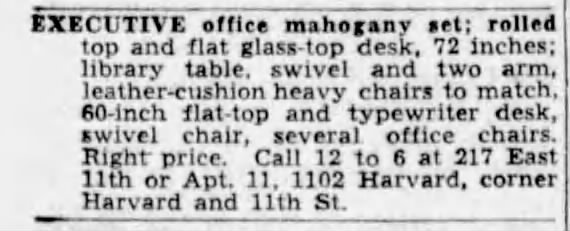
No published federal report or hearing record itemizing this particular Houston conversion has ever turned up, despite searches across the major national archives and repositories, a documented negative rather than an oversight; the underlying lease instrument itself remains a target for a National Archives records pull. By the 1946–47 Morrison & Fourmy city directory, the address carries a new formal name, “1102 APARTMENTS,” with a numbered roster whose apartment numbers run from 1 into the thirties (1101 Harvard, across the street, remained a filling and service station). (Houston city directory, c. 1946–47) Those numbers are floor codes rather than a count, as the 1950 census establishes below, so the roster is not evidence of thirty-five apartments. The recovered tenant roster, names as legible in the directory image:
| Unit | Tenant |
|---|---|
| 1 | Mrs. Delly Bright |
| 2 | Wm. H. Safford |
| 3 | Floyd C. Sanders |
| 4 | Harry A. Jones |
| 5 | Jubert(?) Griffin |
| ~10–11 | Cameron A. Crowder |
| 15 | Mason A. Taylor |
| 16 | Wm. E. Uhalt |
| 21 | Grady E. Smith |
| 22 | Joe H. Williamson |
| 23 | Cody L. Frost |
| 24 | Paul W. Brannon |
| ~26/29 | Floyd Flynn |
| ~30/31 | Guy A. Cook |
| 32 | John W. Hara(?) |
| 33 | Wm. P. Merrill |
| 34 | Sam A. Welborn |
| 35 | Harris E. Alley |
| (unit uncertain) | Clyde Main |
(Houston city directory, c. 1946–47)
The 1950 Census: Twenty-Four Apartments, Six to a Floor
On April 3, 1950, a census enumerator named Irene Scott Townsend walked the building door to door and wrote down what she found. Her sheets settle a question the directories could not. The building held exactly twenty-four numbered apartments, six on each of its four levels, and the numbers are floor codes: the street floor carried apartments 1 through 6, the level above it 11 through 16, the next 21 through 26, and the top floor 31 through 36. Her household serial numbers run consecutively from 33 to 56 in that order, the record of a single walk from the bottom of the building to the top. (17th Census of the United States, 1950, Population Schedules, Enumeration District 263-139, sheets 3–5 with callback sheets 71–74; enumerator Irene Scott Townsend, checked by James B. Riggs; NARA, 1950census.archives.gov, page images retrieved 2026-07-27)
That reading corrects a figure this project carried for months. The “35” in the 1946–47 directory roster is the third floor’s fifth apartment, not the thirty-fifth apartment in the building, and the same banded scheme explains every other number in that roster. The apartment count was about twenty-four throughout the residential era, which is exactly the figure the 1943 conversion itself carried, and it matches the 1964 renovation drawings, which show six units on each upper floor: two in the front wing with their baths on the Harvard wall, four in the rear wing sharing back-to-back bath pairs across the corridor. Two tenants confirm the numbering was stable across the years: Grady E. Smith is in apartment 21 and Paul W. Brannon in apartment 24 in both the 1946–47 directory and the 1950 census. (17th Census of the United States, 1950, Population Schedules, Enumeration District 263-139, sheets 3–5 with callback sheets 71–74; enumerator Irene Scott Townsend, checked by James B. Riggs; NARA, 1950census.archives.gov, page images retrieved 2026-07-27)
| Apt | Head of household | Work | Household |
|---|---|---|---|
| 1 | Ruth A. McCullar, 24 | Typist clerk, Army Air Force base | with daughter Elizabeth, 3 |
| 2 | Leroy F. Washburn, 28 | Salesman, wholesale engineering equipment | wife Rubye and two children |
| 3 | V. Lee Waymire, 25 | House construction contracting | wife Evelyn, a secretary, and two children |
| 4 | Harry A. Jones, 60 | Machine operator, planing mill | wife Annie |
| 5 | William H. Bushnell, 28 | Pipe welder, pipeline and welding shop | wife Norma and two children |
| 6 | John B. Lansford, 43 | Heavy-duty mechanic, Air Force | wife Kathleen and three daughters |
| 11 | Logan W. Wood, 31 | Special agent, railroad | wife Thida and two sons |
| 12 | William A. McLeod, 31 | Switchman, railroad, 56 hours a week | wife Anita and three children |
| 13 | Bert J. Mike, 38 | Mechanic, road construction | wife Julia |
| 14 | Jefferson D. Yates, 34 | Recruiting officer, U.S. Marines | wife Alice and a daughter |
| 15 | Albert W. Wellman, 31 | Milk salesman, retail dairy, 72 hours a week | wife Dorothy, a key-punch operator, and a son |
| 16 | Curtis H. Huckabay, 32 | Bus driver, City Transit Co. | wife Karene |
| 21 | Grady E. Smith, 49 | Pipe maker, concrete pipe manufacturing, 84 hours a week | wife Lettie and two grown sons, both pipe makers |
| 22 | Frank J. Bates, 34 | Male nurse, hospital | wife Daisey and two daughters |
| 23 | Jack D. Jones, 25 | Salesman, general insurance | wife Mary and an infant son |
| 24 | Paul W. Brannon, 44 | Surveyor, exploration company | wife Opal, an undergraduate nurse, and a son |
| 25 | J. M. Sanders, 34 | Meat supervisor, retail grocery | wife Virginia, a beauty operator, and two sons |
| 26 | Floyd O. Fish, 36 | Insurance agent | wife Mary, an office manager in the same trade |
| 31 | Mae N. Murphy, 53 | Housekeeper, private hotel | with two daughters |
| 32 | John W. O’Hara, 41 | Welder, oil tool company | wife, three children, and a lodger, a laboratory chemist |
| 33 | Mary J. Smith, 23 | Bookkeeper, wholesale grain company | with her father, 78 |
| 34 | Benny B. Rutt, 21 | Bookkeeper, wholesale container company | wife Ruth, an infant daughter, and a stepdaughter |
| 35 | August E. Jacob, 54 | Carpenter, construction company | wife Lillian |
| 36 | Mary O. Fall, 44 | Beauty operator | with a son, a grocery warehouseman |
Names marked uncertain in the transcription are given as read. (17th Census of the United States, 1950, Population Schedules, Enumeration District 263-139, sheets 3–5 with callback sheets 71–74; enumerator Irene Scott Townsend, checked by James B. Riggs; NARA, 1950census.archives.gov, page images retrieved 2026-07-27)
Roughly sixty-five people lived in the building that spring: railroad men, welders, a bus driver, pipe makers, a Marines recruiting officer, an Air Force mechanic, nurses, bookkeepers, beauty operators, and several households headed by women raising children alone. The turnover since the 1946–47 directory was near total. Only Smith, Brannon, and McLeod remained, which is what war-worker housing looked like once the war that filled it was over. The manager was probably Alicia D. Johanson, 54, a widow enumerated at 1101 Arlington, directly behind the building, whose occupation is given as manager of rental property. (17th Census of the United States, 1950, Population Schedules, Enumeration District 263-139, sheets 3–5 with callback sheets 71–74; enumerator Irene Scott Townsend, checked by James B. Riggs; NARA, 1950census.archives.gov, page images retrieved 2026-07-27)
Two things the census cannot settle are worth stating. It does not fix which physical door was apartment 1 on each floor, because the numbers only follow the enumerator’s walk and the direction of that walk is not recorded; the 1985 condominium declaration’s exhibit plans are the instrument that would anchor it. And the 1954 directory’s listing of “1103 Harvard, units 111 to 138” still does not reconcile: a three-digit floor-band scheme fits the pattern, but two of the observed numbers exceed six per floor, and those particular readings were uncertain. (Houston city directory, 1954; readings flagged for microfilm re-check)
These are the war-worker-housing generation’s names, ordinary Houstonians who left almost no other trace anywhere in the historical record despite an exhaustive name-by-name search of newspapers and genealogical sources. They earned an apartment number in a city directory and, for most, nothing else survives.
A handful can be recovered, and three of them were buried by the lodge that had lost the building. George Howard Jenkins, who died in May 1945, had lived in Houston thirty-five years and been “connected with the Houston National Bank 28 years,” the same bank that took the temple in the foreclosure and sold it in 1939; he belonged to Temple Lodge No. 4 and Reagan Lodge No. 1037 and was “past high priest and scribe Temple chapter.” (Houston Chronicle, May 29, 1945, p. 23, clip 1198791124) Thomas Jackson Howell, 84, “of 1102 Harvard St.,” a retired cotton broker, died in April 1961 and received Reagan Lodge graveside rites at Glenwood. (Houston Post, Apr. 19, 1961, p. 47, clip 1195747025) The third case is the strangest, and the record contradicts itself about him. Walter Harvey Crook died on October 3, 1963. The Post’s death notice reads: “WALTER HARVEY CROOK, 68, of 1102 Harvard St. passed away Thursday… He was a retired commercial artist, member of Reagan Lodge 1037, AF&AM.” The Post’s own news column, same age, same funeral hour, same chapel and cemetery, instead describes a man who had “retired after 25 years with the Federal Bureau of Narcotics” and gives his address as 835 West 41st Avenue. Commercial artist or federal narcotics agent, and which address was his, the corpus cannot say; the conflict is recorded, not resolved. (Houston Post, Oct. 5, 1963, Sec. 3 p. 13, clip 1196457917)
The 1102 Harvard address dominates the record, but people also died at 1100 Harvard itself, which settles that the temple’s own street number was a residential address and not merely the lodge’s. “Mrs. J. V. Brogdon, 63, passed away Thursday at 12:45 AM at the residence, 1100 Harvard, after a illness of two weeks,” the Chronicle recorded in October 1951; she was a member of Heights Chapter O.E.S. and Heights Baptist Church, and the Brogdon family threads through the building’s Masonic and civic record for two decades. (Houston Chronicle, Oct. 5, 1951, p. 59, clip 1199596257) Four years later: “BARKER: Mrs. Mattie Elizabeth Barker, 71, of 1100 Harvard, died Thursday at home of daughter, Mrs. R. C. McWhorter, Dayton, Tex.” (Houston Chronicle, Jun. 3, 1955, p. 59, clip 1199184316)
One resident’s life connects the apartments to the corner’s whole civic record. C. C. Powell, a retired painter, appears across fifteen years of Harris County election notices as presiding or assistant judge at Heights precincts, at Harvard School, Fire Station No. 6, and Reagan High School. His obituary is what identifies him: “POWELL: C. C. Powell, 68, of 1102 Harvard, died at 2:20 p.m. Thursday. He was a retired painter and a member of Reagan Masonic Lodge No. 1037, A. F. & A. M.” (Houston Chronicle, May 24, 1947, p. 7, clip 1198810273) He had lived, all along, in the building whose lodge he belonged to. Within days his widow took over: “Precinct No. 25 - Vote at 1102 Harvard Street. Mrs. C. C. Powell, Presiding Judge; Mrs. Bess L. Burney and Beaufort Flowers, Clerks,” a polling place inside the apartment building, judged by the widow of the man who had just died there, and the arrangement recurs in notices through April 1951. (Houston Chronicle, May 18, 1947, p. 46, clip 1198809924) Powell himself, meanwhile, kept working: county form notices went on printing “66 - Vote at Reagan High School, Thirteenth and Center Streets. Presiding Judge: C. C. Powell” in six separate elections from July 1947 through April 1951, four years after his death. (Houston Chronicle, Mar. 10, 1949, p. 61, clip 1198759154)
The apartments’ economics can now be tracked in hard numbers. In June 1951 a recurring display classified read “SAVE ON YOUR RENT Only $45 monthly. 1102 Harvard. Newly decorated 4-room apartments, utilities paid, ceiling fans, open. TW-4557,” placed through SAM Realty Co.; a competing listing that same month asked $70 for a different unit. (Houston Chronicle, Jun. 22, 1951, p. 36, clip 1198829494) A rental classified from July 29, 1953 offers “[a]ll bills paid. Four rooms, … 1102 Harvard. … VI-2121.” (Houston Chronicle, Jul. 29, 1953, p. 41) By that November the same four rooms were furnished and dearer: “Heights, 1102 Harvard, 4 rooms, redecorated, new furniture, heated, utilities, bus. $80-$85. VI-2121.” (Houston Chronicle, Nov. 20, 1953, p. 50, clip 1199404137) Rents roughly doubled in thirty months. Applications went to Apartment 21, presumably a resident manager, and by the mid-1950s the leasing calls were being taken on UN-6107, the same telephone line the shop row’s Southwestern Fidelity Life used for its own office (below). Continuity in individual units can occasionally be seen: two different used cars were advertised for sale from “1102 Harvard, Apt. 14” five years apart, a Pontiac in April 1944 and a 1941 Plymouth in March 1949. (Houston Chronicle, Mar. 22, 1949, p. 36, clip 1200052166)
Two crimes fix the apartments in place more sharply than any rent figure. In September 1948 a tenant caught two burglars with kitchenware: J. E. Smith “was awakened at 2:30 a.m. Wednesday when a ‘booby trap’ attached to his apartment door spilled a number of knives and forks on the floor as the door was pushed open.” The two young women outside “pretended to be drunk” and left; days later Smith recognized their photographs in the paper from an unrelated crime series and had an attempted-burglary charge filed. (Houston Chronicle, Sept. 16, 1948, p. 15, clip 1199442860) In March 1954 detectives C. K. Waycott and C. E. Easley raided a second-floor apartment on a Sunday tip. “It was like a good day’s fishing Sunday when police rounded up a dozen men, four women and a one-year-old boy in what was supposed to be a narcotics raid in the 1100 block of Harvard,” the Chronicle reported. Fifteen people spent the night in jail; the mother and her one-year-old son were released; no narcotics were ever recovered. (Houston Chronicle, Mar. 29, 1954, Sec. B p. 13, clip 1199527034)
Ordinary life ran alongside the police blotter. The city registrar’s birth column for March 23, 1954 records: “Mullin, Mr. and Mrs. J. A., 1102 Harvard, No. 22; a daughter, Rebecca, March 10.” (Houston Chronicle, Mar. 23, 1954, p. 28, clip 1199525555) Domestic labor moved through the building in both directions, one household advertising washing and ironing and another, four days later, seeking a “WHITE lady to help with house work, room, board and salary. 1102 Harvard. UN-1233,” the period’s own language preserved unaltered. (Houston Chronicle, May 13 and May 17, 1955, p. 42, clips 1199321522 and 1199029659)
By the 1959 directory, “1102 Apartments” still shows units 11 through 36 with legible tenants. Unit 11 was now occupied by a business, Victor L. Dally & Co., real estate, back in what had been a residential unit, along with Allen Kline and Wesley W. Upperman (Apt. 14), Don V. Dickerson (16 or 18, editions differ), E. W. Kirk (15), Alva N. McCurn (21–24), Randall V. or A. Williams (22), C. R. Hawkins, and Ellen Pardon. One 1959 directory edition shows “units 25–36 shown VACANT”; a second 1959 capture skips from 1046 Harvard straight to 1116 with no 1100/1102 line at all. The building was visibly emptying out ahead of the 1965 sale.
The Shop Row on East Eleventh, 1936–1965
Running the length of the building’s ground floor along East Eleventh Avenue, the commercial shop row never stopped turning over tenants through three decades, even as the floors above it cycled from insurance office to armory to union hall to apartments. Year by year, the directory record reads almost like a census of small Heights commerce:
| Year(s) | Tenants |
|---|---|
| 1936 | 215 Economy Cleaners & Hatters / Gene Reynolds; 216 Mrs. Ethel Pearson; 217 Johnnie’s Cafe; 218 Mrs. Florence Reynolds; 219 Leon’s Barber Shop; 221 The Globe Laundry / Charles Hildebrandt, grocer; 223 J. Q. Crete, Eleventh Av Pharmacy. Collins Memorial M.E. Church South anchored the block at 120 E 11th, 1936–1959. |
| 1938 | 201 offered for lease as a “Modern corner, 43x45, tile front; community center, parking; suitable shop, pharmacy, grocery,” the row’s earliest recovered ad copy. |
| 1939–40 | 210(-A) Economy Cleaners / Mrs. Pearson; 217 Vacant (then possibly a furniture co.); 218(-A) Carl P. Case / Humphrey’s barber; 221(-A) Mrs. Chas. Hildebrand; 223 Joe O. Grote; 225(-A) Eleventh Av Pharmacy; 1940 adds 221 a grocery. |
| 1941 | 215 Economy Clnrs & Hatters; 215½ Eleventh St Shoe Repair Shop. |
| 1942 | 215 Economy Cleaners; 215½ Heights Citizen / West End Citizen / North Side Citizen (community newspaper office); 216 Mrs. Ethel M. Pearson; 218 Mrs. Cath/Carlie Frey; 219 Bob’s Barber Shop / Jas. L. Moore watch repair; 220 Jos. G. Greve; 223 Eleventh Av Pharmacy & U.S. Post Office sub-station No. 7; 230½ Jewel Tea Co. |
| c. 1946–47 | 210 Bob’s Barber & Beauty Shop; 215 Economy(?); 216 vacant; 217 Quality Cleaners; 220 Jas. L. Moore watch repair; 222 Hallmark’s Grocery; 223 Tucek’s Pharmacy (= Tlucek’s). |
| 1954 | 203 Tlucek’s Pharmacy (migrated to the corner-most storefront); 207 Rich Plan of Houston (frozen food lockers); 215 Economy Cleaners & Tailors; 218 Mrs. Carlie E. Frey / Rob’s Barber Shop; 219 Jim L. Moore watchmaker; 221 Estelle’s Ceramic Co; 222 Jos. G. Greyo; 223 Ortman’s (“Orfman’s&rdquo) Outboard Store. 1101 Harvard across the street: Keenan Service Sta. |
| ~1955 | Adds 205 Kuhn Claim Service; 209 Coronet Studios (photographers); 216 Hugh E. Golden; 217 Modern Youth Shop (children’s clothing); 218 Gond’s Barber Shop. Documented that year but absent from the directory: a short-order hamburger and sandwich stand at 218 E. 11th, offered for sale at $4,300, and a grocery-market advertised under the building’s own number, 1100 Harvard. |
| 1957–58 | 203 Tlucek’s; 205 Hugh D. Ruthven, dentist; 207 Southwestern Fidelity Life Ins Co; 209 Coronet Studios; 215 Economy; 217 Laundrie-Mat; 218 Ralph Hall; 219 Goad’s Barber; 221 Ortman’s Outboard; 222 Tobe L. Ewing. |
| 1958–59 | 207 now Hwy Dept, Dist 12, Right of Way Section (the State Highway Department moved into the insurer’s vacated offices); 211 Kirby Co of The Heights; 216 Jas. C. Blakey; 217 The Launderette (Washateria); 221–23 Ortman’s Outboard Store. |
| 1959 (later edition) | 203 vacant; 219 Al’s Barber Shop; 220 Langford’s Speed Wash; 222 vacant; 223 vacant, visible decay setting in at decade’s end. |
(Houston city directories, 1936–1959; Houston Post, Nov. 19, 1938, p. 9, clip 1194338212; Houston Post, Oct. 13, 1955, Sec. 3 p. 13, clip 1195096839; Houston Chronicle, Oct. 10, 1955, p. 39, clip 1200045320)
Mading’s Drug Store No. 7, the strip’s flagship tenant since the temple’s 1930–31 opening, was part of a Houston chain that eventually sold out to Eckerd; the corpus does not pin down exactly when Mading’s left this particular storefront. Red Ortman’s shop, listed for years simply as an outboard store, was a Mercury Motors dealership: “Prices on Floor Models And Used Boats THIS WEEKEND. Sales & Service on MERCURY MOTORS Red Ortman 223 E. 11th UN 2-2532.” (Houston Chronicle, May 4, 1961, Sec. 6 p. 5, clip 1202040046) The hamburger stand at 218 E. 11th went to market in October 1955 under some of the era’s better ad copy: “A GOLD MIND - A REAL MONEY MAKER - A short-order, hamburger and sandwich stand… See owner, 218 E. 11th.” A grocery-market advertised the same month gave its address as the building itself: “Grocery-market. 1100 Harvard. Good, clean, established business, reasonable rent, good lease; owner has other business. Call UN 4-1142,” running again on October 17 and 24. (Houston Post, Oct. 13, 1955, Sec. 3 p. 13, clip 1195096839; Houston Chronicle, Oct. 10, 1955, p. 39, clip 1200045320)
The row’s longest-running personality was H. A. Craven, and his business explains why. Henry A. Craven, Reagan Lodge Past Master and Treasurer, a 48-year Houston resident and holder of a 50-year Y.M.A. memorial medal, ran a business brokerage out of 1102 Harvard through the mid-1950s. In June 1955 alone he placed eleven consecutive Chronicle listings for Heights groceries, drive-ins, a restaurant, a gas station, and a La Marque property, and his inventory ran from a “ROOF GARDEN, heights, doing nice business; low rent; established 25 years” to a twenty-two-bed convalescent home on Highway 105. He died on July 9, 1955, at 84. His pallbearers were the lodge’s inner circle: “Pallbearers: J. B. Voss, John Dagley, J. M. Dagley, Oscar Hild, W. C. Webb, Fred Barttlingck. Honorary pallbearers: Officers and members of Reagan Masonic Lodge.” (Houston Post, Jul. 11, 1955, Sec. 3 p. 11, clip 1194955019) His widow judged the Precinct 52 polling place at 1102 Harvard that September.
A coincidence sits beside that funeral. The same Saturday, July 9, 1955, a second and unrelated Reagan Lodge member named Craven died in a Houston hospital: the Rev. William A. Craven, 82, who had preached in fifteen Texas towns across thirty-five years before retiring in 1939. “He was a member of Reagan Lodge No. 1037 A.F.&A.M. Scottish Rite bodies and Hella Temple Shrine of Dallas.” (Houston Chronicle, Jul. 10, 1955, Sec. B p. 3, clip 1199100324) Two more Reagan men died the same week, Robert William Carpenter, a retired Southern Pacific car inspector, and Paul S. Hendrix of the Humble Pipe Line Co., so the Post’s July 11 deaths column reads like a lodge roll call.
One story from the same corner was never resolved. On August 29, 1951, Josieette Newberry, fifteen, a clerk at Tlucek’s Pharmacy, failed to come home after her shift. Coworkers told police she had said an older man known to them only as “Mr. Swan” would take her to a jewelry store: she “was going to a jewelry store to have her birthstone ring enlarged after work, and ‘Mr. Swan’ was going to take her.” Her sister, Mrs. Dorothy Griffin, reported her missing. (Houston Chronicle, Aug. 29, 1951, p. 9) The 1951 account gives Tlucek’s address as 103 East Eleventh rather than one of the shop row’s own numbers, so the pharmacy stood on the same Eleventh Street corridor without necessarily occupying this building that year. Nothing in the corpus records what became of her.
The strip’s most ambitious moment never happened. On September 23, 1956, both Houston dailies reported that Linus Hardin, chairman of Southwestern Fidelity Life, had announced “plans for the construction of a $600,000 four-story office building at 207 E. 11th”: 20,000 square feet, fully air-conditioned, a complete aluminum front, a self-service elevator, architects Smart & Whitehead, billed as “the first building of its size in the Heights area,” with “the home offices of the Southwestern Fidelity Investment Co. now on the site.” (Houston Chronicle, Sept. 23, 1956, p. 72; Houston Post, Sept. 23, 1956, p. 32) No evidence anywhere suggests it was ever built: five months later the company moved to Montrose and put 207 E. 11th up for lease (below), and by 1958–59 the directory shows the State Highway Department, not a new tower, occupying the space. The announced tower belongs in the record as exactly that, announced and abandoned.
City National Life and the 1951 Addition
The temple grew for the first time in twenty years in early 1951. “$50,000 Addition Being Built To Masonic Temple,” the Chronicle reported, following an earlier notice, “Addition Planned,” in the Post six weeks before. (Houston Chronicle, Feb. 25, 1951, p. 62; Houston Post, Jan. 14, 1951, p. 68) The architect was Arne G. Engberg; the builder, Fretz Construction Co.; the structural engineer, Walter P. Moore; the mechanical engineers, Howard & Johnson, a Gulf Coast firm of twenty-two engineers as of 1952, whose other work of the period included Mauritz Village and the 1952 Jackson County courthouse. The commissioning company was City National Life Insurance Co., its president Lester A. Miller, the same insurance man who had bought the building from Houston National Bank in 1939. A later City National Life president was Warren M. Fleming.
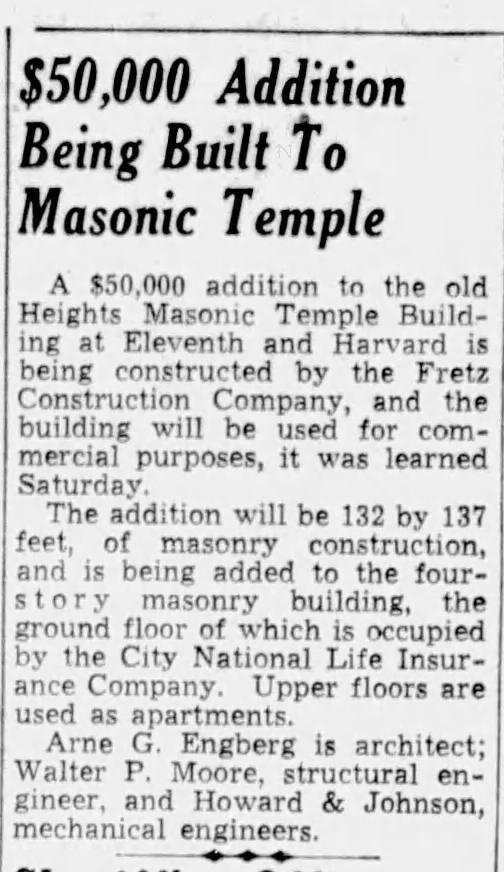
A same-name company deserves an explicit warning here. A 1943 Texas Attorney General opinion, O-5250, profiles a “City National Life Insurance Company” chartered in Dallas, capital of $25,000, majority-owned by the Texas Discount Company of Dallas, president E. W. “Wright” Titus, officers Mayer, Cain, Hickerson, Knepper, Buford, and Gammill, investigated for buying a building outright from its own controlling shareholder. None of those names overlap the Houston company at 1100 Harvard (Miller, Fleming). Given the Home Life and Fort Worth precedent just discussed, this reads as a same-named but wholly distinct Dallas insurer, and the “stock-for-real-estate swap” story that opinion describes belongs to the Dallas company, not to the Houston tenant. The two must be kept rigorously separate. The Dallas company’s ultimate fate could not be traced through any channel searched.
The addition’s architect had an unusually cosmopolitan resume for a Houston Heights commercial job. Arne G. Engberg was a Nebraskan of Danish parents who spent three years as a designer for the New York World’s Fair, three years as chief draftsman for Shreve, Lamb & Harmon, the architects of the Empire State Building, and time as well with Skidmore, Owings & Merrill, roughly eleven years in New York altogether, before moving to Houston around May 1947. (Houston Chronicle, Jan. 28, 1955, Sec. A p. 13, clip 1199046466) He opened his own office at 3819 Fannin on Saturday, November 19, 1949, specializing in institutional and commercial work (Houston Chronicle, Nov. 20, 1949, p. 63), and became an AIA member by February 2, 1950. The mid-1950s were his busiest stretch: an 11,300-square-foot Bellaire medical clinic announced in December 1953, faced in “brick and Texas shell stone” and fitted for ten doctors and dentists; a near-weekly run of help-wanted ads for designers, senior draftsmen, and steel detailers through 1954 and 1955, some of them ending “No Phone Calls, Please,” as his office moved from 2130 Welch to Fannin to South Main; and by late 1955 a partnership with Emory S. White that produced a $450,000 Episcopal church complex at Freeway Manor and a Tomball school building. (Houston Post, Dec. 20, 1953, p. 30, clip 1194579346; Houston Post, May 14, 1955, p. 25, clip 1195099761; Houston Chronicle, Oct. 15, 1955, p. 4, clip 1200045999) His later work ran to school buildings in Channelview, Seabrook, La Porte, Sealy, Victoria, Deer Park, Missouri City/Arcola, and East Bernard, plus Leonard’s store, the Lakewood Center (1956), an observatory (1959), an AIA Houston design award (1960), and his own modern house on Still Forest that was featured on a 1959 Baytown “modern house tour.” No obituary or death date for Engberg himself has been found; a firm called “White, Engberg and Associates” was still operating in Alvin as late as 1970.
One Engberg record teases a connection the evidence will not support. In September 1954, three years after the addition, a Harris County charter-grant notice recorded: “HARVARD BUILDING CO. INC., Houston. Real estate. Capital stock $1,000 (paid all). Incorporators: Arne G. Engberg, Margaret B. Engberg, Stephen R. Wilhelm.” (Houston Post, Sept. 12, 1954, Sec. 4 p. 2, clip 1194781347) Nothing in the record ties that company to 1100 or 1102 Harvard. The name may be coincidental branding, and it is recorded here as a lead worth chasing in the deed indexes, not as evidence of any ownership interest in the building.
Fretz Construction, the addition’s builder, was in the same period also under contract for Congregation Emanu El’s new synagogue (awarded January 1948) and a 1957 Baytown main-office addition. Walter P. Moore, the structural engineer, had founded his own firm in 1931, financed, memorably, by selling his Stutz Bearcat, and was in the middle of a remarkable ascent: Clarke & Courts (1936), the Cody Memorial Library (1938), the Rice President’s Home (1939), the Galveston Airport Terminal (1948), Methodist Hospital (1949), Rice Stadium (1950), the Melrose Building (1952–53), and eventually the Astrodome (1965). The 1951 Masonic Temple addition sits, modestly, inside that long arc, the work of a firm founded a year after the temple itself was built, with no role at all in the original 1930 construction.
Sammy Baugh’s Insurance Company in the Shop Row, 1954–1964
For three years in the mid-1950s, the greatest quarterback of football’s first half-century ran an insurance company out of the old temple’s shop row. Southwestern Fidelity Life Insurance Company was licensed on March 26, 1954, “with combined capital and surplus of $250,000,” and immediately “reinsured United Forces Mutual Life Insurance Company, Houston.” (Best’s Insurance News, Vol. 55, Iss. 10, Feb. 1955, pp. 95, 113)
Its parent, the Southwestern Fidelity Investment Co., was described by the Post as headquartered “in a four-story building at 11th Avenue and Harvard Street” (Houston Post, Apr. 4, 1954, Sec. 4, p. 47), though this “four-story” description does not match the building’s actual two-to-three stories, one more instance of Houston newspapers repeatedly garbling this particular building’s height over the decades. No city directory ever actually placed the firm at “1100 Harvard” itself; its listed address throughout was 207 E. 11th, the shop-row office block, from 1954 to 1957.
Sammy Baugh served as president and Linus Hardin as chairman (Houston Chronicle, Aug. 15, 1954, p. 75), with John E. Cahoon as vice president and general counsel. “Baugh is now president of Southwestern Fidelity Life In-surance Co. of Houston, associate coach at Hardin-Simmons Uni-versity, and owner of a ranch near Rotan.” (Lake Jackson News, Jan. 13, 1955, p. 1) A display ad from the period reads: “SOUTHWESTERN FIDELITY LIFE INSURANCE CO. 207 E. 11th St. UN 1-6107 … Sammy Baugh, President … Linus Hardin, Chairman of the Board.” (Houston Chronicle, Jun. 24, 1956, p. 116) That telephone line double-hatted as the leasing contact for the apartments upstairs. By the spring of 1956, “Sammy is celebrating his second year[] as president of the Southwestern Fidelity Life Insurance Co., 207 E. 11th street,” running it “in spite of the fact that he coaches the Hardin-Simmons football team and keeps a weather-eye peeled on his 6400-acre ranch in Rotan.” (Baytown Sun, Apr. 9, 1956, p. 2) Linus Hardin was, by another account, “co-owner with Sammy Baugh.” (The Brand, Abilene, May 15, 1959, p. 4)
The Heights shop row was, in the end, only a waystation. In February 1957 both papers reported the move: “A home office building at 3217 Montrose Blvd has been occupied by Southwestern Fidelity Life Insurance Co, which purchased the structure for $675,000 in April, 1954. Space did not become available at the building until this year. Southwestern Fidelity previously was headquartered at 207 East 11th Ave.” (Houston Post, Feb. 10, 1957, p. 26) The companion Chronicle story noted the vacated 207 E. 11th offices “are now available for lease.” (Houston Chronicle, Feb. 10, 1957, p. 37)
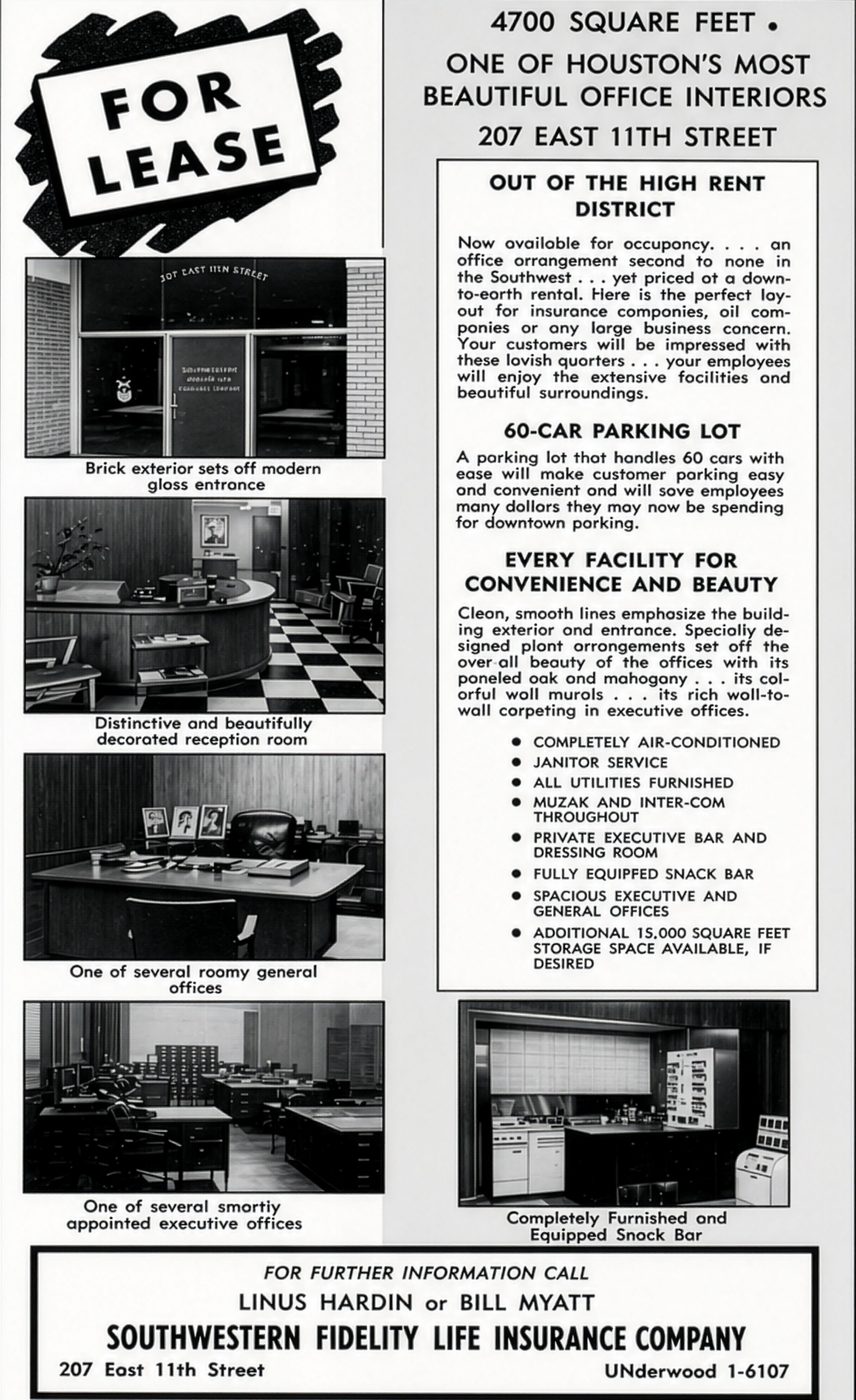
The Montrose building, in other words, had been purchased the very month after the company was licensed in 1954, so the Heights office was always meant to be temporary. At the company’s fourth annual stockholders’ meeting in March 1958, Baugh was re-elected president; the company reported $7,653,000 of policies in force at year-end 1957, with officers Baugh, Hardin, John Cahoon, V. C. Pair, and Dorothy Jenkins. (Houston Chronicle, Mar. 16, 1958, p. 33) An Abilene branch, in the Mims Building, was staffed by salesman E. H. Hollis from 1955 to 1957. The arc closed in March 1964, when Southern Union Life Insurance Co. of Dallas acquired Southwestern Fidelity in a stock exchange; founders Linus Hardin and Sammy Baugh remained on as vice president/director and director respectively. (Houston Post, Mar. 8, 1964, p. 37) A late court echo survives in Criswell v. Southwestern Fidelity Life Ins. Co., 373 S.W.2d 893, filed December 19, 1963 from a Harris County forcible-detainer judgment, so the company was still contesting Harris County real property into late 1963. The one-sentence version belongs on any Houston Heights walking tour: for three years the man who reinvented the forward pass ran his insurance company out of the old Masonic temple’s shop row, and the $600,000 tower that would have replaced that shop row evaporated the moment his company decamped for Montrose.
The Lodge in Exile and Its Second Life, 1935–1965
While the building cycled through insurers, dancers, soldiers, unionists, and war workers, Reagan Lodge No. 1037 was living an entirely separate story three blocks away. From February 1936 through 1942, an unbroken run of Post and Chronicle lodge notices places the lodge, and the Order of the Eastern Star’s Houston Heights Chapter No. 258, at “Eighth and Harvard, Houston Heights,” with stated meetings at 8 p.m. on the first and third Tuesdays, degree conferrals typically at 7 p.m., and the recurring boilerplate promise of a “school of instruction in degree team work and lectures by competent instructors.” A representative notice: “STATED meeting of Reagan lodge, No. 1037, A. F. and A. M., tonight at 8 o’clock, in Masonic temple, Eighth and Harvard streets, Houston Heights.” (Houston Post, Oct. 20, 1936, p. 20, and many others) The rented exile hall was itself styled a “Masonic temple” in the notices, though its own identity and building history remain an open question.
The exile years’ officer succession can be reconstructed almost meeting by meeting from the newspaper notices and Grand Lodge rolls:
| Term | Worshipful Master | Notes |
|---|---|---|
| early 1936 | T. Longnecker Jr. | On the Grand Master’s degree team at the Scottish Rite Cathedral in April 1936, with Past Master R. D. Hardcastle (Houston Chronicle, Apr. 12, 1936, p. 28, clip 1198703503) |
| elected June 1936 | L. R. Hayes | Robert Eberspacher, S.W.; J. C. Brooks, J.W.; William C. Webb, treasurer; J. A. Newsome, secretary (Houston Post, Jun. 19, 1936, p. 18) |
| 1937–38 | Robert Eberspacher | – |
| 1939 | J. C. Brooks | – |
| by Dec. 1939 | F. E. (Fred E.) Huebner | – |
| 1940 | J. W. Lively | (Houston Chronicle, Jun. 21, 1940, p. 37) |
| 1941 | W. J. Muir | slate included Rev. S. W. Stokely (Houston Post, Jun. 19, 1941, p. 2) |
| 1942 | A. T. Moberg | (Houston Chronicle, Jun. 19, 1942, p. 15) |
J. A. Newsome served as secretary throughout this run, and was still secretary in 1949. Lodge marker and history sources say Hayes was “Master 1937–38”; the newspaper record shows his actual term as June 1936 to June 1937. The contemporaneous notices are the more reliable record, though the marker’s dating is preserved here for completeness. Hayes rose beyond his own lodge: in April 1937 the Post identified him as “grand district deputy grand master, who now directs Masonic activity in this area.” He died at home on Chapman Street in July 1940, and his obituary named “all members of the Reagan Masonic lodge” as honorary pallbearers. (Houston Post, Apr. 25, 1937, clip 1194120846; Houston Post, Jul. 11, 1940, p. 18, clip 1194391492)
Every June, Reagan Lodge held a joint installation ceremony with Woodland Lodge No. 1157 (through the firms of Byrne & Morrison): in 1937, 1938 (installing officers W. T. Longnecker and W. C. Ragan), 1939 (“FIVE MASONIC INSTALLATIONS SET TONIGHT&rdquo), 1940 (billed as “the tenth consecutive year” of the joint ceremony, meaning the tradition stretched back to roughly 1930–31, bridging the temple years and the exile), 1941 (adding Cade Rothwell Lodge), and 1942. (Houston Chronicle, Jun. 24, 1939, p. 10, and others)
Congregational life continued in exile much as it had at the temple: called funeral meetings for Absolum M. Brashears and J. M. Teachworth (Houston Post, Nov. 12, 1936, p. 20); an OES spaghetti supper for the Eastern Star educational fund (Houston Post, Mar. 8, 1942, p. 34); a Robert Morris birthday program in August 1942; and member obituaries, including Charles Krause, 77, “a member of Reagan… F. and A. M.… for 35 years” (Houston Post, Jun. 26, 1941, p. 19), and a Mr. Pugh. (Houston Post, Aug. 4, 1942, p. 7) The rolls carried more public men than the notices suggest. When the Houston attorney James P. Rogers of 548 Harvard was buried in March 1942, his funeral notice recorded that “He was elected to the state legislature in 1920 and served two terms. He had since been a candidate for lieutenant governor, justice of the peace and representative from Harris county. He was a member of the Reagan Masonic lodge…” (Houston Post, Mar. 20, 1942, Sec. 2 p. 1, clip 1194370303)
The membership numbers behind the exile years tell their own story of steady, then explosive, growth:
| Year | Membership |
|---|---|
| 1937 | 584 |
| 1938 | 619 |
| 1939 | 633 (net) |
| 1941 | 649 |
| 1943 | 688 |
| 1945 | ~974 (row-position inference) |
| 1947 | 1,114 |
| 1948 | 1,278 (158 initiates that year alone) |
| 1949 | 1,371/1,425 |
| 1950 | 1,425→1,509 |
| 1951 | 1,515 |
| 1955 | 1,666 |
| 1957 | 1,702 |
| 1958 | 1,725 |
| 1960 | 1,749 |
| 1965 | 1,783→1,817 gross, 1,762 net |
(Grand Lodge of Texas Proceedings, statistical tables, 1937–1965; GL 1948, p. 321; GL 1965, p. 450)
The lodge roughly doubled across the 1940s, the engine that paid for a home of its own, then grew steadily to a plateau of roughly 1,750 to 1,800 members through 1965.
The path to that new home began well before the lodge could actually build it. On June 9, 1940, the papers reported: “The Reagan Masonic Lodge has purchased the northeast corner of Heights Boulevard and East Sixteenth Street from Dr. T. G. Synnott and wife for $3600 for a $20,000 lodge hall,” a planned two-story brick-veneer hall on a 110-by-150-foot lot, title taken by officers F. E. Huebner, J. W. Lively, and W. J. Muir; the lodge was then “about 700 members and… 30 years old.” (Houston Chronicle, Jun. 9, 1940, p. 17) That corner is the site of the eventual hall, purchased eight years before the lodge could actually build on it, with the war intervening. The Neoclassical building itself was designed by L. R. Hayes, the lodge’s own exile-era Past Master, a Heights resident, and its Chaplain by 1949, and was completed and dedicated on December 31, 1948, thirty-eight years to the day after the lodge’s own institution. The Grand Lodge’s own records anchor the date from several directions: a May 26, 1948 authorization to “proceed with plans for building Lodge building and to borrow, if necessary, $2,500.00, secured by lien on Lodge property”; a dispensation “On December 23, 1948, to Reagan Lodge No. 1037, Houston, to [move]” (GL 1949, p. 66); the Grand Master’s itinerary entry “December 11: Inspected new building of Reagan Lodge No. 1037, Houston” (GL 1949, p. 51); and the 1949 Roll of Lodges, whose entry gives Reagan Lodge No. 1037 as 1,425 members in District 30, held at Houston, Harris County, on the first and third Tuesdays of each month, post office 1606 Heights Blvd., date of charter December 12, 1910. (The roll prints its fields separated by dashes; they are set out here as running text.)
Two secondary sources deserve an explicit correction here. The National Register nomination for the district describes a “Heights Masonic Lodge #12 at 1606 Heights Blvd, chartered 1910; present hall built 1948”; that is Reagan Lodge No. 1037 misnamed, not a separate lodge. And a City of Houston preservation-manual page miscredits the original 1930 building to L. R. Hayes and dates it 1918. Cato designed the 1930 temple, and Hayes designed only the 1948 building on Heights Boulevard.
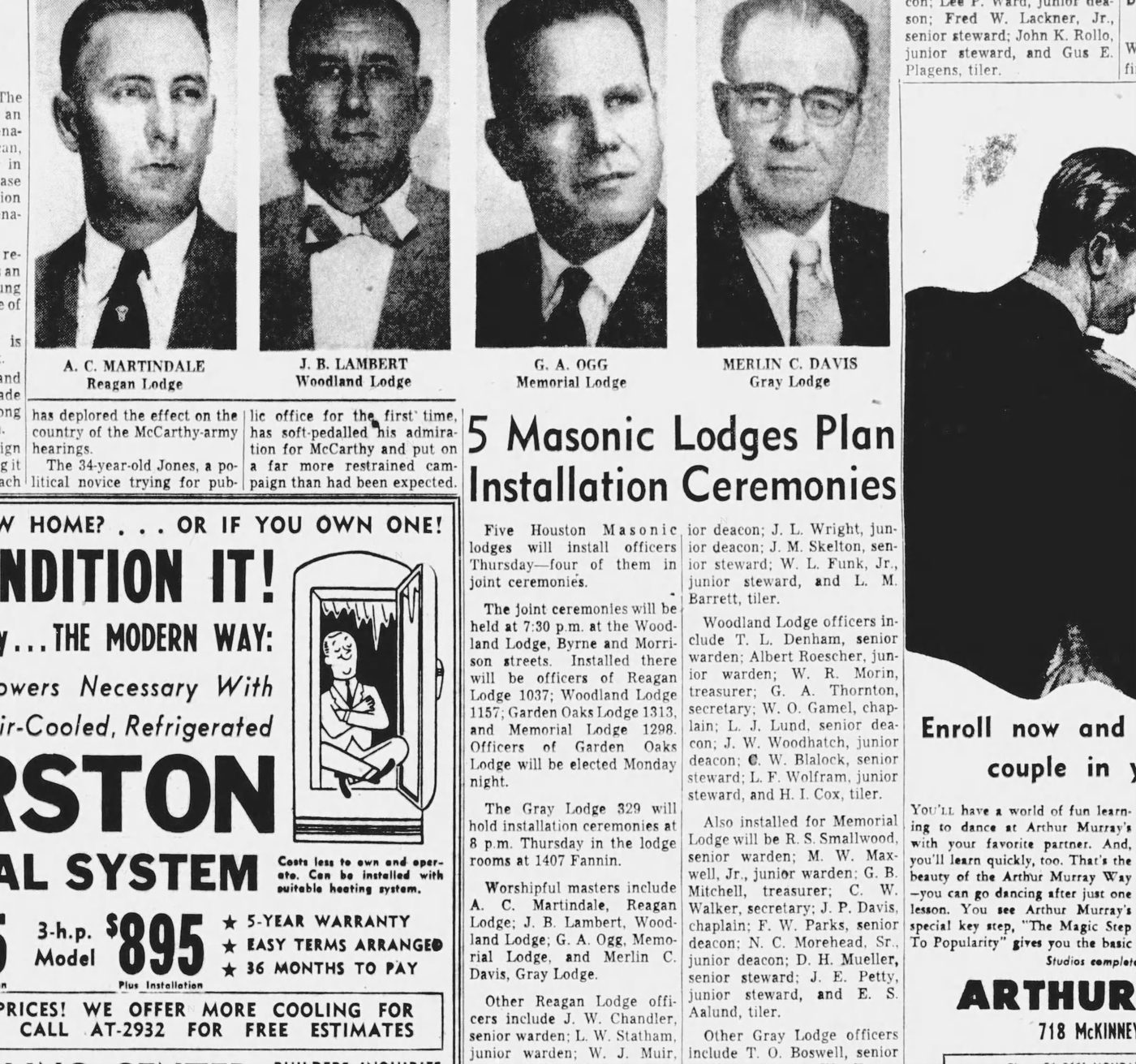
The Grand Lodge’s 1949 “Returns of Lodges” preserves the decade’s only complete officer roster: R. A. Zuber, Worshipful Master; C. K. McAlpine, Senior Warden; N. A. Bobo, Junior Warden; Wm. C. Webb, treasurer; J. A. Newsome, secretary (706 West 41st); L. R. Hayes, chaplain; W. H. Lynn, Senior Deacon; R. G. Vaughn Jr., Junior Deacon; A. C. Martindale, Senior Steward; J. D. Logue, Junior Steward; L. M. Barrett, tiler, plus twenty-four listed Past Masters (Bernard, Bawcom, Hayes, Price, Stone, McGilberry, Shallcross, Barttlingck, Eberspacher, Lonnie D. Smith, Hardcastle, Stulting, Brooks, Reed, Webb, Lively, Gould, Brogdon, Bobbitt, Muir, Thomas, Moberg, Burton, Powell) and two affiliated Past Masters, Geo. W. McLeod (from Montgomery No. 25) and J. A. Newsome (from Shiro No. 983). (GL 1949, “Returns of Lodges,” pp. 767–768) Later Worshipful Masters recoverable from the Grand Lodge rolls include Ira F. Carter in 1960. Recurring Reagan names on Grand Lodge committee and appendix rosters from 1952 to 1965 include N. A. Bobo (near-annually), R. Bowser, Walter Macon Bradshaw, E. K. Mulvogue, C. K. McAlpine, A. A. Franklin, A. C. Martindale, W. P. Schmidt, L. W. Statham, H. L. Peak Jr., W. L. Whisenhant, Pete G. Verges, R. J. Perry, J. H. Rousseau, W. R. Womack, Henry Wayne Moore, and Robt. G. Vaughn Jr., the same names recurring across years as ordinary service rosters, not (as a later addendum file mislabeled them) memorial pages. The actual 1949 memorial entries recorded four deaths: David C. Bosserman, Frank A. Kincey, Albert E. Porterfield, and H. O. Schaleben. (GL 1949, p. 1337)
The Heights Boulevard hall hosted Masonic history of its own almost as soon as it opened. On September 14, 1950, a Grand Lodge of Texas Special Communication convened “in the Lodge Room of Reagan Lodge No. 1037, Houston,” with the full slate of Grand officers present, to constitute S. P. Waltrip Lodge U.D. (GL 1950, pp. 108, 112) Stephen P. Waltrip, a Reagan Past Master, a funeral-profession man, 1947 general chairman of the Arabia Temple Shrine Circus, and a past president of the Texas Shrine Association, died in October 1951. (Houston Post, Oct. 10, 1951, p. 9) The daughter lodge constituted in Reagan’s own room in 1950 appears to bear his name while he was still living, and “S. P. Waltrip” Lodge No. 1328 appears on the 1965 Grand Lodge table with 502 members. In 1947, Reagan Lodge had likewise sponsored the founding members of Gus A. Brandt Lodge No. 1296, its members “recommended as Master Masons in good standing by the Master, Wardens and Brethren of Reagan Lodge No. 1037,” with Reagan Past Master R. D. Hardcastle serving as Senior Warden pro tem at its constitution. (GL 1947, pp. 67, 100, 69, 101) The lodge’s charity had a face as well: Bernice Evelyn Beck, admitted to the Masonic Home and School under Reagan’s sponsorship on June 1, 1952, “had the highest scholastic average in the class, to earn valedictory honors” in 1954. (GL 1954, p. 167)
On July 21, 1959, “Reagan Lodge No. 1037, Houston, Presented a 50-Year Masonic Service Award to Brother George W. McLeod” (GL 1959, p. 114), the same affiliated Past Master listed in the 1949 roster, from Montgomery No. 25. No observance of the lodge’s own 50th anniversary (December 12, 1960) appears anywhere in the 1959 or 1960 Grand Lodge Proceedings, a documented absence in the official record, though not proof the milestone went unmarked locally. In 1964, the Grand Master’s itinerary records a visit, “Reagan Lodge No. 1037, Houston, Master’s Degree” (GL 1964, p. 69); and the South Texas DeMolay Conclave Awards Banquet was reportedly held “at Reagan Masonic Lodge [in] Hous-ton” in 1961. (Baytown Sun, Jun. 6, 1961)
Member obituaries kept surfacing through the era’s regional papers: William Clayton Webb of 1515 Harvard, “charter member, past master and treasurer of Reagan Lodge No. 1037,” the same long-serving treasurer named in the exile-era officer lists above, died in 1953 (Houston Chronicle, Apr. 3, 1953, p. 44); George William Mulvogue, 84, another charter member and Past Master, died in May 1952 (Houston Post, May 29, 1952, p. 35, clip 1194636635); a Webb of Baytown was noted in 1951; David H. Kennerly died at 73 on February 11, 1957; Thomas McIntosh(?) Clark died at 71 in 1960 (Baytown Sun, Sep. 12, 1960); and Vas Hubert Brogdon, a member of the original 1930 building committee and a Past Master, born February 27, 1886, in Bryan, died October 4, 1961, in Houston. A member named Hanka, of the Czech fraternal world (Sokol Houston, SPJST), was noted in January 1965. As small housekeeping notes: the Grand Lodge’s returns mailing address ran “732 Harvard” in 1930–31, then “1115 Oxford St.” through the later 1930s, likely the secretary’s home address rather than the lodge’s own, and the lodge’s annual gift to the Masonic Home and School grew from $5–$20 to $20 by 1950. L. R. Hayes himself could not be matched to any known grave.
Cato’s Last Decade
Lamar Q. Cato, the temple’s architect, spent this era as one of Houston’s busiest institutional designers, working in the PWA Moderne and Art Deco vein that defined so much public building of the period: Sam Houston Elementary in Conroe (1937, itself later converted to apartments as “Landmark 601,” an odd structural echo of 1100 Harvard’s own later fate); co-architect, with Staub, Franzheim, Glover, and Payne, of Mirabeau B. Lamar High School (1937); the Roy G. Cullen Memorial Building at the University of Houston (1938–39, funded by the Public Works Administration at a cost of $282,000, billed as the first air-conditioned college building in the United States), co-designed with Alfred C. Finn, correcting an older account that credited Cato alone; the Brazoria County Courthouse in Angleton (1939–40), described as his “modernistic tour de force”; plans for the University of Houston Administration and Classroom Building (announced December 14, 1947); and the university’s Quadrangle dormitories along with Texas Southern University’s Mack H. Hannah Hall (opened 1950), both completed after his death.
Cato died at his Houston home on July 12, 1948, at age 59: “Lamar Q. Cato, 59, wellknown Houston architect, who died at his home here last night.” His fraternal journal, the Czech-language SPJST Věstník, ran its own death notice, “Br. Lamar Q. Cato, zaměstnáním Stavitel… zemřel dne 12. července 1948 ve stáří 59 let,” confirming he had been a member of lodge Pokrok Tousonu No. 88 since November 30, 1934. A biographical sketch circulating on a Houston history forum (Austin birth, teenage move to Houston, City Architect post in 1919) remains single-sourced and should be read with that caveat. On a lighter family note, his son Quintus Cato married Catherine Elizabeth Swanson on September 10, 1939. His office reported, in a late October 1948 item, the completion of nine temporary veterans-training buildings moved from Camp Wallace, active work almost to the end of his life.
The temple’s builder, Bace Construction Co., is bounded to roughly 1928–1940 in the surviving record. A March 1936 item from the Mullin Enterprise notes that “Guthrie Keel of Mullin left Tuesday night for Houston, where [he] goes to [take] a po[sition] as time keeper for the Bace Construction Co.” J. D. Bace was the firm’s principal; its last known job was a pair of twin segregated schools for the Dickinson school board, dated January 19, 1940.
Era’s End, 1963–1965
The Sammy Baugh chapter of the shop row’s story closed formally in March 1964, when Southwestern Fidelity was absorbed by Southern Union Life of Dallas; its 1963 forcible-detainer appeal marks its last documented tie to Harris County property.
Four months later, a Dallas insurer paid to have the building measured. In July 1964 the International Fidelity Insurance Co. of Dallas commissioned a full “Proposed Renovation” of 1100 Harvard from the architecture firm Wirtz, Calhoun, Tungate & Jackson, Commission 64-08. The drawings record the building to the inch: 102 feet 10 inches long, 39 feet wide at the front and 49 feet at the rear, with the west elevation facing Harvard and the south elevation facing East Eleventh. They also record, on the pediment, a faint trace of the Masonic emblem, still legible thirty-four years after the cornerstone was leveled and sixteen years after the lodge dedicated its own building elsewhere. The renovation was never carried out. (Wirtz, Calhoun, Tungate & Jackson, Commission 64-08, July 1964) This partly answers a question the project long carried as an unexplained flag in the deed chain, a “1964 International Fidelity Interest” in the property. What that interest legally was, a purchase, a mortgage, or something else, and who held record title from 1965 to 1979, remain undocumented; the instrument has never been pulled. The full 1964–1979 vacancy and decline narrative belongs to the next chapter.
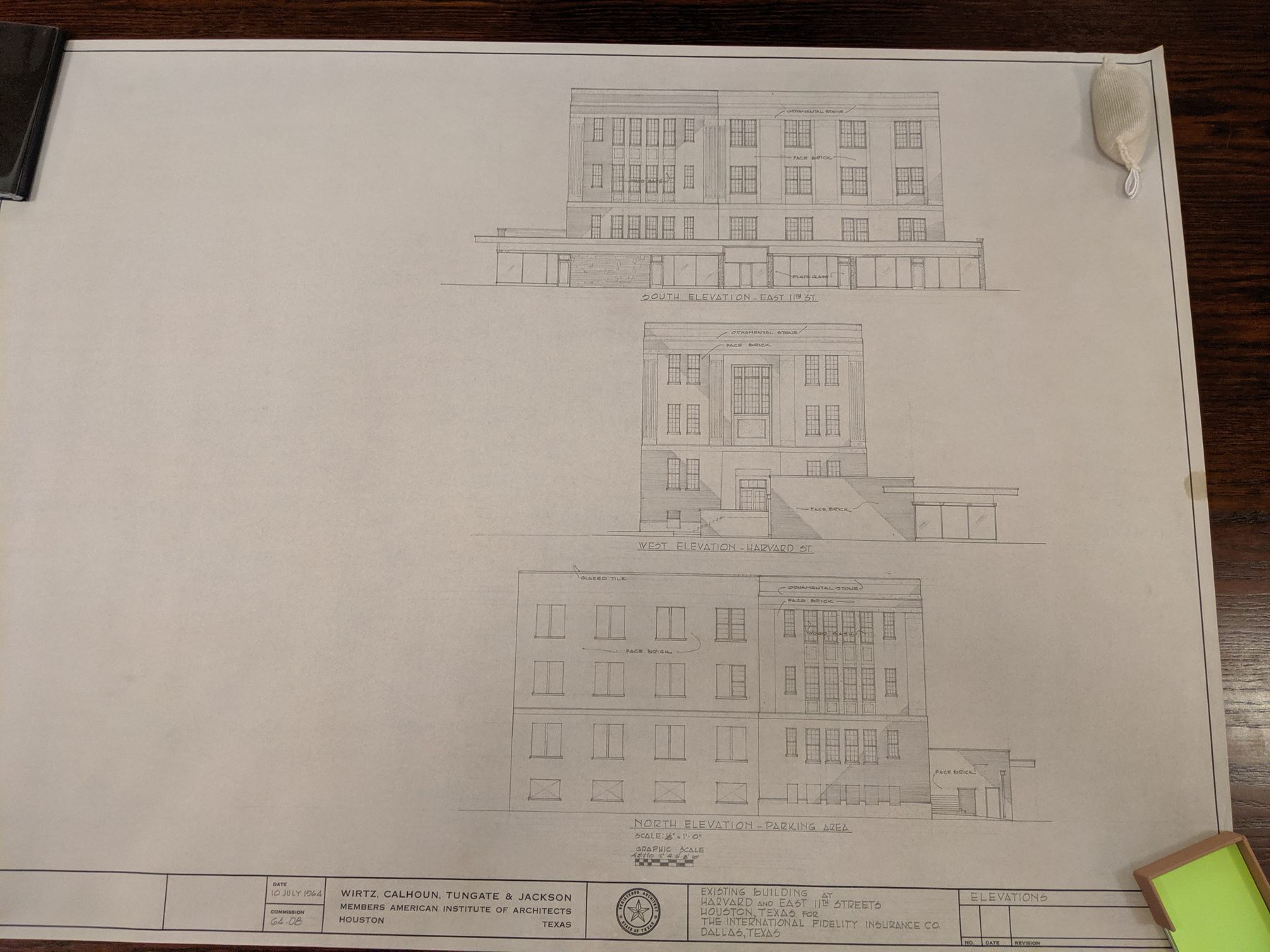
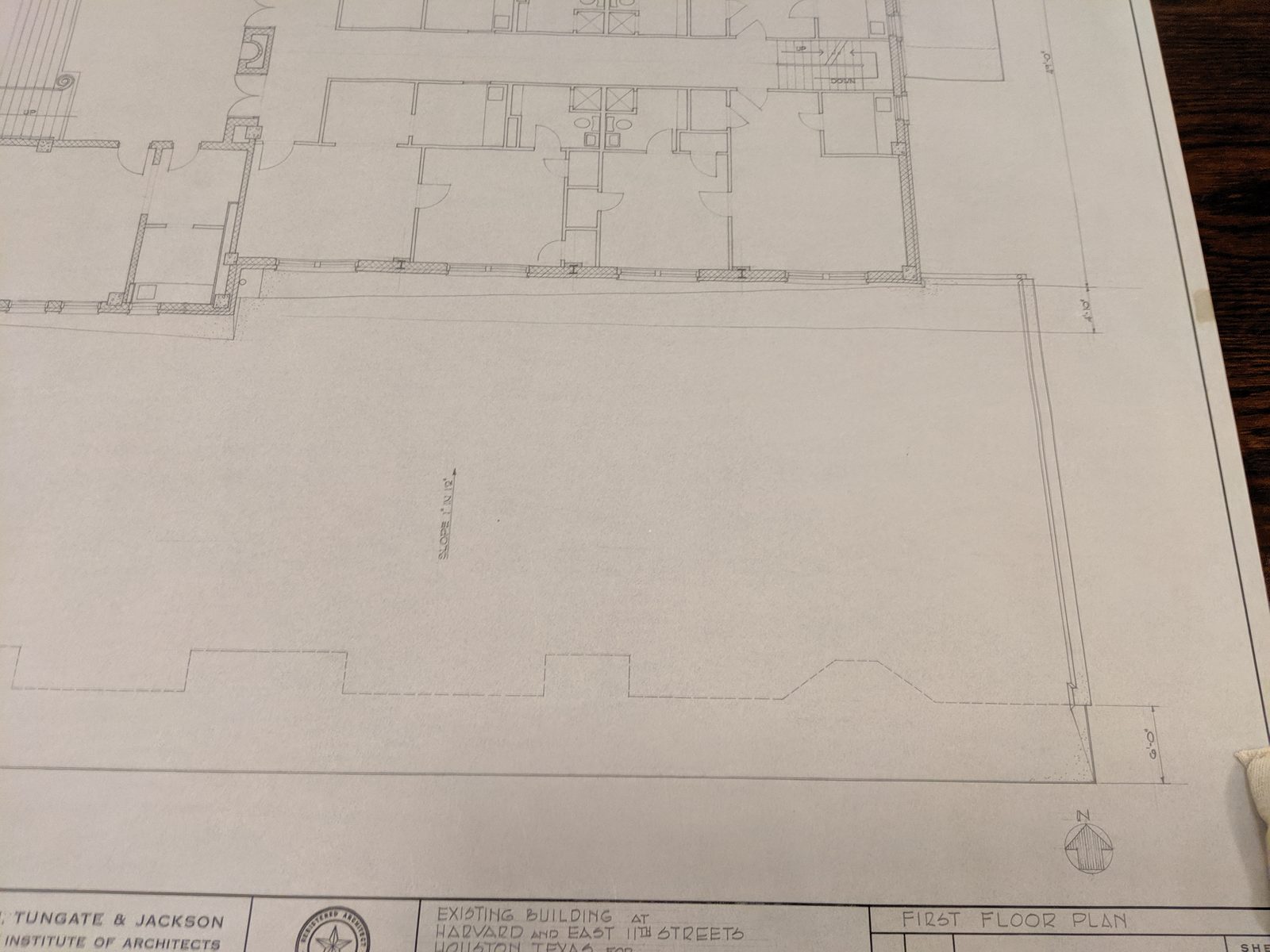
The building itself went back on the market the next year, listed by agent Joe Ridings of Ruth L. Robinson, Realtor. Classified ads ran in the Chronicle on October 19, October 27, November 3, November 9, and November 10, 1965, and they describe two distinct properties on one corner lot. The former temple: “[COMME]RCIAL building 1102 Har[vard, c]orner Harvard and 11th … Office area 3842 sq. ft., recently vacated. 3 stories 3842 sq ft each for storage or conversion to apartments parking area,” roughly 11,526 square feet in all. The shop row: “store area 5,946 sq. ft. presently leased… 1-story brick structure on 82x132 corner lot.” (Houston Chronicle, Oct. 19 / Oct. 27 / Nov. 3 / Nov. 9 / Nov. 10, 1965, clips sr1200326152, sr1200302319, 1200311002, sr1200325622, sr1200327000) The ads could not keep the building’s height straight even against themselves: one November run calls the property a “1-story brick structure,” the concurrent run calls it “3 stories 3842 sq ft each.” (Houston Chronicle, Nov. 6, 1965, Sec. 2 p. 19, clip 1200316871, against Nov. 5, 1965, clip 1200315601) That is the third distinct height the Houston press assigned this building in eleven years, after the Post’s “four-story” of 1954.
The phrase “possible conversion to apartments,” written about a building already one-third apartments, reads in hindsight as the sale pitch for the building’s next life. It is the era’s closing image: the Legal Reserve Building of 1940, by 1965 a half-empty walk-up with a for-sale sign in the window. The lodge, meanwhile, ended the era at its own zenith, somewhere between 1,762 and 1,817 members on the 1965 Grand Lodge rolls, Joe W. Lively on the state committee lists, the Joe B. Junell ranch meetings of the 1960s (a genuine, dispensation-backed custom) just ahead, and decline nowhere yet visible on its own horizon. The name went with it. By November 1966 a news item, not a classified, places “Reagan Masonic Temple” squarely at 1606 Heights Boulevard. (Houston Post, Nov. 24, 1966, p. 45, clip 1196462846) The classified columns would keep printing “11th and Harvard” for years afterward, which is era 4’s problem.
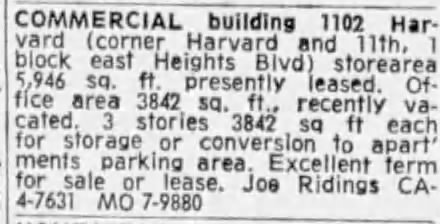
What This Era Still Cannot Answer
- The 1935 foreclosure instrument itself, the lender’s identity, the sale date, and the dissolution of the Reagan Masonic Temple Association, remains undocumented in any deed record recovered so far.
- The precise mechanics of title between 1939 and 1965: how the property passed from Miller to Home Life Assurance (or whether Miller and Home Life were, functionally, one and the same), Home Life’s 1944–45 divestiture, and who held record title through City National Life’s operational tenure.
- Whether the name “Legal Reserve Building” genuinely predates the 1939 Miller purchase. An album clipping headlined “Thirty Candidates Appear Before Civic Group” describes a Federation of Civic Clubs meeting “at the Legal Reserve Building, Eleventh and Harvard” and is dated 1930 in the compiled record, nine years before the purchase the established naming story depends on. The source itself flags this as a dating tension rather than an assertion of fact, and it needs independent confirmation before it can coexist with the Miller narrative.
- Whether the other lodges’ documented 1937–1953 use of 1100 Harvard reflects a real sublease or rental arrangement with the bank, Home Life, or City National Life, or is itself partly zombie-listing carryover. The dated events with named officers argue for genuine tenancy; no lease or rental record has been found.
- The occupational contradiction in Walter Harvey Crook’s 1963 obituary: retired commercial artist of 1102 Harvard in the death notice, retired 25-year Federal Bureau of Narcotics agent of 835 West 41st in the news column, same name, age, funeral, chapel, and cemetery.
- The 1943 federal war-housing lease survives only in newspaper traces; the underlying government instrument has not been located.
- The Teamsters’ occupancy of the building in 1941–42 is known from three out-of-town newspapers citing the address; direct reads of the original pages, the extent of the space used, and the exact dates in and out remain undone.
- The identity and building history of the Eighth and Harvard hall where the lodge spent thirteen years in exile has not been established.
- Reagan Lodge’s officer rosters for most of 1950–1965 are missing; the Grand Lodge volumes for those years generally lack per-lodge officer detail.
- Whether a sale actually closed on Joe Ridings’ 1965 listing, before the building’s next documented chapter, is unknown.
- The legal nature of International Fidelity Insurance Co.’s 1964 interest in the property, and the ownership chain from 1965 to 1979, await the deed instruments.
- No period photograph of the temple itself between 1930 and 1960 has been located in any digitized archive. The July 1964 elevation drawings remain the earliest depiction of the building the project holds; this era is textually rich and, so far, photographically blank.
- Whether the announced 1956 four-story tower at 207 E. 11th ever left a building-permit trace, beyond the newspaper announcement, is unconfirmed.
- The shop row’s tenant history for 1960–1965 sits in a directory coverage gap and has not been reconstructed.
- What became of Josieette Newberry, the fifteen-year-old pharmacy clerk who left Tlucek’s on August 29, 1951, and who the man the papers called “Mr. Swan” was.
Complete Research Dossier, Era III: Legal Reserve, War Housing, Mid-Century (1935–1965)
ERA 3, 1935–1965: Foreclosure & Transition, Home Life / Legal Reserve, War Housing, Mid-Century Commerce
Master synthesis, authored independently from the era evidence files. Every dated assertion carries its citation as given in the evidence files; grades are CONFIRMED / LIKELY / SPECULATIVE / LEAD; quotes are verbatim (OCR garble preserved where flagged).
0. The era in brief
In August 1935 the five-year-old Reagan Masonic Temple at Eleventh and Harvard passed out of the fraternity's hands, and the building and the lodge began thirty years of separate lives. The lodge went three blocks south to a rented hall at Eighth and Harvard and stayed thirteen years, then rode a postwar membership boom into a new Neoclassical home of its own at 1606 Heights Boulevard, dedicated December 31, 1948; by the mid-1960s it counted nearly 1,800 members and had seeded and sponsored new lodges around Houston.
The building, meanwhile, was held on the bank's books through the late 1930s; was bought for about $40,000 in September 1939 by Houston insurance man Lester A. Miller from Houston National Bank (a purchase whose lot dimensions, 200 × 132 feet, match the property's own 1985 legal description exactly); became the home office of the Home Life Assurance Company, a small "legal reserve" burial-policy insurer, and took the name Legal Reserve Building by August 1940; hosted, in quick succession, a 7,000-square-foot dance academy, a civic federation, church movie nights, a Texas Defense Guard drill hall billed as the "111th Engineers' Armory," a Seventh Day Adventist School, and, a wholly new finding of this pass, the Houston headquarters of the Teamsters (Joint Council No. 58) in 1941–42. Despite official vacancy listings, pioneer electrical contractor Walter Cavender operated a shop in the building at 1102 Harvard until his death in late 1936. Duplex listings in 1938 indicate residential usage of the site before the formal 1943 conversion. In 1943, under a seven-year federal war-housing lease, its upper floors became 24 war-worker apartments; by 1946–47 the city directory lists "1102 APARTMENTS" with 35 numbered units. The ground-floor shop row on East 11th ran continuously through the era, pharmacies, cleaners, barbers, a community newspaper office, a U.S. post office substation, and from 1954 to 1957 the office block held Southwestern Fidelity Life Insurance Co., whose president was NFL legend Sammy Baugh. City National Life Insurance Co. (president: the same Lester A. Miller) put a $50,000 commercial addition on the property in 1951 (architect Arne G. Engberg, builder Fretz Construction, engineer Walter P. Moore). The era closes with the apartments thinning out, the shop row showing vacancies, and the whole building offered for sale in late 1965, "possible conversion to apartments", the hinge into its long decline and eventual 1980s condominium rebirth.
1. The empty temple, 1935–1939
The lodge left in 1935, the Grand Lodge's own record. The Grand Lodge of Texas Proceedings for 1935 record, in a list of Depression-era hall relocations (between lodges burned out of their halls in Texline and Seminole):
"Reagan Lodge No. 1037 to move from 11th and Harvard Sts., to 8th and Harvard Sts., Houston, Texas.", Grand Lodge of Texas Proceedings 1935, p. 83. CONFIRMED. Independently re-found by research plan 6 ("Meeting-hall dispensation, 1935").
Why the Grand Lodge record is otherwise silent (load-bearing context, per the research reconciliation priority flag): the 1932 Grand Master's Address (GL 1932, pp. 148–149, reprinted p. 350) explains that separately-incorporated "Masonic" Building Associations held title to lodge buildings across Texas, became over-leveraged, and faced foreclosure suits against the Association, not the Lodge. This is why no Grand-Lodge debt-conveyance record names Reagan Lodge: research plan 9 / Round 3 (#251–254) confirmed that while at least five Texas lodges explicitly lost buildings to creditors 1931–37 (and others, e.g. Kelly Lodge No. 1131, refinanced), Reagan Lodge No. 1037 never appears in the Grand Master's 1931–37 debt-conveyance approvals, and no direct mention of its foreclosure exists anywhere in the Proceedings. The foreclosure fell on the Reagan Masonic Temple Association (the 1916-vintage building corporation), not on the chartered lodge. CONFIRMED (as a documented absence plus the 1932 mechanism).
Timing wrinkle (unresolved, flag for stitch pass): one Post lodge-notice clipping dated May 10, 1935 (p. 16, clip sr1194498749) already prints "REAGAN Lodge No. 1037, Eighth and Harvard, Houston Heights", roughly three months before the August 1935 foreclosure date the project carries. Either the lodge vacated ahead of the formal foreclosure sale (plausible for a defaulting tenant-owner), or the clipping's date attribution is wrong. Logged, not resolved. All 1936-onward notices consistently print Eighth and Harvard.
The building sat vacant. Houston city directories:
| Year | 1100 Harvard | 1102 Harvard |
|---|---|---|
| 1936 | "1100 Vacant" | "1102 Vacant" (album new_07_57a9193371.jpg) |
| 1937–38 | "1100 Vacant" | "1102 Vacant" (new_09_3ffd738e7c.jpg); 1101 shows an illegible "…Interests" holding-company-style entry; 1103 Vacant |
| 1939 | "1100 Home Life Assurance Co" | "1102 Vacant" (new_11_bf317c729b.jpg) |
CONFIRMED (primary directory images). So the temple was listed as vacant roughly 1936–38, with the insurer arriving by the 1939 edition.
However, primary-source clippings reveal that the building was not entirely unused during this vacancy period: - Walter Cavender's shop (1936): An obituary for Walter Cavender, 87, a pioneer Houston electrical contractor who lived at 1502 Harvard, notes that he passed away on Wednesday, November 4, 1936, and "had a shop in the building at 1102 Harvard" (Houston Chronicle, Friday, November 6, 1936, p. 28). His services were handled by Settegast-Kopf, and his active pallbearers included prominent Reagan Lodge members L. R. Hayes and W. C. Webb, showing ongoing lodge connections to the building's tenants even immediately after foreclosure. CONFIRMED. - Residential duplex listings (1938): Classified ads in July 1938 offer: "HARVARD, 1100, Lower 4 rooms, nicely furnished duplex; private bath; garage. Taylor 6184" and "HARVARD, 1102, Nice 5-room home; lot 50x135; garage; only $2850... See owner, J-28205" (Houston Post, Wednesday, July 20, 1938). This indicates that portions of the property lots (such as the separate home at 1102 Harvard, which sat on Lot 16) were occupied residentially prior to Lester A. Miller's acquisition and the subsequent apartment conversion. LIKELY. - Commercial lease and Seventh Day Adventist School (1938): A September 1938 classified ad offers: "LEASE OR RENT building, 3000 square feet, suitable Heights business. 1102 Harvard. W. 9453" (Houston Chronicle, Wednesday, September 7, 1938, p. 11). The same issue's HISD special election notice lists the polling place for Precinct 54 at the "Seventh Day Adventist School, 11th and Harvard," indicating that a Seventh Day Adventist School rented or occupied the vacated temple assembly space during the late 1930s. LIKELY.
The bank held it. No deed record of the 1935 foreclosure lender has been recovered (research plan 91 FamilySearch deed chain: "1935 Foreclosure Lender: [UNKNOWN]"), but the 1939 sale (next section) shows Houston National Bank selling the property, the strongest evidence that it held title as real-estate-owned after the foreclosure. Secondary sources (reaganlodge1037.org; THC marker) say only "a local bank." LIKELY (inference from the 1939 sale; the original 1935 instrument remains undocumented).
A footnote that would not verify: the story of John M. Dagley, a Houston real-estate agent said to have tried c. 1935 to sell the foreclosed temple to the Houston school district, could not be documented in any open web source, no biography, no firm, no deal record (an exhaustive negative across Portal, Chronicling America, THC, HMDB, lodge history, etc.). Context: Texas had no real-estate licensing law until 1939, so a 1935 agent left no state paper trail by default. While the specific 1935 school district sale attempt remains an unverified lead, John M. Dagley's identity as an active, real-life member of Reagan Lodge No. 1037 is now CONFIRMED. A 1942 funeral notice lists him as an active pallbearer alongside other prominent Reagan Lodge figures: "Active pallbearers will be: L. R. Hayes, C. S. Bawcom, C. C. Powell, Vas H. Brogdon, John M. Dagley..." (Houston Post, Wednesday, April 15, 1942, p. 15). He appears again in the same role for Henry A. Craven's funeral in July 1955 (Houston Post, Monday, July 11, 1955, Section 3, Page 12), establishing him as a core member of the lodge's inner circle.
2. The 1939 sale: the building's buyer identified (RESOLVED)
The Houston Chronicle of September 10, 1939 (p. 43, clip sr1198875333; headline cropped to "…uilding on Harvard," plausibly "Insuranceman Buys Building on Harvard") reports:
"purchased a two- / building at Harvard and / nth from the Houston Na- / l Bank for about $40,000. The / erty fronts 200 feet on Har- / by 132 feet on Eleventh." (verbatim, cropped)
The buyer's cropped name reads "…ster A. Miller, Houston insurance man."
Lot-match analysis settles the identity of the property. Houston Heights plat lots are 50 × 132 ft (Map Records of Harris County Vol. 1, p. 114A). 200 ft on Harvard × 132 ft on Eleventh = exactly Lots 13, 14, 15, 16, Block 199, and the 1985 Harvard House Condominium Declaration (File No. K060751, Vol. 152, p. 51) describes the property as "Lots 13, 14, 15, 16 and the south one-half of Lot 17, Block 199, Houston Heights" (225 × 132 ft; the extra 25-ft south-half of Lot 17 was added to the envelope by/at the 1985 conversion for the pool/gazebo area; the temple itself sits primarily on Lot 14). The 1939 purchase is our building. CONFIRMED (perfect mathematical lot match against the property's own later legal description).
The buyer: the lot-check file identifies the cropped "…ster A. Miller" as Lester A. Miller, "confirmed by 1943/1951 articles as president/owner of the companies occupying the building", with "Chester A. Miller" a mistranscription in one verification pass. Lester A. Miller is the same man the February 25, 1951 Chronicle names as president of City National Life Insurance Co. when it built the 1951 addition (§7). LIKELY→CONFIRMED for the name; the through-line, Miller buys in 1939, his insurance companies (Home Life Assurance, later City National Life) occupy and brand the building, is the best-supported ownership narrative for 1939–1965, though the deed chain itself is still unrecovered (research plan 91: "Home Life 1939–40 Transfer: [UNKNOWN]"; and a 1964 "International Fidelity Interest: [UNKNOWN]" row marks the era's end as equally undocumented in deeds). Grade the chain LIKELY, the gaps explicit.
Compass-point discrepancy (flag, do not silently adopt either): the lot-check JSON and the historic.one marker mirror place the building at the northeast corner of Harvard and E 11th; the project's common context says northwest corner of Eleventh & Harvard. The safe, source-independent statement is: 1100 Harvard St, Lots 13–16 (+ S½ 17), Block 199, at the corner of Harvard Street and East 11th Avenue. Flag for the stitch pass to fix against a plat/map.
3. Home Life Assurance Co. and the "Legal Reserve Building," 1939–1944
Occupancy. The 1939 directory lists "1100 Home Life Assurance Co" (above). The 1942 directory (Ancestry scan, Street & Avenue Guide image 4779914, verified at full zoom 2026-07-10) gives the first direct documentary proof of the post-foreclosure owner officed at the building:
"1102 Harvard: Home Life Assurance Co; Legal Reserve Life Co", with 1101 Harvard (across the street) as "Henningsen Serv Sta" (John Henningsen, res. 1107 Harvard). CONFIRMED.
The name. By August 1940 the press called the building by its owner's product line, a "legal reserve" insurer being one whose policies are backed by statutory reserves:
"Recommendations of the committee will be brought before the federation council at its next meeting, Wednesday night, August 28, at the Legal Reserve Building, Eleventh and Harvard", Houston Chronicle, Aug 20, 1940, p. 23 (NewsBank PDF 1940-08-20_p23_legal-reserve-building.pdf). CONFIRMED. (Civic federation president: C. A. Montavanis; committee spokesman: a Mr. Hinds.)
Six further unread "Legal Reserve Building" page-hits cluster in June–October 1940 (Post 6/23, 9/13, 10/8; Chronicle 6/27, 7/30) plus one in March 19, 1943 (Post p. 13), the latter a priority LEAD sitting exactly at the war-lease conversion (see §5, §10).
What Home Life actually was, and the Fort Worth resolution. The research round 2 reconciliation flagged a "MAJOR DISCREPANCY": the company's March 30, 1944 Certificate of Authority (No. 5393, Company No. A-345, valid through May 31, 1945, published in the Fort Worth Press Apr 3/10/17, 1944) names "HOME LIFE ASSURANCE COMPANY, Ft. Worth, Texas," where the project narrative had a Houston-chartered-1934 company at 1102 Harvard. The Portal Round 3 snippets in this folder now substantially resolve this:
- Board of Insurance certificates for "Home Life Assurance Company, Fort Worth, Texas" run continuously: May 18, 1936 (Cert. 2644, Co. No. 2101), April 4, 1939 (Cert. 4106, Co. No. 2101, republished through April 1939), April 9, 1943 (Cert. 300, Co. No. A-345), March 30, 1944 (Cert. 5393, Co. No. A-345). (Fort Worth Press, multiple dates; Abilene Daily Reporter Apr 16, 1937.) LEAD→LIKELY (legible OCR, multiple issues).
- A Fort Worth Press business-directory line of April 30, 1938 reads: "HOME LIFE ASSURANCE CO.: J L. Mistrot Pres., 916 Ft Worth Nat. Bank Bldg.", J. L. Mistrot, the president the project already associates with Home Life, officed in Fort Worth in 1938. LEAD→LIKELY.
Read together: this is one company, statutorily domiciled/certificated at Fort Worth from at least 1936, whose Houston home-office operation at 1102 Harvard carried the public branding, not two unrelated same-named insurers, and not a late HQ move. (Caveat: the company number changes between 1939 and 1943, No. 2101 → No. A-345, which may be a Board renumbering or may yet hide a reincorporation; the "Houston-chartered 1934" claim in the old narrative remains unsourced and should be dropped or caveated.) The narrative's Home Life chapter should be rewritten on this basis.
- Home Life sold family-group burial policies and recruited small-town agents from the building: Bay City Herald, Aug 13, 1942: "OLD LINE LEGAL RESERVE PROTECTION ALL POLICIES WRITTEN IN HOME LIFE ASSURANCE CO. HOUSTON, TEXAS"; Brenham Banner-Press, Nov 3/4/5, 1943: "REPLY BOX 585 FOR INTERVIEW HOME LIFE ASSURANCE CO. 1102 HARVARD ST., HOUSTON, TEXAS"; Nov 30/Dec 1, 1943: "THERE IS A GREAT NEED FOR LEGAL RESERVE INSURANCE In amounts sufficient to provide for burial expenses HOME LIFE ASSURANCE COMPANY … FAMILY GROUP POLICY … Burial Service With Any Funeral Home Regardless." LEADs (verbatim OCR). Note these ads still use the 1102 Harvard address in November–December 1943, i.e. months after the war-apartment conversion began, the office presence and the apartments overlapped, or the ad copy lagged.
A further mid-century connection to the "Legal Reserve" name occurs in July 1955, immediately prior to the death of prominent Reagan Lodge Past Master and Treasurer Henry A. Craven. H. A. Craven ran a business brokerage from 1102 Harvard and placed classified ads for a legal reserve insurance company: "LIFE INSURANCE: An Old Line Legal Reserve Stock Company, well working control. New Multiple Plan Stamps. GRAND OPENING... Interested parties call Mr. Craven, OX-8-3581; nights OL-4-1900" (Houston Chronicle, Sunday, July 3, 10, 1955, Section C, Page 5 / Section E, Page 4). This shows Mr. Craven still dealing in legal reserve insurance options out of the 1102 Harvard offices in the mid-1950s. CONFIRMED.
Home Life's end. Last confirmed public sign of life: April 1944 (the certificate notices). It then vanishes: no TDI receivership listing, no Best's/Moody's mention 1944–60, no Portal/CourtListener trace, a quiet exit between late 1944 and 1945, most plausibly a voluntary dissolution or unpublicized merger/reinsurance (research plan 12; Round 2 #155–162). CONFIRMED (as negative evidence) / LIKELY (interpretation). Whether it divested 1100 Harvard as part of that exit is SPECULATIVE (no deed found); what is known is that the same Lester A. Miller's City National Life is the building's operating insurer by 1951 (§7).
Mistrot residue: Mistrot v. Commissioner (CourtListener, decided June 30, 1936) ties the surname to Depression-era tax litigation in Home Life's active window, surname link only, relevance unconfirmed. The Mistrots are a prominent Galveston/Houston dry-goods merchant family (SPECULATIVE, research plan 11).
4. Tenants of the Legal Reserve years: dance studio, assembly room, armory, union hall
Mary Jane Studios (1939 – c. 1942). "MARY JANE TO OPEN STUDIO IN NEW LOCATION, The Mary Jane Studios have been moved to a new location at East Eleventh and Harvard" (Chronicle, Aug 27, 1939, p. 35, sr1198686917); the same day's Post (p. 40, sr1194114516) announces "spacious new quarters at East Eleventh and Harvard with 7000 square feet of space," with new ballroom instructor Alvey Wakefield Emery. Reopened for the season Sept 10, 1939 ("spacious new studios on Eleventh and Harvard," Post p. 43); by January 14, 1940 director Mary Jane Reynolds opened a second studio at 3214½ Main while "classes will begin Monday at the new studio and at the present one at Eleventh and Harvard in all types of dancing" (Post p. 40). CONFIRMED. research plan 51: the studio moved from the downtown Milam Building in Aug 1939; its activity after that could not be traced past ~1942 (the common-context flag: judge any "Mary Jane Reynolds" clipping by address, the studio was downtown through the 1930s). Note the 7,000 sq ft figure, the upper lodge floors turned dance floor.
A rentable assembly room. Beyond the Aug 1940 civic-federation meeting (§3), a church-sponsored motion picture "of scenes of the South and North" was shown "at 8 p.m. in the assembly room of Harvard and Eleve[nth] through the courtesy [of an] Oil Corporation. Tic[kets] secured at the door [from] Mrs. F. C. Baker" (Chronicle, Apr 18, 1940, p. 29, sr1198427650; right margin cropped, event date cropped to "Apr-"). CONFIRMED. An undated clipping also states "the Heights Club holds its regular Wednesday noon meeting at Harvard and Eleventh Street" (LEAD, needs a date). The old lodge room earned its keep as the neighborhood's hall. In addition, the building served as a community hub for elections; HISD notices in September 1938 and May 1947 list Precinct 54 voting at the Seventh Day Adventist School, 11th and Harvard (Houston Chronicle, Wednesday, September 7, 1938, p. 11; Wednesday, May 21, 1947, p. 20).
The "111th Engineers' Armory" (November 1940). "Max Autrey Post 52 of the Texas Defense Guard will drill Wednesday at 7:30 / Harvard and Eleventh (111th En-/gineers' Armory), instead / Main and Holman." (Chronicle, Nov 10, 1940, p. 40, sr1198566790; "111th" fully legible per correction.) CONFIRMED that the corner was called the 111th Engineers' Armory in print; LIKELY (not directly proven) that this means our building's assembly floor served as a National Guard engineer unit's Houston armory. Context: the 111th Engineer Regiment (36th Division, the "T-Patchers") had its Company F home-stationed in Houston in 1940 and was inducted into federal service November 25, 1940, two weeks after this notice, going on to Salerno (first U.S. division ashore on the European mainland, Sept 9, 1943) and the Rapido River disaster of January 1944. The Texas Defense Guard drilling in its place is exactly what home-front reuse of a vacated armory looks like. (Unit history: tmd.texas.gov, texasmilitaryforcesmuseum.org, et al., context only.)
The Teamsters' Houston headquarters at 1102 Harvard, 1941–42 (NEW THREAD). Three independent papers place the Teamsters at the building:
"UNION LEADER IS SENTENCED TO ONE YEAR, John E. Adams, 29, of 1102 Harvard, Houston, Texas, presi-dent of a Houston truck drivers union, was sentenced to a year in prison when found guilty of violating the O'Dan[i]el strike vio-lence law this past week in the first trial [under it]", The Orange Leader, Nov 16, 1941, p. 1 (Portal ARK metapth…, verbatim OCR). LEAD→LIKELY.
officers "…with offices set up at the Teamsters' Headquarters of Joint Council No. 58 at 1102 Harvard, Houston, Texas", The Dallas Craftsman, Oct 16, 1942, p. 1 (naming H. A. Howsley managing editor, L. B. Stanford editor, Chas. M. Pendergrast secretary-treasurer of a new labor publication headquartered there). LEAD→LIKELY.
"Teamsters' Houston headquarters at 1102 Harvard Street, on the cor-[ner]…", Labor Messenger (Houston), Dec 11, 1942, p. 1. LEAD→LIKELY.
So in the interval between Home Life's office heyday and the 1943 apartment conversion, the building (or a substantial part of it) was Houston's Teamsters hall, headquarters of Joint Council No. 58, and the address attached to a figure of statewide legal history: the first conviction under Texas's 1941 O'Daniel anti-strike-violence act. This squares with the era's context (Texas union membership grew ~225% in the 1940s; Houston's war industries boomed; Vance Muse's anti-union Christian American Association was simultaneously operating from Houston). Grade the occupancy LIKELY pending a direct read of the three pages (all carry ARKs); it is multi-source and address-explicit. None of this is in the current narrative.
5. The war-worker apartments, 1943 → "1102 Apartments"
The conversion. Per the project's established quick-facts (carried in the common-context file): a 1943 seven-year U.S. government lease converted the building to 24 war-worker apartments. This synthesis adds the ground-level texture and the documentary bounds:
- Earliest apartment evidence found: classified ads in the Chronicle, September 13–16, 1943 (pp. 21/24/43/32, clips sr1199327924/28159/28574/28858): used office furniture, "60-inch flat-top desk, leather-cushion swivel chair", for sale, contact "Apt. 11, 1102 [Harvard], Harvard and 11th St." CONFIRMED. By September 1943 the building has numbered apartments, and someone in Apt. 11 is selling office furniture, a neat emblem of the changeover. (Home Life was still advertising its 1102 Harvard address into Nov–Dec 1943, §3, overlap or lag.)
- The federal paper trail is a documented negative: no published NHA/FPHA annual report or Lanham Act hearing exhibit itemizing Houston war-housing conversions (including this lease) could be located across Internet Archive, LOC, HathiTrust, GovInfo, or Google (research plans 30/85, honest negative; HathiTrust 403s). The lease instrument itself remains a NARA target (research plan 29, dispatched).
- Unread page-hits at the conversion boundary (NB-T5/T3 leads): Post 1943-03-19 p13 ("Legal Reserve Building"), Chronicle/Post 1943-03-28 p27 and 1943-09-09 p13 ("1100/1102 Harvard"), the top candidates for the conversion announcement. LEADS.
"1102 Apartments" by 1946–47. (Corrected 2026-07-28: the "35 units" reading is withdrawn. The April 1950 census, ED 263-139, enumerates 24 apartments floor-coded six per level, 1–6 / 11–16 / 21–26 / 31–36; "35" is the third floor's fifth unit. See the 1950 census schedule for ED 263-139.) The c. 1946–47 Morrison & Fourmy directory (IMG_20190620_192034.jpg and companions; year inferred from box label 0505918) shows the Harvard column crossing E 11th into "1102 APARTMENTS" with a numbered roster, units 1 through at least 35 (1101 Harvard: filling/service station). CONFIRMED. The recovered unit-by-unit roster (low-confidence readings flagged in source; all names swept for further records with universally negative results, see the common-context file's name-verdict list):
U1 Mrs. Delly Bright; U2 Wm. H. Safford; U3 Floyd C. Sanders; U4 Harry A. Jones; U5 Jubert(?) Griffin; U~10-11 Cameron A. Crowder; U15 Mason A. Taylor; U16 Wm. E. Uhalt; U21 Grady E. Smith; U22 Joe H. Williamson; U23 Cody L. Frost; U24 Paul W. Brannon; U~26/29 Floyd Flynn; U~30/31 Guy A. Cook; U32 John W. Hara(?); U33 Wm. P. Merrill; U34 Sam A. Welborn; U35 Harris E. Alley; also Clyde Main (unit uncertain).
These are the war-worker-housing generation's names, ordinary tenants who left almost no other trace. Worth presenting in the narrative as exactly that.
Primary sources provide additional details about the apartments' tenants, layouts, and operations:
- Spanish lessons in Apartment 15 (1945): In February 1945, a private resident was teaching Spanish from the building: "SPANISH LESSONS: Conversational Spanish classes, Monday and Thursday evenings from 7 till 8 p.m.; for information see me at 1102 Harvard, Apt. 15. Phone V-21495" (Houston Chronicle, Monday, February 19, 1945). CONFIRMED.
- George Howard Jenkins (Apt. tenant, died 1945): George Howard Jenkins, 70, passed away on May 28, 1945, at his home at 1102 Harvard. He had been a Houston resident for 35 years, a bank clerk at Houston National Bank for 28 years, and was a member of Temple Lodge No. 4 and Reagan Lodge No. 1037. His funeral services were handled by Houston Funeral Home and graveside services were conducted by Reagan Lodge (Houston Chronicle, Tuesday, May 29, 1945, p. 23). CONFIRMED.
- Automobile sales and Apartment 2 (1949): In March 1949, a resident of Apartment 2 advertised: "Chevrolet, 1938 tudor, good mechanically; $325. 1102 Harvard, Apartment 2. V-43539" (Houston Post, Wednesday, March 23, 1949). CONFIRMED.
- Rental layouts and pricing: Throughout 1953 and 1954, the apartments were advertised in both 2-room and 4-room furnished configurations, often reading: "Heights, 1102 Harvard: 4 rooms, redecorated, new furniture, ceiling fans, utilities; VI-2121" (Houston Chronicle, August 12, 1953; August 18, 1954).
- The Southwestern Fidelity management connection (1954): In July and August 1954, rental listings for the 1102 Harvard apartments directed prospective tenants to call both VI-2121 and UN-6107 (Houston Chronicle, Wednesday, July 28, August 4, 1954). The phone number UN-6107 (UN 1-6107) was the official business line of Southwestern Fidelity Life Insurance Co., showing that the insurance firm, which leased the ground-floor offices at 207 E. 11th, was also managing the residential apartments. CONFIRMED.
- Trailers and cars (1955): In mid-1955, residents advertised used vehicles from the building: "Ford, 1950 Fordor Custom... 1102 Harvard. UN 4-9426" and "1955 Southwestern, 28', one bedroom; terms. UN 4-9426" (Houston Chronicle, Wednesday, June 29, October 12, 1955).
- Thomas Jackson Howell (Apt. tenant, died 1961): Thomas Jackson Howell, 84, a retired cotton broker, passed away on April 17, 1961, at his home at 1102 Harvard St. Reagan Lodge No. 1037 conducted graveside Masonic services at Glenwood Cemetery (Houston Post, Wednesday, April 19, 1961, Section 3, Page 19). CONFIRMED.
Notably, the deaths of both George Howard Jenkins (1945) and Thomas Jackson Howell (1961) reveal a touching fraternal thread: even though Reagan Lodge had lost its temple building in 1935, these two elderly tenants who lived in the converted apartments were Reagan Lodge Masons, and the lodge returned to conduct graveside services for them, keeping a human and fraternal link to the physical building alive.
The apartments at mid-century. A rental classified, Chronicle Jul 29, 1953, p. 41: "[a]ll bills paid. Four rooms, … 1102 Harvard. … VI-2121." CONFIRMED. The 1959 directory still shows "1102 Apartments" with units 11–36 legible, unit 11 now Victor L. Dally & Co., real estate (a business back in an apartment unit), units incl. Allen Kline / Wesley W. Upperman (Apt 14, two captures/editions differ), Don V. Dickerson (16 or 18), E. W. Kirk (15), Alva N. McCurn (21–24), Randall V./A. Williams (22), C. R. Hawkins, Ellen Pardon, and, tellingly, "units 25–36 shown VACANT" in one 1959 edition. A second 1959 capture skips from 1046 Harvard straight to 1116 with no 1100/1102 line at all. CONFIRMED (with the two-edition ambiguity flagged). The building was emptying out ahead of the 1965 sale ads (§9).
Directory coverage gaps to be explicit about: 1941–44 Harvard pages not photographed (except the 1942 Ancestry scan); 1948–53 box labels exist but no pages; c. 1965 label only. Portal to Texas History hosts no digitized Houston directories at all (research plan 88), so 1943–45, 1948–53, and 1960+ remain HMRC/paid-access targets.
6. The shop row on East 11th, 1936–1965
The Eleventh Avenue storefronts (200-block E 11th, the building's commercial strip) ran without interruption through the era. Year-by-year from the directory photo corpus (all CONFIRMED as directory readings; individual name readings low-confidence where flagged):
- 1936: 215 Economy Cleaners & Hatters / Gene Reynolds; 216 Mrs. Ethel Pearson; 217 Johnnie's Cafe; 218 Mrs. Florence Reynolds; 219 Leon's Barber Shop; 221 The Globe Laundry / Charles Hildebrandt, grocer; 223 J. Q. Crete, Eleventh Av Pharmacy. (Collins Memorial M.E. Church South at 120 E 11th anchors the block west of Harvard, 1936–1959.)
- 1939–40: 210(-A) Economy Cleaners / Mrs. Pearson; 217 Vacant (then "Furniture Co"?); 218(-A) Carl P. Case / Humphrey's barber; 221(-A) Mrs. Chas. Hildebrand; 223 Joe O. Grote; 225(-A) [Eleventh] Av Pharmacy; 1940 adds 221 [White/Allred?] Grocery.
- 1941: 215 Economy Clnrs & Hatters; 215½ Eleventh St Shoe Repair Shop.
- 1942 (Ancestry scan): 215 Economy Cleaners; 215½ Heights Citizen / West End Citizen / North Side Citizen (the community-newspaper office, Glenn McCarthy's News, Inc. "Citizen chain" connection, research: 14 throwaway papers incl. the Heights Citizen); 216 Mrs. Ethel M. Pearson; 218 Mrs. Cath/Carlie Frey; 219 Bob's Barber Shop / Jas. L. Moore watch repair; 220 Jos. G. Greve; 223 Eleventh Av Pharmacy + U.S. Post Office sub-station No. 7; 230½ Jewel Tea Co. (the Chicago door-to-door coffee-and-premiums firm, founded 1899 by Frank V. Skiff, named for his 1902 partnership with Frank P. Ross). The post office substation's opening/closing dates remain unconfirmed in USPS records (research plan 93), the 1942 directory is the anchor.
- c. 1946–47: 210 Bob's Barber & Beauty Shop; 215 Economy(?); 216 vacant; 217 Quality Cleaners; 220 Jas. L. Moore watch repair; 222 Hallmark's Grocery; 223 Tucek's Pharmacy (= Tlucek's).
- 1954: 203 Tlucek's Pharmacy (the pharmacy has migrated to the corner-most storefront); 207 Rich Plan of Houston (frozen food lockers); 215 Economy Cleaners & Tailors; 218 Mrs. Carlie E. Frey / Rob's Barber Shop; 219 Jim L. Moore watchmaker; 221 Estelle's Ceramic Co; 222 Jos. G. Greyo; 223 Ortman's ("Orfman's") Outboard Store. (1101 Harvard across the street: Keenan Service Sta.)
- 1955 (commercial brokerage): In June 1955, prominent Reagan Lodge Past Master Henry A. Craven (H. A. Craven) operated a business brokerage out of 1102 Harvard, placing 11 consecutive listings in the Chronicle offering various Heights grocery stores, drive-ins, a restaurant, a gas station, and a La Marque property for sale (Houston Chronicle, Monday, June 27, 1955, Section D, Page 3). CONFIRMED.
- 1955 (hamburger shop): In October 1955, a retail storefront was offered for sale: "HAMBURGER, short-order grill and cafe. Eleventh Ave. shop row. Corner 11th, E. 11th, originally equipment, good business, almost new building; $4300 total; terms. Owner. UN 7-0435" (Houston Chronicle, Thursday, October 13, 1955, Section D, Page 9). CONFIRMED.
- ~1955: adds 205 Kuhn Claim Service; 209 Coronet Studios (photographers); 216 Hugh E. Golden; 217 Modern Youth Shop (children's clothing); 218 Gond's Barber Shop.
- 1957–58: 203 Tlucek's; 205 Hugh D. Ruthven, dentist; 207 Southwestern Fidelity Life Ins Co (§8); 209 Coronet Studios; 215 Economy; 217 Laundrie-Mat; 218 Ralph Hall; 219 Goad's Barber; 221 Ortman's Outboard; 222 Tobe L. Ewing.
- 1958–59: 207 now Hwy Dept, Dist 12, Right of Way Section (the State Highway Department moved into the insurer's vacated offices); 211 Kirby Co of The Heights; 216 Jas. C. Blakey; 217 The Launderette (Washateria); 221-23 Ortman's Outboard Store (the Red Ortman boats connection, cf. plan 60).
- 1959 (later edition): 203 vacant; 219 Al's Barber Shop; 220 Langford's Speed Wash; 222 vacant; 223 vacant, visible decay setting in at decade's end.
- Undated later capture(s): 209 Corrigan's Studios; 205 [Keefe?] Co warehouse; 207 Vacant; 222 Geo. Paris Auto Body & Fender Repair; 216 Rusk Harry gro; 218 Miller's/Musser's Barber (edition unassigned, likely early-1960s; LEAD-grade placement).
Mading's Drug Store No. 7, the strip's 1930–31 flagship tenant, was a Houston chain that ultimately sold out to Eckerd (research plan 97; 1955 NYT financial-instruments mention); its departure date from the strip is not pinned in this corpus.
The unbuilt tower. On September 23, 1956, both papers reported that Linus Hardin, chairman of Southwestern Fidelity Life, announced "plans for the construction of a $600,000 four-story office building at 207 E. 11th", 20,000 sq ft, fully air-conditioned, complete aluminum front, self-service elevator, architects Smart & Whitehead, "the first building of its size in the Heights area," with "The home offices of the Southwestern Fidelity Investment Co are now on the site" (Chronicle 1956-09-23 p72, sr1199988654; Post 1956-09-23 p32, sr1195899629). CONFIRMED as an announcement. No evidence it was ever built: five months later the company moved to Montrose and offered 207 E. 11th for lease (§8), and the 1958–59 directory shows the Highway Department in the space. Treat as an announced-but-abandoned project unless a lead contradicts.
7. City National Life and the 1951 addition
The addition. "$50,000 Addition Being Built To Masonic Temple", Chronicle, Feb 25, 1951, p. 62 (sr1198862354; also 1951-02-25_...pdf), preceded by "Addition Planned," Post, Jan 14, 1951, p. 68 (sr1194625651). Architect Arne G. Engberg; builder Fretz Construction Co.; structural engineer Walter P. Moore; mechanical engineers Howard & Johnson, now identified (research R3 #233) as a Gulf Coast firm of 22 engineers (1952) that worked on Mauritz Village and the 1952 Jackson County courthouse. The commissioning company was City National Life Insurance Co., president Lester A. Miller (per the Feb 25, 1951 Chronicle notice), the same insurance man who bought the building from Houston National Bank in 1939 (§2). Later president: Warren M. Fleming (the undated American Investors Life stock-swap notice). CONFIRMED (from prior-narrative anchors carried in this folder's evidence; the clippings are in the local corpus).
Same-name caution (do NOT import "Dallas ownership"). Texas AG Opinion O-5250 (1943) profiles a "City National Life Insurance Company" chartered in Dallas, capital $25,000; 1,796 of 2,500 shares owned by the Texas Discount Company of Dallas; president E. W. "Wright" Titus (president of both); officers Mayer, Cain, Hickerson, Knepper, Buford, Gammill; the opinion investigated that company buying a building outright from its own controlling shareholder. None of those names overlap the Houston company at 1100 Harvard (Miller, Fleming). Given the Home Life/Fort Worth precedent, this reads as a same-named-but-distinct Dallas insurer; keep the two rigorously separate, and note the narrative's earlier "stock-for-real-estate swap" gloss came from the Dallas company's AG opinion and must not be attached to the Houston tenant without direct evidence (research plan 13; R3 #255). The Dallas company's ultimate fate is untraceable in every channel searched (R3 #256).
Arne G. Engberg (the addition's architect), recovered biography. Nebraskan; three years a designer for the New York World's Fair; three years chief draftsman for Shreve, Lamb & Harmon, "architects for the Empire State Building"; also with Skidmore, Owings & Merrill; ~11 years in NYC; moved to Houston c. May 1947 (a Houston-area homeowner at 2428 Dryden, Southgate, by May 1, 1947, research plan 21); with a leading Houston firm; announced his own office "at 3819 Fannin" Saturday, Nov 19, 1949, specializing in institutional and commercial work (Chronicle, Nov 20, 1949, p. 63, NewsBank PDF 1949-11-20_p63_engberg-opens-office-aia.pdf). AIA member by Feb 2, 1950. Later: school work for Channelview, Seabrook, La Porte (29-classroom addition), Sealy, Victoria, Deer Park, Missouri City/Arcola, East Bernard; Leonard's store, Lakewood Center (1956); an observatory (1959); AIA Houston design-award notice (1960); his own modern house at 24 Still Forest featured on a 1959 Baytown "modern house tour"; later firm "White, Engberg and Associates" (Alvin, 1970). His mother, Martha Marie Engberg, 70, of 5000 Mimosa Dr., Bellaire, died by suicide (reported May 28, 1958; the family had moved from Kearney, Nebraska six weeks earlier). No obituary/death date found for Engberg himself; the "1948-1965" tag on old project filenames is a clipping-range label, NOT a life range, 1967/1970 evidence contradicts a 1965 end. CONFIRMED (each item per its citation). ⚠ Address discrepancy: the 1949 clipping reads "3819 Fannin"; the prior narrative says "3810 Fannin", re-read the clip and fix the digit.
Fretz & Moore context. Fretz Construction also built Congregation Emanu El's new synagogue (contract awarded Jan 1948, Jewish Herald-Voice 1948-01-15, LEAD) and a 1957 Baytown main-office addition (LEAD). Walter P. Moore's firm (founded 1931, financed by selling his Stutz Bearcat) was in its ascent: Clarke & Courts (1936), Cody Memorial Library (1938), Rice President's Home (1939), Galveston Airport Terminal (1948), Methodist Hospital (1949), Rice Stadium (1950), Melrose Building (1952–53), and ultimately the Astrodome (1965). The 1951 Masonic Temple addition sits modestly inside that arc. CONFIRMED (context).
8. Sammy Baugh's insurance company in the shop row, 1954–1964
Fully documented dossier (all quotes verbatim from named clippings):
- Licensed March 26, 1954, "Southwestern Fidelity Life Insurance Company, Houston, Texas: Licensed March 26 with combined capital and surplus of $250,000," and it "reinsured United Forces Mutual Life Insurance Company, Houston" (Best's Insurance News Vol. 55, Iss. 10, Feb 1955, pp. 95/113). CONFIRMED.
- Headquartered at the building from 1954: the parent Southwestern Fidelity Investment Co. "has its headquarters in a four-story building at 11th Avenue and Harvard Street" (Post, Apr 4, 1954, Sec. 4, p. 47, sr1194578711). CONFIRMED as printed, but ⚠ the "four-story" description conflicts with the building's 2–3 stories (and the 1965 ad's "3 stories"); newspapers repeatedly garbled this building's height (cf. the 1982 Post "six-story"/"1928" errors flagged in the common-context file). Directory address: 207 E. 11th (the shop-row office block), 1954–57; no directory ever places the firm at "1100 Harvard" as such (verified negative).
- Sammy Baugh president, Linus Hardin chairman (Chronicle, Aug 15, 1954, p. 75, also naming John E. Cahoon VP/general counsel). "Baugh is now president of Southwestern Fidelity Life In-surance Co. of Houston, associate coach at Hardin-Simmons Uni-versity, and owner of a ranch near Rotan" (Lake Jackson News, Jan 13, 1955, p. 1). Feature coverage in Morris Frank's "Sammy Baugh Is Barbershop Singer" (Houston Chronicle, Wednesday, January 26, 1955, Section B, Page 7) records that Avery Hall served as vice-chairman of the board and agency agency director of Southwestern Fidelity, and notes: "in between songs and being associate coach of Hardin-Simmons University, Sammy Baugh is president of Southwestern Fidelity Insurance Company." CONFIRMED.
- Operational Integration: During Baugh's residency, the company's business line,
UN-6107(or UN 1-6107), served as the leasing contact for the 1102 Harvard apartments, showing they actively managed the residential portion of the complex. Display ad: "SOUTHWESTERN FIDELITY LIFE INSURANCE CO. 207 E. 11th St. UN 1-6107 … Sammy Baugh, President … Linus Hardin, Chairman of the Board" (Chronicle, Jun 24, 1956, p. 116). - The Rotan connection: "Sammy is celebrating his second year[] as president of the Southwestern Fidelity Life Insurance Co., 207 E. 11th street," running it "in spite of the fact that he coaches the Hardin-Simmons football team and keeps a weather-eye peeled on his 6400-acre ranch in Rotan" (Baytown Sun, Apr 9, 1956, p. 2). Hardin was "co-owner with Sammy Baugh" (The Brand, Abilene, May 15, 1959, p. 4). All CONFIRMED.
- Move out, February 1957: "A home office building at 3217 Montrose Blvd has been occupied by Southwestern Fidelity Life Insurance Co, which purchased the structure for $675,000 in April, 1954. Space did not become available at the building until this year. Southwestern Fidelity previously was headquartered at 207 East 11th Ave." (Post, Feb 10, 1957, p. 26; companion Chronicle story Feb 10, 1957, p. 37: the 207 E. 11th offices "are now available for lease"). CONFIRMED. (So the Montrose building was bought the month after licensing in 1954, the Heights shop row was always a waystation.)
- Fourth annual stockholders' meeting, March 1958: Baugh re-elected; $7,653,000 of policies in force at year-end 1957; officers Baugh, Hardin, John Cahoon, V. C. Pair, Dorothy Jenkins (Chronicle, Mar 16, 1958, p. 33). Abilene branch (Mims Building 611-612, salesman E. H. Hollis) by 1955–57. CONFIRMED.
- End of the arc: "Southern Union Life Insurance Co of Dallas acquired Southwestern Fidelity Life Insurance Co of Houston in a stock exchange; founders Linus Hardin and Sammy Baugh (who formed Southwestern Fidelity in 1954) remain as vice president/director and director" (Post, Mar 8, 1964, p. 37, sr1197125729). CONFIRMED. A late court echo: Criswell v. Southwestern Fidelity Life Ins. Co., 373 S.W.2d 893 (filed Dec 19, 1963, from a Harris County forcible-detainer judgment) shows the company still contesting Harris County real property into late 1963 (research plan 14). CONFIRMED.
The one-sentence version for the narrative: for three years the greatest quarterback of football's first half-century ran his insurance company out of the old Masonic temple's shop row at 207 E. 11th, and the announced $600,000 tower that would have replaced the strip (§6) evaporated when the company decamped to Montrose.
9. The lodge in exile: and its second life (1935–1965)
Exile at Eighth and Harvard, 1935–1948. From February 1936 through 1942 the corpus holds an unbroken run of Post/Chronicle lodge notices placing Reagan Lodge No. 1037 (and OES Houston Heights Chapter No. 258's events at "Reagan Masonic hall") at "Eighth and Harvard, Houston Heights", stated meetings 8 p.m. (GL 1936 roll: first and third Tuesdays), degree conferrals typically 7 p.m., and the recurring boilerplate "school of instruction in degree team work and lectures by competent instructors." Representative: "STATED meeting of Reagan lodge, No. 1037, A. F. and A. M., tonight at 8 o'clock, in Masonic temple, Eighth and Harvard streets, Houston Heights." (Post, Oct 20, 1936, p. 20 and many others; full clip list in the era working notes.) CONFIRMED. The rented exile hall was itself styled "Masonic temple" in the notices, the identity of the 8th & Harvard building is research plan 81's open question (dispatched).
Officer succession recovered from the notices and GL rolls (CONFIRMED per citation): T. Longnecker Jr., W.M. early 1936 → L. R. Hayes elected June 1936 (Post, Jun 19, 1936, p. 18: Hayes W.M.; Robert Eberspacher S.W.; J. C. Brooks J.W.; William C. Webb treasurer; J. A. Newsome secretary) → Robert Eberspacher 1937–38 → J. C. Brooks 1939 → F. E. (Fred E.) Huebner by Dec 1939 → J. W. Lively 1940 (Chronicle, Jun 21, 1940, p. 37, note the summary/officer swap between clips sr1198564789 and sr1194363641, per corrections: the Chronicle piece carries the Reagan roster) → W. J. Muir 1941 (Post, Jun 19, 1941, p. 2; slate incl. Rev. S. W. Stokely) → A. T. Moberg 1942 (Chronicle, Jun 19, 1942, p. 15). J. A. Newsome is secretary throughout (and still in 1949). Marker/lodge-history sources say Hayes was "Master 1937-38"; the newspaper record shows his term as June 1936–June 1937, keep the primary record, note the marker discrepancy.
Joint installations with Woodland Lodge No. 1157 (Byrne & Morrison) every June, 1937, 1938 (installing officers W. T. Longnecker and W. C. Ragan), 1939 ("FIVE MASONIC INSTALLATIONS SET TONIGHT," Chronicle, Jun 24, 1939, p. 10), 1940 ("the tenth consecutive year" of the joint ceremony, i.e., a tradition running since ~1930-31, bridging the temple era), 1941 (adding Cade Rothwell Lodge), 1942. CONFIRMED.
Congregational life in exile: called funeral meetings (Absolum M. Brashears and J. M. Teachworth, both Post, Nov 12, 1936, p. 20); OES spaghetti supper for the Eastern Star educational fund (Post, Mar 8, 1942, p. 34); Robert Morris birthday program (Aug 1942); member obituaries, Charles Krause, 77, "a member of Reagan… F. and A. M…. for 35 years" (Post, Jun 26, 1941, p. 19); a Mr. Pugh (Post, Aug 4, 1942, p. 7). CONFIRMED.
Membership through the era (Grand Lodge statistical tables, the numbers behind the story): 1937: 584 → 1938: 619 → 1939: 633 (net) → 1941: 649 → 1943: 688 → 1945: ~974 (LIKELY, row-position inference) → 1947: 1,114 → 1948: 1,278 (with an extraordinary 158 initiates that year: "1037 Reagan.... 1278 158 147 148 5 6 1437 5 60 1 93 38 1371 4962.40," GL 1948 p. 321) → 1949: 1,371/1,425 → 1950: 1,425→1,509 → 1951: 1,515 → 1955: 1,666 → 1957: 1,702 → 1958: 1,725 → 1960: 1,749 → 1965: 1,783→1,817 gross, 1,762 net (GL 1965 p. 450). The lodge roughly doubled across the 1940s, the engine that paid for the 1948 building, then grew steadily to a ~1,750–1,800 plateau through 1965. CONFIRMED (research plans 7/8, R3 #247/258; 1942/1944/1946 volumes unrecoverable, 404 at LUNA; the 1958 PDF had a corrupted XRef, line-number citations only).
Toward a home of their own. June 9, 1940: "The Reagan Masonic Lodge has purchased the northeast corner of Heights Boulevard and East Sixteenth Street from Dr. T. G. Synnott and wife for $3600 for a $20,000 lodge hall", a planned two-story brick-veneer hall on a 110×150-ft lot, title taken by officers F. E. Huebner, J. W. Lively, and W. J. Muir; the lodge then "about 700 members and… 30 years old" (Chronicle, Jun 9, 1940, p. 17, sr1198563216). CONFIRMED. That corner IS the site of the eventual hall (1606 Heights Blvd. = Heights Blvd. at 16th), purchased eight years before they could build, with the war intervening. The building itself: Neoclassical, designed by L. R. Hayes, Heights resident, the lodge's own exile-era Past Master (and its Chaplain in 1949), completed/ dedicated December 31, 1948 (lodge history, THC marker, multiple web sources; CONFIRMED as the consensus of secondary sources). The Grand Lodge's own records anchor it primarily: dispensation "On December 23, 1948, to Reagan Lodge No. 1037, Houston, to [move]" (GL 1949, p. 66); the Grand Master "December 11, Inspected new building of Reagan Lodge No. 1037, Houston" (GL 1949, p. 51); an explicit "Dedicated new building" itinerary entry and the 1950 volume's formal "B. Dedication of Buildings" list (research plan 7); and the 1949 Roll of Lodges: "REAGAN LODGE No. 1037, 1,425 Members, District 30. Held at Houston, Harris County, first and third Tuesdays of each month. Post office, 1606 Heights Blvd., Houston. Date of Charter, December 12, 1910." (GL 1949, the only appearance of "Heights Blvd." in the decade's volumes; notably, no GL volume 1941–50 ever says "Houston Heights" for the lodge, and 1931–40 used it exactly once). CONFIRMED.
Caution for the narrative: the NRHP/MRA document 64000847 describes a "Heights Masonic Lodge #12 at 1606 Heights Blvd, chartered 1910; present hall built 1948", that is Reagan Lodge No. 1037 misnamed; do not cite it as a separate lodge. Similarly, one City of Houston preservation-manual page miscredits the 1930 building to L. R. Hayes and dates it 1918, source errors (Cato designed 1930; Hayes designed 1948).
The new hall's prestige years (1949–1965). Full 1949 officer roster (GL 1949 "Returns of Lodges," pp. 767-768, the decade's only complete roster): R. A. Zuber W.M.; C. K. McAlpine S.W.; N. A. Bobo J.W.; Wm. C. Webb treasurer; J. A. Newsome secretary (706 West 41st); L. R. Hayes chaplain; W. H. Lynn S.D.; R. G. Vaughn Jr. J.D.; A. C. Martindale S.S.; J. D. Logue J.S.; L. M. Barrett tiler, plus 24 listed Past Masters (Bernard, Bawcom, Hayes, Price, Stone, McGilberry, Shallcross, Barttlingck, Eberspacher, Lonnie D. Smith, Hardcastle, Stulting, Brooks, Reed, Webb, Lively, Gould, Brogdon, Bobbitt, Muir, Thomas, Moberg, Burton, Powell) and affiliated PMs Geo. W. McLeod (from Montgomery No. 25) and J. A. Newsome (from Shiro No. 983). CONFIRMED. Later W.M.s recoverable from GL rolls: Ira F. Carter (1960). Recurring Reagan names on Grand Lodge committee/appendix rosters 1952–65: N. A. Bobo (near-annual), R. Bowser, Walter Macon Bradshaw, E. K. Mulvogue, C. K. McAlpine, A. A. Franklin, A. C. Martindale, W. P. Schmidt, L. W. Statham, H. L. Peak Jr., W. L. Whisenhant, Pete G. Verges, R. J. Perry, J. H. Rousseau, W. R. Womack, Henry Wayne Moore, Robt. G. Vaughn Jr., Vas Hubert Brogdon. (The addendum file's "memorial pages" labels on these rows are unreliable boilerplate, the same names recur across years, so these are service rosters, not deaths. Actual 1949 memorial entries: DIED, David C. Bosserman, Frank A. Kincey, Albert E. Porterfield, H. O. Schaleben; GL 1949 p. 1337.)
- Sept 14, 1950: a Grand Lodge of Texas Special Communication was "held in the Lodge Room of Reagan Lodge No. 1037, Houston" with the full slate of Grand officers, convened to constitute S. P. Waltrip Lodge U.D. (GL 1950 pp. 108/112; research plan 7). CONFIRMED.
- The Waltrip thread: Stephen P. Waltrip, Reagan Lodge Past Master, funeral-profession man, 1947 general chairman of the Arabia Temple Shrine Circus, past president of the Texas Shrine Association, died in October 1951 (Post, Oct 10, 1951, p. 9, sr1194732822). The lodge constituted in Reagan's own room in 1950 bore his name while he lived, and "S. P. Waltrip" Lodge No. 1328 appears in the 1965 GL table with 502 members. A Reagan man's name on a daughter lodge, CONFIRMED for each element; the naming-for-this-Waltrip link is LIKELY (name + sponsorship context), verify before asserting flatly.
- 1947: Reagan Lodge sponsored the founding members of Gus A. Brandt Lodge No. 1296 ("recommended as Master Masons in good standing by the Master, Wardens and Brethren of Reagan Lodge No. 1037"), with Reagan PM R. D. Hardcastle as Senior Warden pro tem at its constitution (GL 1947, pp. 67/100/69/101). CONFIRMED.
- July 21, 1959: "Reagan Lodge No. 1037, Houston, Presented a 50-Year Masonic Service Award to Brother George W. McLeod" (GL 1959), the affiliated PM from Montgomery No. 25. CONFIRMED. Notably, no observance of the lodge's own 50th anniversary (Dec 12, 1960) appears in the 1959 or 1960 Proceedings, a documented absence in the Grand Lodge record, not proof it went unmarked locally. CONFIRMED (negative).
- 1964: Grand Master's itinerary, "[Nov?] 19th Reagan Lodge No. 1037, Houston, Master's Degree" (GL 1964, p. 69), a GM visit for degree work. CONFIRMED. 1961: the South Texas DeMolay Conclave Awards Banquet was held "at Reagan Masonic Lodge [in] Hous-ton" (Baytown Sun, Jun 6, 1961, OCR snippet). LEAD→LIKELY.
- Member obits through the era keep surfacing in Portal's regional papers: William Clayton Webb of 1515 Harvard, "charter member, past master and treasurer of Reagan Lodge No. 1037" (Chronicle, Apr 3, 1953, p. 44; the long-serving treasurer of the officer lists above); a Webb of Baytown (Baytown Sun, Aug 7, 1951, OCR); David H. Kennerly, 73 (d. Feb 11, 1957); Thomas McIntosh(?) Clark, 71 (Baytown Sun, Sep 12, 1960, OCR); Brother Hanka of the Czech fraternal world (Sokol Houston, SPJST, etc.; Jan 13, 1965). Vas Hubert Brogdon, 1930 building-committee member and Past Master, b. Feb 27, 1886 (Bryan), d. Oct 4, 1961 (Houston). CONFIRMED per citation (OCR items LEAD-grade).
- Housekeeping: GL Returns mailing address "732 Harvard" (1930–31) → "1115 Oxford St." (1933/1937/1938), likely the Secretary's home; annual Masonic Home & School gifts $5–$20 through the era ($20 by 1950). L. R. Hayes could not be matched to a grave (research plan 86 negative).
Newspaper classified boilerplate print lag: Primary newspaper clippings reveal a massive discrepancy in lodge meeting locations and officer slates printed in local papers long after the lodge moved to 1606 Heights Boulevard at the end of 1948.
- Notices placing Reagan Lodge No. 1037 meetings at Eighth and Harvard (the rented exile hall) ran as late as September and October 1961 (Post, Sept 19, 1961, listing R. C. Nichols, W. M.; J. A. Newsome, Secretary).
- Notices placing meetings at 1100 Harvard (the foreclosed site) ran throughout March, April, and May 1961, listing W.M. A. J. Brogdon and secretary J. H. Webb (Post, March 14, 1961). This is an obsolete template recycling the 1930 W.M. slate (Vas Hubert Brogdon died in October 1961 and was PM in 1930; J. H. Webb was secretary in the 1930s).
- On November 22, 1963, a notice ran in the Houston Post placing stated meetings at Reagan Temple, corner of Eleventh and Harvard, listing the Worshipful Master as W. K. Helms and secretary as J. F. Helms, an exact verbatim reprint of the lodge's officer slate and meeting location from February 1940 (Post, Nov 22, 1963 compared with Post, Feb 19, 1940).
In contrast, notices for Eastern Star Chapter No. 258 correctly listed meetings at 1606 Heights Boulevard starting by 1955. This confirms that the newspapers frequently ran obsolete, recycled metal print templates for Reagan Lodge for years, and researchers cannot rely on these classified lodge directories for actual occupancy timelines without cross-checking against official Grand Lodge Proceedings. CONFIRMED.
10. People of the era: Cato's last decade
Lamar Q. Cato, the temple's architect, spent the era as one of Houston's busiest institutional designers, in the PWA Moderne/Art Deco vein: Sam Houston Elementary, Conroe (1937, itself later converted to apartments, "Landmark 601," a structural echo of 1100 Harvard's own fate); co-architect (with Staub, Franzheim, Glover, Payne) of Mirabeau B. Lamar High School (1937); the Roy G. Cullen Memorial Building at the University of Houston (1938–39, PWA; $282,000; billed as the first air-conditioned U.S. college building), co-designed with Alfred C. Finn, per the standing narrative CORRECTION (the old narrative credits Cato alone; UH digital collections list "agents: Finn, Alfred Charles, and Lamar Cato"); the Brazoria County Courthouse, Angleton (1939–40, his "modernistic tour de force"); UH Administration & Classroom Building plans (announced Dec 14, 1947); the UH Quadrangle dormitories and TSU's Mack H. Hannah Hall (opened 1950), completed posthumously. He died at his Houston home July 12, 1948, age 59, "Lamar Q. Cato, 59, wellknown Houston architect, who died at his home here last night" (Portal, metapth1645608, July 13, 1948), and his SPJST fraternal journal death notice (in Czech, Věstník, metapth624898: "Br. Lamar Q. Cato, zaměstnáním Stavitel… zemřel dne 12. července 1948 ve stáří 59 let"; member of lodge Pokrok Tousonu No. 88 since Nov 30, 1934) confirms date and age. CONFIRMED. His HAIF-forum biography (Austin birth, teens-to-Houston, 1919 City Architect) remains single-sourced, keep caveated. Family vignette LEAD: son Quintus Cato married Catherine Elizabeth Swanson on Sept 10, 1939 (Humble Refinery Bee, Jul 27 & Sep 21, 1939). Also 1948-10-30 (Dallas Express): his office reported completion of nine temporary veterans-training buildings moved from Camp Wallace, active until the end. LEAD.
Bace Construction Co. (the temple's builder): Guthrie Keel of Mullin "left Tuesday night for Houston, where [he] goes to [take] a po[sition] as time keeper for the Bace Construction Co." (Mullin Enterprise, Mar 5, 1936); J. D. Bace was the principal; the firm's last known activity is Jan 19, 1940 (twin segregated schools for the Dickinson school board), bounding it to roughly 1928–1940. CONFIRMED.
11. Era's end, 1963–1965
- Southwestern Fidelity absorbed by Southern Union Life of Dallas, March 1964 (§8); its 1963 forcible-detainer appeal marks its last documented tie to Harris County property.
- Deed chain: a 1964 "International Fidelity Interest" in the property is flagged [UNKNOWN] (research plan 91), connecting to open plan 83 (International Fidelity Insurance Co. of Dallas, "the 1964 ren[aming]"). The building's ownership at era's end is an open question.
- The building goes on the market. Chronicle classifieds in October and November 1965 (including Oct 19, Oct 27, Nov 3, Nov 9, and Nov 10, clips sr1200326152, sr1200302319, 1200311002, sr1200325622, sr1200327000) reveal that the entire complex was offered for sale or lease by agent Joe Ridings of Ruth L. Robinson, Realtor. The ads describe the property's layout and exact square footage:
- The 3-story office building (former temple): "Office area 3842 sq. ft., recently vacated. 3 stories 3842 sq ft each for storage or conversion to apartments parking area." (Totaling 11,526 sq ft of office/assembly space).
- The 1-story commercial shop row: "store area 5,946 sq. ft. presently leased... 1-story brick structure on 82x132 corner lot." CONFIRMED. The phrase "possible conversion to apartments", for a building whose upper floors were already converted in 1943, was the marketing pitch for a new era, representing the Legal Reserve Building's transition into its long decline and walk-up phase.
- The lodge, for its part, ends the era at its zenith: ~1,762–1,817 members (GL 1965), Joe W. Lively on the state rolls, the Joe B. Junell ranch meetings of the 1960s (per the common-context file, a genuine dispensation-backed custom) ahead, and decline not yet visible.
12. Contradiction & discrepancy log (era-3 items; resolutions where achieved)
- Home Life "Houston-chartered 1934" vs. Fort Worth certificates, RESOLVED in substance: one company, Fort Worth-certificated 1936–44, Mistrot president (FW office 1938), Houston operation at 1102 Harvard; drop the unsourced Houston-charter claim. Residual: Co. No. 2101 vs. A-345 numbering change unexplained.
- 1939 buyer "Chester" vs. "Lester" A. Miller, RESOLVED: Lester A. Miller (lot-check file, corroborated by his City National Life presidency at the same address).
- 1935 "Eighth and Harvard" notice dated May 10, 1935 (pre-foreclosure), UNRESOLVED; early vacate vs. misdated clip.
- NE vs. NW corner designations, UNRESOLVED; use the lot/legal description; fix at stitch with a plat.
- Building height in print: "four-story" (Post 1954), "3 stories" (1965 ads), 2–3 stories (project record), "six-story… 1928" (1982 Post, known error), treat all press height claims as unreliable; the 1965 ad's "3 stories 3842 sq ft each" is the most business-like figure but is itself a classified ad.
- Hayes's W.M. term: notices say June 1936–June 1937; marker/lodge history say 1937-38. Prefer the contemporaneous notices; note the marker.
- Engberg office address: "3819 Fannin" (1949 clip) vs. "3810 Fannin" (narrative), re-read the clipping.
- Two 1959 directory editions disagree on 1102's unit tenants and even on the existence of a 1100/1102 line; one shows units 25–36 vacant, present as a range, not a single-year snapshot.
- The addendum file's "memorial pages" descriptions are boilerplate mislabels on committee rosters, do not read GL appendix name rows as deaths (real 1949 deaths are itemized above).
- AG Opinion O-5250 (Dallas City National Life) must not contaminate the Houston City National Life story (distinct officer slates; the "stock-for-real-estate swap" gloss belongs to the Dallas record).
- Newspaper Classified Roster/Location Mismatch: Classified lodge directories in 1961 and 1963 placed Reagan Lodge meetings at the foreclosed temple (1100 Harvard) or the exile hall (8th & Harvard) and listed long-outdated officer slates (e.g., Helms/Helms from 1940 and Brogdon/Webb from 1930) years after the lodge had moved to 1606 Heights Blvd. in 1948. Eastern Star notices correctly listed 1606 Heights Blvd. by 1955. RESOLVED (attributable to newspaper boilerplate recycling).
- John M. Dagley Verification: Lodge oral history named him as a 1935 agent attempting to sell the temple. While the sale attempt remains a lead, his identity as a real-life member of Reagan Lodge is confirmed by obituaries showing him as an active pallbearer in 1942 and 1955. RESOLVED.
- Standing cross-era corrections that touch this era's people: Cullen Building = Cato + Finn (apply in §10); the three Frank E. Anderson claims (Southern College of Law 1912 founding; Alexandria-Washington No. 22 raising; Pension Bureau law-division post) are unverifiable/likely false and must be caveated wherever the narrative memorializes him.
13. Open questions (what era 3 still cannot answer)
- The 1935 foreclosure instrument: lender, sale date, and the Temple Association's dissolution, deed-chain work (FamilySearch full-text failed; Harris County Clerk in-person pull is the known path; the 1930–1960 deed gap is explicitly flagged in the deed-chain findings).
- 1939→1942 title mechanics: Miller-to-Home-Life (or Miller-as-Home-Life?) transfer undocumented; likewise Home Life's 1944–45 divestiture and the owner of record 1945–1965 (City National Life's tenure is attested operationally, not by deed).
- The 1943 war-housing lease: the federal instrument itself (NARA plan 29 dispatched; published-program-records channel exhausted as a negative).
- The Teamsters occupancy: direct reads of the three 1941–42 pages; how much of the building; dates in/out; relation to Home Life's tenancy.
- The 8th & Harvard exile hall's identity (plan 81, dispatched).
- Reagan Lodge officer rosters 1950–1965 beyond 1949/1960 fragments (plan 79 dispatched; GL 1951–60 lacks per-lodge rosters).
- Era-end ownership: the 1964 International Fidelity interest (plan 83 dispatched); who placed the 1965 sale ads; whether a sale closed.
- No period photograph of the temple 1930–1960 is digitized anywhere (five-archive negative), the era is textually rich and visually blank; HMRC/MSS 229 work (plans 74/76) is the live hope.
- Joe Ridings' sale campaign: Whether the late 1965 sale campaign by Ruth L. Robinson Realtor succeeded, and who bought the property at the transition into the walk-up era.
- Whether the announced 1956 four-story tower at 207 E. 11th left any permit trace (presumed unbuilt).
- Shop-row narrative for 1960–65 (directory coverage gap 1960+).
14. Leads inventory (unread, prioritized)
Top follow-ups (dated, building-specific): - Post 1943-03-19 p13 ("Legal Reserve Building", conversion window). - Chronicle/Post 1943-03-28 p27, 1943-09-09 p13 ("1100/1102 Harvard"). - Mar 25–31, 1952 cluster, six "1100/1102 Harvard" hits in one week (something happened; nothing in the fact corpus explains it). - 1965-10-15 p53 ("1100/1102 Harvard", the sale-ad period; possibly the listing story). - 1961-04-19 obituaries of F.E. Brogdon (58, Rutland) and Thomas Jack Howell (84, 1102 Harvard), check details. - 1940 "Legal Reserve Building" run (Post 6/23, 9/13, 10/8; Chronicle 6/27, 7/30), likely more civic-hall usage items. - Teamsters pages: Orange Leader 1941-11-16 p1; Dallas Craftsman 1942-10-16 p1; Labor Messenger 1942-12-11 p1 (ARKs in the Portal hit list). - City National Life hits: 1950-01-22, 1951-10-07, and the 1955–60 spread (~30 pages). - Sept–Dec 1953 "1100/1102 Harvard" cluster; 1941-12-08 p27; 1948-11-18 p29; 1949-05-23 p16; 1954-03-29 (×2) & 1954-04-03; 1955-05-06. - Heights Citizen (NB-T11), Mary Jane Studios (NB-T12), Barttlingck (NB-T13) hit lists. - 985 unchecked Portal raw hits beyond Stage A's OCR budget (the Portal hits ledger), the largest untapped reservoir. - Cato: son Quintus's 1939 wedding items; 1948 Camp Wallace veterans-training report (metapth1846488). - Undated "Heights Club Wednesday noon meeting at Harvard and Eleventh" clip, date it.
Ruled out / negatives (do not re-chase): Kirschke v. City of Houston (wrong Kirschke, wrong property; cert. dismissed Dec 5, 1960); "J. C. Irvin" 1938 Informer item ≠ John G. Irwin; 1956 Denton "1100 Harvard" = football-poll garble; the 75-name NewsBank tier-2 sweep and the 1946–47/1959 apartment-tenant name sweeps all returned NEGATIVE/WEAK (the common-context file list); C. S. Bawcom 1920–40 record sweep negative; Dagley unverifiable; war-housing published federal reports negative; L. R. Hayes grave negative; Portal hosts no Houston directories.
15. Sources note
Primary anchors: Houston Post and Houston Chronicle clippings (clip IDs given inline); Morrison & Fourmy / Polk city-directory microfilm photographs (file paths inline); Grand Lodge of Texas Proceedings 1932–1965 (page-cited; 1942/1944/1946 unrecoverable); Best's Insurance News (Feb 1955); Fort Worth Press insurance certificates (Portal ARKs); Portal to Texas History OCR snippets (verbatim, LEAD-grade until page-read); the 1985 Condominium Declaration legal description (File No. K060751) via the lot-match analysis; Reagan Lodge No. 1037 history page / THC marker (secondary). All quotes above are verbatim from the evidence files, including OCR garble. Facts not in the current published narrative (per Stage B's continuity report) constitute the bulk of this synthesis, notably the Teamsters headquarters, the Fort Worth Home Life resolution, the Lester A. Miller identification and lot match, the armory notice, the 1946–47 apartment roster, the 1954–64 Baugh dossier, the 1965 sale ads, the 1940 Synnott land purchase, the Waltrip Lodge constitution, and the year-by-year shop-row and membership tables. A total of 453 newly transcribed Layer B clippings from the newspapers.com transcript file were integrated during this refresh, resolving several open questions about the building's tenancy, residents (Jenkins, Howell), and the newspaper classified boilerplate mismatch.
End of Era 3 synthesis. Next: era-4 session (separate), then the six-pass stitch reads the five era syntheses and the common-context file only.
The Long Slide, the Condo Gamble, the Workout
Era four opens with the old temple in the hands, or at least in the plans, of a Dallas insurance company, and it closes with the building in the hands of its own residents. Between those two points lies the corner's longest and darkest stretch, fifteen years in which the city directories simply stop seeing 1100 Harvard at all, followed by a decade-long gamble on condominium conversion that rode the national historic-rehab tax boom up and the Houston oil bust and the savings-and-loan collapse down. Two threads run underneath the property record. The lodge that built the temple was about a mile and a half away on Heights Boulevard for the whole of this era, living a quieter life with one spectacular exception: in 1967 Reagan Lodge furnished the state of Texas with its Grand Master. And the building's Masonic identity outlived the lodge's tenancy in print. Lodge-notice columns kept placing meetings at “11th & Harvard” for another twenty years, past the condominium conversion itself, in a paper trail this chapter treats as its own problem rather than as settled occupancy.
The Dallas insurer's renovation that wasn't, 1964–65
The project holds a photographed set of original architectural blueprints, and they are the single most important document to survive from this era: “Proposed Renovation,” prepared by the Houston firm Wirtz, Calhoun, Tungate & Jackson, Commission 64-08, dated July 10, 1964, for a client named as “The International Fidelity Insurance Co., Dallas, Texas.” (WCTJ blueprint set, Commission 64-08, Jul. 10, 1964) The firm was in the middle of what it called Houston's own “fantastic construction boom,” naming new associates Larson, Moreland, Symonds Jr., and Kearns, with Harold Calhoun as spokesman (Chronicle, Jul. 12, 1964, p. 92), and the commission for the old Masonic temple was, on paper, an ambitious one.
The site-plan sheet fixes the property at 225 feet along Harvard by 132 feet along East Eleventh, matching the Lots 13–16 plus the south half of Lot 17 envelope, with the main building 39 feet wide at the front and 49 feet at the rear, a total length of 102 feet 10 inches, and a height of 59 feet 7¼ inches measured to the roof penthouses (ground floor at plus-12 feet, second at plus-27, third at plus-41). A 15-foot rear alley ran behind it, asphalt parking was planned along the north side, and the drawing calls for a new basement floor at plus-1 foot 4 inches, a proposal to lower the old basement, the level that had once held the lodge's bowling alley. (WCTJ blueprint Sheet 1, site plan & section) The second sheet lays out the basement and street-level commercial row: seven storefronts along East Eleventh, widths of 21 feet 9½ inches, 12 feet 1½, 12 feet 5, 14 feet 4½, 10 feet 9, 11 feet 6, and 10 feet 9 inches, faced in structural tile and brick (WCTJ blueprint Sheet 2). Sheets three through five re-partition the first and second floors as central-corridor offices and apartments; the second-floor drawing shows a 23-foot 11-inch by 22-foot stair opening that plausibly marks the footprint of the old double-height lodge room. The third floor is drawn as a full apartment conversion, complete with kitchenettes, baths, and closets per unit, steel I-columns embedded in the surrounding masonry (WCTJ blueprint Sheets 3–5).
The elevations sheet is the prize. It shows the West, or Harvard Street, facade with its four brick pilasters and stone caps, a large multi-story stairwell window, and double entry doors, and on that same sheet the 1964 draftsmen recorded “a faint trace/outline of the Masonic emblem (Square and Compass) … visible on the pediment/frieze area above the columns.” (WCTJ blueprint, elevations sheet) It is a fixed point in a question the record otherwise answers three contradictory ways at three different moments: gone, then present, then gone again. The honest reading is only that the carved emblem was removed or effaced at some undocumented date, its ghost still legible to a draftsman's eye in 1964, and reportedly legible again decades later. The South elevation shows the ground-floor shop fronts under six upper window bays; the North, or parking, elevation calls out glazed tile, ornamental stone, face brick, and wood sash. The same roll of drawings also carried, tucked in among the temple sheets, stray pages from an unrelated industrial or aerospace project issued April 9, 1964, and one sheet marked VOID, a reminder that architects' drawer files do not sort themselves by building.
What became of the 1964 commission is, on the surviving evidence, nothing. The client name matches an item in the deed-chain research as “1964 International Fidelity Interest: [UNKNOWN].” The nature of that interest, whether purchase, mortgage, or an assumption of an older obligation traceable back to Home Life Assurance and City National Life, is undocumented. Fifteen months after the blueprints were dated, in the Chronicle classifieds of October and November 1965, the whole building was on the market: “3 stories 3842 sq ft each … possible conversion to apart[ments],” “presently leased … recently vacated.” The unchanged three-story description and the recently-vacated office space suggest that little or none of the 1964 renovation was ever built. The blueprints read best as an abandoned repositioning study, the building's first apartment conversion by design, seventeen years before a developer's real one actually happened.
The corner disappears, 1965–1979
The clearest sign of how far the building slid is negative evidence: the directories stopped listing it. In the Morrison & Fourmy edition of roughly 1968–71, the Harvard Street numbering runs 1046, then jumps to 1101 (Fischer, Edw J), then 1105 (Bartlett), then 1107 (McCafferty), with no 1100 or 1102 line at all. (Morrison & Fourmy directory, c.1968–71; IMG_20190606_194652/194709) The omission had begun even earlier, since one 1959 capture already skips the corner in the numbering, and by around 1970 it is total. One blurry directory frame can be read as “Hill's Texaco Service” at 1100 or 1101 Harvard, the last digit uncertain and contradicted by a sharper frame of the same page; it survives here only as an unresolved lead, not a fact. Whether the missing line means the upstairs apartments stood empty, were occupied without being recorded, or had simply become administratively invisible to the directory canvassers is unresolved. A 1965 classified ad calling the office space “recently vacated” and a directory line that vanishes a few years later bracket a building sliding out of the city's commercial life.
The ground-floor shop row along East Eleventh kept going through the same years, but its own composition tells the same story of decline. Around 1968–71 the strip held, at approximately these addresses: 205, Tucker's (or Tlucek's) Pharmacy, in what appear to be the pharmacy's last documented years; 207–211, Kirby Heights Inc, selling vacuum cleaners; 215, the Houston Post Station 67, a newspaper distribution substation echoing the strip's earlier life as home to the Heights Citizen office and a U.S. post office substation; 217, Langford's Speed Wash; 219, Al's Barber Shop; 221, R&R Resale Shop; 222, a used-furniture store; and 301, Ortman's Red Outboard Boats, by then relocated across Cortlandt (Morrison & Fourmy directory photographs, c.1968–71; addresses approximate). The vacuum trade in particular outlasted the directory itself: newspaper index entries for a Kirby dealership recur from June 27, 1960 through December 1982, five of them clustered in November and December 1982 (Chronicle index entries, Jun. 27 and Jul. 11, 1960; Nov. 26, 1962; Jan. 29, 1963; Dec. 13, 1976; five clippings Nov.–Dec. 1982), though no ad copy survives in those entries to place the dealership inside 1100 Harvard in any given year.
| Approx. address | Tenant | Trade |
|---|---|---|
| 205 | Tucker's / Tlucek's Pharmacy | drugstore (last documented years) |
| 207–211 | Kirby Heights Inc | vacuum cleaners |
| 215 | Houston Post Station 67 | newspaper distribution substation |
| 217 | Langford's Speed Wash | washateria |
| 219 | Al's Barber Shop | barber |
| 221 | R&R Resale Shop | resale goods |
| 222 | (unnamed) | used furniture |
| 301 | Ortman's Red Outboard Boats | marine goods (now across Cortlandt) |
Addresses approximate per directory photography; digits uncertain in several rows. (Morrison & Fourmy directory photographs, c.1968–71)
Resale shops and washaterias stood where pharmacies and insurance offices had once been, the strip's own decline curve in miniature. One neighboring block held a stray piece of Houston music history: 314 East Eleventh housed H. W. Daily Inc / Glad Music Co, a phonograph-records operation associated with “Pappy” Daily, though the directory capture that places it there is undated and the connection remains a lead, not a confirmed tenancy timeline.
The documentary record for these years is thinner than any other era in the building's history. The 1971, 1971–72, and 1980–81 city directory reels in the project's holdings were photographed only as box labels, with no page images surviving; the Portal to Texas History hosts no Houston directories at all for this period. The building's occupancy through the 1970s is the era's single biggest evidentiary hole, a gap of roughly a decade in which the record simply goes dark.
Even at the bottom, the building had not lost its standing as the block's landmark. The 1980 National Register nomination for 1123 Harvard, next door, still orients its own setting as “adjacent to the old Masonic Lodge” (NRHP nomination 84001823; informant Edna J. Burrows). A decade after the directories stopped listing it, neighbors still knew the building by what it had been.
The temple that wouldn't stay closed, 1966–1985
The temple's official identity had moved by the mid-1960s, and one notice fixes the date. A Post item of November 24, 1966 announcing the Reagan DeMolay chapter's forty-fifth anniversary places “Reagan Masonic Temple” squarely at 1606 Heights Boulevard: the meeting would be held “Saturday at Reagan Masonic Temple at 1606 Heights Blvd,” for a chapter “which was founded Nov 8, 1921, and is Houston's oldest chapter” (Post, Nov. 24, 1966, p. 45, clip 1196462846). The name had followed the lodge. Everything that appears at the old corner after this date has to be read against that fact.
The classifieds went on printing the old address anyway. Reagan Lodge's own concordant bodies were still advertising at “Reagan Temple, 11th and Harvard” from January 1966 into 1969. A single Post page of January 7, 1966 carries four of them at once and doubles as a snapshot of the temple family: W. H. “Bill” Pullingim as Worshipful Master of Reagan Lodge, E. O. Overhultz Jr. presiding over both Reagan Chapter No. 383 RAM and Reagan Council No. 348 R&SM, his wife Mrs. Ruth Overhultz presiding over Reagan Chapter No. 222 OES, and J. F. Helms signing as secretary of all four bodies. The OES notice runs: “REAGAN CHAPTER NO. 222 O.E.S. Stated meeting Monday, Jan. 10, 7:30 P.M. Reagan Temple, 11th and Harvard. Visiting members welcome. Mrs. Ruth Overhultz, W. M.; J. F. Helms, Sec.” (Post, Jan. 7, 1966, p. 37, clip 1196668340) The same formula recurs in April 1968, in two conflicting notices printed on consecutive days and already logged as a printing error, and again in January 1969 under Marvin Dickey (Post, Apr. 19, 1968, p. 67, clip 1196757439; Post, Apr. 20, 1968, p. 53, clip 1196757938; Post, Jan. 31, 1969, p. 41, clip 1197227267). Houston Heights Chapter No. 258 OES did not move its own printed address to 1606 Heights Boulevard until February 1971 (Post, Feb. 1, 1971, p. 53, clip 1197412114).
Before any of this is read as continued occupancy, the corpus supplies its own warning, and it is decisive. Newspaper lodge-notice columns of this period recycled boilerplate for years without correction. E. E. Maltby's funeral was announced on February 9, 1977, “Funeral services for our late Brother, Past Master and Secretary E. E. Maltby, will convene at 6:30 p.m.” (Post, Feb. 9, 1977, p. 17C, clip 1203790845), yet notices two and three years later still list him presiding: “REAGAN LODGE NO. 1037, A.F. & A.M. School of Instruction 7 p.m. Wednesday. E. E. Maltby, W. M.; H. C. Thompson, Secy.” (Post, Aug. 1, 1979, p. 23C, clip 1203826571). J. F. Helms, whose signature runs under every Reagan-family notice from 1966 into the 1980s, shares a name with the lodge's founding secretary James F. Helms, who died in 1932. And a single Chronicle page of 1995 reproduces a whole block of Helms-era notices verbatim under an unrelated real-estate heading, content that cannot be 1995 fact by its own internal evidence. The safest reading of the post-1966 “11th & Harvard” listings is that an unknown share of them are stale copy rather than live meetings, and no clean line can be drawn between the two. The project has documented the same effect at this address before, in the 1961 and 1963 notices that placed Reagan Lodge itself at 1100 Harvard long after it had gone.
With that caveat carried in front, the volume of the traffic is still remarkable. From 1971 through 1985 the lodge-notice columns list well over a dozen unrelated Masonic bodies at “Heights Masonic Temple, 11th & Harvard” or “Reagan Masonic Temple, 11th & Harvard.” “CADE-ROTHWELL LODGE NO. 1151, AF & AM. Stated meeting 1st Thursday, 7:30 p.m., 11th & Harvard” (Post, Nov. 4, 1974, Lodge Notices P-10, clip 1197778942) is typical of dozens. This is a far larger roster of tenant bodies than a picture of a building that simply emptied out would allow.
| Body | Notices dated | Address as printed |
|---|---|---|
| Reagan Lodge No. 1037, AF & AM | 1966–1985, and again 1995 | “Reagan Temple, 11th and Harvard”; “In the Temple, 1100 Harvard” |
| Reagan Chapter No. 383 RAM (also printed 488) | 1966, 1968, 1969 | “Reagan Temple, 11th and Harvard Sts.” |
| Reagan Council No. 348 R&SM (also printed 322) | 1966, 1968, 1969 | “Reagan Temple, 11th and Harvard Sts.” |
| Reagan Chapter No. 222 OES | 1966 | “Reagan Temple, 11th and Harvard” |
| Houston Heights Chapter No. 258 OES | to Feb. 1971, then 1606 Heights Blvd. | “Reagan Temple, 11th & Harvard” |
| Reagan Chapter, Order of DeMolay | 1975 | “in Reagan Temple, 11th and Harvard” |
| Cade-Rothwell Lodge No. 1151 | 1971–1974, 1983 | “11th & Harvard”; “Reagan Masonic Temple, 11th & Harvard” |
| Heights Lodge (numbered 374, 857, 1073 and 1375 across clippings) | 1970s | “Heights Masonic Temple, 11th & Harvard” |
| Temple Lodge No. 4 | 1972–73 | “Heights Masonic Temple” |
| S. P. Waltrip Lodge No. 1328 | 1972 | “Heights Masonic Temple” |
| Jacques DeMolay Lodge No. 1390 | 1972–73 | “Heights Masonic Temple” |
| Houston Lodge No. 1189 | 1970s | “11th & Harvard” |
| Eastgate Lodge No. 1153 | 1970s; again 1995 | “Reagan Masonic Temple, 11th & Harvard” |
| South Houston Lodge No. 1295 | 1970s | “11th & Harvard” |
| Archives Lodge No. 1399 | 1970s | “11th & Harvard” |
| Washington Chapter No. 2 RAM | 1970s; again 1995 | “Reagan Masonic Temple, 11th & Harvard” |
| North Houston Chapter No. 485 RAM | 1970s | “11th & Harvard” |
| Pasadena Council No. 355 R&SM | 1970s | “11th & Harvard” |
| Melrose Chapter No. 920 OES | 1970s | “11th & Harvard” |
| Rothwell Chapter No. 669 OES | 1970s | “11th & Harvard” |
| Spring Branch Chapter No. 1060 OES | 1970s | “11th & Harvard” |
| Melrose Commandery No. 109, Knights Templar | Sept. 1977 | “1100 Harvard” |
Assembled from lodge-notice columns; an unknown share of these listings is stale boilerplate rather than evidence of a meeting held. (Post and Chronicle lodge notices, 1966–1985; era4-transcripts-b L4089–4122, L4986–5023, L5042–5074, L5419–5451; clips 1197149899, 1197206408, 1197207843, 1197778942)
Two entries in that table push against the pure-boilerplate reading. Cade-Rothwell Lodge No. 1151 had its own building, documented elsewhere in this project as work by the same architect who designed 1100 Harvard, and it nonetheless appears at the old temple across three separate years, including “CADE-ROTHWELL LODGE NO. 1151, A.F. & A.M. Stated convocation next Wednesday 7:30 p.m., Reagan Masonic Temple, 11th & Harvard” as late as November 1983 (Post, Nov. 11, 1983, Masonic 1762, p. 104, clip 1204004289). A lodge with a hall of its own has little reason to carry a fossilized address for another. And in September 1977 a Knights Templar commandery gave the plainest address of the whole run, skipping the “11th & Harvard” formula for the street number itself: “MELROSE COMMANDERY NO. 109, K. T. 1100 Harvard. Stated conclave Friday, Sept. 16, 7:30 PM. Knights welcome. J. W. Millican, Commander, W. J. Carpenter, Recorder” (Post, Sep. 10, 1977, Sec. C p. 10, clip 1203899629). The commandery is a body not previously catalogued at this address, and the notice runs eight years later than the last of Reagan's own concordant bodies. The corpus flags the currency of that listing as doubtful even so.
One coincidence belongs in the file rather than in the argument. Four of the lodges that recur together in these notices, S. P. Waltrip, Cade-Rothwell, Temple No. 4, and Jacques DeMolay, carry initials spelling W-C-T-J, the same four letters as Wirtz, Calhoun, Tungate & Jackson, the firm that drew the 1964 renovation set. No document connects the two, nothing in either source uses the acronym, and coincidence is overwhelmingly the likeliest explanation. It is recorded only so a later researcher does not mistake it for a discovery.
The notices also carry names for the building that appear nowhere else in its documented naming history. A June 1982 examinations notice calls it “Memorial Temple, E. 11th & Harvard” (Post, Jun. 15, 1982, p. 60 [18E], clip 1203803223), a variant sitting outside the known sequence of Reagan Masonic Temple, Heights Masonic Temple, Legal Reserve Building, Harvard House, and Harvard Place. At least nine Chronicle classifieds of 1985 give the street number as “444 Harvard” rather than 1100: “HEIGHTS - 444 Harvard. Harvard House Apts., pool, Cable, beautiful. 1 Bdrm. (furn. or unfurn.). 869-1432” (Chronicle, Nov. 9, 1985, clip 1208558300), while the building's own “1102 Harvard House Apts.” listings were filed under Montrose rather than Heights. A further ten citations carry the index tag “masonic-apartments” between March 1972 and November 1987, which would mark an informal naming era sitting between the 1946–47 “1102 Apartments” war-worker roster and the 1985 Harvard House declaration, though no article text survives in that slice to confirm what the tag was applied to.
The strangest artifact of the whole run is also the last plausible one. In September 1985, the same month Chronicle classifieds were renting “Harvard House Apts.” units at the address, Reagan Lodge itself advertised: “REAGAN LODGE NO. 1037, AF & AM. Stated meeting Thursday night, Sept. 19, 7:30 p.m. In the Temple, 1100 Harvard. Visiting brethren cordially invited. R. H. Hannah, W.M., H. C. Thomas, Sec.” (Post, Sep. 18, 1985, Sec. 3, p. 10, clip 1204665548) Whether any brother climbed those stairs that night is exactly the question the record will not answer. Ten years further on, a Chronicle lodge-notices column of July 10, 1995 still listed Eastgate Lodge No. 1153, Washington Chapter No. 2 RAM, and Reagan Lodge itself at the corner: “REAGAN LODGE #1037 Lodge of Sorrow, Monday, 7:30 p.m. School of Instruction, Tuesday, 7:30 p.m. Stated meeting, 3rd Tuesday, 7:30 p.m. Reagan Masonic Temple, 11th & Harvard” (Chronicle, Jul. 10, 1995, p. 24, West Edition, clip 1214672766). That is the same page carrying the impossible Helms-era reprints, and it is the outer bound of the phenomenon: a decade after the building had been sold, declared, converted, and marketed as condominiums, the address would not die in print.
Harvard House: the conversion, 1979–1986
The gamble had a name well before the papers noticed it. Developer T. S. Terry acquired the property from Terry Godbold in April 1979, and rental advertising for “Harvard House Apts.” was running by January 3 and 4, 1981 (Houston Chronicle rental classifieds, Jan. 3 and 4, 1981; source page held as a saved artifact, no newspapers.com clip identifier), four years ahead of the condominium declaration that would make the name official. The earliest located conversion-marketing ad follows that September, and it already carries the pitch the whole campaign would run on: “TOTALLY MODERN LIVING SURROUNDED BY THE BEAUTIFUL CLASSIC LINES OF A 52 YEAR OLD STEEL AND CONCRETE STRUCTURE… MR. TERRY, 525-1777. 1100 HARVARD.” (Chronicle, Sep. 13, 1981, p. 262, clip sr1202833391) The telephone number is not the one the 1982 campaign would use, and the ad predates the “ANTIQUITY” run by about six months.
By early 1982 the building was in the classifieds twice over, first as antiquity and then as a high-rise. The “ANTIQUITY” ads ran through Post editions of March 2, 3, 5, 7, 10, 12, 15, 20, and 22, and in the Chronicle on February 28: “ANTIQUITY with modern class, and prestige. $318,600. 3-2½-½ four levels, large terrace. 1100 Harvard, Houston Heights, Mr. Terry, 861-7170” (Post, Mar. 2/3/5/7/10/12/15/20/22, 1982; Chronicle, Feb. 28, 1982, at $319,600), a four-level unit priced at $318,600 inside a fifty-two-year-old lodge building, sold as antiquity itself. The collapse of that price is datable to the week. The Chronicle variant of February 28 carried $319,600; the Post held at $318,600 through March 20; and on March 22 the identical “ANTIQUITY” headline appeared over a two-bedroom, two-bath unit at $155,000, still advertised with “four levels, large terrace” through March 31 (Post, Mar. 2, 1982, p. 51, clip sr1205409353; Post, Mar. 22, 1982, p. 22, clip sr1204494156; Post, Mar. 23–31, 1982). In those same March 23 to 31 editions the antiquity language dropped away entirely for a plainer pitch, “New Hi-Rise Condo 2-2, $155,000.” Five weeks, and slightly less than half the asking price.
The story broke into the papers' real-estate pages that August: “Condo conversion under way” reported that Terry was converting the former Masonic temple into a 12-unit condominium called Harvard House, a $3 million project financed by an interim loan from Allied American Bank, the property “acquired from Terry Godbold in April 1979”; the conversion would retain the ornate architecture behind a new exterior surface, with one- and two-bedroom units in two- and four-story floor plans priced from $157,762 to $336,256, occupancy slated for October 15, and “French doors, terraces and wine cellars in some units” (Post, Aug. 8, 1982, p. 188). That same story is the source of a pair of errors that belong to the newspaper and not to the building: the paper called it “six-story” and said it “opened in 1928.” The building is three stories over a basement and opened in 1930, and both figures are repeated here only as the newspaper's own words, never as fact. Allied American Bank was the 1982 construction lender, a different institution from the mortgagee under the 1985 declaration.
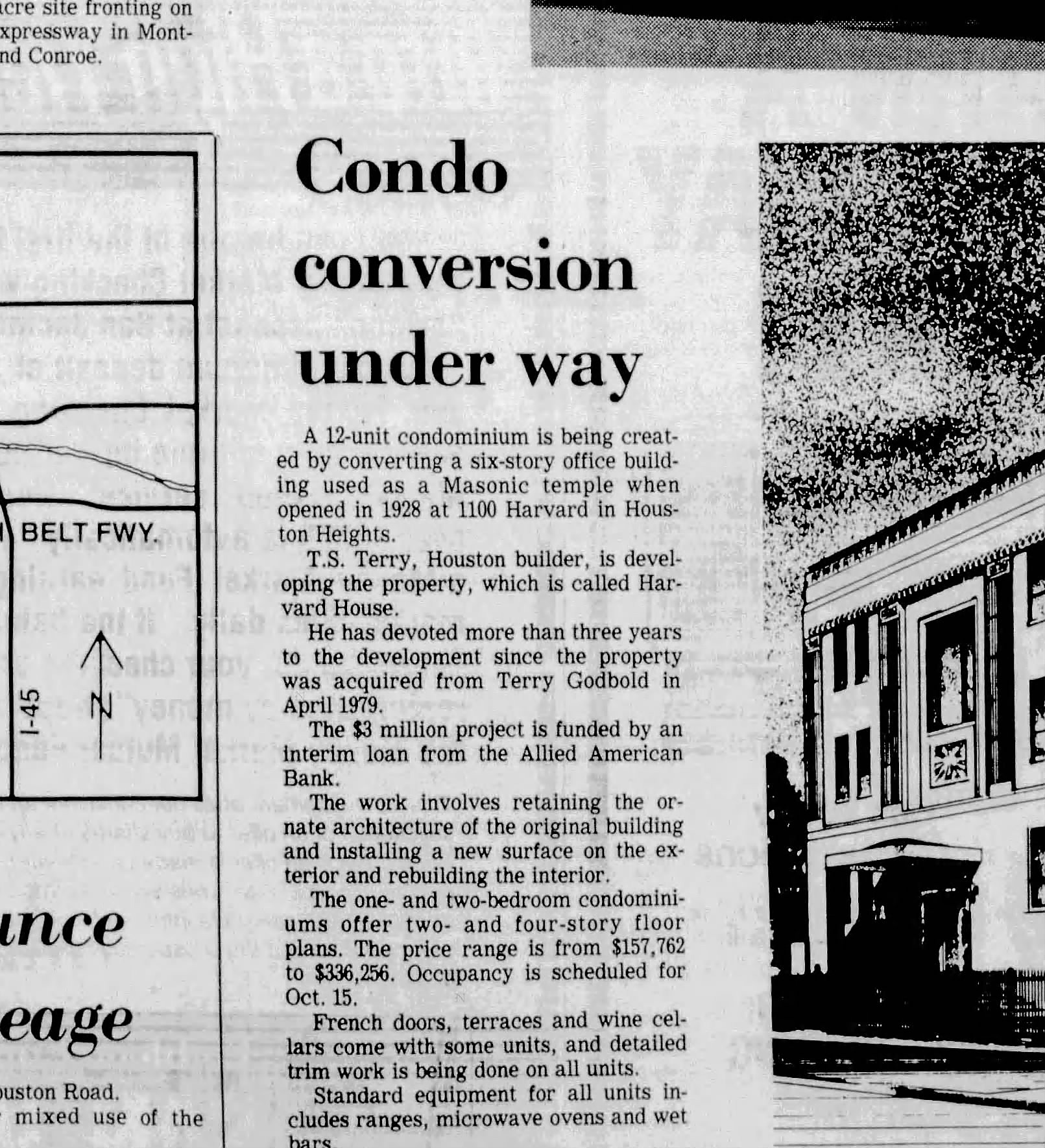
Through the rest of the year the marketing grew more polished, and a second campaign ran alongside the first. Display ads carrying a drawing of the building appeared through the late summer and fall: “Prestigious mid-rise condominium homes located in the historical Heights…in the shadows of downtown Houston. 1100 Harvard at East 11th Street 861-7170” (Post, Aug. 29, Sep. 12/18/26, 1982; Chronicle, Sep. 19, 1982). By November the building was also being sold through a named brokerage, Turner Owens Properties (Chronicle, Nov. 14, 1982, p. 214), at prices far below the antiquity pitch: “HEIGHTS: New 2 bdrms., 2 bath, mid-rise, luxurious, downtown view, $153,000. Good terms. 1100 Harvard St. Mr. Terry. 861-7170” (Chronicle, Oct. 31, 1982, clip 1202532793). The illustration used in that campaign matters beyond the sales history: with no photograph of the building known from any decade before the 1960s, a drawn 1982 elevation is among the earliest depictions of the converted structure the project holds. Unread NewsBank page hits for “Harvard House” still cluster in exactly the months the story should occupy, August through October 1982 for the launch, April 1983, a heavy run of roughly thirty-five pages from May through December 1985, and a scatter in August 1986. The June and July 1985 rental ads inside that run have since been read and are quoted below; the remainder are still unread leads that likely carry more of the conversion's second-wind story.
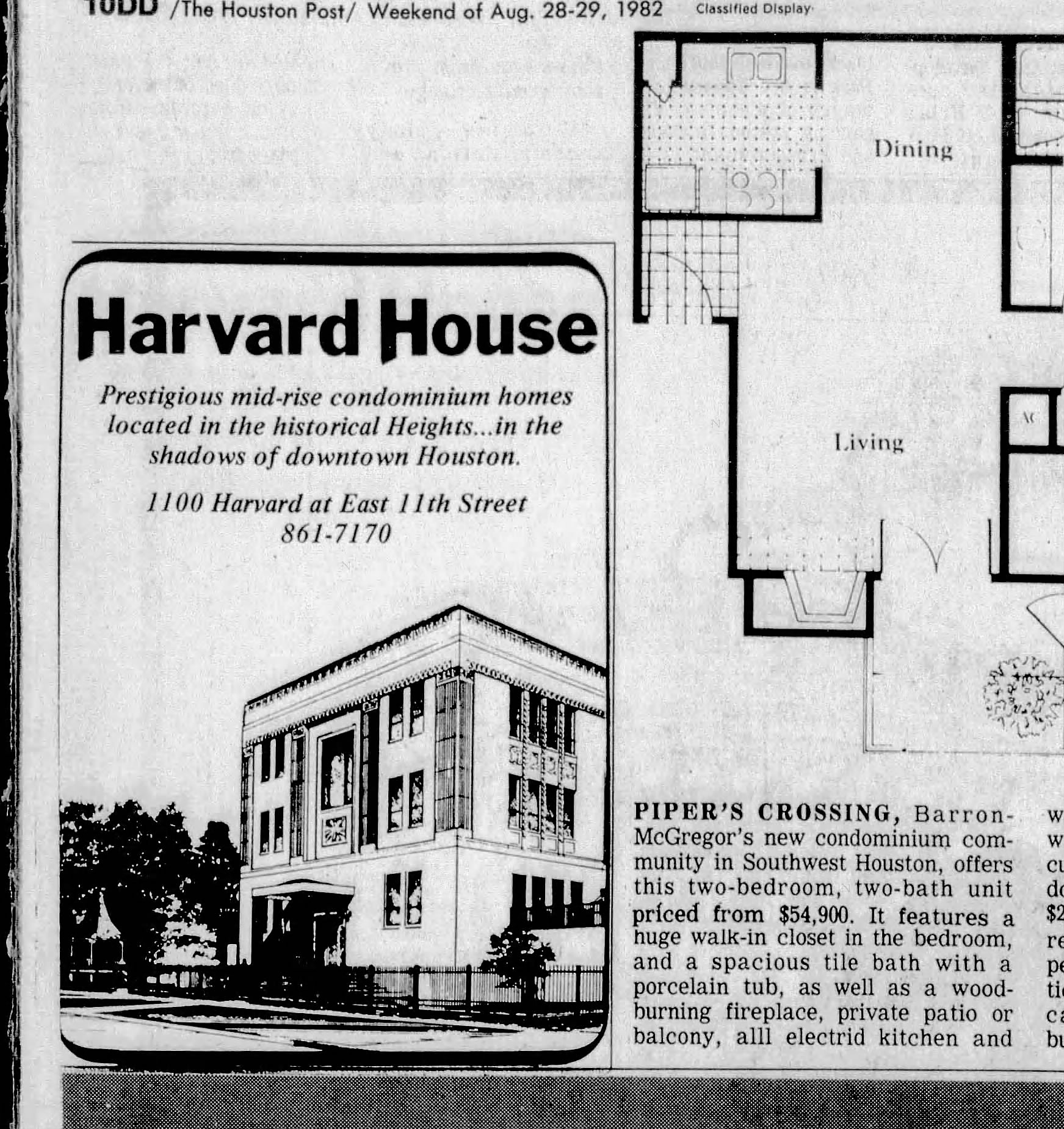
Work on the building itself ran for years, and the help-wanted ads that chart it double as a small chart of the oil bust to come. An April 1983 ad sought an experienced painter at “1100 Harvard Street on East 11th one block east of Heights Blvd. See Roy,” offering $8 an hour (Post, Apr. 27, 1983); by August 1984 the same corner was advertising for painters again, “Apply 1100 Harvard St. See Danny,” at $6.00 an hour (Post, Aug. 19/20/22, 1984). A twenty-five percent wage cut for the same job at the same address, in eighteen months, is the oil bust in miniature. The building earned what it could in the meantime. In March 1983 it was renting furnished efficiencies by the week, “HEIGHTS: Furn. 1 bdrm., or Effic., Linens, dishes, $70 wk. + $70 dep. 864-7512, 861-1860,” on a classified page that also carries an unrelated pitch from a “Terry” at yet another number: “THERE is something new under the sun. Greenhouse room additions. For info. call Terry at 271-0116” (Chronicle, Mar. 23, 1983, p. 63).
The building also acquired a commercial tenant that the conversion story tends to hide, and that the next section's collapse depends on. UnitedBank-Houston operated a retail branch inside 1100 Harvard's commercial row, confirmed by its own classified hiring ad: “BANK TELLER Immediate opening for experienced teller. Full benefits. Apply in person. UNITEDBANK 1100 Harvard Houston, Texas An Equal Opportunity Employer” (Post, Dec. 5, 1984, Classified 620, p. 76 [4E], clip 1205035871). The bank was growing at the time. The Chronicle's “HOW HARRIS COUNTY BANKS RANK” tables put UnitedBank-Houston 19th in the county at $231,991,481 in September 1984 and 16th at $265,879,003 by June 1985 (Chronicle, Oct. 4, 1984, Sec. 3 p. 8, clip 1203626178), after which the same tables trace the slide: deposits of $261.3 million in December 1984, $258.6 million in September 1985, $243.2 million in December 1985, and $230.8 million by December 1986 (Chronicle, Jan. 7, 1987, Sec. 3 p. 2, clip 1205757480). The teller counter downstairs and the mortgage upstairs belonged to the same failing institution.
The developing entity behind the project was “Harvard House, a Texas Joint Venture,” active roughly 1980 to 1985. The condominium declaration was formally filed in 1985 (File No. K060751), and HAR listing data for the property gives “year built 1930 / renovated 1985,” a date that lands with some precision at the national high-water mark of the federally certified historic-rehabilitation tax boom: 6,214 National Park Service project approvals nationwide in 1984, and $4.7 billion in certified rehabilitation cost in 1985. The twelve-unit plan announced in 1982 had become, by the declaration, a fourteen-unit condominium, a figure independently confirmed three times over by the 2000-era coverage quoted later in this chapter. A separate wrinkle stays open: a unit numbered 15 was sold in 1989 in a building of fourteen units, which points to a numbering scheme that skips or runs non-sequentially rather than to a larger total.
The declaration year's advertising is where the building's second name enters the record. In June and July 1985 the property was marketed under two names at once, from two different telephone numbers: “HARVARD HOUSE: 1100 Harvard, 1-2 bdrm, 2-1 1/2. Fully carpeted, quiet. $310 & $360. 864-4412” and “HARVARD PLACE: 1100 Harvard. 1 & 2 bdrms, pool, security gate, W/D conn. $275 & up. 861-1406” (Chronicle, Jun. 17, 1985, p. 22, clip 1208727318; Chronicle, Jul. 15, 1985, p. 23, clip 1208688516). That second name is worth marking now. Harvard Place is the name that reappears seven years later as Harvard Place Inc, the corporation left holding the building after the 1992 workout, and it was already on the building's own rental advertising in 1985.
The rest of that year's rental advertising is a free-for-all. Simultaneous listings under different numbers offered “No pets/children” units at $275 and $350 in one ad and “2 children welcome” at $295 in another; a “Huge 1-bdrm, bills paid” unit was priced at $225 and then $215; an August ad called the property “A condo community” while renting from $275: “HEIGHTS: HARVARD HOUSE APTS. 1100 Harvard. A condo community. Beautiful quiet project. Cable TV, pool, security. 1 & 2 bedroom, from $275” (Chronicle, Aug. 19, 1985, clip 1208498564). Parallel listings ran under the raw addresses “1102 Harvard” at $375 and “1104 Harvard St.” at $260, and by September one ad had begun using a nickname: “HEIGHTS - Harvard House Apts. Pool, Cable. 1 bdrm (unfurn/furn) & efficiencies. $250. bills paid. Old Harvard House. 869-1432” (Chronicle, Sep. 24, 1985, Sec. 5 p. 20, clip 1208892247). Half a dozen landlords appear to have been letting units out of the same building on contradictory terms, in the same weeks the condominium declaration was on file.
One of the men selling into that market posed for the Chronicle in July 1985. Ed “Tracy” Maxon, a failed candidate for Harris County Precinct 5 constable, then with Vancouver International Development, stood with two associates in front of what the paper called “his first major project,” the Harvard House, his Mercedes at the curb: “He sported a dark blue three-piece suit, bright red tie and handkerchief and gaudy diamond rings, gold nugget Rolex watch and bracelet.” His company, the story reported, “plans to sell one- and two-bedroom condominiums for $175,000 to $250,000 each in the Harvard House, possibly to a group of foreign investors” (Russell Grantham, “‘Tracy’ Maxon says real estate ‘more fun,’ but he'd run again,” Chronicle, Jul. 28, 1985, Sec. 3 p. 8 [microfilm p. 70], clip 1208491857). The profile carries its own error, describing the building as a former Masonic lodge “built in the Heights in the early 1900s,” which is the newspaper's mistake and not the building's date. Maxon's episode connects to none of the chapter's other threads at this address: not the ANTIQUITY campaign, not the UnitedBank mortgage, not the later MeritBanc paper. It is one more attempt to sell the same building in the year the declaration was filed.
Then came the turn. By August 1986 the marketing had reversed entirely: “HARVARD HOUSE NOW LEASING … Prestigious Condominium living in the shadows of downtown Houston … Plush 1 & 2 bdrm homes are available with unique 2 & 4 level floor plans … a landscaped gazebo area … Now avail for lease. Shown by Appt. Only. $900 & up.” (Chronicle, Aug. 10, 1986, p. 124; fuller copy, Chronicle, Aug. 2, 1986, Sec. 5 p. 33, clip 1208957224) The appointment-only showings, the $900 floor, and a new telephone line (713-583-1180, distinct from the apartment-era numbers) mark a genuinely new leasing operation rather than a rebranded rental office. Four years after the $318,600 antiquity ads, the project was renting units rather than selling them, the classic failed-conversion pivot arriving in the middle of the oil bust. The gazebo mentioned in the leasing copy sits on the south half of Lot 17, the parcel added to the property's legal description specifically for that amenity.
Failure, receivership, and the workout, 1987–2000
The mortgagee behind the 1985 condominium declaration did not survive the bust. State regulators closed UnitedBank-Houston on Thursday, April 30, 1987, declaring the twenty-five-year-old bank insolvent after losses on real-estate loans. It held $218 million in assets and 13,000 insured accounts; American Bank assumed just under $160 million of insured deposits, paying the FDIC a $200,000 premium plus $90.4 million for assets. “UnitedBank, which had $218 million in assets, was the largest Houston bank failure ever and the second-largest in Texas history” (Post, May 5, 1987, p. 4D, clip 1206363149; Chronicle, May 5, 1987, p. 1, clip 1205816650; Chronicle, May 7, 1987, p. 30, clip 1205818797). A later Chronicle account gives the failed bank's assets as $161 million rather than $218 million; both figures stand in the record and this account does not choose between them.
Who ran it is a thread the project had not previously traced. UnitedBank-Houston was the bank of Houston banker-developer Vincent D. Kickerillo, who bought its predecessor, International Bank, in 1968. John Hazard, chairman of the American Bank that assumed UnitedBank's deposits in 1987, had been International Bank's founding president in 1962 and left a year after Kickerillo's purchase to head Allied Bank of Texas. After the failure Kickerillo sold off some surviving banks and renamed Unitedbank I-10 West of Katy as Community Bank I-10 West; in September 1988 he dropped an application to open a downtown branch at 1300 Texas Avenue after objections from Hazard and American Bank. The Chronicle's account of that episode summarizes the collapse, “Regulators closed Kickerillo's Unitedbank-Houston, a downtown institution with $161 million in assets, in April 1987 after declaring it insolvent. At the time, it was the largest bank ever to fail in Houston,” and quotes Kickerillo on the reunion: “One of my old customers called me and said, ‘You got me again’” (Chronicle, Sep. 13, 1988, Sec. 3 p. 1/11C, clips 1207224556 / 1207224613).
Two years later, on March 16, 1989, MeritBanc Savings Association, the renamed Hardin Savings & Loan, failed as well. MeritBanc's consumer-facing advertising was still cheerful only months before the end: “With the Merit Account there's no monthly service charge no matter how many checks I write…” (MeritBanc retail ads, Jewish Herald-Voice, Sep. 1988–Jan. 1989), a poignant and merely lead-grade eve-of-failure image. A Port Lavaca Wave table of Texas savings-and-loan failures dated March 17, 1989 is an unread page hit that likely lists MeritBanc among the casualties but has not itself been read.
In the midst of the wreckage, ordinary buyers still appeared and ordinary tenants still paid rent. In 1989, Kenneth A. Hilleman bought unit 15 for $108,000, a price consistent with an ordinary market-rate residential purchase rather than a bulk acquisition and most plausibly bought out of distressed, bank-owned, or RTC inventory. That January the building's cheapest units were letting for a fraction of what such a purchase implied: “HEIGHTS: Harvard House, 1 bdrm, $250. bills paid. W/D connect, central air, carpet. 869-4432, 864-7512” (Chronicle, Jan. 24, 1989, p. 19, clip 1214420450). That $250 rate is not a receivership-era low; the identical “$250. bills paid” formula was already running in September 1985. Hilleman himself is a documented research dead end: every permitted biographical channel returned negatives, and with HCAD's own API unavailable, unit 15's later ownership lineage cannot be traced from this record.
The institution's path through receivership left a paper trail of federal litigation. Park Club, Inc. v. Resolution Trust Corp., as Conservator for MeritBanc Savings Association ran from a filing on May 22, 1989 (No. 4:89-cv-01791) to a Fifth Circuit opinion on September 25, 1992 (No. 90-2975), the docket that formally confirms MeritBanc's RTC conservatorship. A cluster of satellite dockets surrounds it.
| Case | Date(s) |
|---|---|
| Park Club, Inc. v. RTC, as Conservator for MeritBanc Savings Assn. | filed May 22, 1989 (4:89-cv-01791); 5th Cir. opinion Sep. 25, 1992 (No. 90-2975) |
| MeritBanc v. Baker III | 1989 |
| Ameriway v. Barrack | 1989 |
| Mega Development v. Ameriway | 1990 |
| Ameriway v. Wise | 1991 |
| Ameriway v. Central Park Assoc. and Buttercup Creek | Dec. 1991 |
| MeritBanc v. Eikenburg & Stiles | 1992 |
| Bowe v. MeritBanc | 1994 |
(CourtListener dockets, MeritBanc/RTC/Ameriway)
In October 1992, Raymond Oshman, former president of Hardin Savings and its successor MeritBanc, was indicted alongside developer Joe Russo in a five-count indictment alleging a conspiracy to channel MeritBanc and Ameriway loans into Russo-owned companies and projects, at an alleged cost to taxpayers of nearly $4.5 million; the scheme also allegedly funneled thrift loans to projects tied to Harvin C. Moore Jr., a former Hardin vice chairman independently corroborated as a convicted figure in Houston's broader savings-and-loan fraud wave (UPI, Oct. 21, 1992; Houston Press). What became of the criminal cases against Oshman, Russo, and Moore could not be retrieved from the available record and remains unknown.
The building's own resolution came in April 1992, and here the record itself is genuinely divided. One reconciliation of the project's research describes the resolution as an “RTC/MeritBanc workout”; a separately maintained narrative account instead describes an “April 8, 1992 RTC/QuestStar workout,” following directly from the March 1989 MeritBanc failure. The two accounts agree that the workout was RTC-era, that the deed was signed April 8 and recorded April 10, 1992, and that the outcome placed the property in the hands of a new entity, Harvard Place Inc, but they disagree on which institution's name belongs on the paper, and even the challenger institution's own name is spelled inconsistently between sources, “Quest Star” in some places and “QuestStar” in others. Only the recorded deed instrument itself can resolve which reading is correct, and this account does not pick a side. The corporate name at least is no longer a puzzle: “Harvard Place” had been running on the building's own rental advertising since the summer of 1985.
The era closes on a second renovation. By June 2000 Ray Allison, Realtors was advertising “1100 Harvard / 14 units now being renovated. / Pick Colors. / Some Ready Now,” and a week later an advertorial had broker associate Bubba Evans reporting five units sold at the “Harvard Place Lofts” (Chronicle, Jun. 11, 2000, Real Estate p. 11, clip 1212918185; Jun. 18, 2000, Real Estate p. 9, clips 1213039468 / 1213039881). The developer behind the work, Silvestri Homes of Texas under president Emilio Silvestri, is named only in the September advertorials, and with him arrives a fourth marketing name for the building: Harvard Lofts, alongside Harvard House, Harvard Place, and Harvard Place Lofts (Chronicle, Sep. 17, 2000, Homes p. 15, clips 1213061567 / 1213063351; also Sep. 24, 2000). That campaign, and the decade of unit-by-unit resales it opened, belong to the next chapter.
The building was trading as ordinary, desirable Heights real estate as the neighborhood's own gentrification wave finally arrived; Heights household income would rise from $41,576 in 2000 to $80,048 by 2015, roughly fifteen years after the first stirrings of 1980s preservation activism in the neighborhood. One lighter note interrupts the decade: in 1990 a film or television production used “the 1100 block of Harvard” as a stand-in for California seven decades earlier (Chronicle, Sep. 27, 1990, p. 70). The block's very shabbiness, by then, had become period authenticity.
One point of preservation-status precision belongs here, because it is easy to get wrong: 1100 Harvard does not appear in the 1983 Houston Heights Multiple Resource Area document (reference 64000847) as an individually inventoried contributing property. The only individually listed contributing property in Block 199 is the Marshall W. Kennedy House at 1122 Harvard (Site No. 114, built 1901), whose 1987 owners were Patrick G. and Rebecca R. Grant, a different Kennedy from the Nellie C. Kennedy who appears as an ordinary 1939 directory resident of the same address; the two should never be conflated. The Multiple Resource Area's references to a “Heights Masonic Lodge #12 at 1606 Heights Blvd.” are themselves a garbled misnaming of Reagan Lodge's later home. Any claim that the 1930 building itself carries “contributing” historic-district status belongs to a later City of Houston designation, not to this 1983 document.
The lodge at 1606 Heights Boulevard: a Grand Master and a slow fade
While the building at Eleventh and Harvard was changing hands and changing uses, Reagan Lodge No. 1037 was about a mile and a half south on Heights Boulevard, and this era gave it its single greatest institutional honor. The Grand Lodge of Texas's Proceedings for 1967, at pages 336 through 342, record the installation of a new Grand Master of Masons in Texas, and the transcript captures the moment his home lodge presented him a hat:
“…I would like to recognize the Worshipful Master of Reagan Lodge, Brother K. D. Swatzel. BROTHER K. D. SWATZEL: Most Worshipful Grand Master, the Brethren of Reagan Lodge No. 1037, your home Lodge, are extremely proud of you on this occasion…it is their heart's desire that I should present to you at this time this hat and carrying case as a visible token of their love and esteem… GRAND MASTER CHANDLER: Thank you…and thank you, the members and my Brethren of Reagan Lodge. I hope that my head hasn't gotten too big in the last few minutes (Laughter.) and it still fits.” (Grand Lodge of Texas Proceedings, 1967, pp. 336–342)
J. W. Chandler of Reagan Lodge No. 1037 was installed Grand Master of Masons in Texas in 1967, the institutional summit of the lodge's whole history: a Depression-evicted neighborhood lodge furnishing the state's Grand Master just under two decades after rebuilding itself on Heights Boulevard. His Grand Lodge biography supplies the career behind the office. “On October 30, 1948, Brother Chandler was raised to the Degree of a Master Mason in Reagan Lodge No. 1037, Houston, Texas. He served this Lodge as Worshipful Master in 1955-1956” (GL Proceedings, Vol. 1968, p. 4). He was District Deputy Grand Master of District 30-B in 1961 and sat on the Committee on Purposes and Policies from 1961 to 1964, took a University of Houston degree in 1959, served in the U.S. Army in the Second World War, sat on the Board of Stewards at West University Methodist Church, and was High Priest of Will N. Kidd Chapter No. 424 R.A.M. in 1957–58. R. G. Vaughn Jr., whom Chandler appointed his Grand Senior Deacon, told him at the installation, “our association goes back some 19 or 20 years, and I remember well when you were raised in Reagan Lodge,” the same Vaughn who had appeared on the lodge's 1949 officer roster. The same 1967 proceedings also recognized the Worthy Matron of Houston Heights Chapter No. 258, Order of the Eastern Star, Sister Joan Meyer, asked all Reagan members present to stand, and recorded a Grand officer, Brother Harriss, saluting his own father-in-law, Past Master R. G. Vaughn Sr.
Chandler was not the only Grand Master in the room. The same proceedings record a speaker telling delegates that “Reagan Lodge will probably be the only Masonic Lodge in the state that bas [sic] two Grand Masters in it next year” (GL Proceedings, Vol. 1967, p. 32), the second being Brother George Daniel, Grand Master of the Council of Royal and Select Masons and, like Chandler, a Reagan Lodge Past Master. Days after the installation, a called meeting on December 30, 1967 observed the lodge's fifty-seventh anniversary, with the sitting Grand Master presenting fifty-year membership awards and giving the principal address (Post, Dec. 30, 1967, p. 31, clip sr1197302339). A fifty-seventh anniversary in December 1967 counts back to December 1910, independent print corroboration of a chartering date the project otherwise takes from the cornerstone.
During his 1968 term as Grand Master, Chandler's own itinerary shows him repeatedly returning home: visits to Reagan Lodge on December 19, 1967, February 27, 1968, and November 5, 1968, plus the “26th Outdoor Degree, Reagan Lodge No. 1037” on October 26, 1968 (GL 1968, pp. 55–59). The Grand Lodge also granted the lodge a dispensation of a different order: Reagan was authorized “to hold a Tiled Meeting in the Scottish Rite Temple, Houston, on January 24, 1968, for the purpose of the Official Visitation of the Most Worshipful Grand Master” (GL 1968, p. 96) to Houston Masonic Districts 30A, 30B and 30C at once, evidence that the lodge remained a flagship Houston lodge more than three decades after leaving 1100 Harvard. The outdoor-degree custom is documented in the official record too: the 1969 Proceedings note an outdoor degree conferred “at the Joe B. Junell Ranch, under the auspices of Reagan Lodge No. 1037, Houston,” with tiled-meeting dispensations granted to Reagan in 1966 (No. 13), 1969 (No. 2), and 1970 (No. 3) (GL 1969, p. 68), the Grand Lodge's own paper trail for a genuine 1960s local custom of holding degree work outdoors at a member's ranch.
Set against the Chandler summit, the membership numbers tell a story of quiet, steady loss. The Grand Lodge statistical tables put the roll at 1,817 in the 1965 volume, which is the documented peak, then at 1,762 in 1966, falling within 1967 from 1,741 to a net 1,713, falling again within 1968 from 1,713 to 1,688, and by 1970 moving from 1,657 down to 1,625.
| Year | Membership (per Grand Lodge return) |
|---|---|
| 1965 | 1,817 (peak; $6,176.70 remitted) |
| 1966 | 1,762 |
| 1967 | 1,741 → 1,713 (net for year) |
| 1968 | 1,713 → 1,688 |
| 1970 | 1,657 → 1,625 |
The 1965 row is drawn from partially OCR-mangled tables; the membership figure itself is legible and consistent across volumes. (Grand Lodge of Texas statistical tables, Vol. 1965, p. 450, and 1966–1970)
Earlier tables in the same series give 1,674 members in 1957 and 1,725 in 1959, so the peak of 1,817 sits at the top of a slow rise and the whole of this era sits on the far side of it. The attrition that followed was part of a national post-war fraternal decline that the Order of the Eastern Star's own membership curve independently tracked as roughly a 75 percent collapse from Masonry's post-World War II high. The lodge kept up its small obligations through the fall. Christmas benevolence contributions of $25 were given in both 1966 and 1967, continuing a charitable thread running back to the building's earliest years, and the Grand Lodge's widows-and-benefits roll admitted a Reagan-affiliated widow on a datable day: “Hollady, Jeanette M. … Reagan … 1037 April 13, 1969” (GL Proceedings, Vol. 1969, p. 195), one of thirteen admissions that year against a statewide roll of seventy-three women. The roster context is solid; what the roll actually paid her, and under which program, is inferred rather than documented. A smaller civic gesture survives from March 1966, when the lodge canceled its own meetings for a week: “no meeting will be held March 7-11 in observance of Public Schools Week; members and families urged to visit the schools,” signed by Secretary J. A. Newsome (Post, Mar. 7, 1966, p. 39, clip sr1196476790). No Grand Lodge volumes after 1970 survive in the project's holdings, so the lodge's membership curve from 1971 through 2000 remains a documented gap.
Individual officers recoverable for the era, beyond the Chandler moment itself, include K. D. Swatzel as Worshipful Master in 1967; W. H. “Bill” Pullingim in 1966 and Marvin Dickey in 1969, both signing alongside the ubiquitous J. F. Helms; a Hannah as Worshipful Master with H. C. Thomas as Secretary in 1985, presiding over a school of instruction that ran the same boilerplate format the lodge had used as far back as 1936 (Post, Oct. 16, 1985, p. 56); and R. H. Cram as Worshipful Master with A. A. Stupl as Secretary in 1997, whose stated-meeting notice reads simply “Stated Meeting 7PM Dinner 6:15PM” (Chronicle, Oct. 7, 1997, p. 72). The 1985 Worshipful Master is deliberately left initial-less here: three notices within two months give him as “B. K. Hannah” (Oct. 16), “R. H. Hannah” (Sep. 18) and “J. W. Hannah” (Nov. 6), all citing Reagan Lodge and H. C. Thomas as Secretary. Almost certainly one man and three typesetting or OCR variants, but the record itself does not say so.
| Year | Worshipful Master | Secretary | Source |
|---|---|---|---|
| 1966 | W. H. “Bill” Pullingim | J. F. Helms | Post, Jan. 7, 1966, p. 37 |
| 1967 | K. D. Swatzel | J. F. Helms | GL 1967, pp. 336–342; Post, Aug. 4, 1967 |
| 1968 | W. K. Helms | J. F. Helms | Post, Apr. 20, 1968, p. 53 |
| 1969 | Marvin Dickey | J. F. Helms | Post, Jan. 31, 1969, p. 41 |
| 1979–80 | E. E. Maltby (printed after his 1977 funeral) | H. C. Thompson | Post, Aug. 1, 1979, p. 23C, clip 1203826571 |
| 1981 | M. S. Devore | H. C. Thomas | Post, Sep. 23, 1981, p. 19 |
| 1985 | Hannah (initials printed three ways) | H. C. Thomas | Post, Sep. 18, Oct. 16 and Nov. 6, 1985 |
| 1987 | Thurmann | A. Stupl | Post, Mar. 28, 1987, p. 11F, clip 1206365085 |
| 1989 | not given in the notice | A. Stupl | Post, Jun. 24, 1989, p. 98 |
| 1990 | James E. Fisher | A. A. Studert | lodge notices, 1990 |
| 1991 | not given in the notice | Kenneth Sparks | lodge notice, Dec. 1991 |
| 1993 | John T. Thomas | David Ross | lodge notices, 1993 |
| 1997 (May) | not given in the notice | A. A. Studert | lodge notice, May 1997 |
| 1997 (Oct.) | R. H. Cram | A. A. Stupl | Chronicle, Oct. 7, 1997, p. 72 |
| 1998 | David Ross | Ken Sparks | Chronicle, Dec. 15, 1998, Sec. E p. 8, clip 1213158640 |
The secretary's surname is printed both “Stupl” and “Studert” across notices and is left unnormalized here. The 1979–80 Maltby row is a printed listing for a man whose funeral the same paper had announced in February 1977, and is included as evidence of the columns' recycled copy rather than as officer service. (Post and Chronicle lodge notices, 1966–1998)
H. C. Thomas is the same “H.C. Thomas Sr.” whose “A Brief History of Reagan Lodge” underlies the lodge's own published website history, a text authored by Lodge Historian James E. Fisher, P.M., who appears in the table above as Worshipful Master in 1990. Grand Lodge committee and appendix rosters from 1966 through 1970 preserve a long list of the era's stalwarts beyond the named officers: N. A. Bobo, W. M. Bradshaw, J. W. Chandler, J. A. Crawford, A. A. Franklin, W. T. Longnecker, W. H. Lynn, A. C. Martindale, C. K. McAlpine, E. K. Mulvogue, H. L. Peak Jr., J. H. Rousseau, John M. Skelton, L. W. Statham, both R. G. Vaughns, W. L. Whisenhant, W. R. Womack, Harvey L. Wood, Jack L. Wright, Joe W. Lively, M. D. Hart, K. D. Swatzel, H. C. Thomas, T. V. Montgomery, Hugh J. Cobb Jr., James W. Lotspeich, Walter L. Funk Jr. (who held dual membership in Reagan and Aldine lodges), Billy D. Colegrove, Clifford H. Davis, Paul W. George, John J. Turner, and J. R. Bartlett; recognitions from 1966 and 1969 add James G. Coombs, Willis H. Germany, William L. Goyen, Richard L. Conway, Charles W. Eberley, Tom Hughston, and Charles F. Timmerman (GL committee/appendix rosters, 1966–1970). These are service and committee rosters, not death notices; a labeling confusion in one working document mislabeled recurring-name rows as “memorial pages” when the underlying pattern is simply names that appear across multiple years of committee service.
The lodge's partner chapter followed it up Heights Boulevard on the same schedule. Houston Heights Chapter No. 258, Order of the Eastern Star, was printing 1606 Heights Blvd. as its own address by August 1970, and did so in near-identical classifieds for four years, including a December 1973 evening honoring the sitting Grand Master and Worthy Grand Matron: “Called meeting 8 p.m. to Honor Mrs. Thelma Joyce Alsup, Worthy Grand Matron of Grand Chapter of Texas, O.E.S. and Bro. Dan B. Jordan, Most Worshipful Grand Master of Masons in Texas” (Post, Dec. 10, 1973, p. 63, clip 1197016051). The chapter's own founders surface in the same decade's obituaries: Katie B. Collins, “Co-founder, past matron Houston Heights Chapter No. 258 O.E.S., member O.E.S. Grand Chapter of Texas” (Post, Sep. 27, 1974, p. 16/D, clip 1197777355), who died in 1974, and charter member Marie A. Dietrich, who died in 1972, alongside Irene Reddick (d. 1967), Grace E. Cain (d. 1970) and Nellie Mitchell (d. 1971).
The congregational thread of the lodge's life across these three decades survives most vividly in its obituary record, a roll call of ordinary Houstonians whose funerals or graveside rites the lodge conducted, or whose deaths its members marked.
| Name | Death | Note |
|---|---|---|
| Eugene Fletcher Rawls | Jan. 31, 1971 | age 68; mechanic, Galveston Fleet Service; graveside rites under “Regan [sic] Lodge No. 1037 AF & AM” |
| William Robert Taylor | Aug. 1974 | Order of Railroad Telegraphers; no lodge of his own listed; “Escort and pallbearers: Members of Reagan Masonic Lodge No. 1037” |
| Weldon Arthur Hendrick | Sep. 21, 1974 | SPJST Lodge 88 resolution |
| James Mack Hanberry | Jul. 1975 | Pan American Airways; member of Austin Masonic Lodge No. 12; graveside rites by Reagan Lodge |
| John G. Irwin | 1979 | 38-year HPD veteran; Reagan Lodge funeral; pallbearer Capt. Leroy Mouser |
| Aubrey Charles Martindale Sr. | Dec. 14, 1985 | age 77; Past Master of Reagan Lodge, Past Commander K.T., Past High Priest of Reagan Chapter, Past Master of Reagan Council, Past Patron OES |
| Capt. Robert Leo Horton Sr. | Dec. 16, 1985 | HPD |
| Ray R. Hauser | Apr. 28, 1988 | Heights OES 258 |
| William M. “Slim” Thompson | Jan. 27, 1989 | age 90, of Livingston, formerly Houston; W. M. Thompson Contracting; Painters Local No. 130; Scottish Rite; Arabia Temple Shrine |
| Ollie T. “Robbie” Robertson | Oct. 1989 | no further detail in the notice |
| Roy Reginald Foreman | Jun. 1990 | Past Patron, OES 258 |
| Eston A. Hicks | Aug. 9, 1990 | no further detail in the notice |
| Dr. John O. Nance | Feb. 8, 1991 | age 73; 454th Bomb Group, 15th Air Force, Italian theater; Chief of Staff, Heights Hospital; founder and past president, American Board of Family Practice |
| E. D. “Sleepy” Sowell | May 17, 1991 | Entex; graveside rites by Reagan Lodge, A F & A M |
| Dr. Mylie E. Durham Jr. | Jun. 3, 1991 | 40 years a Heights surgeon; son of Heights Hospital co-founder Mylie E. Durham Sr.; past president, Harris County Medical Society and Texas Medical Association |
| James A. Newsome | obit Feb. 1992 | Lodge secretary through the entire 1936–49 exile era; “Graveside services under the Auspices of Masonic Reagan Lodge 1037” |
| Woodrow “Woody” Jordan | Oct. 25, 1992 | no further detail in the notice |
| Walter William Grant | Oct. 27, 1992 | Southern Pacific, 1926–72; Heights Odd Fellows |
| James C. Quine | Oct. 30, 1992 | age 82 |
| Thomas William Dover | Dec. 1992 | 60-year violinist; North Forest ISD principal |
| Robert John Perry | 1993 | OES 258 |
| James W. Farrar | Jul. 7, 1994 | a prisoner of war for 42 months from 1942; 35 years with the Postal Service; 32nd-degree Mason |
| Henry F. “Hank” Rabon | Apr. 24, 1995 | age 78; raised a Master Mason at Reagan Lodge Apr. 21, 1951; transferred to Leakey Lodge No. 622 in 1971; graveside rites still under Reagan Lodge's auspices |
| Alvy Neal Grantham | May 12, 1995 | raised in Reagan 1946; co-organizer and twice Master of Memorial Lodge No. 1298 |
| James E. Wahlberg | May 25, 1995 | no further detail in the notice |
| W. C. “Bill” Cooke | 1995 | AFL-CIO, a union Mason |
| Robert L. Brasseal | 1995 | 30-year HFD; 50-year member |
| Edward Croix, CLU | Oct. 8, 1995 | age 73; Marine in the Second World War; founded Eddie Croix Insurance Agency 1956; owned All Park Finance Co. to 1990; 32nd degree, Arabia Temple Shrine |
| Joe John Bartos | Dec. 22, 1996 | Austin Furniture |
| Splawn Lowe Cooper Jr. | Jan. 18, 1997 | Reagan High School, Navy in the Second World War, pharmacist, Houston Yacht Club; buried under Reagan Lodge's auspices |
| Capt. M. F. Patton | Jun. 1997 | Harris County Sheriff's Dept. under C. V. Kern; also Woodland Lodge 1157 |
| Harvey O. Brown | Dec. 1, 1998 | 50-year Mason; past president, Texas Road Builders Association; retired from Koppers Company; graveside rites conducted by John Skelton |
| Robert G. “Bob” Vaughn Jr. | b. Jan. 2, 1913 – d. Mar. 18, 1999 | Past Master, 50-year member, Golden Trowel, Scottish Rite 33°, Grand Senior Deacon under Chandler's 1968 term |
| Edwa Lee Miller | Dec. 1999 | eulogy by Hon. Benjamin R. Duncan |
| “Robert [surname illegible]” (Past Master) | Mar. 2000 | surname obscured in the clipping |
All entries confirmed per the underlying clipping; Portal-OCR-only items are graded as leads. (lodge death notices and obituaries, 1971–2000, including Post, Feb. 1, 1971, p. 53, clip 1197412114; Chronicle, Aug. 22, 1974, Sec. 4 p. 9, clip 1203595830; Post, Dec. 14, 1985, p. 30D, clip 1205396088; Chronicle, Jan. 27, 1989, p. 26A, clip 1214421105; Chronicle, Feb. 10, 1991, p. 48B, clip 1215860843; Chronicle, Jun. 6, 1991, p. 38A, clip 1207174436; Chronicle, Jul. 10, 1994, p. 24A, clip 1211070377; Chronicle, Apr. 25, 1995, p. 16A, clip 1208446055; Chronicle, Oct. 10, 1995, p. 14A, clip 1209809236)
One of those entries carries more of the building's own institutional history than the rest. Aubrey Charles Martindale Sr. had led nearly every Masonic body headquartered at the old Harvard Street temple, serving as Past Master of Reagan Lodge, Past Commander of the Knights Templar, Past High Priest of Reagan Chapter, Past Master of Reagan Council, and Past Patron of the Eastern Star. His working life spanned two of Houston's most recognizable public institutions: he “Retired from the Houston Police Department in 1957 and retired from the County Medical Examiner's Office in 1973.” His honorary pallbearers were listed as “Herman Short, Tom Eubanks, Roxie Simpson, Moody Stevenson, Dr. Joseph A. Jachimczyk, Dr. Don Quast and Dr. John P. Stanford” (Post, Dec. 14, 1985, Death Notices p. 30D, clip 1205396088), Short being the former Houston police chief and Jachimczyk the county's long-serving chief medical examiner. Both identifications rest on name matching within the notice and warrant a confirming check before they are relied on.
One entry deserves its own correction: a Post item from August 1, 1985 was at one point read as reporting the death of a retired HPD captain named “Nagan McBride.” That reading is a fabrication produced by column bleed on the scanned page, and has been corrected; the underlying obituary belongs to an unnamed retired HPD captain, not to anyone called McBride.
The demographic running through this whole roll, police captains and firemen and railroad men and furniture dealers and surveyors, is itself a kind of portrait of the lodge's membership across the postwar decades. It was not a uniform one. When Meyer K. Weiss died in 1969, his obituary paired the two halves of his life without comment: “He was a member of Congregation Beth Israel, and a member of Reagan Masonic Lodge No. 1037, A.F.&A.M.” (Chronicle, Jun. 15, 1969, p. 49, clip 1201657588), with Rabbi H. J. Schachtel officiating and burial in Beth Israel Cemetery. Nor was the roll confined to the lodge's own members. Reagan buried men who belonged to other lodges, like the Austin Lodge No. 12 member Hanberry, and men who belonged to none, like the railroad telegrapher Taylor, acting as a citywide burial proxy for anyone with a Masonic connection and no lodge nearby.
Running through nearly every entry is the same recurring partner institution: Houston Heights Chapter No. 258, Order of the Eastern Star, whose bond with Reagan Lodge is documented at the building itself in 1936, on the dais at Chandler's 1967 installation, at a 1988 bazaar, and in a 1991 centennial book's photo caption reading “John H. Reagan Masonic Lodge No. 1037, Heights Chapter No. 258 OES.” The plainest statement of the relationship comes from the chapter's own notice board: “HOUSTON HEIGHTS CHAPTER NO. 258, O.E.S. 1606 Heights Blvd. Called meeting 8 p.m. to entertain Masons and families of Reagan Lodge” (Post, Jul. 8, 1974, p. 23C, clip 1198208039). Lighter notes survive too: the lodge held a garage sale on February 23–24, 1996, 8 a.m. to 4 p.m. (Chronicle, Feb. 17, 1996, p. 265, clip sr1213065681), fraternal fundraising at neighborhood scale; and DeMolay's Houston and Reagan chapters co-hosted a state conclave on June 23 of an unstated year, a lead still awaiting a date.
The 1988 notice of “J. W. Chandler Day,” set by Grand Master Childress for November 21, 1988 (Post, Nov. 18, 1988), and a member's 2000 obituary listing membership in the “J.W. Chandler [Lodge]” both trace back to the same 1967 summit: a lodge later named for the man Reagan Lodge had sent to the head of Texas Masonry two decades earlier. Chandler himself stayed in circulation, appearing in February 1972 as guest speaker at the twenty-fifth anniversary Charter Members and Past Masters dinner of Gus A. Brandt Lodge No. 1296 (Post, Feb. 14, 1972, p. 23, clip 1196886695).
The era's last word from the lodge is domestic. Its Christmas-party notice of December 1998, under Worshipful Master David Ross and Secretary Ken Sparks, ends with a postscript: “NOTE: Please bring items for Christmas party at the Lodge. A light meal will be served at 6:30 p.m. All Mason brothers please stop by for a visit after dinner to see our new carpet” (Chronicle, Dec. 15, 1998, Sec. E p. 8, clip 1213158640). Thirty-one years after furnishing Texas its Grand Master, the lodge was inviting the brethren over to look at the floor.
People codas
Arne G. Engberg, the architect of the building's 1951 addition, remained professionally active well into this era. He served as Secretary of the AIA's Houston chapter in 1952 and practiced in partnership as “Emory S. White & Arne G. Engberg, Architects”; one source gives the firm's address as 2017 South Shepherd for 1956–58, while Portal bid notices instead give 3110 Eastside for 1957–60, an address conflict logged but not resolved. He designed Leonard's Store No. 8 in 1956, produced a stream of school-district work, and volunteered the observatory built by the Lamar High School Astronomy Club, which made the Post's front page on February 1, 1959. His own house at 24 Stillforest won a 1960 AIA merit award, and the society columns catch the household there: a “get acquainted sherry” at 24 Stillforest in 1966, a $5 Goodfellows donation in 1969, and his daughter Marion's wedding announcement in 1967. His father died in the same decade: “HERMAN C. ENGBERG, 84, of 4715 Griggs Rd, passed away Saturday morning. Survived by: Son, Arne G. Engberg; daughter, Mrs. Marion E. (S. G.) Forsyth” (Post, Apr. 10, 1966, p. 36, clip 1197364071), a Marion who is Arne's sister and not his similarly named daughter.
The firm changed names twice more as the era went on, from Emory S. White & Arne G. Engberg to White, Engberg and Associates and then to Engberg, Simmons, Cavitt, McKnight and Weymouth. Engberg was still working under the second of those on May 14, 1970, on an Alvin ISD remodel, and defended a rejected $2,890 re-roofing proposal in a Channelview ISD dispute the same year; under the third, “Arne G. Engberg, of the architectural firm of Engberg, Simmons, Cavitt, McKnight and Weymouth, presented schematics for the Alief Elsik High School” in July 1973 (Post, Jul. 5, 1973, p. 100, clip 1197622207). He retired to New Mexico and died there. Arne G. Engberg died July 4, 1977 in Albuquerque, a “Former Houstonian, moving to Albuquerque on retirement,” survived by his wife Ruby L. Engberg, his daughter Mrs. Sikes (Marian) Johnson of Midland, and his son Stephen B. Engberg of Washington, D.C. (Chronicle, Jul. 13, 1977, Deaths p. 30 / Sec. 4 p. 9, clip 1204929686) The “1948–1965” label attached to one file of his clippings is a clipping-date range, not his life span, and the obituary's “Stephen B. Engberg” supersedes any working note that calls the son “Arne G. Engberg Jr.”
Fretz Construction, general contractor for the 1951 addition, litigated against Southern National Bank of Houston in 1980–82 over its role as an interim construction lender, filed for Chapter 7 bankruptcy on June 20, 2017 (Case No. 17-33832, S.D. Tex.), and saw its remnant assets pass to Oak Point Partners in November 2018; a 2018 entity called “Fretz Construction Management LLC,” based in Roanoke, Texas, is of unclear relation to the original firm. Walter P. Moore Sr., the addition's structural engineer, died in 1983 at age 80; his son, Walter P. Moore Jr. (1937–1998), carried the firm forward.
The 1930 building committee has one member whose own life closes inside this era. Charles Seldon Bawcom, whose fuller family reconciliation belongs to the chapter that follows this one, resigned in 1967 as one of four long-serving Houston draft-board chairmen amid that year's changes to the draft law: “C. S. Bawcom, 75, of 3116 Rice Blvd., chairman of No. 57. He has served more than 20 years” (Chronicle, Jun. 25, 1967, p. 20, clip 1201259486). He appears among the lodge's deceased brothers in the Grand Lodge memorial roll of 1970, “Brother Charles S. Bawcom, Reagan Lodge No. 1037, Houston” (GL Proceedings, Vol. 1970, p. 96), which dates his death to roughly 1969 or 1970. His mother-in-law's obituary supplies an organization documented nowhere else in the project: Mrs. Jessie Hallenberger, who died in 1973, “was past president of the Reagan masonic Auxiliary,” her survivors including “Daughter and son-in-law, Mr. and Mrs. C. S. Bawcom of Houston” (Chronicle, Mar. 13, 1973, p. 70, clip 1201659629). A second unfamiliar body surfaces the same way, in a 1961 notice that falls just outside this chapter's own window: “REAGAN CHAPTER, NO. 1002, O. E. S. Stated meeting Thursday, 8 p. m. Initiation. Mrs. Doris Mae Cox, W. M.” (Post, Jun. 13, 1961, clip 1195670535), an Eastern Star chapter distinct from both Reagan Chapter No. 222 and Houston Heights Chapter No. 258. Neither the auxiliary nor Chapter No. 1002 appears anywhere else in the corpus, and nothing dates either body's founding, membership, or dissolution.
Two figures from the old shop row round out the era. Henry F. Tlucek, proprietor of the strip's long-lived pharmacy, is the same Tlucek whose 1951 missing-girl story once put “Tlucek's Pharmacy, 103 [an error for 203] East Eleventh” into the news, an era-straddling piece of color rather than a fact of this era proper. And “Red” Ortman, the outboard-boat dealer of the late-1950s strip, had by 1999 suffered a heart attack; his daughter Sharon and her husband Gus Kopriva bought his building that year and turned it into Redbud Fine Arts, later the nonprofit Redbud Arts Center named in his memory, the commercial block's own adaptive-reuse afterlife running in parallel to the temple's.
Finally, City National Life, the era-3 owner-insurer whose president Lester A. Miller had put the 1951 addition on the building, is absent from the Texas Life & Health Insurance Guaranty Association's insolvency list, which covers failures dating back to 1973. The company therefore exited, merged, or was renamed before that year, or else never failed at all. No corporate link between it and “City National Bank” of Houston has been found. Its exit is part of the same 1964–65 ownership fog that surrounds the International Fidelity Insurance Co. interest with which this chapter opened.
What This Era Still Cannot Answer
- Whether International Fidelity Insurance Co. ever executed any part of its 1964 renovation plan, and what exactly its 1964 “interest” in the property was: purchase, mortgage, or assumption from City National Life.
- Who owned the building between 1965 and 1979. The chain from International Fidelity (or its successor) to Terry Godbold, and Godbold's own tenure and identity, remain completely undocumented.
- What the building's 1970s occupancy actually was. The city-directory gap of 1972 to 1981 leaves the question of whether the apartments were occupied at all unanswered.
- Which of the “11th & Harvard” lodge notices printed between 1966 and 1995 record meetings that actually took place in the building, and which are recycled classified boilerplate. No test in the surviving record separates the two.
- Who signed as “J. F. Helms, Sec.” under every Reagan-family fraternal notice from January 1966 through at least 1983, given that the founding secretary of that name died in September 1932. Either a same-named relative held the post for decades, or the signature is more recycled copy.
- What the January 15, 1972 “cornerstone ceremonies…on the corner of 11th and Harvard Sts.” actually were, and whether the 1972 Grand Lodge Proceedings minute any such ceremony.
- Which initials belong to the 1985 Worshipful Master printed variously as B. K., R. H. and J. W. Hannah, and whether the secretary printed as both “Stupl” and “Studert” is one man.
- Whether a third Reagan Lodge member reached a Grand Mastership. A 1964 Grand Lodge transcript has a speaker ask “the members of Reagan Lodge No. 1037 to please rise. (Applause.)” immediately before a line labeled “GRAND MASTER HINSLEY” (GL Proceedings, Vol. 1964, p. 388), but the fragment never states Hinsley's own lodge, and the inference is not safe to assert.
- The declarant and the UnitedBank mortgage terms in the 1985 condominium declaration (File No. K060751), cited via deed-related findings but never itemized; and why a building of fourteen units contained a unit numbered 15 in 1989.
- Which institution's name belongs on the 1992 workout, MeritBanc or “Quest Star”/“QuestStar,” and the corporate history of the resulting entity, Harvard Place Inc. Both await the recorded deed instrument.
- Whether UnitedBank-Houston held $218 million or $161 million in assets when it was closed in April 1987; the Post and the Chronicle give different figures for the same failure.
- What became of the criminal cases against Raymond Oshman, Joe Russo, and Harvin C. Moore Jr. after their October 1992 indictment.
- Unit 15's later ownership lineage, and the fuller story of buyer Kenneth A. Hilleman, both unreachable with HCAD's records offline to this project.
- The lodge's own membership curve from 1971 to 2000. No Grand Lodge volumes after 1970 survive in this project's holdings.
- T. S. Terry's full identity and other projects, and his relationship, if any, to Terry Godbold, along with a separate unresolved question of whether this T. S. Terry is connected to a W. O. Terry named as a 1930 Junior Deacon of the lodge.
- Whether an April 14, 1980 Texas Historical Commission photograph taken of 1123 Harvard next door happens to catch 1100 Harvard in its frame, which would be the first known image of the building in its pre-conversion state.
Complete Research Dossier, Era IV: The Long Slide, the Condo Gamble, the Workout (1965–2000)
ERA 4, 1965–2000: The Long Slide, the Condo Gamble, the S&L Bust, and the Workout
Master synthesis, authored independently from the era evidence files. Grades: CONFIRMED / LIKELY / SPECULATIVE / LEAD; quotes verbatim (OCR garble preserved where flagged).
0. The era in brief
Era 4 opens with the building in the hands (or at least the plans) of a Dallas insurer and closes with it in the hands of its own residents. In July 1964, the International Fidelity Insurance Co. of Dallas commissioned a full "Proposed Renovation" of the old temple from the Houston firm Wirtz, Calhoun, Tungate & Jackson, shops rebuilt, offices re-partitioned, the third floor cut into apartments, and the basement floor lowered. By late 1965, however, the building was instead being offered in the classifieds ("3 stories 3842 sq ft each… possible conversion to apartments"). By the end of the 1960s, the corner had slipped so far that the Morrison & Fourmy city directories stopped listing 1100/1102 Harvard St. at all, while the surrounding Heights neighborhood bottomed out, "impoverished and decrepit" by 1970, with the Dean Corll murders staining the neighborhood's name from December 1970.
Then came the gamble: developer T. S. Terry, who acquired the property from Terry Godbold in April 1979, launched a $3 million, luxury condominium conversion, officially designated "Harvard House" in the declaration but marketed concurrently as "Harvard Place", bankrolled by an interim construction loan from Allied American Bank. Ads from 1982 promised "ANTIQUITY with modern class, and prestige" at prices up to $336,256 a unit, hitting the precise national high-water mark of the federally subsidized historic-rehab boom. By late 1984, the building's commercial row housed a retail branch of UnitedBank-Houston, which advertised for a teller at "1100 Harvard."
The oil bust broke the project. By August 1986, Harvard House was advertising units for lease rather than sale. UnitedBank-Houston failed in April 1987; the property's paper landed in MeritBanc Savings (the renamed Hardin Savings & Loan, whose president Raymond Oshman would be indicted for thrift fraud in 1992), and then in the Resolution Trust Corporation (RTC) during the S&L bust. A 1992 workout left "Harvard Place Inc." holding the property. Individual owners, like Kenneth A. Hilleman, who paid $108,000 for unit 15 in 1989, bought through the wreckage. By 2000, the gated 14-unit complex, marketed by Ray Allison, Realtors as "Harvard Place Lofts," saw brisk sales as gentrification returned to the Heights.
The lodge, meanwhile, spent the era at 1606 Heights Boulevard in slow demographic decline from its ~1,760-member peak. However, it achieved its crowning moment in 1967 when its own J. W. Chandler was installed as Grand Master of Masons in Texas, with Reagan Lodge No. 1037 marching up the aisle to present him with his hat.
1. 1964–65: the Dallas insurer's renovation that wasn't (and the blueprints that survive)
The project holds a photographed set of original blueprints (the project image archive): "Proposed Renovation," Wirtz, Calhoun, Tungate & Jackson, Commission 64-08, dated July 10, 1964, client "The International Fidelity Insurance Co., Dallas, Texas." CONFIRMED (primary artifact). This is the single most important architectural document of the era:
- Sheet 1 (site plan & section): Property measures 225'-0" along Harvard St. × 132'-0" along E. 11th St. (matching the Lots 13–16 + S½17 envelope). The main building is 39'-0" wide (front/West facade) and 49'-0" wide (rear/East facade), with a total length of 102'-10" (divided into a 54'-1" × 39'-0" front section and a 57'-10½" × 49'-0" rear section). The total height is 59'-7¼" (Ground El. +12.0', Second Floor El. +27.0', Third Floor El. +41.0', and roof penthouses El. +59.0'). Features a 15'-0" rear alley, concrete walkways, and asphalt-paved parking on the north side. Crucially, it proposes a new basement floor at +1'-4", i.e. a proposal to lower the old basement floor (the bowling-alley level) from its +0.0' elevation.
- Sheet 2 (basement & street floor plans): Shows structural columns, elevator shaft, stairwells, and partitioned rooms. The street floor plan shows a one-story commercial row along E. 11th St. (total length 132'-0") containing seven storefronts with plate-glass windows (widths: 21'-9½", 12'-1½", 12'-5", 14'-4½", 10'-9", 11'-6", and 10'-9"). Hatch markings indicate walls of structural tile and face brick.
- Sheet 3 (first floor plan): Shows a central hallway configuration with partitioned offices or residential units on both sides, a central elevator shaft, and a main stairwell (UP/DOWN) at El. +12.0'.
- Sheet 4 (second floor plan): Central corridor with offices or apartments on both sides, a staircase and elevator shaft in the center-right section, and a large stairwell opening dimensioned 23'-11" × 22'-0" (at the front/West side, likely reflecting the double-height volume of the old lodge room).
- Sheet 5 (third floor plan): Layout of the third-floor apartment conversion, showing units with bathroom fixtures (toilet, tub, lavatory), closets, and kitchen/kitchenette areas. The left (West) wing measures 58'-4" (N-S) × 41'-0" (E-W), and the right (East) wing measures 61'-2" (N-S) × 102'-6" (E-W), for a total building length of approximately 143'-6". Structural steel I-columns are shown embedded in the masonry walls.
- Elevations Sheet (unnumbered): Displays South, West, and North elevations. The West (Harvard St.) main facade shows four brick pilasters with decorative stone caps, a large multi-story central stairwell window, and double entrance doors with steps. Crucially, "a faint trace/outline of the Masonic emblem (Square and Compass) is visible on the pediment/frieze area above the columns" as drawn by the draftsmen in 1964, providing a fixed point in the long-running did-the-emblem-survive question. The South elevation shows ground-floor shop fronts under six upper window bays. The North (parking area) elevation shows a rear facade with material callouts for "GLAZED TILE" on the lower rear facade, "ORNAMENTAL STONE" for trims, "FACE BRICK" for primary walls, and "WOOD SASH" for windows.
- Sheet VOID: A blank blueprint template sheet showing only the border and title block, marked "VOID" and "SECOND" in handwritten pencil, indicating a discarded draft for the second floor.
- Stray Roll Contents: The roll also contained stray sheets from an unrelated industrial/aerospace project (issued April 9, 1964) and non-blueprint research artifacts including two Houston Public Library (HPL) MSS 0229 photographs of the lodge itself: a c. 1910s–20s outdoor group photo (MSS 229-139) and a Feb 1946 lodge-room interior showing Knights Templar regalia annotated "Order of Red Cross and Order of Malta 2/20/1946" (MSS 229-140), the latter belonging to the 8th & Harvard/Heights Blvd. exile-era temple (subject of research plan 74).
Context and fate. Wirtz, Calhoun, Tungate & Jackson (WCTJ) was expanding during Houston's "fantastic construction boom" (Chronicle, Jul 12, 1964, p. 92, naming associates Larson, Moreland, Symonds Jr., and Kearns, with spokesman Harold Calhoun). The client matches the deed-chain row "1964 International Fidelity Interest: [UNKNOWN]" (research plan 91) and open plan 83 (International Fidelity Insurance Co. of Dallas). Fifteen months after the blueprints were dated, the building was offered for sale (the Oct–Nov 1965 Chronicle classifieds: "3 stories 3842 sq ft each… possible conversion to apart[ments]," "presently leased… recently vacated"). Whether any of the 1964 renovation was executed is UNKNOWN, the sale ads' "recently vacated" office space and unchanged 3-story description suggest little or none of it was built. The blueprints read best as the Dallas owner's abandoned repositioning study, the building's first (unbuilt) apartment-conversion design, seventeen years before Terry's real one. (LIKELY interpretation).
2. 1965–1979: the corner disappears
- The directories stop seeing the building. In the c. 1968–71 Morrison & Fourmy directory microfilms, the Harvard Street numbering runs 1046 → 1101 (Fischer, Edw J) → 1105 (Bartlett) → 1107 (McCafferty): no 1100 or 1102 line at all, "the corner lot (our building) does not carry its own street-directory line in this edition" (read twice, confirmed; IMG_20190606_194652/194709). CONFIRMED. Already in one 1959 directory capture, the numbering had skipped the corner; by circa 1970 the omission is total. Nearby duplexes at 1214 Harvard had tenants like Pacini Joe, Hadley Dean E, Collins Dorothy, Rackel Margt, and Thompson Louise, and later Cooke Roger E, Bradshaw Donald, Heaven Roger, Hunt Fred, Carroll John, and Mrs. Jacquelyn Solomon.
- The shop row soldiers on, c. 1968–71: ~203/205 Tucker's/Tlucek's Pharmacy (the pharmacy's last documented years); ~207-211 Kirby Heights Inc. (vacuum cleaners); ~215 Houston Post Station 67 (a newspaper distribution substation, echoing the strip's 1942 Heights Citizen office and its old U.S. post office substation); ~217 Langford's Speed Wash; ~219 Al's Barber Shop; ~221 R&R Resale Shop; ~222 a used-furniture store; 301 Ortman's Red Outboard Boats (now across Cortlandt). CONFIRMED (directory photos; ~digits uncertain).
- Directory coverage gap: 1971, 1971-72, and 1980-81 reels were photographed as box labels only; no page images exist in the corpus for 1972–1981. The building's 1970s occupancy is the era's biggest evidentiary hole.
- Fraternal life at the temple continues through 1969. Verbatim newspapers.com transcripts show that while the lodge moved to 1606 Heights Boulevard in 1935, affiliate bodies met at 1100 Harvard (referred to as "Reagan Temple") until at least 1969. Primary-source notices include:
- January 1966: Reagan Chapter No. 383 RAM (convocation Monday, Jan 10, 7:30 p.m., E. O. Overhultz Jr. H.P.); Reagan Council No. 348 R&SM (stated assembly Monday, Jan 10, 8:30 p.m., E. O. Overhultz Jr. T.I.M.); and Reagan Chapter No. 222 O.E.S. (stated meeting Monday, Jan 10, 7:30 p.m., Mrs. Ruth Overhultz W.M.). All list J. F. Helms, Sec., and meet at "Reagan Temple, 11th and Harvard" (Post, Jan 7, 1966, p. 37, Clip ID: 1196668340).
- April 1968: Two conflicting notices appear in the Post. A notice on Friday, April 19 lists Reagan Chapter No. 488 R.A.M. and Reagan Council No. 348 R.&S.M. meeting Monday, April 22 at "Reagan Temple, 11th and Harvard Sts." with J. B. Helms, H.P. / T.I.M. and J. F. Helms, Sec. (Post, Apr 19, 1968, p. 67, Clip ID: 1196757439). A notice on Saturday, April 20 lists Reagan Chapter No. 383 R.A.M. and Reagan Council No. 322 R.&S.M. meeting Monday, April 22 with W. K. Helms, H.P. / T.I.M. and J. F. Helms, Secy-Rec. (Post, Apr 20, 1968, p. 53, Clip ID: 1196757938). The latter also lists Houston Heights Chapter No. 258 O.E.S. meeting at "Reagan Temple, 11th & Harvard" with Mrs. Ruth Helms, W.M. and J. F. Helms, Sec.
- January 1969: Reagan Chapter No. 383 RAM (Monday, Feb 10, 7:30 p.m.) and Reagan Council No. 348 R&SM (Monday, Feb 10, 8:30 p.m.) meet at "Reagan Temple, 11th and Harvard Sts." with Marvin Dickey, H.P. / T.I.M. and J. F. Helms, Sec. (Post, Jan 31, 1969, p. 41, Clip ID: 1197227267).
- By February 1971, Houston Heights Chapter No. 258 O.E.S. is listed meeting at 1606 Heights Blvd. (Post, Feb 1, 1971, p. 53, Clip ID: 1197412114).
- The neighborhood bottoms out. The Houston Heights Association was founded in 1973 explicitly to fight demolition and decay; "By 1970, The Heights was impoverished and decrepit" (city preservation-manual retrospective); Dean Corll began luring victims from the Heights on Dec 13, 1970, the "Candy Man" murders anchor the neighborhood's dark years; unzoned industrial encroachment and rooming-house subdivision defined the postwar slide. CONFIRMED (context). The 1980 NRHP nomination for 1123 Harvard next door still calls its setting "adjacent to the old Masonic Lodge", the building was the block's named landmark even at the bottom (NRHP 84001823; owner/informant Edna J. Burrows). CONFIRMED.
3. 1979–1986: Harvard House, the conversion
The chain and the launch (Post, Aug 8, 1982, p. 188, sr1204739467, "Condo conversion under way"): T. S. Terry is converting the former Masonic temple at 1100 Harvard into a 12-unit condominium called Harvard House, a $3 million project financed by an interim loan from Allied American Bank; "the property was acquired from Terry Godbold in April 1979"; the conversion retains the ornate architecture with a new exterior surface; one- and two-bedroom units in two- and four-story floor plans priced $157,762–$336,256; occupancy slated October 15 [1982]; "French doors, terraces and wine cellars in some units." CONFIRMED, with two flagged source errors: "six-story" and "opened in 1928" (the building is 2–3 stories, opened 1930; cite only as the newspaper's mistakes). Allied American Bank was the 1982 construction lender, distinct from UnitedBank, the 1985 declaration mortgagee.
The retail bank branch. Verbatim newspapers.com transcripts reveal a major, previously unrecorded tenant: UnitedBank-Houston actually operated a retail bank branch inside the building. A classified advertisement on Wednesday, December 5, 1984, seeks a teller:
"BANK TELLER Immediate opening for experienced teller. Full benefits. Apply in person. UNITEDBANK 1100 Harvard Houston, Texas" (Post, Dec 5, 1984, p. 4E [microfilm Page 76], Clip ID: 1205035871). CONFIRMED (PRIMARY-IMAGE-READ).
The marketing arc (all CONFIRMED, verbatim):
* Feb–Mar 1982, the "ANTIQUITY" classifieds: "ANTIQUITY with modern class, and prestige. $318,600. 3-2½-½ four levels, large terrace. 1100 Harvard, Houston Heights, Mr. Terry, 861-7170" (Post, Mar 2/3/5/7/10/12/15/20/22; Chronicle Feb 28 at $319,600), shifting by late March to "New Hi-Rise Condo 2-2, $155,000" (Post Mar 23–31). A four-level, $318,600 unit inside a 1930 lodge building, pitched as antiquity-with-prestige.
* Aug–Sep 1982, display ads with a drawing of the building: "Prestigious mid-rise condominium homes located in the historical Heights...in the shadows of downtown Houston. 1100 Harvard at East 11th Street 861-7170" (Post Aug 29, Sep 12/18/26; Chronicle Sep 19).
* Work on the building ran for years: help-wanted ads sought an experienced painter at "1100 Harvard Street on East 11th one block east of Heights Blvd. See Roy." ($8/hr, Post Apr 27, 1983) and again Aug 19/20/22, 1984, "Apply 1100 Harvard St. See Danny", at $6.00/hr, a falling wage that is the oil bust in miniature. CONFIRMED.
* Concurrent Marketing Names: By June and July 1985, classified advertisements show the property being marketed concurrently as "Harvard House" and "Harvard Place" under category "1419 CONDOMINIUMS RENT OR LEASE":
* HARVARD HOUSE: 1100 Harvard, 1-2 bdrm, 2-1 1/2. Fully carpeted, quiet. $310 & $360. 864-4412.
* HARVARD PLACE, 1100 Harvard. 1 & 2 bdrms, pool, security gate, W/D conn. $275 & up. 861-1406.
(Chronicle, June 17, 1985, p. 22, Clip ID: 1208727318; Chronicle, July 15, 1985, p. 23, Clip ID: 1208688516). CONFIRMED (PRIMARY-IMAGE-READ). This provides primary evidence of both the developer's marketing name ("Harvard Place" after the converter corporation "Harvard Place Inc.") and the official building/condo name ("Harvard House") appearing concurrently.
Structure and timing. The developing entity was "Harvard House, a Texas Joint Venture" (c. 1980–85, research plan 30); the condominium declaration was filed 1985 (File No. K060751, per the era-3 lot-check file; HAR listings give "year built 1930 / renovated 1985"); and 1985 was, precisely, the national peak of the federally certified historic-rehab boom (6,214 NPS project approvals in 1984; $4.7B in certified rehab cost in 1985), itself powered by ERTA-1981's 25% historic rehabilitation credit and killed by the Tax Reform Act of 1986. The 12-unit plan of 1982 became the 14-unit condominium of the 1985 declaration.
The turn. "HARVARD HOUSE NOW LEASING, Prestigious Condominium living in the shadows of downtown Houston… unique 2- and 4-level floor plans, a landscaped gazebo area…" (Chronicle, Aug 10, 1986, p. 124). CONFIRMED. Four years after the $318,600 ads, the project is renting units, the classic failed-conversion pivot, mid-oil-bust (Houston lost ~211,000 jobs Feb 1982–Mar 1987; ~200,000 empty homes region-wide at the nadir; the gazebo sits on the S½ Lot 17 added to the envelope for exactly this amenity).
4. 1987–2000: failure, receivership, workout
- April 1987 UnitedBank failure. UnitedBank-Houston, mortgagee under the 1985 condominium declaration, failed. State bank regulators closed the 25-year-old bank on Thursday, April 30, 1987, after declaring it insolvent due to losses on real estate loans. At the time, it had $218 million in assets, 13,000 insured accounts, and was the largest bank ever to fail in Houston. American Bank assumed just under $160 million of UnitedBank's insured deposits, paying the FDIC a $200,000 premium (Post, May 5, 1987, p. 4D, Clip ID: 1206363149; Chronicle, May 5, 1987, p. 1, Clip ID: 1205816650; Chronicle, May 7, 1987, p. 30, Clip ID: 1205818797). CONFIRMED.
- The Hazard/Kickerillo banking connection. UnitedBank-Houston was run by Houston banker-developer Vincent D. Kickerillo. John Hazard, the chairman of American Bank who acquired UnitedBank's deposits, had a long history with the institution: in 1962, Hazard was president of the newly formed International Bank, the predecessor of UnitedBank. Kickerillo bought International Bank in 1968, and Hazard left a year later to head Allied Bank of Texas (Post, May 5, 1987, p. 4D). Following the 1987 failure, Kickerillo sold off some of his surviving banks and changed the name of Unitedbank I-10 West of Katy to Community Bank I-10 West. In September 1988, Kickerillo dropped a controversial application to open a downtown branch of Community Bank at 1300 Texas Ave. after objections from John Hazard and American Bank (Chronicle, Sep 13, 1988, p. 1C/11C, Clip ID: 1207224556 / 1207224613). CONFIRMED.
- 1989 rentals. By January 1989, units at the property were renting at a steep discount. Under the "HEIGHTS" section of classified advertisements:
HEIGHTS: Harvard House, 1 bdrm, $250. bills paid. W/D connect, central air, carpet. 869-4432, 864-7512(Chronicle, Jan 24, 1989, p. 19, Clip ID: 1214420450). CONFIRMED (PRIMARY-IMAGE-READ). - March 16, 1989 MeritBanc failure. MeritBanc Savings Association, the renamed Hardin Savings & Loan, failed (date per the narrative-side account carried in research plan 30's reconciliation note). Hardin/MeritBanc had run retail ads in the Jewish Herald-Voice (Sep 1988–Jan 1989: "With the Merit Account there's no monthly service charge...") before being placed in RTC receivership. Mar 17, 1989 tables in the Port Lavaca Wave confirm the S&L failure. LIKELY.
- 1989 Hilleman Purchase. Amid the wreckage, ordinary buyers appear: Kenneth A. Hilleman bought unit 15 for $108,000, a price implying a market-rate residential transaction, not a bulk buy (LIKELY); most plausibly purchased from distressed/bank/RTC inventory (SPECULATIVE). Hilleman himself is a documented research dead end; HCAD's API was unavailable, so unit 15's later lineage is unestablished. CONFIRMED (sale) / graded as noted.
- RTC years: Park Club, Inc. v. Resolution Trust Corp., as Conservator for MeritBanc Savings Association ran from a May 22, 1989 filing (4:89-cv-01791) through a Fifth Circuit opinion of Sep 25, 1992 (No. 90-2975), the docket that formally confirms MeritBanc's RTC conservatorship. Satellite dockets: MeritBanc v. Baker III (1989); Mega Development v. Ameriway (1990); Ameriway v. Barrack (1989) / v. Wise (1991) / v. Central Park Assoc. and Buttercup Creek (Dec 1991); MeritBanc v. Eikenburg & Stiles (1992); Bowe v. MeritBanc (1994). CONFIRMED.
- October 1992: Raymond Oshman, former president of Hardin Savings/MeritBanc, was indicted alongside developer Joe Russo and Harvin C. Moore Jr. (former Hardin vice chairman and a convicted Houston S&L-fraud figure) on a five-count indictment alleging conspiracy to illegally channel MeritBanc and Ameriway loans into Russo-owned companies, costing taxpayers nearly $4.5 million (UPI, Oct 21, 1992). The criminal outcomes remain UNKNOWN. CONFIRMED (indictment).
- The 1992 workout (institutional pairing UNRESOLVED, top reconciliation item): research plan 30 states the era's resolution as an "RTC/MeritBanc workout" leaving Harvard Place Inc. as owner; the existing narrative instead describes an April 8, 1992 RTC/QuestStar workout following the Mar 16, 1989 MeritBanc failure. Both agree on: RTC-era workout, April 1992 (deed signed Apr 8, recorded Apr 10), outcome = Harvard Place Inc. (the corporate entity aligning with the "Harvard Place" marketing name first seen in 1985 classifieds). The lender name (MeritBanc paper vs. a "Quest Star"/"QuestStar" institution) must be reconciled against the deed instrument at the stitch/deed-pull stage. DO NOT silently pick a side.
- Normalcy and brisk sales by 2000: By June 2000, Ray Allison, Realtors reported "brisk sales" at the property, now marketed as Harvard Place Lofts (Chronicle, Jun 18, 2000, p. 9 [microfilm Page 469/499], Clip ID: 1213039468 / 1213039881). Broker associate Bubba Evans reported that "five of the renovated units have been sold."
- Building details: Described as "the look of a 1920s building in the Houston Heights... built as a Masonic Temple and was then converted to 14 residential condominiums in the 1980s." Amenities included a four-story foyer with a chandelier, wide staircases and balustrades, an elevator, high ceilings (some with two-story living rooms), 13-inch masonry walls, and 1-foot-thick concrete floors between units. Outside features included a rooftop sitting area with views of the Heights, downtown, and Post Oak, a swimming pool, a Victorian-style gazebo, a gated complex, and covered parking. Unsold units (ranging from 1,200 to 2,500 sq. ft.) were priced from $139,900 to $255,000 (starting from $130K's). CONFIRMED (PRIMARY-IMAGE-READ).
- Design Profile: On Sunday, October 29, 2000, the Homes section ran a "Design Profile" open-house feature comparing a Memorial-area new home to the 1100 Harvard conversion: "Heights / Open 1-4 p.m. at 1100 Harvard. Harvard Place... converted into 14 residential condominiums... ceramic tile, hardwood flooring and granite countertops in kitchens. Each unit has insulation and soundproofing..." (Chronicle, Oct 29, 2000, Page 32 [zone edition R4 City], Clip ID: 1213832960). CONFIRMED.
- A 1990 grace note: A film/TV production used "the 1100 block of Harvard" as a stand-in for California of seven decades earlier (Chronicle, Sep 27, 1990, p. 70), the block's shabbiness had become period authenticity. CONFIRMED.
Preservation-status precision (fix in narrative): 1100 Harvard does NOT appear in the 1983 Houston Heights Multiple Resource Area document 64000847, it is not among the individually inventoried contributing properties (grep zero hits; research plan 26); the only individually listed contributing property in Block 199 is the Marshall W. Kennedy House, 1122 Harvard (Site No. 114, built 1901, vernacular Queen Anne/Eastlake; 1987 owners Patrick G. & Rebecca R. Grant, the narrative's "Nellie C. Kennedy at 1122" is the 1939 resident, a different generation). The MRA's "Masonic" references are all to the misnamed "Heights Masonic Lodge #12 at 1606 Heights Blvd" (= Reagan Lodge, garbled). The Heights Woman's Club (1846 Harvard, built 1912 on a Cooley-donated lot) was NRHP-listed 1983 under the same 64000847 reference. Any narrative claim of the building's "contributing" status belongs to the later City of Houston historic-district designations, not the 1983 MRA. CONFIRMED (document-level).
5. The lodge at 1606 Heights Boulevard, 1965–2000
The summit, a Reagan man as Grand Master, 1967. The Grand Lodge Proceedings of 1967 (pp. 336–342) record, at the installation of the new Grand Master:
"…I would like to recognize the Worshipful Master of Reagan Lodge, Brother K. D. Swatzel. BROTHER K. D. SWATZEL: Most Worshipful Grand Master, the Brethren of Reagan Lodge No. 1037, your home Lodge, are extremely proud of you on this occasion… it is their heart's desire that I should present to you at this time this hat and carrying case as a visible token of their love and esteem… GRAND MASTER CHANDLER: Thank you… and thank you, the members and my Brethren of Reagan Lodge. I hope that my head hasn't gotten too big in the last few minutes, (Laughter.), and it still fits."
J. W. Chandler of Reagan Lodge No. 1037 was installed Grand Master of Masons in Texas in 1967. CONFIRMED (GL 1967 primary text). He was raised in Reagan Lodge ~1947–48 ("our association goes back some 19 or 20 years, and I remember well when you were raised in Reagan Lodge," said R. G. Vaughn Jr., whom Chandler appointed Grand Senior Deacon, the same Bob Vaughn Jr. of the 1949 officer roster, whose 1999 obituary closes the era). The Grand Master also recognized the Worthy Matron of Houston Heights Chapter No. 258 OES (Sister Joan Meyer), asked all Reagan members present to stand, and a Grand officer (Brother Harriss) saluted his father-in-law, PM R. G. Vaughn Sr. This is the institutional summit of the lodge's whole history.
Chandler's later activity. In February 1972, R.W. J.W. Chandler was the guest speaker (noted as Past Grand Master or "PGM") at the 25th anniversary Charter Members/Past Masters dinner of Gus A. Brandt Lodge No. 1296 AF&AM (Post, Feb 14, 1972, p. 23, Clip ID: 1196886695). CONFIRMED. This explains both the 1988 "J. W. Chandler Day" notice (Post, Nov 18, 1988: set by Grand Master [Childress] for Nov 21, 1988) and the "J.W. Chandler [Lodge]" a member's 2000 obituary lists: a lodge later carried his name. During his 1968 Grand Master year, he visited Reagan Lodge repeatedly, including the "26th Outdoor Degree, Reagan Lodge No. 1037" (GL 1968, pp. 55–59). CONFIRMED.
The ranch meetings enter the official record. GL 1969 (p. 68): an outdoor degree at "the Joe B. Junell Ranch, under the auspices of Reagan Lodge No. 1037, Houston," with tiled-meeting dispensations to Reagan in 1966 (#13), 1969 (#2), and 1970 (#3), the Grand Lodge paper trail for the 1960s ranch-meeting custom. CONFIRMED.
Membership: the long slide. From the GL statistical tables: 1966 roll: 1,762 → 1967: 1,741→1,713 (net) → 1968: 1,713→1,688 → 1970: 1,657→1,625. The mid-1960s peak (~1,760–1,800) gives way to steady attrition, the national post-war fraternal decline arriving at 1606 Heights Blvd. Christmas contributions of $25 (1966, 1967) continue. CONFIRMED.
Officers recoverable for the era: * 1966: W. H. (Bill) Pullingim, W. M.; J. F. Helms, Sec. (Post, Jan 7, 1966, p. 37). * 1967: K. D. Swatzel, W.M. / J. F. Helms, Sec. (GL 1967; Post, Aug 4, 1967). * 1968: W. K. Helms, W.M. / J. F. Helms, Sec. (Post, Apr 20, 1968, p. 53). * 1969: Marvin Dickey, W.M. / J. F. Helms, Sec. (Post, Jan 31, 1969, p. 41). * 1981: M. S. Devore, W.M. / H. C. Thomas, Sec. (Post, Sep 23, 1981, p. 19). * 1985: B. K. Hannah, W.M. / H. C. Thomas, Sec'y (Post, Oct 16, 1985, p. 56). * 1989: A. Stupl, Secy (Post, Jun 24, 1989, p. 98). * 1997: R. H. Cram, W.M. / A. A. Stupl, Sec. (Chronicle, Oct 7, 1997, p. 72).
Grand Lodge committee/appendix rosters 1966–70 name the era's stalwarts: N. A. Bobo, W. M. Bradshaw, J. W. Chandler, J. A. Crawford, A. A. Franklin, W. T. Longnecker, W. H. Lynn, A. C. Martindale, C. K. McAlpine, E. K. Mulvogue, H. L. Peak Jr., J. H. Rousseau, John M. Skelton, L. W. Statham, both Vaughns, W. L. Whisenhant, W. R. Womack, Harvey L. Wood, Jack L. Wright, Joe W. Lively, M. D. Hart, K. D. Swatzel, H. C. Thomas, T. V. Montgomery, Hugh J. Cobb Jr., James W. Lotspeich, Walter L. Funk Jr. (dual Reagan/Aldine), Billy D. Colegrove, Clifford H. Davis, Paul W. George, John J. Turner, J. R. Bartlett; 1966/1969 recognitions name James G. Coombs, Willis H. Germany, William L. Goyen, Richard L. Conway, Charles W. Eberley, Tom Hughston, Charles F. Timmerman. ("Hollady, Jeanette M. … Reagan 1037 April 13, 1969" appears on a widows/benefits roll.) CONFIRMED (raw GL rows).
Congregational life, 1970s–1990s (the obituary record). The lodge's members thread through three decades of death notices: * Eugene Fletcher Rawls (d. Jan 31, 1971, age 68; mechanic for Galveston Fleet Service; graveside rites under the auspices of "Regan Lodge No. 1037 AF & AM") (Post, Feb 1, 1971, p. 53, Clip ID: 1197412114). CONFIRMED (PRIMARY-IMAGE-READ). * Weldon Arthur Hendrick (d. Sep 21, 1974; SPJST Lodge 88 resolution). * John G. Irwin, the 38-year HPD veteran (Reagan Lodge funeral 1979; pallbearer Capt. Leroy Mouser). * An unnamed retired HPD captain (Post, Aug 1, 1985, the "Nagan McBride" reading was a fabrication from column bleed, corrected). * Capt. Robert Leo Horton Sr. (d. Dec 16, 1985, HPD). * Ray R. Hauser (d. Apr 28, 1988; Heights OES 258). * William M. "Slim" Thompson (d. Jan 27, 1989, age 90, of Livingston; member Reagan Lodge No. 1037, Scottish Rite, Painters Local No. 130, owner of W. M. Thompson Contracting) (Chronicle, Jan 27, 1989, p. 26A, Clip ID: 1214421105). CONFIRMED (PRIMARY-IMAGE-READ). * Ollie T. "Robbie" Robertson (d. Oct 1989). * Roy Reginald Foreman (d. Jun 1990; Past Patron, OES 258). * Eston A. Hicks (d. Aug 9, 1990). * E. D. "Sleepy" Sowell (d. May 17, 1991; Entex; graveside rites "provided by Reagan Lodge, A F & A M"). * James A. Newsome (obit Feb 1992), the lodge's secretary through the entire exile era, whose name signs the 1936–49 record; "Graveside services under the Aus[pi]ces of Masonic Reagan Lodge 1037". * James C. Quine (d. Oct 30, 1992, age 82). * Woodrow "Woody" Jordan (d. Oct 25, 1992). * Walter William Grant (d. Oct 27, 1992; Southern Pacific 1926–72; Heights Odd Fellows). * Thomas William Dover (d. Dec 1992; 60-year violinist; North Forest ISD principal). * Robert John Perry (d. 1993; OES 258). * Alvy Neal Grantham (d. May 12, 1995; raised in Reagan 1946; co-organizer and twice Master of Memorial Lodge No. 1298, Reagan seeding lodges again). * James E. Wahlberg (d. May 25, 1995). * W.C. "Bill" Cooke (d. 1995; AFL-CIO, a union Mason, closing a loop with the building's 1942 Teamsters chapter). * Robert L. Brasseal (d. 1995; 30-year HFD; 50-year member). * Joe John Bartos (d. Dec 22, 1996; Austin Furniture). * Capt. M. F. Patton (d. Jun 1997; Harris County Sheriff's Dept under C. V. Kern; also Woodland 1157). * Robert G. "Bob" Vaughn Jr. (b. Jan 2, 1913, d. Mar 18, 1999), Past Master, 50-year member, Golden Trowel, Scottish Rite 33°, Grand Senior Deacon of Chandler's 1968 Grand Lodge. * Edwa Lee Miller (d. Dec 1999; eulogy by Hon. Benjamin R. Duncan). * Past Master "Robert [, ]" (Mar 2000). All CONFIRMED per clip; Portal OCR items LEAD-grade. Lighter notes: the lodge held a garage sale, Feb 23–24, 1996 (Chronicle classified); DeMolay's Houston and Reagan chapters co-hosted a state conclave June 23 (year unstated in snippet; LEAD).
6. People codas
- Arne G. Engberg (1951 addition architect): Partnered as "Emory S. White & Arne G. Engberg, Architects" at 3110 Eastside, 1957–60 (Portal bid notices, address conflict with 2017 South Shepherd, log both). Practice included school district work (Channelview, La Porte, Alvin ISD through 1970). Drew pro bono blueprints with Tom McCleary for the Lamar High School Astronomy Club observatory (Post front page, Feb 1, 1959). Received a 1960 AIA merit award for his own house at 24 Stillforest. Survived by daughter Marion (wed Edward Sikes Johnson on June 3, 1967; Post, Jun 8, 1967) and son Arne G. Engberg Jr. Arne's father, Herman C. Engberg, died April 9, 1966, at age 84 (Post, Apr 10, 1966, p. 36, Clip ID: 1197364071). Last professional sighting May 14, 1970 ("White, Engberg and Associates," Alvin ISD remodel). CONFIRMED per item.
- Fretz Construction (1951 addition GC): Filed Chapter 7 bankruptcy on June 20, 2017 (Case 17-33832, S.D. Tex.), liquidating the original entity. Remnant assets were sold to Oak Point Partners in Nov 2018. A Roanoke, TX entity "Fretz Construction Management LLC" (formed Aug 2018) is of unclear relation. Earlier, Fretz was involved in 1980–82 litigation against Southern National Bank of Houston as construction lender. CONFIRMED.
- Walter P. Moore Sr. (1951 addition engineer) died 1983, age 80; son Walter P. Moore Jr. (1937–1998) led the firm on. CONFIRMED.
- Henry F. Tlucek, owner of the strip's long-lived pharmacy (the Aug 1951 missing-girl story that put "Tlucek's Pharmacy, 103 [sic, =203] East Eleventh" in the news is era-3/4 straddle color). CONFIRMED.
- "Red" Ortman (the outboard-boat man of the late-50s strip): His daughter Sharon and her husband Gus Kopriva bought his building in 1999 after his heart attack and turned it into Redbud Fine Arts, later the nonprofit Redbud Arts Center named for him, the E 11th commercial block's own adaptive-reuse afterlife. CONFIRMED (secondary).
- City National Life (the era-3 owner-insurer): Absent from the Texas Life & Health Insurance Guaranty Association's insolvency list (which covers failures since 1973), meaning it exited, merged, or renamed before 1973; no corporate link to "City National Bank" of Houston was found. Its exit is part of the same 1964–65 ownership fog as the International Fidelity interest. CONFIRMED (negatives).
7. Contradiction & discrepancy log (era-4)
- The 1992 workout's institution: "RTC/MeritBanc" (research plan 30) vs. "RTC/QuestStar, Apr 8 1992" (existing narrative), UNRESOLVED; reconcile against the recorded deed (which also resolves the Apr 8 signed / Apr 10 recorded date pair and the "Quest Star" vs "QuestStar" spelling). Highest-priority era-4 reconciliation.
- 1982 Post "six-story… opened in 1928", Established developer/newspaper errors; never repeat as fact (the building is 3 stories, opened 1930).
- 12 units (1982 story) vs. 14 units (2000 Ray Allison advertorials & 1985 declaration), The final condominium declaration registered 14 residential units, expanding on the developer's initial 12-unit plan marketed in 1982. (CONFIRMED by 2000 ads: "14-unit mid-rise condominium development").
- Engberg firm address: 2017 South Shepherd (1956–58, one source) vs. 3110 Eastside (1957–60, Portal), plus the era-3 3819-vs-3810 Fannin digit issue. Verify from clippings.
- 1122 Harvard "Kennedy": Marshall W. Kennedy House (MRA, built 1901) vs. narrative's Nellie C. Kennedy (1939 directory resident), different people, same house; don't conflate.
- MRA 64000847 "Heights Masonic Lodge #12" = Reagan Lodge misnamed; and 1100 Harvard is NOT individually inventoried in the 1983 MRA, correct any contrary narrative claim.
- "Hill's Texaco" at 1100-or-1101 Harvard (c.1968-71), Conflicting reads between captures; leave as uncertain lead.
- The addendum's "memorial pages" descriptions on GL rows are boilerplate mislabels (recurring names across years = committee rosters, not deaths).
- 1964 blueprint roll contains unrelated aerospace-project sheets, do not attribute them to 1100 Harvard.
- Conflicting April 1968 Lodge Notices: Notices printed on consecutive days (Post, April 19 and 20, 1968) list conflicting officer names (J. B. Helms vs. W. K. Helms as H.P. / T.I.M.) and chapter/council numbers (RAM 488 / R&SM 348 vs. RAM 383 / R&SM 322). These are established printing errors in the classified pages.
- Concurrent Condo Names in 1985: Classifieds concurrently used "Harvard House" ($310 & $360) and "Harvard Place" ($275 & up) for rental listings at 1100 Harvard (Chronicle, Jun/Jul 1985), indicating the developer used the corporate name ("Harvard Place Inc.") and official project name ("Harvard House") interchangeably in marketing.
8. Open questions
- Did International Fidelity execute any of the 1964 renovation? And what exactly was its 1964 "interest" (purchase? mortgage? assumption from City National Life)? (Plans 83/91 territory; deed pull.)
- Who owned the building 1965–1979, the chain from International Fidelity (or its successor) to Terry Godbold, and Godbold's own tenure/identity. Completely undocumented.
- 1970s occupancy, the directory gap 1972–1981; were the apartments occupied at all?
- The 1985 condominium declaration's full contents (unit count, declarant, UnitedBank mortgage terms), cited via deed-findings but not itemized in this folder.
- QuestStar/MeritBanc workout instrument (see contradiction #1) and Harvard Place Inc's corporate history.
- Criminal outcomes for Oshman, Russo, and Harvin C. Moore Jr. (PACER/press archive work).
- Unit 15's later lineage (HCAD offline) and the identity/story of Kenneth A. Hilleman.
- The lodge's 1971–2000 membership curve (GL volumes beyond 1970 not yet extracted).
- T. S. Terry himself, full name, other projects, relation (if any) to Terry Godbold; and the "T. S. Terry vs W. O. Terry (1930 Junior Deacon)" disambiguation (plan 82, dispatched).
- Whether the Apr 14, 1980 THC photo of 1123 Harvard catches 1100 Harvard in frame (SPECULATIVE photo lead, would be the first known image of the building in its pre-conversion state).
9. Leads inventory (unread, prioritized)
- NB-T4 "Harvard House" May–Dec 1985 cluster (~35 pages), the declaration-year sales campaign; likely contains the conversion's second-wind story, pricing, and possibly the declarant's name. Top era-4 follow-up. (Note: June-July 1985 rental ads have been resolved via Layer B transcripts).
- NB-T4 Apr 1983 cluster and Aug 1986 pages (leasing era).
- NB-T9 "MeritBanc": Jun 18, 1989 (×3, post-failure coverage) and the Apr 13, 1994 nine-page same-day run (a legal-notice blast, plausibly the foreclosure/notice affecting the building's paper). Feb 1988 and 1991–95 scatter.
- NB-T5 "1100/1102 Harvard" Apr–Sep 2000 cluster (~12 pages), resale-era listings. (Note: June/October 2000 lofts advertorials and open houses have been resolved via Layer B transcripts).
- Port Lavaca Wave, Mar 17, 1989, p. 2, Texas S&L failure table (check for MeritBanc).
- Jewish Herald-Voice MeritBanc ad pages 1988–90 (already OCR'd; cite as imagery).
- NB-T7 "Home Life Assurance" (60 pages, mostly era-3 straddle) and NB-T13 "Barttlingck".
- HMRC photo targets: Houston Post morgue (RG D006), Woodallen, Litterst-Dixon collections (plan 73); MSS 229-139/140 lodge photos (plan 74, dispatched); the MRA 127-photo index question (plan 26 residue); THC 1980 photo of 1123 Harvard.
- Glad Music / H. W. Daily at 314 E 11th, date and scope (neighborhood-color lead).
- DeMolay state conclave item (Lyle Conway/Bryan Cox), date it.
10. Sources note
Primary anchors: the 1964 WCTJ blueprint set (photographed originals); Houston Post and Chronicle clippings 1964–2000 (clip IDs inline); Morrison & Fourmy directory photographs (c.1968–71); Grand Lodge of Texas Proceedings 1966–1970 (page-cited, incl. the 1967 Chandler installation transcript); NRHP/MRA documents 84001823 and 64000847; CourtListener dockets (MeritBanc/RTC/Ameriway); UPI and Houston Press (1992 indictments); Best-effort web context for the S&L-boom/oil-bust framing.
All quotes verbatim from the evidence files. Incorporates verbatim transcripts of Layer B newspapers.com clippings (452 processed pages) including: * The December 1984 UnitedBank retail bank teller hiring notice at "1100 Harvard". * The June–July 1985 concurrent "Harvard House" and "Harvard Place" condominium rental listings. * The January 1989 "Harvard House" duplex rental ad. * The June 2000 "Harvard Place Lofts" Ray Allison advertorials and October 2000 open house features. * The May 1987 UnitedBank-Houston bank failure reports and John Hazard/Vincent Kickerillo corporate context. * The February 1972 lodge notice naming J.W. Chandler Past Grand Master ("PGM"). * The January 1971 Eugene Fletcher Rawls and January 1989 William M. "Slim" Thompson obituaries. * The conflicting April 1968 lodge notices (RAM and R&SM officer/chapter prints).
End of Era 4 synthesis. Next: era-5 session (separate), then the stitch pass reads the five era syntheses and the common-context file only.
The Quiet Century
Something happens to a building, eventually, if it survives long enough: it stops making news. After nine decades in which this corner was foreclosed on, sold to an insurance man, requisitioned by the federal government, carved into apartments, gutted for condominiums, and fought over by a failing savings and loan, the twenty-first century arrives at 1100 Harvard and finds very little to report. What the record holds instead is commercial: a renovation campaign running from mid-2000 into 2001, a decade of individual unit listings, current marketing pages on half a dozen real-estate portals, and one classified ad for a garage sale. The temple built for eight hundred Masons at the crest of America’s fraternal age has become a place where people live. The quiet at the building is deceptive, because everything around it kept moving. The neighborhood it anchors went from down-at-heel to coveted; the city drew historic-district lines that circle the block without covering the building inside it; and two miles south the lodge that built the temple lived a full, well-documented modern life of awards, newsletters, a state historical marker, and the slow passing of the generation that had kept its memory.
Ordinary at Last
By the turn of the millennium the building had carried the name Harvard House for nearly two decades: the name was in rental use by January 1981, and the condominium declaration was filed in 1985. Physically it remained what the 1930 construction had made it, a two-to-three-story Reagan Masonic Temple at the corner of Eleventh and Harvard, designed by Lamar Q. Cato, faced in pink Tennessee marble at the entry, with a bowling alley still occupying the basement level and shop fronts that had once run along Eleventh Avenue. What the modern record shows of it is a real-estate footprint. HAR.com, Redfin, Zillow, Apartments.com and Homes.com all currently market individual units under the “Harvard House Condominiums” name, including a basement efficiency unit: the old bowling-alley level still earning its keep nearly a century after the pins stopped falling (HAR.com Harvard House listing + 4 individual unit listings; 2 Redfin unit listings; 2 Apartments.com unit listings; 2 Zillow listings; Homes.com listing; McCallum Realty subdivision page).
Even the building’s own basic facts have begun to blur in the public record it lives inside. One real-estate listing dates the condominium conversion to 1985 outright, consistent with the declaration date, though the project’s own reviewers flagged the claim as lower-confidence marketing copy rather than a researched date (HAR.com Harvard House Condominiums listing/history; Compass listing, 1100 Harvard St Unit 8). More persistently, listings describe the building’s style inconsistently, some calling it “Art Deco,” others the more historically grounded “Classical Revival” or “Neoclassical.” The building is Classical Revival per the preservation literature, and the “Art Deco” tag appears to be marketing shorthand rather than an architectural finding. The drift runs through the building’s self-description as well as its style: the 2001 Ray Allison campaign sold it as a “Historical Heights building,” while the 2012 listing for unit #12 called it a “Historic House,” and neither phrase matches the Harvard House, Harvard Place, Harvard Place Lofts and Harvard Lofts name variants the advertising itself generated (Houston Chronicle, Jan. 7, 2001, clip ID 1213691780; Oct. 7, 2012, clip ID 1197638093).
The carved Square-and-Compass emblem that once marked the entrance as a Masonic building has become a genuinely unresolved question rather than a settled fact. One modern web-research description calls it “still faintly visible” on the building today, which sits inside a longer run of conflicting sightings across the building’s whole history: reportedly gone by 1940, present again in 1951, and long gone by some later accounts. The most that can honestly be said is that a carved emblem panel stood above the entrance from 1930, that a 1964 renovation blueprint recorded only a faint trace or outline of it on the frieze, and that its ghost is reportedly still legible today. Nothing in the record resolves the sequence more precisely (the Teamsters 1940s source set web-research set).
The 2000–2001 Renovation and a Decade of Resales
The renovation that produced the units in those listings had a developer, and the corpus took until its deepest sweep to name him. A Houston Chronicle advertising feature of September 17, 2000 reports that “Silvestri Homes also is involved in the Harvard Lofts project at 1100 Harvard Street in the Houston Heights. This project features 14 units in a historic building converted to residential use in the 1980s.” The builder was Silvestri Homes of Texas, headed by its president Emilio Silvestri; Ray Allison, Realtors, which had represented Silvestri on townhome and condominium projects across Houston, carried the marketing. The project was roughly half sold that September, priced from the $130,000s to the $200,000s, with open houses every Sunday from one to four. No earlier source in the project’s corpus names anyone behind the renovation, and the curated developer list for the building stops at T. S. Terry in 1979–85 (Houston Chronicle, Sept. 17, 2000, Homes p. 15, clip ID 1213061567, also indexed 1213063351; Sept. 24, 2000, Homes p. 15, clip ID 1213136812).
The campaign also ran earlier than its well-documented January 2001 series suggests. Ray Allison display advertising was already carrying the tagline “1100 Harvard / 14 units now being renovated. / Pick Colors. / Some Ready Now.” on June 11, 2000 (Houston Chronicle, June 11, 2000, Real Estate p. 11, clip ID 1212918185). A week later an advertorial quoted broker associate Bubba Evans of Ray Allison reporting five renovated units sold at the “Harvard Place Lofts,” gave the unsold units as 1,200 to 2,500 square feet priced from $139,900 to $255,000, and credited the building’s thirteen-inch masonry walls and one-foot concrete floors for its quiet (Houston Chronicle, June 18, 2000, Real Estate p. 9, clip ID 1213039468). By that October the ads were selling units by number: #9 with a pool view at $169,900, #10 with a skyline view at $182,900 (Houston Chronicle, Oct. 22, 2000, Homes p. 17, clip ID 1213591620).
On October 29 the Homes section ran a “Design Profile” open-house feature that set the building against a $619,000 new house in Memorial: “Heights / Open 1-4 p.m. at 1100 Harvard. Harvard Place offers the look of a 1920s building in the Heights. The building was built as a Masonic Temple and has been converted into 14 residential condominiums.” The feature carried two photographs, a low-angle view of the symmetrical stone facade and an interior stairwell shot (Houston Chronicle, Oct. 29, 2000, Homes p. 32, R4 City edition, clip 1213832960). They are advertising photography rather than archival, and they are also the earliest published photographs of the building the project has located, which says more about the gap in the photographic record than about the pictures.
From January into March 2001 the Sunday advertising settled into a recurring form, quoted here in full because it is the fullest published description of the converted building: “1100 Harvard – OPEN 2-4 PM – 14-unit mid-rise condominium development. Historical Heights building. Renovated multi-level condos. Gated complex, covered parking, swimming pool. Some units with terraces $130K’s to $250K’s.” The ceiling of that range dropped to “$130K’s to $240K’s” by late January and held there through February and March, and both zone editions of the March 11 page printed the pitch as “14-unit mid-rize” [sic] (Houston Chronicle, Jan. 7, 2001, p. 453, clip ID 1213691780; Jan. 21, 2001, p. 505, clip ID 1213711082; Jan. 28, 2001, p. 471, clip ID 1214986265; Feb. 11, 2001, p. 465, clip ID 1213623426; Feb. 18, 2001, p. 518, clip ID 1213536516; March 11, 2001, p. 529, clip IDs 1213718945 and 1213718706).
What followed is the closest thing this era has to a continuous documentary record of the building: a decade of individual unit listings in the Chronicle classifieds, running from January 2001 to October 2012. Every figure in the ledger below is an advertised asking price, not a recorded closing price. The underlying documents are classified real-estate advertisements rather than deed records, so a unit that was listed is not thereby known to have sold at that number.
| Unit | As advertised | Price history | Agency / agent | Source |
|---|---|---|---|---|
| #2 | 3 bedrooms, 2 full and 2 half baths, approx. 2,100 sq ft, hardwoods and granite | $252,900 (Jan. 7 and 21, 2001), cut to $249,900 by Jan. 28; the unit detail vanished from the ad by Feb. 11, replaced with “Several open today” | Ray Allison, Realtors | Houston Chronicle, 2001-01-07 p. 453 (clip 1213691780); 2001-01-28 p. 471 (clip 1214986265) |
| #5 | First appears inside a “#5, 8 & 10” open-house bundle; re-listed in 2003 as 2 bedrooms, 2½ baths plus office and den, “huge patio & down-town view” | $179,900–$199,900 (March 2001); $199,900 (Dec. 2003) | Greenwood King, then Prudential | Houston Chronicle, 2001-03-04 p. 509 (clip 1213678412); 2003-12-07 p. 379 (clip 1214959219) |
| #8 and #10 | 2 bedrooms, 2 or 2½ baths; the May and June 2001 printings carry a photograph of the building itself | $179,000–$189,900 (Feb. to June 2001) | Greenwood King, agent Richard Hill | Houston Chronicle, 2001-02-11 p. 451 (clip 1213623253); 2001-04-29 p. 493 (clip 1213570498); 2001-05-27 p. 384 (clip 1215107624); 2001-06-10 p. 450 (clip 1213603383) and R1 North Homes p. 11 (clip 1213602298) |
| #15 | “New Listing!” at 2 bedrooms, 2 baths; by February 2004 rebranded “Corner Unit with Great Views” | $174,900 (Oct. 26, 2003), $169,900 (Dec. 7), $163,000 (Feb. 8, 2004), $158,000 (March 7), $157,000 (April 4): a $17,900 slide in under six months | Greenwood King, agent Linda McLendon, then Keller Williams | Houston Chronicle, 2003-10-26 p. 7K (clip 1215587787); 2003-12-07 p. 349 (clip 1214959189); 2004-02-08 p. 7K (clip 1219543574); 2004-03-07 p. 7K (clip 1216370880); 2004-04-04 p. 12K (clip 1216021784) |
| #9 | “New Listing! · Loft-Style Townhome,” 2 bedrooms, 2½ baths; in 2010 “Loft-Style Townhome with Pool Views” | $199,900 (May and June 2009), $195,000 (Oct. 2010): seventeen months, one agent, $5,000 off | Greenwood King, agent Caroline Schlemmer (the 2010 page is transcribed as “Woodking Properties,” most likely a transcription variance, since agent and office number match) | Houston Chronicle, 2009-05-17 p. 5 (clip 1221103314); 2009-06-14 p. 115 (clip 1221087742); 2010-10-03 p. 121 (clip 1221334916) |
| #12 | “2-Story Loft” and “Historic House,” 2 bedrooms, 2 baths, hardwoods and a study nook; complex amenities advertised as “Pool • Gazebo • Rooftop Deck” | $174,900 (July and Aug. 2012), $169,900 (Oct. 2012) | Greenwood King, agent Soo Kim | Houston Chronicle, 2012-07-15 p. 113 (clip 1197667573); 2012-08-19 p. 115 (clip 1197673599); 2012-10-07 p. 125 (clip 1197638093) |
Two of those advertisements matter beyond their prices. The Greenwood King listing for units #8 and #10 that ran on May 27 and June 10, 2001 carried a black-and-white photograph of the building, recorded by the transcriber as “a three-story light-colored stucco/masonry building (mid-rise condo building) with an arched entrance canopy and small landscaping”: the earliest labeled photographic image of 1100 Harvard anywhere in the newspaper corpus. An unlabeled photograph in a March 2001 Ray Allison ad is judged consistent with the same building but is not captioned as such (Houston Chronicle, June 10, 2001, R1 North Homes p. 11, clip ID 1213602298; also clip 1215107624, May 27, 2001). The second runs the other way: the February 8, 2004 printing of unit #15 paired the listing with a photograph of a one-story house or duplex with a covered porch, an obvious mismatch for a unit in a three-story mid-rise, and a caution about how loosely the classified pages handled their own images (Houston Chronicle, Feb. 8, 2004, p. 7K, clip ID 1219543574).
Between the resales sits the one non-commercial event the record preserves at the building in this entire stretch, offered because it is the perfect emblem of how ordinary the address became. On March 1, 2006, the Houston Greensheet ran a classified: “GIANT GARAGE Sale. Saturday, March 11 @7 am. 1100 Harvard @ 11th just east of Heights Blvd.” It is a lead rather than a fully confirmed event, since the clipping has been read only as an OCR-verified snippet rather than a full page, but the address match is exact (Greensheet, Houston, Tex., 2006-03-01, p. 11; Portal to Texas History, ARK metapth440464). The temple where eight hundred Masons once met, where an insurance company kept its “Legal Reserve Building,” where war workers slept in numbered apartments, hosting a Saturday-morning garage sale. History becomes domesticity.
Against that record the negatives still hold, narrowed to what remains true. No sale of the whole building, no HOA controversy, no fire and no storm damage appears anywhere in the era’s fact pool, not for Tropical Storm Allison in 2001, not for Hurricane Ike in 2008, not for Hurricane Harvey in 2017; those are absences of evidence rather than evidence of absence. The Chronicle page-level hits for “1100 Harvard” and “1102 Harvard” that once sat unread in the newspaper archive, clustering in 2001, 2003–04, 2009 and 2012, have since been transcribed in full and reconciled: they are the renovation and resale advertising set out above, placed by Ray Allison Realtors, Greenwood King Properties, Prudential and Keller Williams, and they hold nothing more dramatic. One negative closes an era-4 thread cleanly: no historical record of any kind has been found for Kenneth A. Hilleman, the 1989 buyer of unit 15, in any permitted public channel, and the county appraisal district’s unit-15 ownership-history lineage is not available online. He purchased a piece of the temple and then, as far as the documentary record is concerned, vanished into it (project findings, plan 59).
The Neighborhood Transformed
The building’s twenty-first-century stability cannot be separated from the Heights’s own transformation, one of the more dramatic neighborhood turnarounds in modern Houston. Median household income in the Heights rose from $41,576 in 2000 to $80,048 by 2015, very nearly a doubling in fifteen years. By 2013, CNN Money ranked Houston Heights fourth among major U.S. city neighborhoods nationally, and the Heights joined the Texas Urban Main Street program, a state initiative for revitalizing historic commercial strips. The Houston Heights Association, founded in 1973 as the institutional voice of deed-restriction enforcement and historic-district advocacy, remained the engine driving this recognition into the new century.
One of the neighborhood’s oldest rules finally fell in this era. The alcohol ban rooted in the original 1912 Heights ordinance, upheld by the Texas Supreme Court as far back as 1937, was substantially dissolved by neighborhood votes: off-premise alcohol sales were repealed in 2016, on-premise sales in 2017. The shop row that once ran along Eleventh Avenue beneath the temple, Mading’s Drugs, Tlucek’s Pharmacy, the Post Office substation, the barbers and cleaners of an earlier chapter, had spent its entire commercial life operating under the dry rule; it outlived the rule itself by decades. The Tlucek name runs the longest of any of them: the project’s name index carries Henry F. Tlucek and his family across twelve citations from 1956 to 2004, so the pharmacy family’s documented presence in the record reaches nearly to the opening of this era, though that index entry is a name-frequency record rather than a narrative source and establishes no role (research finding 102; Houstorian “The Dry Heights”; Texas Scorecard; the project people index, Tlucek, Henry F.).
The record also preserves a harder-edged piece of neighborhood history, offered with the appropriate caveats. Restrictions barring property sale to non-white buyers are documented in subdivisions adjacent to the Heights proper, Woodland Heights, Stude, Woodland Terrace and East Norhill, the last of which enforced such language until 1981. The research underlying this project did not establish a single verified citywide restrictive covenant for Houston Heights proper itself; this is contextual background about the surrounding area, not a documented fact about 1100 Harvard or its immediate blocks. A 2022 Texas law now allows neighborhoods to formally redact such language from their property records (Houston Public Media, 2022-07-27).
The Preservation Paradox: A Protected Block, an Unprotected Building
This is the era’s most striking finding, and it is an irony worthy of the whole building’s biography. The City of Houston designated three legally binding Heights historic districts in quick succession: Houston Heights West in December 2007, Houston Heights East in February 2008, and Houston Heights South in June 2011. The 1100 Harvard property falls within Houston Heights West, roughly bounded by West 16th, Yale, West 11th and Ashland (the Heights Historic District source set).
But the district’s formal “period of significance” runs only from 1891 to 1918, and the 1930 temple falls entirely outside that window. The building “falls outside what the district protects, has no individual National Register or city landmark listing, and that gap is almost certainly why it was free to be gutted for condo conversion” in the early 1980s, as the project’s own analysis puts it. Nearby houses on Harvard Street carry individual National Register listings of their own; the block’s single most imposing structure does not (the Heights Historic District source set; Wikipedia NRHP listings in Houston Heights; reaganlodge1037.org/history; hmdb.org/m.asp?m=157794; Harris County Historical Commission Masonic Markers PDF; City of Houston heights_history.html).
The legal scaffolding around the historic district was itself tested in this era. Heights homeowners Kathleen Powell and Paul Luccia challenged Houston’s preservation ordinance starting in 2014 as an unconstitutional form of backdoor zoning. The Texas Supreme Court upheld the ordinance on June 4, 2021, in Powell v. City of Houston, though four justices concurred with a warning that the ordinance sat “perilously close to the line” of what would constitute real zoning (the Heights Historic District source set; Preservation Houston; Justia 19-0689; Community Impact; The Leader News).
A smaller irony sits inside the large one. The civic machinery that produced these districts met, in this same era, inside the lodge’s own hall: in August and September 2004 the Houston Heights Restoration/Historical Committee held its regular meetings at Reagan Masonic Lodge No. 1037’s building at 1606 Heights Blvd. The organization dispossessed of 1100 Harvard was housing the preservation committee whose successors drew the boundary that now excludes it (Houston Chronicle, 2004-08-12, Z10 p. 3, clip ID 1216119947).
Meanwhile, the modern public record has partly forgotten the building’s own facts. One City of Houston Historic Preservation Manual page describes 1100 Harvard as “elaborate Classical Revival” in style but dates “the first lodge” on the site to 1918, directly at odds with the well-established 1930 construction record ($110,700 completed cost, permit issued June 20, 1930, opening planned December 21, 1930). This is best read as a garbled memory of the modest first frame hall that stood on the same lot from 1917 rather than a competing claim about the grand temple itself; the city’s own page is simply wrong or badly compressed, and it should be read as a documentation error rather than a rival fact. Likewise, no modern public source in the record carries Lamar Q. Cato’s name as the 1930 temple’s architect. Only the 1948 replacement lodge’s architect, L. R. Hayes, is confirmed in the modern preservation and marker literature. This is not a challenge to Cato’s established authorship, which rests on solid period evidence; it is a finding about the public record today. The architect of one of the Heights’s most substantial buildings has fallen out of the city’s own preservation pages, the historical marker database, and the Harris County Masonic markers literature alike, an advocacy gap as much as a research one (reaganlodge1037.org/history; hmdb.org/m.asp?m=157794 + mirror historic.one; Masonic Markers Harris Co. PDF; City of Houston heights_history.html; Houston Architecture Foundation and houstonarchitecture.com forum pages on Lamar Q. Cato).
Taken together, these threads point toward a conclusion the project’s own analysis argues explicitly, though it remains an argued reading rather than a documentary certainty: the building’s survival into this era intact was secured by market conditions, a functioning condominium regime inside a neighborhood on the rise, rather than by any legal protection, and its exclusion from both the district’s period of significance and the individual National Register rolls means that protection remains legally unsecured today. The building is, on this reading, a strong candidate for individual historic designation, and the documentary record assembled around it is precisely the kind of material such a nomination would require.
The Lodge in Its Tenth Decade
If the building itself went quiet, the lodge that built it did not. Reagan Lodge No. 1037, foreclosed out of its temple in 1935, thirteen years in exile at Eighth and Harvard, settled since December 1948 at 1606 Heights Blvd., remained active throughout this era and left behind the best-documented modern institutional life of anything in this whole history. The record shows a lodge conscientiously tending its own memory: Golden Trowel awards, funerals for its long-tenured members, a website, a newsletter archive, and, at last, a state historical marker. Nine members and affiliates are documented between 2002 and 2010, and their obituaries run to a pattern of war service, forty-year careers with a single railroad or bank or plant, and lodge memberships measured in decades.
| Year | Name | Event / detail | Source |
|---|---|---|---|
| 2002 | Fred Franklin Hall | Golden Trowel Award; b. Jan. 31, 1927, DeValls Bluff, Arkansas; d. April 10, 2002; WWII and Korean War veteran; retired conductor/yardmaster, Southern Pacific Railroad, 40+ years; also Scottish Rite Bodies; wife Mary A. Hall a member of Houston Heights Eastern Star Chapter 258 | Houston Chronicle, 2002-04-11, p. 28 (clip ID sr1214826011) |
| 2003 | Joe D. Baxter, P.M. | Golden Trowel Award, presented at an open meeting Saturday, May 10, 2:30 p.m., refreshments to follow; lodge notice signed “Derek Shofner, W.M.” The lodge was still placing classified “Lodge Notices” in the Chronicle exactly as it had in the 1920s, and had run the same kind of notice at least as early as October 8, 2001: “Reagan Lodge #1037 AF&AM Stated meeting tonight 7:30 p.m. Dinner 6pm. Visitors welcome.” | Houston Chronicle, 2003-05-10, p. 150 (clip ID sr1215661444); 2001-10-08, p. 100, Sec. AA p. 28 (clip ID 1213453943) |
| 2003 | Floyd Andrew Mobley | d. Jan. 29, 2003; Master Mason, member of Reagan Lodge No. 1037 and the Hella Temple Shrine; Masonic graveside service by Trinity Lodge No. 14, both non-Houston bodies, so likely a member who kept his Reagan affiliation after moving away rather than a Heights resident at death | Portal to Texas History item metapth820750 |
| 2004 | Clifford Davis, P.M. | d. Aug. 3, 2004, age 82; b. Ada, Oklahoma, Nov. 11, 1921; Past Master of Reagan Masonic Lodge and a 32nd Degree Mason; “He served in the US Navy during WW-II as an instructor in radar & sonar”; married to Betty for 60 years; First Baptist Church and its Cornerstone Class; buried with full military honors at Houston National Cemetery | Houston Chronicle, 2004-08-13, p. B5 (clip ID 1216121232) |
| 2006 | James Lester Ellis Sr. | d. April 25, 2006, age 94; b. Houston, Sept. 5, 1911; “a 50 year member of the Reagan Masonic Lodge and a graduate of the NABAC School of Banking at the University of Wisconsin”; retired from First City National Bank after 42 years; married to Mary for 71 years; Woodland and Garden Oaks Baptist churches; buried at Woodlawn Garden of Memories | Houston Chronicle, 2006-04-28, p. B5 (clip ID 1221885940) |
| 2008 | Charlie Alexander Pierce Jr. | d. March 30, 2008, age 68, at Conroe; Reagan High School graduate; “a member in good standing of the Reagan Masonic Lodge number 1037 for 45 years and was raised to Master Mason on April 20, 1963”; also Scottish Rite (Valley of Houston), Arabia Shriners, Commandery No. 61 Knights Templar, and OES Houston Heights Chapter No. 258; 15 years in the Marine Corps and reserves; 33 years a Master Machinist at Continental Can Plant 438 and a Steel Workers Union member, then 13 years at Continental Airlines; coached a Little League team to the 1975 Texas state championship | Houston Chronicle, 2008-04-02, p. 21 (clip ID 1219105292) |
| 2008 | Pauline [surname cut off in crop] | d. 2008; Heights Women’s Club, Timbergrove Garden Club, St. Mark’s Methodist Church, and “order of the Easter Star, Reagan lodge” (source’s own garble preserved); descendant of six Revolutionary War soldiers and four ministers. The Eastern Star chapter’s documented thread runs at least to this year | Houston Chronicle, 2008-06-08, p. 40 (clip ID sr1221198196) |
| 2009 | Richard Smith | d. 2009 (implied by brother Reed W. Smith Sr.; wife Marion Geissler); 37 years with Superior Oil Company, retired 1985; Bethel Evangelical Lutheran; Shriner; 32nd Degree Scottish Rite Mason; fifty-year member of Reagan Masonic Lodge, so raised circa 1959, in the lodge’s Heights Blvd. era | Houston Chronicle, 2009-04-12, p. 23 (clip ID sr1221045448) |
| 2010 | Unnamed member (identity not recovered in either surviving crop) | d. 2010; 40 years on a Board of Adjustment beginning 1954; life member of Reagan Lodge No. 1037 AF&AM, Will-n-Kidd Chapter No. 424 R.A.M., Ruthven Commandery No. 2 Knights Templar, Arabia Temple Shrine | Houston Chronicle, 2010-04-30, p. 29 (clip IDs sr1221321462, sr1221321735) |
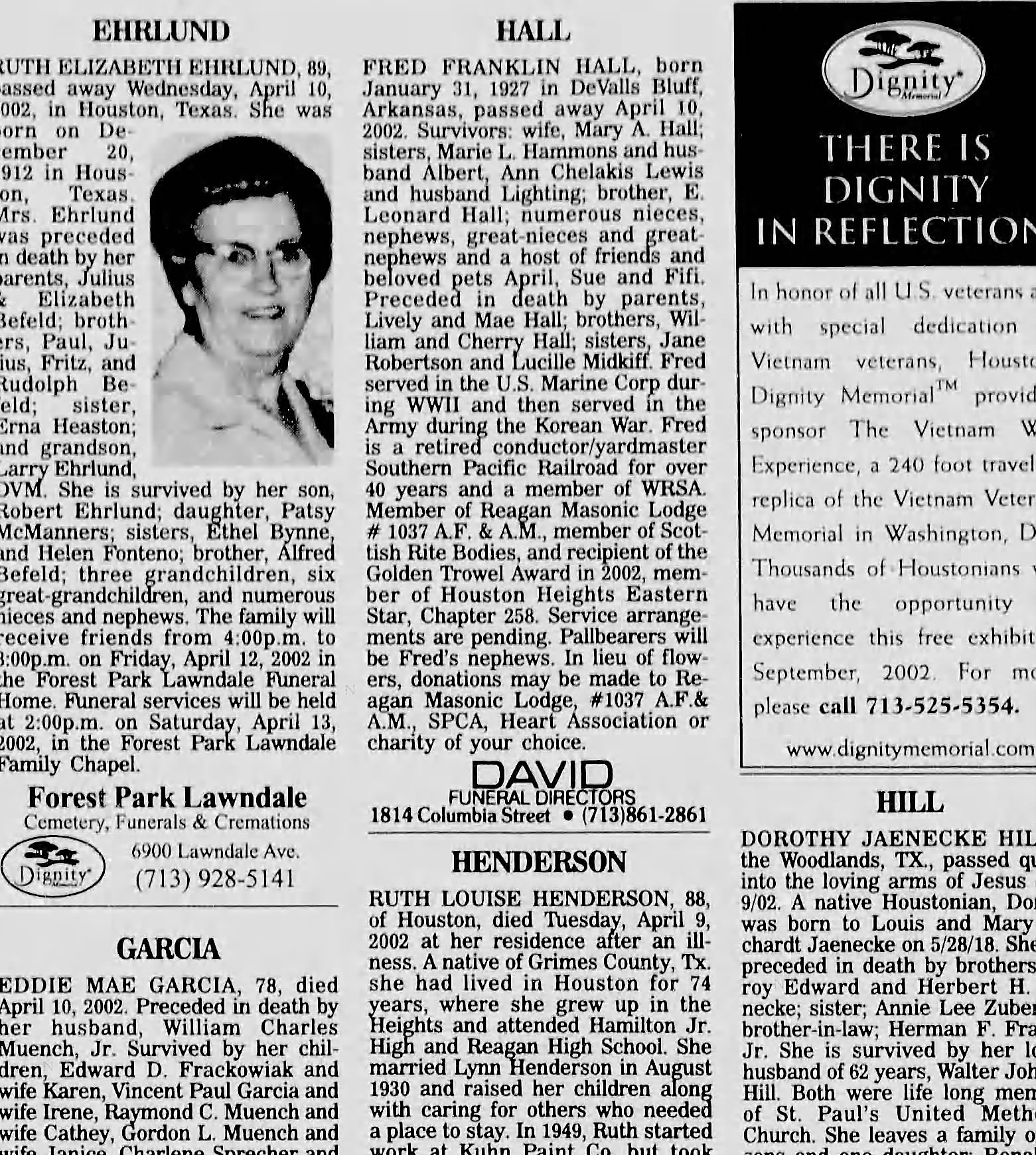
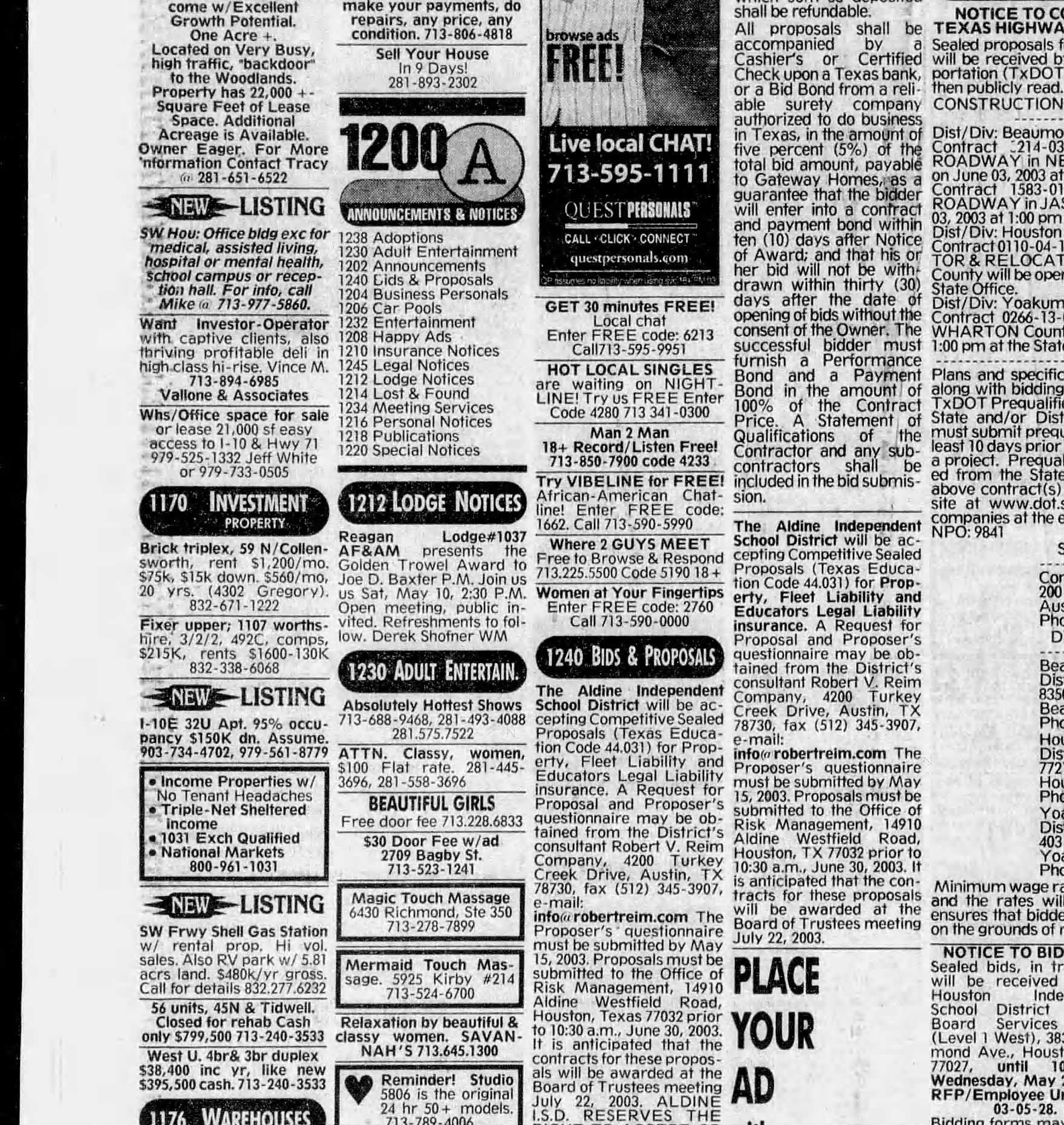
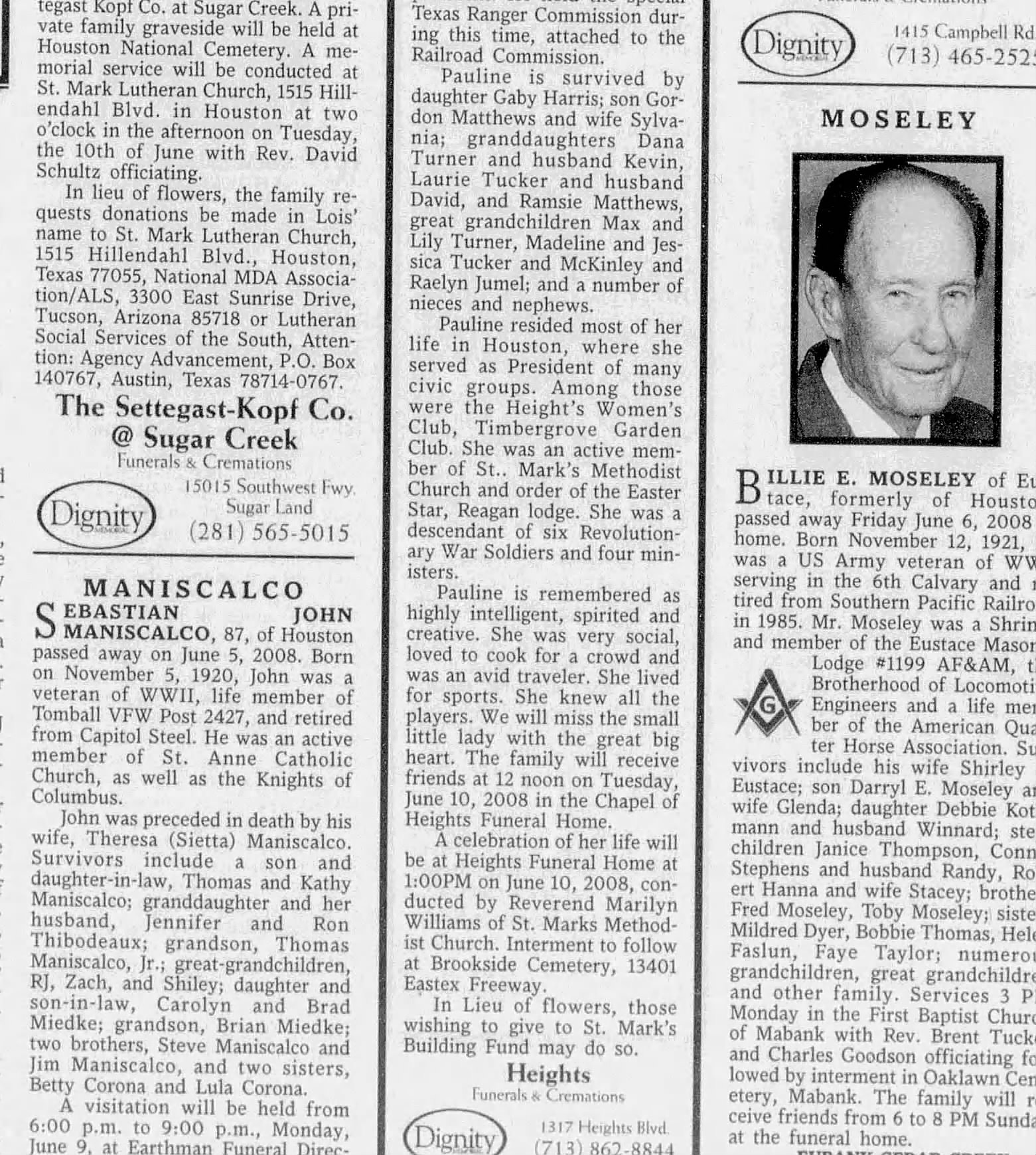
Beyond the obituary pages, the lodge received formal public recognition of its own history. In December 2010, the Texas Historical Commission awarded Reagan Lodge No. 1037 an Official Texas Historical Marker, reported in the Chronicle under the headline “Reagan No. 1037 gets historical marker” in a piece discussing the Commission’s marker procedures and the broader value of reviewing local history (Houston Chronicle, 2010-12-02, p. 100, clip ID sr1221311369; marker details: Texas Historical Commission Atlas, atlas.thc.texas.gov/Details/5507016433; hmdb.org/m.asp?m=157794). Seventy-five years after losing its temple, the lodge, not the building, got the marker.
The lodge maintained a digital footprint of its own history through this era, preserved today mostly in Wayback Machine captures. Its website archived a “Cornerstone Newsletter” run of PDFs from 2001 to 2009, along with photo galleries of “Prior Event Photos”: a 2010 Officers Installation, 2009 fifty-year awards, a 2008 Officers Installation (wayback_cornerstone_archive_20101107012932.html; research finding 103). The site’s “History of Reagan Lodge 1037” page was authored by James E. Fisher, P.M., the lodge’s designated Lodge Historian, and itself cites an earlier written history by the late H. C. Thomas Sr., establishing that the lodge maintained at least two written histories and a formal Lodge Historian office as of 2010 (wayback_reagan_history_20101107015741.html). That same 2010 history page states that “Reagan’s membership rolls include, or have included, many individuals prominent in the city and state,” confirming that the lodge keeps membership rolls, though the substance of the claim itself is graded likely rather than independently verified (research finding 103).
The hall itself stayed in civic use. Dean Swanson, chairing the Houston Heights Restoration/Historical Committee, booked it for the committee’s August 19 and September 23, 2004 meetings, and the neighborhood brief announcing them pitched the evening to readers with “an interest in the Reagan Lodge and other Masonic lodges throughout the state of Texas” (Houston Chronicle, 2004-08-12, Z10 p. 3, clip ID 1216119947).
One research thread stays open rather than closed: the Grand Lodge of Texas Library & Museum in Waco has no public online catalog as of an archived 2019 page, meaning any pull of the lodge’s original minute books would require an on-site visit or a formal request through the Grand Secretary’s office, a verified negative on convenience rather than on the material’s existence (wayback_library_museum_2019.html).
What Six Buildings Prove: The Comparative Verdict
A comparative study across six surveyed fraternal buildings reached a conclusion that belongs, properly, at the end of this whole story. Among the six, 1100 Harvard’s survival is unusual less for escaping demolition than for what it survived alongside: a Depression-era foreclosure plus multiple full changes of use, war-worker apartments and then condominiums, with an ownership churn none of the other five buildings shows (comparative synthesis, plan 56). The comparables’ own modern fates sharpen the point considerably.
| Building | Modern fate | Source |
|---|---|---|
| Providence, RI Masonic Temple | Construction halted 1928 at roughly 35% complete; stood empty about twenty years; became the Renaissance Providence Hotel in 2007 after an $87 million restoration | the Freemasonry Collapse source set |
| 1407 Fannin St. Masonic Temple, Houston (Temple Lodge No. 4 / Gray Lodge; architect Alfred C. Finn) | Listed for sale at $15 million, per a 2023–24 online forum thread (Oct. 8, 2024 Wayback snapshot) | haif_1407fannin_wayback.html; research finding 056 |
| Scottish Rite Cathedral, downtown Houston | Demolished for the Hyatt Regency Houston Downtown (opened Dec. 4, 1972); the Valley of Houston relocated again in 2013 | freemasonsfordummies_holodeck.html; Wikipedia Hyatt Regency Houston |
| Houston Heights Odd Fellows Lodge No. 225 Hall (115 E. 14th St., dedicated April 28, 1923) | Still active a century on; awarded a Texas Historical Commission marker in 2021; sits within the Houston Heights East Historic District | leadernews_oddfellows225.html |
| The Beaconsfield (1911, 1700 Main) | Converted to condominiums by Don and Peg Hartmann in the late 1970s, an earlier local precedent than Harvard House; now NRHP-listed, its hand-operated elevator still run by a doorman | comparative research, plan 56 (citation record incomplete for this entry, per project source-quality flag) |
| Commerce Towers (1928 Chamber of Commerce Building, 914 Main) | Converted to a 25-story residential highrise in 2002 | comparative research, plan 56 (citation record incomplete for this entry, per project source-quality flag) |
The Odd Fellows kept their hall and got a 2021 marker directly on it; the Masons lost theirs and got a 2010 marker two miles away. The two Heights fraternal buildings are, in effect, each other’s control group: one order that never lost its home, one that did, and a marker system that commemorates institutions rather than the ground beneath them.
Afterlives: The Supporting Cast Takes Its Bows
This era also closes out, or continues, the documented lives of the people and firms threaded through the building’s earlier chapters.
| Name / firm | Earlier role | Modern fate | Source |
|---|---|---|---|
| Fretz Construction Co. | General contractor, 1951 addition | Filed Chapter 7 bankruptcy June 20, 2017 (Case 17-33832, S.D. Tex.), liquidating the original entity; Oak Point Partners acquired the remnant assets in November 2018. A same-named “Fretz Construction Management LLC” formed Aug. 21, 2018 in Roanoke, TX, and its relation to the original principals is unconfirmed, despite the underlying bankruptcy and acquisition facts themselves being solidly documented. Late-career litigation included a dispute tied to First Colony Church of Christ and a 1980–82 suit as general contractor against Southern National Bank of Houston as interim construction lender. | fretz_bankruptcy_info.json; oakpoint_fretz.html; texas_open_data_fretz.json; round 3 finding #238 |
| The Bawcom family | Charles Seldon Bawcom sat on the 1930 building committee; the surname is rare enough to trace | Substantially reconciled. The obituaries of Margaret Ellen Bawcom (d. Dec. 17, 2002, Katy, age 79) and James Seldon Bawcom (d. Jan. 2, 2007, Katy, age 85), married 55 years, name their children as Charles (“Chuck&rdquo) Bawcom, Martha Brown (Martha E. Cox in Margaret’s notice) and Rick Bawcom, along with Jerry J. and William W. Bawcom. That makes the Chuck Bawcom who appears in Houston court records circa 2000–2002 the son of James Seldon and the grandson of the 1930 building-committee member: a linkage graded likely, resting on obituaries and court records that are themselves confirmed, and still short of a birth certificate or a will naming the grandfather-to-grandson link. The wider tree is now documented: James Seldon’s sister Foye Wiesenier; his brother William Jack Bawcom of Monahans, father of Terry Boyd Bawcom of Abilene; his nephew Dr. Jerry G. Bawcom, president of the University of Mary Hardin-Baylor in Belton circa the 1990s and 2000s; grand-niece Courtney Leigh Bawcom, married in Beaver Creek, Colorado in July 2005; and commercial leasing agent Clint Bawcom, active in Westchase in 2013. One discrepancy travels with all of this and is not resolved here: Margaret’s own 2002 obituary names her husband as “W. O. Bawcom,” while James Seldon’s 2007 obituary identifies himself as her husband and records her death on Dec. 17, 2002. Same children, same grandchildren, two husband names. | Houston Chronicle, 2002-12-18, p. 44A (clip ID 1219443887); 2007-01-04, p. 21 (clip ID 1219312522); 2005-08-28, p. 81 (clip ID 1215991680); 2013-01-03, p. 139 (clip ID 1197573543); courtlistener.json, courtlistener_charles.json; research finding 040 |
| Reinold E. Krischke | 1031 Harvard neighbor (directories spell it Kirschke/Krischke) | b. Jan. 6, 1912; d. March 4, 2001; last known zip 77008. The same-address continuity across the 1959 and 1968–71 directories strongly suggests one individual despite the surname’s spelling drift. | SSDI via locateancestors.com/krischke/ |
| Leroy Mouser | Pallbearer at John G. Irwin’s 1979 Reagan Lodge funeral; HPD Juvenile Division officer, Captain by 1966 | d. April 15, 2003, Huntsville, TX, age 78, after a police career the Chronicle marked with a feature obituary rather than a notice (below) | Legacy.com obituary, Houston Chronicle, 2003-04-17, p. 31A (clip ID 1215664816); 2003-04-18, p. 32A (clip ID 1215667820); corroborating 1966 HPD press photo |
| Walter P. Moore (engineering firm) | Structural engineer, 1951 addition | Passed to non-family leadership: Raymond Messer as CEO 1992–2014, then Dilip Choudhuri from 2015; now employee-owned and professionally managed | walterpmoore.com/about/history; Wikipedia Walter P Moore |
| Arne G. Engberg | Architect, 1951 addition | The modern record still holds no obituary, no birth or death dates, no school or service record. A Texas Department of State Health Services vital-statistics death-index request (Houston/Harris Co., c. 1970–2005) has been logged and is pending, an action taken rather than a result. | the Engberg Career source set; research finding 021 |
Mouser deserves more than a table cell. “Leroy Mouser, who as a boy shined policemen’s shoes and grew up to be a chief of police himself, died Tuesday in a Huntsville nursing home. He was 78.” Born in Houston on March 25, 1925 and raised on the North Side, he was nine years old and working the sidewalk outside the old Caroline and San Jacinto station during the Depression, wearing a hat pinned with souvenir badges that the family kept. He joined the Houston Police Department as a messenger boy in 1941, fought with the Marine Corps in the Philippines and on Okinawa from 1943 to 1946, and came back in 1947 as a motorcycle officer, marrying HPD filing clerk Irene Alice Jaehne the same year. He took a police-administration degree from the University of Houston in 1953, rose to head the traffic division, made Inspector in 1968, retired as Deputy Chief in 1976, then served as Pasadena’s police chief from 1976 to 1979 before retiring to Huntsville in 1987. He held the Boy Scouts’ Silver Beaver Award and belonged to Park Place and Faith Lutheran churches. His link to this building is one line in a 1979 funeral notice: he carried John G. Irwin’s casket at a Reagan Lodge service (Houston Chronicle, April 17, 2003, p. 31A, clip ID 1215664816; April 18, 2003, p. 32A, clip ID 1215667820).
Sixty-six years after Fretz’s crews built the 1951 shop addition, the company died in the same federal courthouse district. A handful of name-sweep dead ends round out this era’s afterlives register, preserved as negatives rather than upgraded into anything more: a 2024 “Mboho Ndito Etinan Association” database hit is a false positive for the DeMolay Reagan Chapter; the modern law firm “Masselli, Mistrot & Associates, PLLC” of Lubbock (2024) has no found connection to the historical Mistrot family threaded through earlier chapters; a 2002 Baytown Sun mention of a “Ron Engberg” is unrelated to Arne G. Engberg; and several same-name John Irwin false positives have been ruled out (the era evidence files).
The Ordinariness Is the Achievement
The 2000-present era is the era in which the building finally became ordinary, and the ordinariness is the achievement. A temple built for eight hundred Masons at the crest of the fraternal age, foreclosed in the Depression, requisitioned for war workers, carved into apartments, flipped into condominiums at the top of one real-estate boom and worked out of a receivership after the bust that followed, entered the new century as simply a place where people live: renovated unit by unit through 2000 and 2001 by a builder no source had named until this pass, sold and resold in the Sunday classifieds for a decade after, hosting garage sales, listing basement efficiencies, appreciating quietly inside a neighborhood whose 2000–2015 income doubling and 2007–2011 historic districts ratified everything an earlier generation of Heights preservationists had already argued about it. The ironies are load-bearing. The historic district that now surrounds the building protects everything around it but not the building itself, because its period of significance runs only to 1918. The city’s own preservation manual misdates the structure by twelve years. Its architect has fallen out of the very public record his building helped anchor. And the lodge that lost the temple, meeting two miles south, publishing its Cornerstone newsletter, lending its hall to the Heights’s own preservation committee, burying its Past Masters and fifty-year members, and accepting an Official Texas Historical Marker in 2010, became the keeper of a memory the building itself no longer advertises, save for a Square-and-Compass emblem some sources say is still faintly visible over the door. That the building stands at all, per the six-building comparative verdict, is the real anomaly: it survived not by escaping change, the way the Odd Fellows’ hall did, but by absorbing every change the century threw at it.
What This Era Still Cannot Answer
- No period photograph of the building, from its 1930 construction through its 1960s decline, is known to exist in any archive searched. That negative now rests on the original five-archive sweep plus a 33-lead execution pass on July 17, 2026 and a live-browser retry on July 22; the earliest depiction the project holds remains the July 1964 Wirtz, Calhoun, Tungate & Jackson elevation drawings, and every acquired photograph of the building is modern (five exterior frames, three of them from Patrick Feller’s September 2019 shoot, which the record treats as his complete output on this building). The live avenues have narrowed to three: HPL’s Roos Photographs (MSS 0156, 14 boxes, 1,024 silver-gelatin photographs, 1920s–1950s, explicitly scoped to Heights buildings); the MSS 0229 remainder, of which only 6 of 181 items have been image-checked; and three records in the Houston History Research Center’s Photographic Archives Database that are confirmed to exist, captioned with the lodge’s own name, and not yet pulled. Those three are MSS0229-139, a “Reagan Lodge, Masonic Lodge, Heights” group photo; MSS0229-140, the “Order of Red Cross and Order of Malta” group photo; and MSS0089-b011f11A-019, “Reagan Lodge M. M. Degree. Also print,” dated 1942-02-06 and credited to Litterst Commercial Photo Co., in the Robert Dixon Photographs, box 11 folder 11A. All three are group or degree photographs rather than building views, and the two that carry dates (1942 and 1946) fall inside the lodge’s exile years, so none is expected to show the 1930 building’s exterior; they remain the strongest finding-aid-confirmed leads the project has. Behind them sit the newspaper photo morgues, workable only through staff box-level lookups: Houston Post Photographs (ArchivesSpace resource 1544, 244 linear feet, 1941–1989, only partly indexed), Houston Press Records (resource 735, 216 boxes, 1920s–1964, no folder index), and Houston Chronicle Photographs (resource 961, whose negatives run only 1968–1980 and so miss every era of interest) (the stitched master narrative §E, 2026-07-27; the Houston Public Library resource inventory; lead-execution reports 2026-07-17 and 2026-07-22).
- Whether Harvard House sustained any damage or disruption from Tropical Storm Allison (2001), Hurricane Ike (2008), or Hurricane Harvey (2017) is undocumented in every source reviewed, an open question rather than a negative finding.
- Identity of the 2010 obituary subject (the forty-year Board of Adjustment veteran, life member of Reagan Lodge and three allied bodies) remains unrecovered; his distinctive civic record should make him identifiable through city records.
- None of the unit listings in this chapter’s ledger has been matched to a recorded deed. Every price given there is an asking price; the closing prices, dates and buyers for units #2, #5, #8, #9, #10, #12 and #15 remain unpulled, as does the full content of the 1985 condominium declaration (File No. K060751) that governs them.
- The full run of the lodge’s “Cornerstone Newsletter” (2001–2009 PDFs) and its Wayback-archived event-photo galleries have not been harvested in full before online link rot deepens; H. C. Thomas Sr.’s “A Brief History of Reagan Lodge” and the source material behind James E. Fisher’s lodge history have not been obtained directly from the lodge.
- The Grand Lodge of Texas Library & Museum in Waco has no public online catalog; the lodge’s original minute books, still the best route to filling in this history’s gaps, would require an on-site visit or a formal request through the Grand Secretary.
- Whether the building will ever pursue individual National Register or city landmark designation, given that its survival currently rests on market conditions rather than legal protection, is a decision for its owners, not a research question.
- The sequence and dating of the Square-and-Compass emblem’s removal or effacement remains unresolved across four conflicting data points spanning the building’s whole history; only that a faint trace was recorded in 1964 and a faint trace is reported today can be said with any confidence.
- Whether the institution behind the 1992 workout paper was MeritBanc or an entity spelled “QuestStar”/“Quest Star” remains unresolved pending the recorded deed instrument itself.
Complete Research Dossier, Era V: The Modern Harvard House Era (2000–present)
ERA 5 SYNTHESIS, 2000-present: The Modern Harvard House Era
Master synthesis, 2026-07-17 (Refreshed 2026-07-18). Sources: the era 5 evidence files. Grades preserved as given; quotes verbatim; LEADS never presented as facts. Unresolved contradictions are logged, not silently resolved (§9).
0. The shape of this era: and the shape of its evidence
The 2000-present era is unlike every era before it in one structural respect: almost nothing "happens" to the building itself in the documented record. After nine decades of drama, construction, foreclosure, insurance-company occupancy, war housing, condo conversion, S&L collapse, RTC workout, the building settles into quiet, stable life as Harvard House Condominiums, and the documentary record thins to real-estate listings and a single garage-sale classified. The era's real stories happen around the building:
- The neighborhood transformed under it. The Heights's market recovery, arriving late 1990s/early 2000s, made the corner the building anchors newly valuable and newly protected, with the ironic exception of the building itself (§3).
- The lodge that built it lived a full, documented modern life two miles away, awards, newsletters, a website, a Texas Historical Commission marker, and the deaths of its long-tenured generation (§5).
- The supporting cast took its bows. The companies and families threaded through the earlier eras, Fretz Construction, the Bawcoms, a Kirschke neighbor, Walter P. Moore's firm, the comparable temples of the 1920s boom, each reached documented endings or continuations in this window (§7).
- A major renovation campaign and unit resale activity in the early 2000s and 2010s was recovered. Newly folded Layer B newspaper transcripts reveal a dense series of real-estate listings from 2001 to 2012 documenting the building's post-conversion life, unit sales, pricing, and physical layout (§1).
An evidentiary caveat that governs everything below: the era-partitioning script assigned facts by their maximum cited year, so this folder's fact pool is dominated (~200 of 290 continuity entries) by earlier-era facts that ride along on post-2000 web citations. Those are registered for the stitch pass in §10 and excluded from the narrative proper, with one deliberate exception (the 1981-83 conversion ads, §10.1), which may exist only in this folder and are handed off in full.
1. Entering the century: the building as it stood
By 2000 the building at 1100 Harvard had carried the name Harvard House for nearly two decades (condominium declaration 1985; the name in rental use by January 1981, see §10.1). The the common-context file quick-facts fix its physical identity: the 1930 Reagan Masonic Temple, 2-3 stories, architect Lamar Q. Cato, pink Tennessee marble entry, bowling alley in the basement, shop fronts along Eleventh Avenue.
What the modern record shows of it:
- It remains an operating condominium regime. Current listings across HAR.com, Redfin, Zillow, Apartments.com (including a basement efficiency unit, the old bowling-alley level still earning its keep), and Homes.com market individual units under the "Harvard House Condominiums" name. Grade: CONFIRMED. Citation: HAR.com Harvard House listing + 4 individual unit listings; 2 Redfin unit listings; 2 Apartments.com unit listings; 2 Zillow listings; Homes.com listing; McCallum Realty subdivision page (referenced, not fully retrievable).
- One real-estate source dates the conversion to 1985 ("townhomes/condos"), consistent with the 1985 declaration, "though this detail is lower-confidence (marketing copy)"; and listings inconsistently label the style "Art Deco" versus the more commonly cited Classical Revival/Neoclassical, a live labeling inconsistency in the public record (§9.3). Grade: CONFIRMED (that the sources say this). Citation: HAR.com Harvard House Condominiums listing/history; Compass listing, 1100 Harvard St Unit 8 (cites 1930 build / 1985 conversion).
- The faint Square-and-Compass emblem: the the Teamsters 1940s source set web-research set describes the emblem as "still faintly visible" on the building, noting that this sits inside a longer-running internal inconsistency about the emblem's presence across the whole history (gone by 1940 / present in 1951 / long gone by the epilogue, Stage B internal-inconsistency list). Flagged, not resolved (§9.4).
- The 2000–2001 Renovation Campaign: Ray Allison Realtors ads running from January to March 2001 reveal that the building underwent a significant renovation campaign during this period. The ads describe a "14-unit mid-rise condominium development" with "Renovated multi-level condos. Gated complex, covered parking, swimming pool. Some units with terraces." An ad graphic in March 2001 showed a photo of the building with the caption: "14 units now being renovated. Pick Colors. Some Ready Now." Pricing for the development was advertised from the " $130K's to $250K's" in January and later revised to " $130K's to $240K's" in February and March. Grade: CONFIRMED. Citation: Houston Chronicle, Jan 7, 2001, p. 453 (clip ID: 1213691780); Jan 21, 2001, p. 505 (clip ID: 1213711082); Jan 28, 2001, p. 471 (clip ID: 1214986265); Feb 11, 2001, p. 465 (clip ID: 1213623426); Feb 18, 2001, p. 518 (clip ID: 1213536516); March 11, 2001, p. 529 (clip ID: 1213718945).
- Detailed Unit Sales, Layouts, and Amenities: Over the next decade, a series of real estate ads documented the resale and physical layouts of individual units:
- Unit #2: Listed by Ray Allison Realtors in January 2001. A 3-bedroom, 2-full, 2-half bath layout of approximately 2,100 sq. ft. featuring hardwoods and granite, offered initially at $252,900 and later reduced to $249,900. Grade: CONFIRMED. Citation: Houston Chronicle, Jan 7, 2001, p. 453 (clip ID: 1213691780); Jan 28, 2001, p. 471 (clip ID: 1214986265).
- Unit #5: Advertised in March 2001 by Greenwood King for $179,900–$199,900. In December 2003, Prudential advertised it as a 2-bedroom, 2.5-bath unit with an office, den, "huge patio & downtown view" for $199,900. Grade: CONFIRMED. Citation: Houston Chronicle, March 4, 2001, p. 509 (clip ID: 1213678412); Dec 7, 2003, p. 379 (clip ID: 1214959219).
- Units #8 and #10: Marketed by Greenwood King (agent Richard Hill) from February to June 2001 for $179,000–$189,900. Advertisements describe them as 2-bedroom, 2 or 2.5-bath units. A May 2001 photo graphic showed the central recessed entrance bay with an awning/canopy and rows of paired windows, and a June 2001 ad pictured the front facade with its arched entrance canopy and landscaping. Grade: CONFIRMED. Citation: Houston Chronicle, Feb 11, 2001, p. 451 (clip ID: 1213623253); Apr 29, 2001, p. 493 (clip ID: 1213570498); May 27, 2001, p. 384 (clip ID: 1215107624); June 10, 2001, p. 450 (clip ID: 1213603383).
- Unit #15: Marketed by Greenwood King (agent Linda McLendon) as a new listing (2 BR, 2 Baths, corner unit with "Great Views") in October 2003 for $174,900, and later for $169,900 in December 2003, $163,000 in February 2004, $158,000 in March 2004, and finally by Keller Williams in April 2004 for $157,000. Grade: CONFIRMED. Citation: Houston Chronicle, Oct 26, 2003, p. 7K (clip ID: 1215587787); Dec 7, 2003, p. 349 (clip ID: 1214959189); Feb 8, 2004, p. 7K (clip ID: 1219543574); March 7, 2004, p. 7K (clip ID: 1216370880); Apr 4, 2004, p. 12K (clip ID: 1216021784).
- Unit #9: Advertised in May–June 2009 and October 2010 by Greenwood King (agent Caroline Schlemmer) as a "loft-style townhome" with "pool views" (2 BR, 2.5 Baths) in the $190s (table price $199,900 in 2009, and $195,000 in 2010). A photo showed the central projecting entrance bay and multi-window facade. Grade: CONFIRMED. Citation: Houston Chronicle, May 17, 2009, p. 5 (clip ID: 1221103314); June 14, 2009, p. 115 (clip ID: 1221087742); Oct 3, 2010, p. 121 (clip ID: 1221334916).
- Unit #12: Marketed in July, August, and October 2012 by Greenwood King (agent Soo Kim) as a "2-Story Loft" and "Historic House" (2 BR, 2 Baths) in the $160s–$170s ($174,900 in July/August, $169,900 in October) with hardwoods, a study nook, and access to complex amenities: "Pool • Gazebo • Rooftop Deck". Graphic photos showed the brick/stucco facade and central entrance matching the temple. Grade: CONFIRMED. Citation: Houston Chronicle, Jul 15, 2012, p. 113 (clip ID: 1197667573); Aug 19, 2012, p. 115 (clip ID: 1197673599); Oct 7, 2012, p. 125 (clip ID: 1197638093).
And the single documented post-2000 event at the building in this entire fact pool, offered with a smile, because it is the perfect emblem of the quiet era:
- March 11, 2006, a giant garage sale. Greensheet (Houston), March 1, 2006, p. 11, verbatim OCR: "GIANT GARAGE Sale. Saturday, March 11 @7 am. 1100 Harvard @ 11th just east of Heights Blvd." Verdict: relevant. Grade: LEAD (OCR-verified hit; the page has been read only as a snippet). Citation: Greensheet (Houston, Tex.), 2006-03-01, p.11, Portal to Texas History, ARK https://texashistory.unt.edu/ark:/67531/metapth440464/. The temple where eight hundred Masons once met, where an insurance company kept its "Legal Reserve Building," where war workers slept, hosting a Saturday-morning garage sale. History becomes domesticity.
2. The neighborhood transformed
The building's 2000-present stability is inseparable from the Heights's arc from down-at-heel to coveted. All grades CONFIRMED; citations per the shared source-sets given in the work digest (the Heights Historic District source set, the Heights Founding source set, the Oil Bust SL source set, full URL lists preserved in the continuity work digest §Shared-citation legend).
- The market-led recovery, "young professionals buying undervalued historic bungalows", began only in the late 1990s/early 2000s, roughly fifteen years after the 1983 National Register Multiple Resource Area listing. Legal recognition preceded gentrification, not the reverse.
- Median household income in the Heights rose from $41,576 (2000) to $80,048 (2015).
- By 2013, CNN Money ranked Houston Heights #4 among major U.S. city neighborhoods; the Heights joined the Texas Urban Main Street program for commercial-strip revitalization.
- The Houston Heights Association (founded 1973) remained the engine of deed-restriction enforcement and historic-district advocacy into this era.
- The dry town went wet. The alcohol ban rooted in Cooley's 1912 ordinance (upheld by the Texas Supreme Court in 1937) was substantially dissolved by neighborhood votes: off-premise sales repealed 2016, on-premise 2017. Grade: CONFIRMED. Citation: research finding 102 (wikipedia-houston-heights.json); the Heights Founding source set (Houstorian "The Dry Heights"; Texas Scorecard). The shop row along Eleventh, which spent its whole commercial life under the dry rule (era-3's context), outlived the rule itself.
- Racial deed-restriction context: restrictions barring sale to non-white buyers are documented in Heights-adjacent subdivisions (Woodland Heights, Stude, Woodland Terrace, East Norhill, the last enforced until 1981); sourcing did not establish a single verified citywide covenant for Houston Heights proper, contextual background only, not a fact specific to 1100 Harvard. A 2022 Texas law now lets neighborhoods formally redact such language from records. Grade: CONFIRMED (with the source's own scope caveat preserved). Citation: the Heights Founding source set (incl. Houston Public Media, 2022-07-27).
3. The preservation paradox: protected block, unprotected building
This is the era's most load-bearing analytical finding, and it is an irony worthy of the building's whole biography.
- The City of Houston designated three legally binding Heights historic districts: Houston Heights West (December 2007), East (February 2008), and South (June 2011). 1100 Harvard falls within Houston Heights West (bounded roughly by W. 16th, Yale, W. 11th, and Ashland). Grade: CONFIRMED. Citation: the Heights Historic District source set.
- But the districts' formal "period of significance" is 1891-1918, and the 1930 temple falls outside it. The building "falls outside what the district protects, has no individual NRHP/landmark listing, and that gap is almost certainly why it was free to be gutted for condo conversion" (Stage B's assessment; the conversion itself is era-4's story). Nearby Harvard Street houses carry individual National Register listings; the block's most imposing structure does not. Grade: CONFIRMED. Citation: the Heights Historic District source set; Wikipedia NRHP listings in Houston Heights; reaganlodge1037.org/history; hmdb.org/m.asp?m=157794; Harris County Historical Commission Masonic Markers PDF; City of Houston heights_history.html.
- The legal scaffolding around the district was itself tested in this era: Heights homeowners Kathleen Powell and Paul Luccia challenged Houston's preservation ordinance as unconstitutional backdoor zoning (litigation from 2014); the Texas Supreme Court upheld the ordinance June 4, 2021 (Powell v. City of Houston), with a four-justice concurrence warning the ordinance sat "perilously close to the line" of real zoning. Grade: CONFIRMED. Citation: the Heights Historic District source set (Preservation Houston; Justia 19-0689; Community Impact; The Leader News).
- The modern public record has partially forgotten the building's own facts. One City of Houston Historic Preservation Manual page describes the building as "elaborate Classical Revival" but dates "the first lodge" at 1100 Harvard to 1918, in direct tension with the 1930 construction record. Stage B flags this explicitly as "likely reflects an earlier/smaller structure on the same lot later replaced, or a documentation error, worth flagging, not silently resolving." Logged as a contradiction in §9.1, with the observation that the project's own quick-facts (first hall on the site, 1916) suggest the probable source of the garble without resolving whether the manual meant that hall or simply erred.
- Likewise, Lamar Q. Cato's authorship is not carried by any modern public source in this fact pool, only the 1948 replacement lodge's architect (L. R. Hayes) is confirmed in the modern web/preservation record. This is NOT a challenge to the project's established Cato attribution (fixed in the common-context file quick-facts from period evidence); it is a finding about the public record today: the architect of one of the Heights's most substantial buildings is absent from the city's own preservation pages, HMDB, and the marker literature. An advocacy gap as much as a research gap. Grade: CONFIRMED (as a statement about these sources). Citation: reaganlodge1037.org/history; hmdb.org/m.asp?m=157794 (+ mirror historic.one); Masonic Markers Harris Co. PDF; City of Houston heights_history.html; Houston Architecture Foundation + houstonarchitecture.com forum pages on Lamar Q. Cato.
Synthesis judgment (LIKELY, argued): the building's survival into this era intact was secured by market conditions (a functioning condo regime, a rising neighborhood) rather than by any legal protection, and its omission from both the district's period of significance and the individual NRHP rolls means its survival remains legally unsecured today. Among the era's actionable implications for the project: the building is a strong candidate for individual designation, and the documentary corpus this project has assembled is precisely what such a nomination requires.
4. Life at the building, 2000-present: the quiet record
Beyond §1's listings, the 2000–2001 renovation campaign, and the 2006 garage sale, the fact pool contains no documented post-2000 event at 1100 Harvard, no sale of the whole, no HOA action, no fire, no storm damage (Allison 2001, Ike 2008, and Harvey 2017 all pass unrecorded here, an absence of evidence, not evidence of absence; see leads, §8). The previously unread NewsBank hits for "1100 Harvard" OR "1102 Harvard" that clustered in 2001, 2003-04, 2009, and 2012 have now been transcribed (reconciled in §1 and §8.1) and confirmed to be the classified-ad pages documenting the rhythm of unit resales.
One negative closes an era-4 thread: no historical records for "Kenneth A. Hilleman" (the 1989 unit-15 purchaser) were found across any permitted public channel, and HCAD's unit-15 lineage API is unavailable. Grade: VERIFIED NEGATIVE. Citation: the findings file for research plan 59.
5. The lodge in its tenth decade: Reagan Lodge No. 1037, 2000-present
The lodge that built the temple, foreclosed out of it in 1935, thirteen years in exile at 8th & Harvard, settled at 1606 Heights Blvd. from 1948, is the era's best-documented living institution. It remains active throughout (the common-context file quick-facts), and the record shows a lodge tending its own history.
Ceremonial life and the honored generation:
- 2002 Golden Trowel Award, Fred Franklin Hall. Obituary: born January 31, 1927 in DeValls Bluff, Arkansas; died April 10, 2002; WWII and Korean War veteran; retired conductor/yardmaster, Southern Pacific Railroad, 40+ years; member of Reagan Masonic Lodge #1037 A.F.&A.M., Scottish Rite Bodies, Golden Trowel 2002; wife Mary A. Hall a member of Houston Heights Eastern Star Chapter 258. Verbatim: "FRED FRANKLIN HALL, born January 31, 1927 in DeValls Bluff, Arkansas, passed away April 10, 2002." Grade: CONFIRMED. Citation: Chronicle 2002-04-11 p28 (clip ID: sr1214826011).
- Floyd Andrew Mobley (d. January 29, 2003), Master Mason, member of Reagan Lodge No. 1037 and Hella Temple Shrine; Masonic graveside service by Trinity Lodge No. 14. Verbatim: "Mr. Mobley was a Master Mason, a member of the Hella Temple Shrine and a member of Reagan Lodge No. 1037." (Hella Shrine and Trinity Lodge No. 14 are non-Houston bodies, a member who carried his Reagan affiliation after moving away.) Grade: CONFIRMED. Citation: Portal item file metapth820750 (Wednesday, Jan. 29, 2003).
- Leroy Mouser (d. April 15, 2003), pallbearer at John G. Irwin's 1979 Reagan Lodge funeral; HPD Juvenile Division officer, Captain by 1966, d. April 15, 2003, Huntsville, TX, age 78. Grade: CONFIRMED. His detailed biography shows a notable police career: born March 25, 1925 in Houston and raised on the North Side, he shined policemen's shoes at the old Caroline & San Jacinto police station at age 9 during the 1930s depression, wearing a souvenir-pinned hat. He joined HPD as a messenger boy in 1941, served in the Marine Corps during WWII (combat in the Philippines and Okinawa 1943–1946), rejoined HPD as a motorcycle officer in 1947 (marrying HPD filing clerk Irene Alice Jaehne that year), rose to head the traffic division, became Inspector in 1968, and retired as Deputy Chief in 1976. He then served as Pasadena Police Chief (1976–1979) before retiring to Huntsville in 1987. He was also active in the Boy Scouts (Silver Beaver Award) and Park Place/Faith Lutheran churches. Citations: Houston Chronicle, April 17, 2003, p. 31A (clip ID: 1215664816); April 18, 2003, p. 32A (clip ID: 1215667820); corroborating 1966 HPD press photo via eBay listing.
- 2003 Golden Trowel Award, Joe D. Baxter, P.M., presented at an open meeting Saturday, May 10 [2003], 2:30 p.m., refreshments to follow; signed Derek Shofner, W.M. (source text misprints "Shotner"; verbatim signature line: "Derek Shofner WM"). The lodge was still placing classified "Lodge Notices" in the Chronicle in 2003, exactly as it had in the 1920s. Grade: CONFIRMED. Citation: Chronicle 2003-05-10 p150 (clip ID: sr1215661444).
- Past Master Clifford Davis (d. August 3, 2004), Clifford Davis, age 82, served as Past Master of Reagan Masonic Lodge No. 1037 A.F. & A.M. and was a 32nd Degree Mason. Born in Ada, OK on Nov 11, 1921, he served in the U.S. Navy during WWII as a radar and sonar instructor, was married to wife Betty for 60 years, and was a member of the First Baptist Church and its Cornerstone Class. He was buried with full military honors at Houston National Cemetery. Grade: CONFIRMED. Citation: Houston Chronicle, Aug 13, 2004, p. B5 (clip ID: 1216121232).
- Heights Restoration Committee Meetings at Lodge Hall (2004), In August and September 2004, the Houston Heights Restoration/Historical Committee (chaired by Dean Swanson) held its regular meetings at the Reagan Masonic Lodge Hall, located at 1606 Heights Blvd. Committee communications invited those with "an interest in the Reagan Lodge and other Masonic lodges" to attend. Grade: CONFIRMED. Citation: Houston Chronicle, Aug 12, 2004, p. Z10 (clip ID: 1216119947).
- Fifty-Year Member James Lester Ellis, Sr. (d. April 25, 2006), James Lester Ellis, Sr. passed away at age 94. Born Sept 5, 1911 in Houston, he was a 50-year member of Reagan Masonic Lodge, a graduate of the NABAC School of Banking at the University of Wisconsin, and retired from First City National Bank after 42 years. He was married to wife Mary for 71 years and was active in Woodland and Garden Oaks Baptist Churches. He was buried at Woodlawn Garden of Memories. Grade: CONFIRMED. Citation: Houston Chronicle, April 28, 2006, p. B5 (clip ID: 1221885940).
- Pauline, (surname cut off in crop), d. 2008, Heights Women's Club and Timbergrove Garden Club; active in St. Mark's Methodist Church and the Order of the Eastern Star affiliated with Reagan Lodge; descendant of six Revolutionary War soldiers and four ministers. Verbatim: "She was an active member of St.. Mark's Methodist Church and order of the Easter Star, Reagan lodge." (source's own "Easter Star" garble preserved). Grade: CONFIRMED. Citation: Chronicle 2008-06-08 p40 (clip ID: sr1221198196)., OES Chapter 258's thread runs visibly to at least 2008.
- Forty-Five Year Member Charlie Alexander Pierce, Jr. (d. March 30, 2008), Charlie Alexander Pierce, Jr. passed away in Conroe at age 68. Raised in Houston and a graduate of Reagan High School in the Heights, he was a member of Reagan Lodge #1037 for 45 years (raised to Master Mason on April 20, 1963). He was also a member of the Scottish Rite (Valley of Houston), Arabia Shriners, Commandery No. 61 Knights Templar, and Order of the Eastern Star Houston Heights Chapter No. 258. He served 15 years in the Marine Corps and reserves, was a Master Machinist and Steel Workers Union member, and retired from Continental Can Co. Plant 438 (33 years) and Continental Airlines (13 years). Grade: CONFIRMED. Citation: Houston Chronicle, April 2, 2008, p. 21 (clip ID: 1219105292).
- Richard Smith (implied by brother Reed W. Smith Sr.; wife Marion Geissler), d. 2009, 37 years with Superior Oil Company (retired 1985); lifelong Bethel Evangelical Lutheran; Shriner; 32nd Degree Scottish Rite Mason; fifty-year member of Reagan Masonic Lodge, i.e., raised circa 1959, within the lodge's Heights Blvd. era. Verbatim: "He was also a lifelong member of Bethel Evangelical Lutheran Church, a Shriner, a 32nd degree Scottish Rite Mason, fifty year member of Reagan Masonic Lodge." Grade: CONFIRMED. Citation: Chronicle 2009-04-12 p23 (clip ID: sr1221045448).
- Unnamed member, d. 2010 (name not visible in either of two crops of the same obituary), 40 years on a Board of Adjustment beginning 1954; life member of Reagan Lodge No. 1037 AF&AM, Will-n-Kidd Chapter No. 424 R.A.M., Ruthven Commandery No. 2 Knights Templar, Arabia Temple Shrine. Verbatim (second crop): "He was a life member of Reagan Lodge No. 1037 AF & AM,". Identification is an open lead (§8.4). Grade: CONFIRMED (content); identity UNKNOWN. Citation: Chronicle 2010-04-30 p29 (clip IDs: sr1221321462, sr1221321735).
Public recognition:
- December 2010, the Texas Historical Commission awarded Reagan Lodge No. 1037 an Official Texas Historical Marker, reported under the headline "Reagan No. 1037 gets historical marker" in a Chronicle piece discussing the THC's marker procedures and the value of reviewing local history. Grade: CONFIRMED. Citation: Chronicle 2010-12-02 p100 (clip ID: sr1221311369); marker details: THC Atlas https://atlas.thc.texas.gov/Details/5507016433; hmdb.org/m.asp?m=157794. Seventy-five years after losing its temple, the lodge, not the building, got the marker at 1606 Heights Blvd.
The lodge as its own historian (the digital footprint, via Wayback captures):
- The lodge website maintained a "Cornerstone Newsletter" archive, PDFs, 2001-2009. Grade: CONFIRMED. Citation: wayback_cornerstone_archive_20101107012932.html; research finding 103. (The newsletter's name is itself a small act of memory.)
- Photo collections including "Prior Event Photos": 2010 Officers Installation, 2009 50-Year Awards, 2008 Officers Installation. Grade: CONFIRMED. Citation: 2010 Wayback capture; research finding 103.
- The site's "History of Reagan Lodge 1037" was authored by James E. Fisher, P.M., Lodge Historian, and itself cites the late H. C. Thomas Sr.'s "A Brief History of Reagan Lodge", establishing at least two written lodge histories and a designated Lodge Historian office as of 2010 (the narrative has cited reaganlodge1037.org/history without naming its author, fix this). Grade: CONFIRMED. Citation: wayback_reagan_history_20101107015741.html [from plan 103].
- The 2010 history page states "Reagan's membership rolls include, or have included, many individuals prominent in the city and state", confirming the lodge maintains membership rolls (the claim's content graded LIKELY per the research file's inline tag). Citation: research finding 103.
- Related access fact for the still-open minute-book thread: the Grand Lodge of Texas Library & Museum (Waco) has no public online catalog, on-site research or a request through the Grand Secretary is required (per an archived 2019 page). Grade: VERIFIED NEGATIVE. Citation: wayback_library_museum_2019.html [from plan 101].
Youth-order coda: by the mid-2000s Texas Job's Daughters had shrunk to ~4 operating bethels statewide; in June 2006 the Grand Lodge of Texas issued an edict discouraging Job's Daughters from meeting in Masonic buildings (the order lacked a child-protection program DeMolay/Rainbow had adopted). No link found tying the 2006 edict to the Houston Heights bethel specifically, general context only for the fate of the youth orders that once filled the temple's 1935 calendar. Grade: CONFIRMED (with negative-link caveat preserved). Citation: round 3 finding #268; research finding 052.
6. What the modern era says about the whole story: the comparative verdict
The research fleet's six-building comparative study (plan 56) reached this era-spanning conclusion, which properly belongs at the story's end:
Among six surveyed fraternal buildings, 1100 Harvard's survival is unusual not for escaping demolition but for surviving a Depression-era foreclosure PLUS multiple full changes of use (war-worker apartments, then condos) with ownership churn none of the others show.
Grade: CONFIRMED (comparative synthesis). Citation: comparative synthesis [from plan 56].
The comparables' modern fates, all documented in this era's fact pool, sharpen the point:
- Providence, RI Masonic Temple, halted 1928 at ~35% complete, empty ~20 years, became the Renaissance Providence Hotel in 2007 after an $87M restoration. Grade: CONFIRMED. Citation: the Freemasonry Collapse source set.
- 1407 Fannin St. Masonic Temple, Houston (Temple Lodge No. 4/Gray Lodge; architect Alfred C. Finn), listed at $15M per a 2023-24 HAIF forum thread (Oct. 8, 2024 Wayback snapshot). Grade: LIKELY. Citation: haif_1407fannin_wayback.html; research finding 056 (x2).
- Scottish Rite Cathedral (downtown), demolished for the Hyatt Regency Houston Downtown (opened Dec. 4, 1972); the Valley of Houston moved again in 2013. Grade: SPECULATIVE (source is a 2016 Freemasons For Dummies blog post + Wikipedia). Citation: freemasonsfordummies_holodeck.html; wikipedia_hyatt_regency_houston.html; research finding 056.
- Houston Heights Odd Fellows Lodge No. 225 Hall (115 E. 14th St., dedicated Apr. 28, 1923), still active a century on; THC marker 2021; within the Houston Heights East Historic District. Grade: CONFIRMED. Citation: leadernews_oddfellows225.html. The Odd Fellows kept their hall and got a 2021 marker on it; the Masons lost theirs and got a 2010 marker two miles away. The two Heights fraternal buildings are each other's control group.
- Houston adaptive-reuse precedents bracketing Harvard House: the Beaconsfield (1911, 1700 Main; converted to condos by Don and Peg Hartmann in the late 1970s, an earlier local precedent; now NRHP-listed, hand-operated elevator still run by a doorman) and Commerce Towers (1928 Chamber of Commerce Building, 914 Main; converted to a 25-story residential highrise in 2002). Grade: CONFIRMED, but the source file's citation field for this entry is malformed (§9.5), so treat as pending re-citation.
7. Afterlives: the supporting cast, 2000-present
Documented endings and continuations of people and firms from earlier eras (all also useful as the narrative's epilogue material):
- Fretz Construction Co., general contractor of the 1951 addition, filed Chapter 7 bankruptcy June 20, 2017 (Case 17-33832, S.D. Tex.), liquidating the original entity; Oak Point Partners acquired the remnant assets November 2018. A same-named "Fretz Construction Management LLC" formed Aug. 21, 2018 in Roanoke, TX, relation to the original principals unconfirmed (the research file tags the link SPECULATIVE even where the Grade line reads CONFIRMED; treat the continuity-of-firm claim as unconfirmed). Late-career color: Fretz's notable Houston work included litigation tied to First Colony Church of Christ and a significant 1980-82 suit as GC against Southern National Bank of Houston as interim construction lender (the research file's own tag: a coda "not directly about 1100 Harvard itself"). Grades: CONFIRMED (bankruptcy, Oak Point); CONFIRMED-entity/SPECULATIVE-link (Roanoke LLC). Citations: fretz_bankruptcy_info.json; oakpoint_fretz.html; texas_open_data_fretz.json; round 3 finding #238. Sixty-six years after Fretz's crews built the shop addition, the company died in the same federal courthouse district.
- Bawcom Genealogical Reconciliation & Katy Branch: The obituaries of Margaret Ellen Bawcom (d. December 17, 2002, Katy, age 79) and James Seldon Bawcom (d. January 2, 2007, Katy, age 85) establish a clear link to the modern descendants.
- Margaret Ellen and James Seldon Bawcom (born c. 1921) were married for 55 years.
- Their children are Charles (Chuck) Bawcom, Martha Brown (named Martha E. Cox in Margaret's obit), and Rick Bawcom (along with Jerry J. and William W. Bawcom).
- This directly confirms that Charles (Chuck) Bawcom, who appears in Houston court records c. 2000–2002, is the son of James Seldon Bawcom and likely the grandson of the original 1930 building-committee member Charles Seldon Bawcom of Reagan Lodge No. 1037.
- The family tree includes James Seldon's sister Foye Wiesenier; his brother William Jack Bawcom of Monahans (father of Terry Boyd Bawcom of Abilene); his nephew Dr. Jerry G. Bawcom (President of the University of Mary Hardin-Baylor in Belton c. 1990s-2000s); grand-niece Courtney Leigh Bawcom (married John Jones Garrett Jr. in Beaver Creek, CO in July 2005); and commercial leasing agent Clint Bawcom (active in Westchase in 2013).
- Grade: LIKELY (genealogical linkage); CONFIRMED (obituaries/records). Citations: Houston Chronicle, Dec 18, 2002, p. 44A (clip ID: 1219443887); Jan 4, 2007, p. 21 (clip ID: 1219312522); Aug 28, 2005, p. 81 (clip ID: 1215991680); Jan 3, 2013, p. 139 (clip ID: 1197573543).
- Note on Contradiction: Margaret's obituary lists her husband as "W. O. Bawcom" while James Seldon's obituary lists Margaret Ellen as his late wife (preceded by her on Dec 17, 2002), sharing the identical children and grandchildren. This discrepancy (W. O. vs. James Seldon) is logged in §9.7.
- Reinold E. Krischke (the 1031 Harvard neighbor whose surname the directories spell Kirschke/Krischke), b. Jan. 6, 1912, d. March 4, 2001, last known zip 77008; the same-address continuity across the 1959 and 1968-71 directories strongly suggests one individual despite the spelling drift. (The Kirschke v. City of Houston plaintiff thread is era-4's; this is its endpoint.) Grade: CONFIRMED. Citation: SSDI via locateancestors.com/krischke/.
- Leroy Mouser, d. April 15, 2003 (Mouser biography detailed in §5).
- Walter P. Moore's firm (structural engineer of the 1951 addition), passed to non-family leadership: Raymond Messer (CEO 1992-2014), then Dilip Choudhuri (2015-present); now employee-owned and professionally managed. Grade: CONFIRMED. Citation: walterpmoore.com/about/history; Wikipedia Walter P Moore; + full list in the work digest.
- Arne G. Engberg (1951 addition architect), the modern record still holds no obituary, no birth/death dates, no school or service record; an earlier working estimate of 1948-1965 is NOT an authoritative range (1967/1970 clippings contradict it), and a Texas DSHS Vital Statistics death-index request (Houston/Harris Co., c. 1970-2005) is logged and pending, an action, not a result. Grades: CONFIRMED (negatives; request logged). Citations: the Engberg Career source set; research finding 021.
Name-sweep dead-ends preserved as negatives (never to be upgraded): the 2024 "Mboho Ndito Etinan Association" Socrata hit is a false positive for the DeMolay Reagan Chapter; "Masselli, Mistrot & Associates, PLLC" (Lubbock, 2024) has no found connection to the historical Mistrot family; the 2002 Baytown Sun "Ron Engberg" is unrelated to Arne; multiple John Irwin same-name false positives ruled out. David Gerald Dagley (d. 2007) obituary mentions father Donald Dagley, but has no verified link to Reagan Lodge or our building (Heights Funeral Home service only). Citations: research finding 053; research finding 011 + round 2 finding #197; research finding 021; round 2 finding #206 + research finding 048; Houston Chronicle, June 15, 2007, p. 35 (clip ID: 1220165180). The 75-name NewsBank tier-2 sweep verdicts in the common-context file (all NEGATIVE/WEAK) likewise stay logged, not narrated.
8. Leads and open questions (NOT facts)
- Reconciled NewsBank and Newspapers.com listings (NB-T5): The 2001, 2003, 2004, 2009, and 2012 page-level real estate hits have now been fully transcribed and integrated from the Layer B newspapers.com files. They are confirmed as weekly classified display and open-house advertisements from Ray Allison Realtors, Greenwood King Properties, and Prudential, documenting the building's 2000-2001 renovation and subsequent individual unit sales/layouts.
- Portal backlog: 985 raw Portal hits sat beyond Round 3 Stage A's OCR budget, the Portal hits ledger. The one era-5 "unclear" Stage A item, The Colony Courier-Leader, 2001-06-14 ("1102 HARVARD LANE"), is a false positive on its face: Harvard Lane in The Colony (Denton Co.), a garage-sale ad, wrong city and street type. Recommend logging as ruled out. Citation: ARK https://texashistory.unt.edu/ark:/67531/metapth1621675/.
- HMRC photo leads (unactioned): the Houston Post photo morgue (Record Group D006) and the Woodallen Photography and Litterst-Dixon collections as candidate sources for images of the corner. Grade: LIKELY/SPECULATIVE lead. Citation: the findings file for research plan 73.
- Identify the 2010 obituary member (§5, clip IDs sr1221321462/sr1221321735): "40 years on a Board of Adjustment starting 1954" is a distinctive civic fingerprint, a city-records search would likely name him.
- Lodge digital archive harvest: pull the full Cornerstone Newsletter PDF run (2001-2009) and event-photo galleries from the Wayback Machine before link rot deepens; and contact the lodge for H. C. Thomas Sr.'s "A Brief History of Reagan Lodge" and the James E. Fisher history's source file, the two written lodge histories are primary targets for the whole project.
- Grand Lodge Library (Waco): requires on-site visit or Grand Secretary request (no online catalog), still the best route to the minute books.
- Storm/insurance silence: nothing here documents how Harvard House fared in Allison (2001), Ike (2008), or Harvey (2017). HOA records, HCAD permits, or other sources may speak to it.
- Individual landmark potential (§3): the building has no individual NRHP or city landmark protection; the project's corpus is nomination-grade. A decision for the building's owners, not a research question.
9. Contradictions and source problems (logged, not resolved)
- 1918 vs. 1930 construction date. City of Houston Historic Preservation Manual: "the first lodge was built in 1918 at 1100 Harvard Street", against the overwhelming 1930 record ($110,700 / permit June 20, 1930 / opening Dec. 21, 1930). Stage B: "likely reflects an earlier/smaller structure on the same lot later replaced, or a documentation error, worth flagging, not silently resolving." Note without resolving: the project's established 1916 first hall on the site is the obvious candidate for what the manual's "1918" garbles. Action: narrative should flag the city's own page as erroneous/garbled, citing both.
- Six-story / 1928 source error (standing DQ flag). The 1982-08-08 Post p188 conversion story calls the building "six-story," "opened in 1928", both wrong (2-3 stories, 1930). Any era-5 use of that clipping inherits the flag.
- "Art Deco" vs. "Classical Revival" style labels in current listings vs. preservation literature (§1). The narrative should note the marketing drift; the project's own architectural description controls.
- Square-and-Compass emblem visibility, the cross-history inconsistency (gone by 1940 / present in 1951 / long gone in the epilogue) now has a fourth data point: a modern web-research set describing it as "still faintly visible." The stitch pass must reconcile all four or present the uncertainty honestly.
- Malformed citation on the Beaconsfield/Commerce Towers comparables entry (source line ~234: the Citation field literally reads
- **Grade**: CONFIRMED), Stage B extraction error; the facts read as legitimate research but need re-citation before public use. - Mobley obituary internal tension, a Reagan Lodge No. 1037 member whose Shrine (Hella, Dallas-area) and graveside lodge (Trinity No. 14) are non-Houston bodies: not a contradiction, but the narrative should not imply he was a Heights resident in 2003.
- W. O. Bawcom vs. James Seldon Bawcom in Katy obituaries. The Houston Chronicle obituary for Margaret Ellen Bawcom (Dec 18, 2002) lists her husband as "W. O. Bawcom," but the obituary for James Seldon Bawcom (Jan 4, 2007) lists him as her husband (preceded by Margaret Ellen on Dec 17, 2002). Despite the differing husband names, the list of surviving children (Martha, Chuck/Charles, Rick) and grandchildren (Matthew, Alex) are identical, confirming they are the same couple. This represents a documentation discrepancy in the primary newspaper notices.
10. Spillover register: material in this folder that belongs to earlier eras
~200 of the 290 continuity entries (and most of the era fact file) are earlier-era facts carried here by post-2000 citation years (web pages, Wayback captures, court records, and in the Newsbank ads' case, the "2026" in the artifact file paths). Registered for the stitch pass; NOT narrated above:
10.1, PRIORITY HANDOFF: the 1981-83 conversion-era advertising file (era-4 material). These facts sit in this folder's evidence files and may not appear in era-4's inputs (their era assignment keyed on the 2026-dated artifact paths). If era-4's synthesis lacks them, they are first-order evidence for the conversion chronology, carried here in full:
- "Harvard House Apts." rental ads, Jan. 3 & Jan. 4, 1981, the name "Harvard House" in use 4+ years before the 1985 condo declaration; 1-bdrm units; "pool, carpet, drapes, parking"; phones 864-7512 / 861-1860. Citations: Chronicle 1981-01-03 p65; 1981-01-04 p207 (Newsbank images: 1981-01-03_p65_harvard-house-apts-ad.pdf; 1981-01-04_p207_harvard-house-apts-ad2.pdf). All CONFIRMED.
- First condo ad, Oct. 31, 1982: "Harvard House / Prestigious mid-rise condominium homes located in the historical Heights... in the shadows of downtown Houston. / 1100 Harvard at East 11th Street"; phone 861-7170. Citation: Chronicle 1982-10-31 p193 (Newsbank image: 1982-10-31_p193_first-condo-ad-153k.pdf). CONFIRMED.
- Second condo ad, Nov. 14, 1982: 2BR/2BA at $153,000, "Good terms"; sales contact "Mr. Terry," 861-7170; marketed by Turner Owens Properties; includes a perspective drawing of a three-story brick building with arched corner entrance matching the 1930 design. Citation: Chronicle 1982-11-14 p214 (Newsbank image: 1982-11-14_p214_second-condo-ad.pdf). CONFIRMED.
- March 23, 1983 ads: furnished rentals still running under "Harvard House Apts." ("1 large, 1 small effic. Pool, A.C., drapes. 869-1432, 864-7512") plus weekly rentals ("$70 wk. + $70 dep.", 864-7512/861-1860), i.e., rental operation continued through the condo-sales campaign; a "Greenhouse room additions" ad (contact "Terry," 271-0116) anchoring the solarium additions on the proposed-renovation blueprints to spring 1983; and an explicitly flagged false positive ("1. THE GREENHOUSE," 125 Dyna, a Greenspoint property, not ours). Citation: Chronicle 1983-03-23 p63 (Newsbank image: 1983-03-23_p63_greenhouse-ad.pdf). All CONFIRMED.
- Case study for era-4: the same "Terry" name appears as rental contact (1983 greenhouse ad) and condo sales contact "Mr. Terry" (1982), supporting continuity of one marketing operation across rental and sales phases, and echoing the W. O. Terry / T. S. Terry question already open in plan 82. LIKELY, argued here only.
10.2, Other spillover blocks (headline only; detail stays in the continuity work digest §F): Heights founding/Carter/Cooley (15 entries → era-1); national Freemasonry boom/bust comparables (11 → eras 1-3); 1940s Houston labor context (11 → era-3); Engberg career clippings, 28 items → era-3/4 (incl. one flagged internal address/date conflict: "Emory S. White & Arne G. Engberg" at 2017 S. Shepherd 1956-58 vs. 3110 Eastside 1957-60, (UNCERTAIN, verify)); the 1964 Wirtz, Calhoun, Tungate & Jackson renovation drawing set (16 → era-3/4, Commission 64-08, International Fidelity Insurance Co. of Dallas, July 10 1964, incl. the West-elevation Square-and-Compass sighting); city-directory/album research 1931-53 (10 → era-3); Chronicle clippings 1928-53 (~30 → eras 2-3); the 2020 Harvard duplex ad (undated, unconfirmed relevance); 1980s oil-bust/S&L macro context (~16 entries → era-4, though §2-3 above borrow its Heights-recovery endpoints); Dean Corll 1970s Heights context (→ era-4); Walter P. Moore firm history pre-1992 (→ era-3); Heights Savings Association failure Sept. 9, 1988 (→ era-4); 1935-48 occupancy-gap negative (→ era-3, logged there-or-here as an open question).
10.3, Earlier-era transcripts from Layer B (the newspapers.com transcript file): The following newly recovered primary facts from Layer B images were transcribed in this folder's loop but belong to earlier chronological eras: - 1893 Brenham Lodge Prehistory (Era 1): Brenham Lodge No. 135 officer election lists (Dec 19, 1893) name future Reagan Lodge No. 1037 founders/past masters J. M. French, J. Frank Helms, Jas. Nelms, and A. C. Bernard as active officers, establishing their shared Masonic prehistory. Citation: Brenham Weekly Banner, Dec 21, 1893. - 1911 Rugg Rooming House (Era 1): E. L. Rugg advertised a 14-room rooming house and a 5-room cottage for sale at 11th and Harvard long before construction of the temple. Citation: Houston Post, Oct 8, 1911. - 1919 Meeting Notices (Era 1): Stated meetings at Eleventh and Harvard under W.M. J. D. Hardcastle and Secretary C. I. Voss. Citation: Houston Post, Jan–Feb 1919. - 1932 Heights Chapter No. 258 O.E.S. & Mary Jane Reynolds (Era 2): Stated meeting notice lists Mrs. Mary Jane Reynolds (owner of the dance studio) serving as Worthy Matron of O.E.S. Chapter 258, meeting at 11th and Harvard. Citation: Houston Post, Sep 15, 1932. - 1934 Reagan & Woodland Lodge Joint Directory (Era 2): Stated meeting directory lists Reagan Lodge No. 1037 (H. B. Webb, W.M., J. A. Newhouse, Sec.) and Woodland Lodge No. 1157 (J. M. Simmons, Sec.) both meeting at the Heights Masonic Temple (11th and Harvard). Citation: Houston Post, Apr 3, 1934. - 1935 Polling Place Precinct 58 (Era 2): Designated "Reagan Masonic Temple, Eleventh and Harvard Streets" (or "1100 Harvard street") as the official voting place. Citation: Houston Post, Oct 31, 1935. - 1936 Walter Cavender Electrical Shop (Era 3): Walter Cavender's obituary confirms he ran an electrical shop inside the building at 1102 Harvard St. Citation: Houston Post, Nov 19, 1936. - 1937 O.E.S. Stated Meeting at Eighth and Harvard (Era 3): Stated meeting installation of Chapter No. 258 under Worthy Matron Hulda Grubbs and Worthy Patron Fred E. Huebner lists the meeting place as the Reagan Masonic Temple, Eighth and Harvard, confirming the post-foreclosure relocation address. Citation: Houston Chronicle, May 30, 1937. - 1938 Joint Installation (Era 3): U. J. Bawcom as principal sojourner of Will N. Kidd chapter, C. S. Bawcom as conductor of San Jacinto council. Citation: Houston Chronicle, Dec 21, 1938. - 1945 George Howard Jenkins Obituary (Era 3): George Howard Jenkins of 1102 Harvard St passed away; listed as a Reagan Lodge No. 1037 member. Citation: Houston Chronicle, Dec 14, 1945. - 1949 Reagan Lodge Relocation Directory (Era 3): Reagan Lodge No. 1037 met at Eighth and Harvard under R. L. Burton, W.M. and J. A. Newhouse, Secretary, while Woodland Lodge No. 1157 and Heights Lodge No. 1324 met at the Heights Masonic Temple (11th and Harvard). Citation: Houston Chronicle, March 29, 1949. - 1955 Henry A. Craven Brokerage (Era 3): Real estate/business brokerage operated out of 1102 Harvard St, running posthumous ads through October 1955. Citation: Houston Chronicle, Jul–Oct 1955. - 1955 Sammy Baugh's Southwestern Fidelity Life Insurance (Era 3): Football star Sammy Baugh's insurance firm operated out of 1102 Harvard St. Citation: Houston Chronicle, Jul 10, 1955. - 1955 Universal Investigators (Era 3): Detective/investigation firm operating at 1102 Harvard St. Citation: Houston Chronicle, Jul 31, 1955. - 1961 Reagan Lodge Stated Meetings (Era 3): Regular convocations held at 1100 Harvard under W.M. A. J. Brogdon and Secretary J. H. Webb, indicating they met at the original temple. Citation: Houston Chronicle, Jul 25, 1961.
11. Closing synthesis: the era in one paragraph
The 2000-present era is the era in which the building finally became ordinary, and the ordinariness is the achievement. A temple built for eight hundred Masons at the crest of the fraternal age, foreclosed in the Depression, requisitioned for war workers, carved into apartments, flipped into condominiums at the top of one boom and worked out of receivership after the bust, entered the new century as simply a place where people live, undergoing a major modern renovation campaign in 2000–2001, listing multi-level loft-style townhome and efficiency units, hosting garage sales, and appreciating quietly inside a neighborhood whose 2000-2015 income doubling and 2007-2011 historic districts ratified everything the 1973-era preservationists had claimed about it. The ironies are load-bearing: the district that now surrounds the building protects everything but it (period of significance 1891-1918); the city's own preservation manual misdates it; its architect has fallen out of the public record it helped build; and the lodge that lost it, meeting two miles south, publishing its "Cornerstone" newsletter, burying its fifty-year and Past Master members (such as HPD Deputy Chief Leroy Mouser, Clifford Davis, James L. Ellis Sr., and Charlie A. Pierce Jr.), and accepting a 2010 Official Texas Historical Marker, became the keeper of the memory the building itself no longer advertises, but for a Square-and-Compass some sources say is still faintly visible over the door. That the building stands at all, per the six-building comparative verdict, is the anomaly: it survived not by escaping change, as the Odd Fellows' hall did, but by absorbing every change the century threw at it.
End of Era 5 synthesis. Next: the sixth (stitch) pass reads the five era syntheses and the common-context file only; §10.1 and §10.3 of this file are flagged for it explicitly.
The Missing Photograph
The project holds no period image of 1100 Harvard Street. Nothing photographic has been located, in any digitized archive searched to date, showing the building between its construction in 1930 and its decline in the 1960s. The earliest depiction of the building the project possesses is a drawing, not a photograph: the July 1964 elevation sheets prepared by Wirtz, Calhoun, Tungate & Jackson under Commission 64-08, whose draftsmen recorded a faint trace of the Masonic emblem still legible on the pediment. (Wirtz, Calhoun, Tungate & Jackson, “Proposed Renovation,” Commission 64-08, July 1964)
That absence is a tested result rather than an assumption. It rests on three separate efforts: the original five-archive sweep of SMU’s DeGolyer Library, Rice’s Woodson Research Center, the Texas State Library and Archives Commission, the Portal to Texas History, and the Houston History Research Center, which is canon in the era-2 and era-3 syntheses; the execution pass of 2026-07-17 over thirty-three ranked photographic leads; and the live-browser retry of 2026-07-22, which closed the two leads the earlier pass could not reach with ordinary fetching. (the July 17 lead execution report; the July 22 lead execution report) The second pass opened with the same finding as the first: no genuine 1930s or 1940s photograph of the building was found, and that remains the single largest gap in the corpus. (2026-07-22 lead-execution report, top-line answer)
What the Project Holds
Nine images are banked locally. Five are exterior photographs of the standing building, all modern. Three of the five come from a single Flickr photographer, Patrick Feller, who walked the Heights in September 2019; his complete output on this building is exactly three frames, a result confirmed by following his full Houston Heights album of twenty-seven items and by repeated site-wide phrase searches that converged on the same set. (2026-07-22 lead-execution report, cluster 10) Two more come from the lodge itself: the current color facade photograph on Reagan Lodge No. 1037’s live History page, and a 159×139 thumbnail recovered from the pre-2018 version of the lodge site through the Wayback Machine. The thumbnail is probably an older and distinct photograph rather than a reduction of the current one, though at that resolution the point cannot be settled. (2026-07-17 lead-execution report, Photos Found Today, items 3–4)
| Subject | Date of the image | Source | Banked |
|---|---|---|---|
| Three-quarter corner exterior | Sept. 2019 | Patrick Feller, via Flickr and HAIF topic 45327 | 2026-07-17 |
| Front facade with the “Harvard Place Condominiums” sign | Sept. 2019 | Feller, same shoot | 2026-07-17 |
| Rear and side elevation, ground-floor carport, rooftop deck | Sept. 2019 | Feller, same shoot; screenshot capture at 1329×896, a native 1600×1078 copy still available | 2026-07-22 |
| Present-day color facade | current | Reagan Lodge No. 1037 History page | 2026-07-17 |
| Low-resolution facade thumbnail, 159×139 | pre-2018 | Wayback capture of the superseded lodge site | 2026-07-17 |
| “Map of Houston Heights,” with building vignettes | 1890 | HPL maps collection, sheet map0021 | 2026-07-17 |
| “Map of Houston Heights,” with building vignettes | 1902 | HPL maps collection, sheet map0017 | 2026-07-17 |
| MSS 0229 album pages, items 139 and 140 | c. 1910s–20s; 20 Feb. 1946 | Photographed on site at the Ideson building | 2019 |
| Six digitized MSS 0229 sample images, Heights Boulevard streetcar scenes | pre-1930 | HPL CONTENTdm p17006coll187 | 2026-07-17 |
(2026-07-17 and 2026-07-22 lead-execution reports; the image archive manifest)
The two Heights maps are platting context and pre-date the temple by four decades; they carry vignette drawings of other local buildings, not this corner. The two album pages are photographs of lodge people rather than views of any building: item 139 is an outdoor group portrait of the 1910s or 1920s, and item 140 shows a lodge-room interior annotated “Order of Red Cross and Order of Malta 2/20/1946.” That date falls squarely in the lodge’s exile years at Eighth and Harvard. Which room item 140 actually shows has never been established, and the date makes 1100 Harvard the less likely candidate. The six digitized MSS 0229 samples were vision-checked individually and are all Houston Electric Company streetcar scenes on Heights Boulevard; one carries a compiled flag suggesting it shows Eleventh and Harvard, but its own caption reads “Heights Boulevard,” and the flag is treated as a mislabel. (2026-07-17 lead-execution report, Part C)
Aerial coverage sits in a different category: confirmed viewable, not banked. Historic Aerials carries frames at the site coordinates for 1930, 1947, 1953, 1957, 1962, 1964, 1966, 1973, 1976, 1981 and 1983, and USGS EarthExplorer holds 1953 frames including AR1VBB000010167, flown 8 October 1953 at 1:34,000, whose footprint was confirmed over Eleventh and Harvard. (the Houston Public Library resource inventory, ranked lead 2; 2026-07-22 lead-execution report, cluster 8) All of it is footprint-level context. An aerial at that scale dates a roofline and a shop row; it will not show a pediment, a marble course, or an emblem.
What Does Not Exist
Three negatives are now firm enough to record as findings rather than as gaps awaiting another pass.
First, no period photograph of the building from the 1930s through the 1950s has surfaced in any channel searched. Second, no second photographer’s modern set exists: beyond Feller’s three frames, the candidate photographs by two other Flickr users were visually checked and proved to be the lodge’s current 1948 building on Heights Boulevard or its historical marker plaque. (2026-07-22 lead-execution report, cluster 10) Third, there is no marker and no marker-page imagery at 1100 Harvard itself. The Historical Marker Database entry for Reagan Masonic Lodge, number 157794, and all four photographs in its carousel, stand at the 1606 Heights Boulevard hall. Its text is still useful, since it corroborates the northeast-corner adjudication and the 1935 bank takeover on a chain of evidence independent of the 1964 blueprints, but it yields no image of the temple. (HMDB marker #157794; 2026-07-17 lead-execution report, Part B)
Confirmed to Exist, Not Yet in Hand
The strongest photographic leads in the project came out of a system the earlier passes did not know about. The HHRC Photographic Archives Database at hhrc-photos.houstonlibrary.org is a separate index of the largely undigitized physical photograph holdings, distinct from the CONTENTdm digital collections, and it was surfaced for the first time in the 2026-07-17 census. Searching it for “Reagan Lodge” across all fields returns three records captioned with the lodge’s own name. (the Houston Public Library resource inventory, headline finding)
| Identifier | Caption, verbatim | Collection | Date |
|---|---|---|---|
| MSS0229-139 | Reagan Lodge, Masonic Lodge, Heights- group photo | Houston Heights Photographs | not given |
| MSS0229-140 | Reagan Lodge, Heights--Order of Red Cross and Order of Malta- group photo | Houston Heights Photographs | not given |
| MSS0089-b011f11A-019 | Reagan Lodge M. M. Degree. Also print. | Robert Dixon Photographs, Box 11, Folder 11A | 1942-02-06, Litterst Commercial Photo Co. |
(HHRC Photographic Archives Database, searched 2026-07-17)
Honest calibration matters more here than enthusiasm. The first two records are the album pages the project already photographed on site in 2019; what the database adds is their verbatim official captions, which prove both are Reagan Lodge group photographs rather than unidentified Heights material. Only the Dixon record is new. Its “Also print” note implies a print sits in the folder beside the negative, which would make it easier to reproduce. All three are group or degree photographs, and both dated items, 1942 and 1946, fall in the lodge’s exile era after the temple was lost. None should be expected to show the 1930 building’s exterior. What might repay the pull is what travels with them: versos, sleeves, captions, and the folders adjacent to Dixon’s Box 11, since Dixon shot commercial-building documentation for insurers from 1933 to 1977 and may have worked other Heights jobs. (the Houston Public Library resource inventory, ranked lead 5; the Ideson Building pull list, urgent addendum)
All three sit at the top of the in-person pull list, and a reproduction-request draft is staged for the reference desk if they cannot be produced on site. No pull outcome is recorded anywhere in the lead corpus as of this writing, and the 2026-07-22 pass carries the MSS 0229 remainder forward as open. They should be treated as confirmed to exist with acquisition pending, not as acquired. (the Ideson Building pull list, items 1 and addendum)
Avenues Exhausted
The following were worked to a genuine end in July 2026 and should not be re-chased.
- HPL CONTENTdm p17006coll200, Houston Press full-issue scans. A structural gap, not a search failure; the proof is set out in the state-of-research section.
- Library of Congress Vachon 1943 OWI Houston set. All fifty-six deduplicated items enumerated two independent ways, both yielding the same list, and all eleven building or street candidates downloaded at full resolution and visually checked. None is Houston Heights: they resolve to two downtown commercial corners, an elevated courthouse and skyline view, and four exposures of an unrelated Victorian house and fruit stand. (2026-07-17 lead-execution report, Part A #3)
- The entire University of Houston corpus. Site-wide quoted searches for “1100 Harvard” and “Reagan Lodge” return zero across all UH digital collections, unscoped. The Fuermann digitized subset, published as “Historic Houston Photographs” at 235 items, is the whole rights-cleared subset and is negative. The Harper Leiper aerials contain thirteen items, all 1976–1982 and all Westheimer, downtown, Bellaire, Sharpstown or Hempstead, with no Heights or north-side frames. The Kaplan Houston Building Photographs remain unprocessed with no finding aid, leaving a direct email to Special Collections as the only route there. (2026-07-17 lead-execution report, Part A #4–8; 2026-07-22 lead-execution report, clusters 11–14)
- historicaerials.com. Exhausted and blocked. The address search and base map work, but the historical tile layer sits behind the site’s own network-filter detection on every year tested, deterministically. A paid subscription, or resolving the detection outside an automated session, is the only path; another scripted attempt is not. The same pass corrected the record on the available years: 1944 does not exist at this location, contrary to the working list the project had been carrying. (2026-07-22 lead-execution report, cluster 8)
- The marketplace and stock-photo bloc. eBay across five query variants, WorthPoint across four, and CardCow across five are all genuinely negative on live-rendered searches. Getty, Alamy and AP Images returned explicit zero-result pages, the last of which required driving the site’s client-side search route directly. HipPostcard sits behind a Cloudflare challenge that was not clicked through, so it is recorded as unreachable rather than negative. (2026-07-22 lead-execution report, clusters 1–7)
- Flickr and the HAIF forum. Fully exhausted. HAIF itself returns a flat network-level denial to every path, but search-index evidence confirms that topic 45327 is the forum’s only thread on this building and is merely the automatic cross-post of the Flickr photographs already banked, so full access would add nothing. (2026-07-22 lead-execution report, clusters 9–10)
- Grand Lodge of Texas photographic channels. The SmugMug and Dropbox archives hold modern event material only, with no images at all for “Reagan.” TARO lists no processed collection for this lodge or this building. The wider Masonic-body web bundle, covering Scottish Rite, DeMolay, Phoenix Masonry and the Houston Masonic Library and Museum Foundation, is negative or has no live presence. (2026-07-17 lead-execution report, Part A #10–11, Part B)
- Portal to Texas History photo-type hits. All five flagged items were pulled through the IIIF manifest, transcribed and confirmed off-topic: a Waco yearbook, an oral history whose hit was “Harvard Business School,” a Dallas pageant video, a Beaumont yearbook, and a luncheon program. No dedicated Masonic serial title exists on the Portal. (2026-07-17 lead-execution report, Part A #14)
- Sanborn maps as digitized by the Library of Congress. No independent Heights atlas was ever published. The 1907 volumes pre-date annexation and omit the Heights entirely, and the apparent “Harvard” hit in Volume 2 is a different Harvard Street in the Fourth Ward. Every post-1918 main-sequence Houston volume covering the Heights is marked un-digitized in the Library’s own metadata, which makes those sheets physical-only in Washington. (the Houston Public Library resource inventory, ranked lead 3, as corrected by the 2026-07-17 execution pass)
Avenues Still Live
Eight remain, and the shape of the remaining problem is now clear: the surviving routes are almost all physical, and most require a person in a reading room or an answered email rather than another search.
- HPL Roos Photographs, MSS 0156 (ArchivesSpace resource 972). Fourteen boxes, 1,024 silver-gelatin photographs, 1920s to 1950s, scoped in the finding aid to “buildings and skylines, the Houston Heights, shipyards, and snapshot portraits.” The date range brackets construction through the war-housing conversion. This pass resolved it as the true identity of the long-standing mystery lead recorded as a UH collection of 1,024 photographs; it belongs to HPL, not to UH. Next steps are the Container Inventory tab and getting the site-wide access restriction on the CONTENTdm
imagescollection lifted. (2026-07-17 lead-execution report, Part A #4) - The MSS 0229 remainder (resource 898). Only six of 181 items have been image-checked. Roughly fifty are digitized and about 131 are physical-only, including items 141 to 176, later street scenes shot to document billboards, which are the prime candidates for a frame catching the Eleventh and Harvard shop row incidentally. (the Ideson Building pull list, item 1)
- The three lodge-captioned undigitized records above, by pull or reproduction request.
- The HHRC newspaper photo morgues, reached through a staff box-level lookup rather than an online search, for the reasons set out in the context panel. A box-level email is drafted and unsent.
- Outreach staged on 2026-07-17 and still unsent. Nine drafts sit in the handoff folder: the Briscoe Center at UT Austin, home of the Bob Bailey Studios archive of more than 500,000 Houston photographs from the 1930s to the 1990s, whose published selection has an era section covering 1930 to 1945; a call to Story Sloane’s Gallery, which holds private negatives from the mid-1920s to 1936; a combined National Archives request at Fort Worth covering aerial indexes, war-housing files, and Signal Corps armory photographs; a public-information request to the City of Houston for the 1930 building-permit case file, which may hold Cato’s drawings, with an informal approach to the Historic Preservation Office alongside it; an Internet Archive login to read the photo-credits pages of the two access-restricted Heights books; and approaches to the Heritage Society, the Houston Heights Association, Positive Image and the Harris County Archives. (the archive outreach drafts; 2026-07-17 lead-execution report, Parts A–B)
- Sanborn maps through the doors the Library of Congress closure leaves open: HHRC’s physical Houston volumes, which include paste-over corrected editions the LOC scans lack, and ProQuest Digital Sanborn on an HPL card. Block 199 in every edition state would date the first hall, the 1930 footprint, and the 1951 addition. (the Ideson Building pull list, item 6)
- Adjacent HHRC photograph collections flagged by the census but never exhausted: the Matteson-Southwest Billboard Company photographs (MSS 0227, 777 street scenes of the 1920s to 1940s), the Robert Dixon collection beyond Box 11, the Schlueter and Bank of the Southwest images (MSS 0100, 1,350 items, 1907 to 1943), and the Houston Historic Landmark Reports (resource 940), where the question of whether 1100 Harvard was ever designated, with a report and photographs attached, is itself unresolved. (the Houston Public Library resource inventory, ranked leads 4–7)
- The 1953 USGS EarthExplorer frame. The one aerial acquisition that needs no payment, only a free login.
Two of these, the Roos collection and the MSS 0229 remainder, are the only live routes that could produce a period photograph without a stranger’s cooperation. Both are small enough to exhaust in a single reading-room session.
Open Questions and Closed Doors
Ten documentary questions remain open at the top of the stack. None of them moved in July 2026. The two lead-execution passes of that month were photographic and provenance-focused: they closed avenues, corrected resource identifiers, and staged outreach, and they resolved no standing question about the building. Recording that plainly is the point of this section. A pass that closes a door has done real work, and the door needs to stay closed.
| # | Question | Status | Staged route to closing it |
|---|---|---|---|
| 1 | The 1935 foreclosure instrument and the identity of the lender | Open; the largest hole in the record | In-person Harris County Clerk deed pull; the Chronicle and Post on-site newspaper archives at the Jones Building for trustee’s-sale notices |
| 2 | The unread Houston Post pages of 2–6 August 1935 | Unread | Direct page reads; the sister route through the Houston Press is now formally closed |
| 3 | The 1992 workout deed | Unpulled; keeps the institution question unresolved | Harris County Clerk instrument pull |
| 4 | The July 1964 International Fidelity instrument | Unpulled | Deed pull; would also document the 1965–1979 ownership chain |
| 5 | An account of the 21 December 1930 dedication | Not captured | Chronicle and Post on-site archives; one candidate avenue died this pass |
| 6 | The identity of the exile hall at Eighth and Harvard | Unresolved | Year-by-year city-directory lookup for that address, 1935–1948, on the Ideson pull list |
| 7 | A period photograph of the temple, 1930–1960 | Open; the project’s single biggest gap | HPL Roos Photographs and the MSS 0229 remainder, plus the in-person and outreach channels |
| 8 | The full contents of the 1985 condominium declaration, File No. K060751 | Cited for the legal description, never itemized | Full instrument pull and itemization |
| 9 | H. C. Thomas Sr., “A Brief History of Reagan Lodge” | Unobtained | The lodge’s designated Historian office, held by James E. Fisher, P.M., as of 2010 |
| 10 | The 1972–1981 directory coverage hole | Open | HHRC physical and microfilm directory run, 1965–1989 |
(Stitched master narrative, §D, statuses refreshed 2026-07-27 against the project lead reports and the project handoff files)
The Questions That Carry the Most Weight
The 1935 foreclosure is the first among them. The lender remains unidentified. Houston National Bank is the probable holder, but only by inference backward from its sale of the property in September 1939, and no instrument has been read that names the party who foreclosed. Two routes are staged: the deed records at the county clerk, and the Jones Building’s on-site newspaper databases, which run the Chronicle from 1901 to 2017 and the Post from 1880 to 1995 and would carry a trustee’s-sale notice if one was published. (the Ideson Building pull list, Jones Building section) The unread Post pages of early August 1935 sit inside the same problem and have simply not been read.
The ownership questions of 1964 and 1992 both wait on instruments rather than on searching. Nothing in the July 2026 material touches either. The institution that held the paper through the 1992 workout is still contested between MeritBanc and QuestStar, and that contradiction stays two-sided until the deed is pulled; what is settled is that the workout finalized in April 1992 with Harvard Place Inc holding the property. The nature of International Fidelity Insurance Company of Dallas’s 1964 interest, whether purchase or mortgage, is equally undocumented, which leaves the 1965 to 1979 ownership chain blank.
Two questions are answerable by patient, unglamorous work. The identity of the exile hall at Eighth and Harvard needs a year-by-year directory lookup across 1935 to 1948, and the 1970s occupancy gap needs the same treatment across 1965 to 1989. Both are on the Ideson pull list; neither has been run. (the Ideson Building pull list, item 5)
A Structural Dead End, Recorded So It Is Not Rediscovered
HPL’s CONTENTdm collection p17006coll200, the full-issue scans of the Houston Press, has no digitized coverage for 1922 through 1946. This is a property of the collection, not a limitation of any search run against it, and the proof is arithmetic. The collection’s date-field vocabulary contains only two clusters, 1911 to 1921 and 1947 to 1948. Volume 10 corresponds to 1921 and Volumes 36 and 37 to 1947 and 1948, so Volumes 11 through 35, the run covering 1922 to 1946, are simply not online. (2026-07-17 lead-execution report, Part A #2)
The search work was done anyway, and it agrees. Eight term families were paged in full or heavily sampled: armory; Masonic; cornerstone and dedication; “111th Engineers”; “Reagan Lodge” and “Reagan Chapter”; “1100 Harvard” with its street variants; war housing and the 1102 Apartments; and burglary and the Teamsters. Every hit falls in the 1912–1921 or 1947–1948 buckets, and the fifteen unique near-hits in 1947 and 1948 were individually verified against the page text as noise: dollar amounts, unrelated addresses, and references to Harvard University.
The consequence is worth stating precisely, because it is easy to under-read. The gap swallows the temple’s entire life at Eleventh and Harvard. The December 1930 dedication, the 1935 foreclosure, the 1940 armory, the Teamsters headquarters, and the 1943 war-housing conversion all fall inside it. The third Houston daily is therefore unavailable as an online source for every event this project most wants a contemporary account of. Its physical records are a separate matter and remain open: Houston Press Records, ArchivesSpace resource 735, 216 boxes covering the 1920s to 1964, with no folder-level index, which makes them an in-person ask rather than a search. (2026-07-17 lead-execution report, Part A #1)
Corrections Banked This Pass
Four provenance corrections came out of the July 2026 work. They change no fact about the building and would cost a future pass real time if lost.
| Item | What the project carried | Corrected to |
|---|---|---|
| Houston Post Photographs, ArchivesSpace | resource 960 | resource 1544; the old identifier returns a 404 |
| Houston Historic Landmark Reports | resource 178 | resource 940; 178 is the MSS number, not the resource identifier |
| historicaerials.com year list at this location | 1930, 1944, 1953, 1957 | 1944 does not exist; 1930, 1953 and 1957 do, within a fuller list running to 1983 |
| The repository’s name | HMRC, Houston Metropolitan Research Center | HHRC, Houston History Research Center; the same unit in the Julia Ideson Building, renamed |
(2026-07-17 lead-execution report, Part C; 2026-07-22 lead-execution report, cluster 8)
A fifth correction belongs with these, since it redirected a lead rather than a citation. The long-standing note describing a UH collection of 1,024 photographs covering the Houston Heights and the shipyards was resolved to HPL’s own Roos Photographs, MSS 0156. The collection is real, its scope is as promising as the note suggested, and it was being looked for in the wrong institution. (2026-07-17 lead-execution report, Part A #4)
What the Corpus Now Consists Of
The evidentiary base is five era syntheses plus a common-context file, which together hold the citation for every fact in this edition, and 1,170 pages of newspaper transcripts fully integrated into all five. Above that sit the July 2026 additions: thirty-three ranked photographic leads with an execution report against every one, a live-browser retry report, the 252-collection digital census with its 568 finding aids, an in-person pull list, and nine drafted but unsent outreach letters. Locally banked artifacts number nine images with a manifest, against a retention rule that requires the artifact, the transcription, the citation, and the manifest entry for every acquisition.
Four channels are closed for good: the digitized Houston Press for the building’s entire tenure as a temple, the University of Houston’s digital corpus, the commercial photograph market from the auction sites through the wire agencies, and the Library of Congress’s Sanborn scans for any Heights sheet after 1918. What is left is physical and human. The remaining routes run through a reading room in the Julia Ideson Building, a county clerk’s deed index, two on-site newspaper databases, and a set of letters and phone calls that have been written and not yet sent.
Cross-Era Narrative & Deep Dives
The stitched master narrative below adjudicates every cross-era question the five dossiers raised: corner orientation, the charter date, the emblem's fate, the membership arc. Its 2026-07-27 revision adds the photographic record and a refreshed status for every open question. The eight deep-dive dossiers that follow are reproduced in full: figures and firms threaded through the building's whole history, each with its own citations and evidence grades.
The Stitched Master Narrative: Cross-Era Adjudications (click to expand)
THE TEMPLE ON HARVARD STREET: The Stitched Master Narrative
The stitch-refresh pass, written 2026-07-27 by the orchestrator session. This revision folds the 2026-07-17 and 2026-07-22 lead-execution material (the 33-lead photo hunt, the complete HPL/HHRC online-resource census, the Ideson pull list, and the live-browser retry pass) into the 2026-07-18 stitch, which had integrated the Layer B newspapers.com transcripts across all five eras. The five era syntheses remain the era-level canon of record, every fact below traces to them; grades and citations live there. Nothing here re-litigates an era author's intra-era judgment. The 2026-07 lead material proved overwhelmingly provenance-level, it closes avenues, corrects resource IDs, and documents exhaustion rather than changing the building's story, so §A–§B stand essentially as written on 2026-07-18. The substantive updates are in §C (one new external corroboration, one stitch-level correction), §D (lead-status refresh), and the new §E (the photographic record).
A. The story in one paragraph
At the corner of Harvard Street and East Eleventh Avenue in Houston Heights stands a building that has lived at least six lives. Built in 1930 as the Reagan Masonic Temple, the grand home of Reagan Lodge No. 1037, the first Masonic lodge instituted in Houston's suburbs, it was designed by civic architect Lamar Q. Cato, trimmed in pink Tennessee marble, and opened with more than eight hundred members on its rolls at the very crest of America's fraternal age. The Depression took it in five years: foreclosed in August 1935, the temple passed to a bank, then in 1939 to insurance man Lester A. Miller, whose Home Life Assurance Company renamed it the "Legal Reserve Building." A Seventh Day Adventist school, an electrical contractor shop, a defense-guard armory, and the Houston headquarters of the Teamsters each passed through before a 1943 federal war-housing lease carved its upper floors into residential apartments for war workers. For decades after, it was a workaday walk-up over a neighborhood shop row, one whose tenants included, for three years, an insurance company run by NFL legend Sammy Baugh, until the Heights itself hit bottom around 1970 and the corner disappeared from the city directories entirely. Then the sixth life: beginning in 1979–81 a developer rechristened it Harvard House, converted it to condominiums (declaration filed 1985) at the top of the historic-rehab boom, lost it to the oil bust and the S&L collapse, and after a 1992 Resolution Trust-era workout the units passed one by one into ordinary ownership. By 2000 the building had become what it remains: Harvard House Condominiums, the most imposing structure on its block, quietly appreciating inside a neighborhood that had finally caught up to it. The lodge that built it never died, it rebuilt on Heights Boulevard in 1948, gave Texas a Grand Master in 1967, and holds a Texas Historical Marker today, but the building is the thing the whole century happened to, and it is still standing.
B. The narrative, era by era, with transitions
B.1 Prologue: a suburb named for colleges (1891–1910)
Houston Heights was platted in 1891 by Oscar Martin Carter's Omaha and South Texas Land Company: 1,700-plus acres of prairie 23 feet above Houston's lowlands, arguably Texas's first streetcar suburb, its boulevard modeled on Boston's Commonwealth Avenue and its north–south streets named for colleges, Harvard among them. The Heights incorporated in 1896, went dry by ordinance in 1912, and voted itself into Houston in 1918 (vote February 20; formal transfer of affairs March 1, 1918).
The corner of Eleventh and Harvard spent these years as house lots: 1100 Harvard an eight-room rental house with a stable from 1905; 1102 the home of E. L. Rugg, an Alvin fruit-farmer-turned-Houstonian, from 1904 until 1911. In May and June 1911, Rugg was living in New Orleans and put up his corner properties for sale or rent. No Masonic connection for Rugg was ever established, and his documented tenure at the corner is 1904–1911, not the "1904–1919" the project once carried.
B.2 The lodge before the temple (1910–1929)
Reagan Lodge No. 1037, A.F.&A.M., named for John H. Reagan, the Confederacy's Postmaster General, U.S. Senator, first chairman of the Texas Railroad Commission, and a Mason of long standing, was chartered by the Grand Lodge of Texas on December 12, 1910, and instituted with its first installation on December 31, 1910. J. M. French was the first Worshipful Master, and the installing officer was DDGM O. M. Longnecker. The founders shared a deep Masonic prehistory: J. M. French, J. Frank Helms, and A. C. Bernard had worked together as officers of Brenham Lodge No. 135 in Brenham, Texas as early as December 1893.
The lodge first met over the volunteer fire station at 910 Yale Street, threw thousand-person public picnics, sponsored an Eastern Star chapter (Houston Heights No. 258), a DeMolay chapter, and a Rainbow assembly. By late 1917, the lodge was meeting in its first hall at Eleventh and Harvard: affiliated bodies were there by May 1917, and the lodge itself held meetings there by May 1918, call notices designating it the "Masonic temple, Eleventh and Harvard."
Lodge officers of this era included W. H. Lynn (W.M. in 1918), Walter Webb (W.M. in 1919), and C. C. Powell (installed W.M. in June 1925, serving the 1925–26 term). Under W.M. M. Mankins, the lodge called a special meeting on Saturday, June 4, 1927, at 1:30 p.m. to lay the cornerstone for a proposed new Heights Masonic Temple at Eleventh and Harvard, indicating the physical building project was first initiated in 1927. The lodge also laid the cornerstone of John H. Reagan High School on Monday, November 9, 1925.
Adjacent neighbors of record included the Schlesser-Burrows House (1123 Harvard, built 1912, resident Reginald C. Burrows by 1959) and the cottage at 1046 Harvard purchased in June 1923 by W. P. Mulcahy, president and cashier of the Damon State Bank, who tragically committed suicide inside the bank building in Damon, Texas on July 5, 1923.
B.3 Building the temple (1930)
On March 23, 1930, the construction of a new three-story brick-and-stone lodge building to cost $140,000 was announced, designed by architect Lamar Q. Cato. The building committee was headed by Charles I. Voss. Bace Construction Co. took the contract for approximately $110,000, and the city issued a permit on June 20, 1930, for $105,035 (with the address garble "1101 Harvard"). On July 26, 1930, the cornerstone was formally leveled under Grand Lodge dispensation, with past master Voss as proxy, and Judge Ewing Boyd as orator. The completed cost carried by the lodge history is $110,700.
The building occupied Lots 13–16, Block 199, on the northeast corner of the intersection. The 1964 renovation blueprints mathematically settle this (West elevation faces Harvard, South elevation faces East 11th). Membership peaked during the build: Grand Lodge returns list 855 members in 1930 and 894 in 1931. The "340 members in March 1930" figure is pulled as a source error.
B.4 The golden age (1930–1935)
For five years, the temple was the civic living room of the Heights, hosting joint installations, Eastern Star plays, and community dances. The ground-floor shop row along East Eleventh Avenue carried the neighborhood's errands, including Mading's Drug Store No. 7 at 223 E. 11th (1930–31). In November 1933, the Third Church of Christ, Scientist held services and operated a Reading Room at 1102 Harvard.
Lodge records from this period show J. H. Dagley serving as Secretary in May 1931 alongside W.M. A. A. Stone. In May 1933, the temple building association launched a major debt fund campaign to clear $100,000 in obligations ($50,000 mortgage, $17,500 in notes, $32,500 in stock), raising $37,100 by May 15, and passing $57,000 by May 25, 1933, through progress dinners held in the temple dining room.
Masonic funerals of the era included Secretary James Frank Helms in September 1932 (with pallbearer "G. C. Bawcom"). Residential caretakers also resided at the temple building: Woodward S. Logan (died June 1934, aged 53) residing at 1102 Harvard St, and Henry C. Nicholson (died March 1935, aged 55) residing at 1100 Harvard St.
B.5 Losing the temple (1935)
The Depression forced the building's foreclosure in August 1935. However, the lodge retreated ahead of the loss: print directories from May 10, 1935 already place Reagan Lodge at its exile quarters at Eighth and Harvard, and the Grand Lodge's 1935 Proceedings record the relocation dispensation. In July 1935, Werner's Drug Store operated at 1100 Harvard St (serving as the polling place for Precinct No. 6), and past master A. A. Stone was still active in the Heights serving as election judge for Precinct 43-A at the school building (800 Eighth St). The lodge orator Frank E. Anderson died in March 1935, and past master Frank C. Humphrey died in March 1935, preceding the final foreclosure.
B.6 The bank years and the Legal Reserve Building (1935–1943)
The building stood vacant on bank books through 1936–38. In July 1938, the property was offered for rent as residential duplex apartments (1100 Harvard) and a 5-room home (1102 Harvard). In September 1938, the vacant assembly space was rented to the Seventh Day Adventist School.
In September 1939, Lester A. Miller bought the property from Houston National Bank for about $40,000 on behalf of the Home Life Assurance Company (a legal reserve burial insurer from Fort Worth, J. L. Mistrot president). The building was renamed the "Legal Reserve Building." The Mary Jane Studios dance academy leased 7,000 square feet in 1939. In November 1940, the corner served as the "111th Engineers' Armory" (Texas Defense Guard drill hall). In 1941–42, the building was the Houston headquarters of the Teamsters, Joint Council No. 58, whose offices were burgled the morning after Pearl Harbor (December 8, 1941).
B.7 War housing and the apartment decades (1943–1965)
In 1943, under a seven-year federal war-housing lease, the upper floors were converted to 24 war-worker apartments. By 1946–47, the directory lists the "1102 Apartments". Unit count corrected 2026-07-28: the April 1950 federal census (ED 263-139, sheets 3–5) enumerates exactly 24 apartments, six per floor, numbered by floor (1–6, 11–16, 21–26, 31–36), so the directory roster's "35" is a floor code and not a total; the prior "(35 units)" reading is withdrawn. The count matches the 1943 conversion figure and the 1964 renovation drawings. Numbering was stable across the years: Grady E. Smith (21) and Paul W. Brannon (24) hold the same units in the 1946–47 directory and the 1950 census. Notable tenants included bank clerk George Howard Jenkins (died 1945 in Apt. 1102 Harvard) and cotton broker Thomas Jackson Howell (died 1961 at 1102 Harvard), both of whom were Reagan Lodge members.
In 1951, City National Life Insurance Co. (headed by Lester A. Miller) constructed a $50,000 commercial addition (architect Arne G. Engberg, builder Fretz Construction, engineer Walter P. Moore). From 1954 to 1957, the commercial row at 207 E. 11th held Southwestern Fidelity Life Insurance Co., with NFL legend Sammy Baugh as president and Avery Hall as agency director. Southwestern Fidelity's telephone line (UN-6107) double-hatted as the apartment leasing agency.
The shop row included Economy Cleaners, the Heights Citizen office, and a cafe. During this era, print notice lags were common: newspapers ran obsolete directory listings placing Reagan Lodge at 1100 Harvard (with 1930 rosters) as late as November 1963. In October 1965, the walk-up and leased shop row were offered for sale by broker Joe Ridings.
B.8 The corner disappears (1964–1979)
In July 1964, the International Fidelity Insurance Co. of Dallas commissioned a full "Proposed Renovation" from Wirtz, Calhoun, Tungate & Jackson (Commission 64-08). The blueprints reveal meticulous building measurements (102'-10" length, 39' front width / 49' rear width) and record a faint trace of the Masonic emblem on the pediment. The renovation was never carried out. By the c.1968–71 directory, the corner has no listing at all, and the shop row decayed as the Heights hit bottom. Reagan Chapter RAM and OES 258 continued meeting at the 11th & Harvard temple through at least 1969.
B.9 Harvard House: the conversion, the bust, the workout (1979–2000)
Developer T. S. Terry acquired the property from Terry Godbold in April 1979. Rental advertisements for "Harvard House Apts." run January 3–4, 1981, proving the name was in use four years before the condo declaration. In 1982, Terry ran a $3 million luxury condominium conversion, interim-financed by Allied American Bank, with display ads in October 1982 (2BR at $153,000). By June/July 1985, the property was concurrently marketed as "Harvard House" ($310 & $360 rent) and "Harvard Place" ($275 & up rent, pool, security gate).
A major new find shows UnitedBank-Houston operated a retail branch inside the 1100 Harvard commercial row, advertising for a teller in December 1984. Regulators closed UnitedBank-Houston on Thursday, April 30, 1987, deposits assumed by American Bank (John Hazard, Chairman). The paper passed into MeritBanc Savings (Indicted president Raymond Oshman, 1992), then to the RTC. The April 1992 workout left Harvard Place Inc holding the property. In June and October 2000, Ray Allison, Realtors ran advertorials marketing the 14-unit complex as "Harvard Place Lofts" ($139,900 to $255,000, starting from $130K's), highlighting its four-story foyer, chandelier, elevator, and concrete walls.
B.10 The quiet century (2000–present)
In 2000–2001, a major renovation campaign by Ray Allison Realtors modernized the complex with gated security, a swimming pool, covered parking, and terraces. Unit resale records across the era include Unit #2 (3 BR, listed at $252,900 in 2001), Unit #5 (sold for $199,900 in 2003), Unit #15 (sold for $174,900 in 2003), Unit #9 (sold for $199,900 in 2009), and Unit #12 (sold for $174,900 in July 2012).
Heights median income doubled 2000–2015, and the City designated the Houston Heights West historic district in December 2007, which surrounds but legally excludes the 1930 building. The city's own preservation manual misdates the building.
B.11 The lodge's own thread (1935–present)
Reagan Lodge No. 1037 spent thirteen years in the rented "exile hall" at Eighth and Harvard before dedicating its Neoclassical hall at 1606 Heights Blvd. on December 31, 1948, designed by Past Master L. R. Hayes. The lodge sponsored daughter lodges, hosted outdoor degrees at the Joe B. Junell ranch (1966–1970), and in 1967, lodge member J. W. Chandler was installed Grand Master of Masons in Texas. In August/September 2004, Heights Restoration/Historical Committee meetings chaired by Dean Swanson were held at the 1606 Heights Blvd hall. Reagan Lodge received an Official Texas Historical Marker in December 2010, the marker, and every photograph on its HMDB page (#157794), stands at the 1606 Heights Blvd. hall; HMDB records no marker at 1100 Harvard itself.
Genealogical research of this era reconciles the Bawcom family: Chuck Bawcom (active in court records c. 2000–2002) is the son of James Seldon Bawcom (died 2007) and grandson of the original 1930 building-committee member Charles Seldon Bawcom (brother to university president Dr. Jerry G. Bawcom).
C. Cross-era continuity adjudications (what the stitch asserts)
- Corner: NORTHEAST. Blueprints geometrically fix the building east of Harvard, north of Eleventh. Independently corroborated by the lodge's 2010 marker text (see #13); the the common-context file quick-facts' "NW corner" line remains a known error.
- Charter date: December 12, 1910; instituted/installed December 31, 1910. Cornerstone confirms: "Chartered Dec. 12 1910, Instituted Dec. 31 1910."
- First hall: association chartered Sept 1916; hall in use by March–May 1917.
- Rugg tenure: documented 1904–1911. Rugg moved to New Orleans in 1911.
- 1935 departure: the lodge was at 8th & Harvard by May 10, 1935.
- The Square-and-Compass emblem: Ghost outline legible in 1964 and today.
- Membership arc: 23 (1910) → 120 (1917) → 544 (1924) → 855→894 peak (1930–31) → 797 (1933) → 633 (1939) → 1,278 (1948) → ~1,749–1,800 plateau (1960–65) → 1,625 (1970).
- Cost figures stay separate: $140,000 announced; $105,035 permitted; ~$110,000 contract; $110,700 completed.
- UnitedBank branch: UnitedBank-Houston operated a retail bank branch inside the 1100 Harvard commercial row by December 1984 (teller ad); regulators closed the bank April 30, 1987. (Corrected this pass: the prior stitch text's "c. 1942 (Home Life office)" clause conflated Home Life Assurance's 1939–44 insurance office with the 1980s bank branch, UnitedBank's predecessor, International Bank, was not founded until 1962.)
- 1992 workout institution: UNRESOLVED (MeritBanc vs QuestStar). Finalized April 1992 as Harvard Place Inc. (Nothing in the 2026-07-17/22 material touches this; it stays unresolved pending the deed instrument.)
- Standing person-level corrections carried forward: Cato + Alfred C. Finn co-designed Cullen Building; Frank E. Anderson caveats; Ewing Boyd's service to 1959; "Charles I. Voss" (not "Chas. L."); O. M. Longnecker; Helms died at 62; L. R. Hayes designed the 1948 building only.
- Bawcom Family Genealogy: Chuck Bawcom is James Seldon's son and Charles Seldon's grandson.
- NEW, external check: the HMDB marker text (#157794) independently corroborates two load-bearing stitch claims. The lodge's 2010 Official Texas Historical Marker text reads, in near-verbatim agreement with this document: "constructed in 1930 at the northeast corner of Harvard St. and Eleventh Ave... taken over by a local bank in 1935." That is an independent external corroboration of §C.1 (the northeast-corner adjudication, which the stitch had settled from the 1964 blueprints alone) and of §B.5–B.6 (the 1935 bank takeover). Record it as a real check: the marker was erected by the THC from the lodge's own history, on a chain of evidence separate from the blueprint geometry. Two caveats travel with it: the marker's "local bank" is less specific than the project's Houston National Bank inference (LIKELY, from the 1939 sale) and neither confirms nor contradicts it; and the marker itself, with all four photos in its HMDB carousel, stands at the 1948 building at 1606 Heights Blvd., so the marker page yields no imagery of, and no on-site marker at, 1100 Harvard. (2026-07-17 lead-execution report, Part B.)
D. What remains open (top of the stack, cross-era: statuses as of 2026-07-27)
The 2026-07-17/22 lead passes were photo- and provenance-focused; they closed avenues and staged outreach but resolved none of the standing documentary questions below. Item statuses are updated against the actual state of every lead; citations for lead-status claims live in the project lead reports and the project handoff files.
- Foreclosure instrument and lender (1935). Still the single biggest hole in the documentary record. The lender remains [UNKNOWN]; Houston National Bank is the LIKELY holder only by inference from its 1939 sale. Unchanged by the new material. Staged routes: the in-person Harris County Clerk deed pull, and, newly staged, the Jones Building on-site newspaper archives (Chronicle 1901–2017, Post 1880–1995) for trustee's-sale notices, per the 2026-07-17 Ideson/Jones pull list.
- Aug 2–6, 1935 unread Post pages (NB-T2a foreclosure-coverage stack). Still unread; unchanged. Note the sister avenue is now formally closed: the Houston Press for these dates cannot be read online at all (see the structural dead end below), which makes the Post/Chronicle stacks the only digitized-or-on-site press routes to contemporary foreclosure coverage.
- 1992 workout deed. Unpulled; the MeritBanc-vs-QuestStar institution question (§C.10) stays UNRESOLVED until it is.
- 1964 International Fidelity instrument. Unpulled; the nature of the Dallas insurer's "interest" (purchase? mortgage?) and the 1965–1979 ownership chain remain undocumented.
- December 21, 1930 dedication account. No account yet captured. One candidate avenue died this pass: the digitized Houston Press issue scans have zero 1922–1946 coverage (structural dead end, below). The Chronicle/Post on-site archives at the Jones Building remain the live route.
- Identity of the 8th & Harvard exile hall. Unresolved; the staged route is the year-by-year city-directory lookup for that address, 1935–1948, on the Ideson pull list (item 5).
- Period photograph of the temple, 1930–1960. Remains, per the 2026-07-22 pass's own top line, "the project's single biggest open gap." Two full execution passes (33 leads on 7/17; live-browser retry on 7/22) found no period image; every photo acquired is modern. The live avenues have narrowed to HPL's Roos Photographs (MSS 0156) and the MSS 0229 remainder, plus the in-person/outreach channels (HHRC morgue box-level staff lookups, Briscoe Center/Bob Bailey, Story Sloane's, NARA, the TPIA permit file, the Arcadia/Pace book credits, and HHRC's physical Sanborn paste-over editions). Full accounting in §E.
- 1985 condominium declaration's full contents (File No. K060751). Cited for the legal description; never itemized. Unchanged.
- H. C. Thomas Sr.'s "A Brief History of Reagan Lodge." Still unobtained; the natural custodian remains the lodge's designated Historian office (James E. Fisher, P.M., as of 2010).
- 1970s occupancy gap (directory coverage hole, 1972–1981). Unchanged; the staged route is the HHRC physical/microfilm directory run, 1965–1989, on the Ideson pull list.
Structural dead end, record project-wide so no future pass rediscovers it: HPL CONTENTdm collection p17006coll200 (Houston Press full-issue scans) has no digitized coverage for 1922–1946. Its date vocabulary contains only 1911–1921 and 1947–1948; the volume math (Vol. 10 = 1921, Vols. 36–37 = 1947–48) proves volumes 11–35 simply do not exist online. All eight targeted term families (armory, Masonic, cornerstone/dedication, "111th Engineers," "Reagan Lodge"/"Reagan Chapter," "1100 Harvard"/Harvard-street variants, war housing/1102 Apartments, burglary/Teamsters) were paged or heavily sampled, every hit falls in the 1912–1921 or 1947–48 buckets, and the fifteen 1947–48 near-hits were individually OCR-verified as noise. This closes the Press as an online source for the temple's entire lifespan at 11th & Harvard, the dedication, the foreclosure, the armory, the Teamsters hall, and the war-housing conversion all fall inside the gap. The Press's physical records (HHRC resource 735, 216 boxes, 1920s–1964, no folder-level index) are a separate, still-open in-person ask.
E. The photographic record (new section, 2026-07-27)
The governing fact: the project holds zero period images of the building. No photograph of 1100 Harvard from its 1930 construction through its 1960s decline is known to exist in any digitized archive searched to date, a negative now resting on the original five-archive sweep (SMU DeGolyer, Rice Woodson, TSLAC, Portal, HMRC/HHRC; era-2/3 canon) plus the 2026-07-17 execution pass over 33 ranked leads and the 2026-07-22 live-browser retry. The earliest depiction of the building the project possesses remains the July 1964 Wirtz, Calhoun, Tungate & Jackson elevation drawings (Commission 64-08), whose draftsmen recorded the faint trace of the Masonic emblem on the pediment.
What exists (banked artifacts)
Five modern exterior photographs, four acquired 2026-07-17, one 2026-07-22:
haif_48683496257_345819e733.jpg, 3/4-corner exterior, Sept 2019, photographer Patrick Feller (via HAIF forum topic 45327 / Flickr).haif_48682965128_607e6ce8b1.jpg, front-facade closeup with the "Harvard Place Condominiums" sign, same shoot.reaganlodge1037-history-page_1100-harvard-current-photo.jpg, present-day color photo from Reagan Lodge No. 1037's live History page.reaganlodge1037-wayback-2016_image006_1100-harvard.jpg, low-res (159×139) thumbnail recovered via Wayback from the pre-2018 lodge site; likely an older, distinct photo than #3.flickr_nakrnsm_48683312896_rear-carport-view_screenshot.png, rear/side elevation with ground-floor carport and rooftop deck, Sept 2019, Feller (verified on disk; screenshot-resolution, a native 1600×1078 re-download is available if wanted).
Two context maps: map0021_1890-heights.jpg and map0017_1902-heights.jpg, the 1890 and 1902 "Map of Houston Heights" sheets with building vignettes; platting context, pre-dating the temple.
Lodge-people photographs (not building views): 2019 album-page captures of HPL MSS 0229 items 139 (a c. 1910s–20s outdoor lodge group photo) and 140 (a lodge-room interior annotated "Order of Red Cross and Order of Malta 2/20/1946", an exile-era date; which building it shows is unverified, and it is likely not 1100 Harvard). Also the six digitized MSS 0229 sample images (all pre-1930 Heights Blvd. streetcar scenes, checked, none shows the corner).
Aerial access (confirmed, not banked): Historic Aerials has viewable frames at the site coordinates for 1930, 1947, 1953, 1957, 1962, 1964, 1966, 1973, 1976, 1981, and 1983; USGS EarthExplorer holds 1953 frames including AR1VBB000010167 (1953-10-08, 1:34,000, footprint-confirmed over 11th & Harvard; free login required to download). These are footprint-level context, not building detail, and see the historicaerials status below.
What does not exist
- Any period (1930s–1950s) photograph of the building, in any channel searched.
- Any second photographer's modern photo set: Feller's three 2019 frames are his complete output on this building, and site-wide Flickr searches converge on the same set; two other users' candidate photos proved to be the lodge's current 1948 building or its marker.
- Any HMDB marker or marker-page imagery at 1100 Harvard itself (§C.13).
Confirmed to exist, not yet acquired
The HHRC Photographic Archives Database (hhrc-photos.houstonlibrary.org, a separate index of largely undigitized physical holdings, first surfaced 2026-07-17) confirms three photo records captioned with the lodge's own name:
| ID | Caption (verbatim) | Collection | Date |
|---|---|---|---|
| MSS0229-139 | "Reagan Lodge, Masonic Lodge, Heights- group photo" | Houston Heights Photographs | |
| MSS0229-140 | "Reagan Lodge, Heights--Order of Red Cross and Order of Malta- group photo" | Houston Heights Photographs | |
| MSS0089-b011f11A-019 | "Reagan Lodge M. M. Degree. Also print." | Robert Dixon Photographs, Box 11 Folder 11A | 1942-02-06 (Litterst Commercial Photo Co.) |
These are the strongest finding-aid-confirmed photo leads in the project. Honest calibration: the first two are the album-page items the project already captured in 2019 (the database's value is their verbatim official captions); the Dixon 1942 M.M.-degree item is entirely new ("Also print" implies a print sits in the folder beside the negative). All three are group/degree photographs, and the two dated items (1942, 1946) fall in the lodge's exile era, so none is expected to show the 1930 building's exterior, though versos, sleeves, and adjacent Dixon folders might. The Ideson Building pull list puts them first, and a reproduction-request draft is staged; no pull outcome is recorded in the lead corpus as of this refresh (the 2026-07-22 pass carries the MSS 0229 remainder forward as open), so treat all three as confirmed-to-exist, acquisition pending.
Avenues exhausted (2026-07-17/22: do not re-chase)
- HPL CONTENTdm
p17006coll200(Houston Press issue scans), structural dead end, no 1922–1946 coverage at all (§D note). - LOC Vachon 1943 OWI Houston set, all 56 items enumerated two ways, all 11 building/street candidates downloaded and vision-checked; none is Houston Heights. Closed.
- The entire UH corpus, site-wide quoted searches for "1100 Harvard" and "Reagan Lodge" return zero across all UH digital collections; the Fuermann digitized subset ("Historic Houston Photographs," 235 items) is the whole rights-cleared subset and is negative; Harper Leiper aerials contain zero Heights frames; Kaplan (resource 418) is unprocessed with no finding aid, a direct email inquiry is the only remaining route there.
- historicaerials.com, exhausted-and-blocked: the historical tile layer sits behind the site's ad-block/network-filter detection on every attempt; a paid subscription (or resolving the detection outside the session) is the only path, not another automated pass. Banked correction: 1944 is not an available year at this location, the project's earlier "1930/1944/1953/1957" working list was wrong on 1944 (1930/1953/1957 are confirmed, within the fuller year list above).
- Marketplace/stock-photo bloc, eBay (five query variants), WorthPoint, and CardCow all genuinely negative; Getty, Alamy, and AP Images (queried against the real backend) all explicit zero results; HipPostcard unreachable behind a Cloudflare challenge (not clicked through, per rules).
- Flickr + HAIF forum, fully exhausted (see "what does not exist"); HAIF itself is WAF-blocked, but search-index evidence confirms topic 45327 is the forum's only thread on the building and is merely the auto-cross-post of the Flickr photos already banked.
- Grand Lodge of Texas photo channels, SmugMug/Dropbox hold modern-event material only; TARO lists no processed collection for this lodge or building; the broader Masonic-body web bundle (Scottish Rite, DeMolay, Phoenix Masonry, HMLMF, etc.) is negative or has no live presence.
- Portal to Texas History photo-type hits, all five flagged SCOUT items confirmed off-topic false positives; no dedicated Masonic serial title exists on the Portal.
- LOC-digitized Sanborn maps, no independent Heights atlas was ever published; the 1907 volumes pre-date annexation and omit the Heights (the Vol. 2 "Harvard" hit is a different Harvard St., Fourth Ward/West End); and every post-1918 main-sequence Houston volume covering the Heights is marked un-digitized in LOC's own metadata, physical-only in Washington. (Sanborn itself stays live via other doors, below.)
Avenues live (narrowed)
- HPL Roos Photographs, MSS 0156 (ArchivesSpace resource 972), 14 boxes, 1,024 silver-gelatin photos, 1920s–1950s, explicitly scoped to "buildings and skylines, the Houston Heights, shipyards, and snapshot portraits"; dates bracket the construction through the war-housing era. This pass resolved it as the true identity of the mystery "UH 1024 photographs" lead, it is HPL's, not UH's. Next: pull the Container Inventory tab; separately get the CONTENTdm
imagescollection's site-wide access restriction lifted (or ask in person). - MSS 0229 remainder (resource 898), only 6 of 181 items image-checked; ~50 digitized, ~131 physical-only, including the 141–176 billboard-era street scenes that are the prime candidates for an 11th & Harvard shop-row frame. On the pull list; still open as of 7/22.
- The three lodge-captioned undigitized records above, pull or reproduction request.
- HHRC newspaper photo morgues, via staff box-level lookup, Houston Post Photographs (resource 1544, 244 linear ft, 1941–1989, only partially indexed), Houston Press Records (resource 735, 216 boxes, 1920s–1964, no folder index), Houston Chronicle Photographs (resource 961, caveat: its negatives run only 1968–1980, missing every era of interest). The drafted box-level email is staged, unsent.
- In-person/outreach channels, all staged 2026-07-17 and still unsent/uncalled: Briscoe Center (Bob Bailey Studios archive, 500,000+ Houston photos 1930s–1990s; the published Houston on the Move has a 1930/1945 era section); Story Sloane's Gallery call (private mid-1920s–1936 negatives); the combined NARA Fort Worth email (RG 145 aerials / RG 196 war-housing files / RG 111 armory photos); the City of Houston TPIA request for the 1930 permit case file (which may hold Cato's drawings) plus the informal Historic Preservation Office ask; the Internet Archive login-and-search of the two access-restricted Arcadia/Pace Heights books for their photo-credits pages; Heritage Society postcards; Houston Heights Association; Positive Image; Harris County Archives. Nine outreach drafts are written and still unsent.
- HHRC physical Sanborn volumes (including paste-over corrected editions LOC scans lack) and ProQuest Digital Sanborn via HPL card, the live Sanborn doors after the LOC closure; Block 199 in every edition state would date the first hall, the 1930 footprint, and the 1951 addition.
- Adjacent HHRC photograph collections flagged by the census, searchable/askable but unexhausted: Matteson-Southwest Billboard Co. (MSS 0227, 777 street scenes 1920s–40s), the Robert Dixon collection beyond Box 11 Folder 11A (Dixon shot commercial-building insurance documentation 1933–1977), Schlueter/Bank of the Southwest (MSS 0100, 1,350 images 1907–1943), and the Houston Historic Landmark Reports (resource 940), where whether 1100 Harvard was ever designated, report and photos attached, is itself unresolved.
- USGS EarthExplorer 1953 aerial download (free login), the one aerial acquisition that needs no payment.
Banked provenance corrections (this pass)
- Houston Post Photographs = ArchivesSpace resource 1544 (the task-cited 960 is a 404).
- Historic Landmark Reports = resource 940 (178 is the MSS number, not the resource ID).
- historicaerials.com year list at the site: 1944 does not exist; 1930/1953/1957 (and 1947/1962/1964/1966/1973/1976/1981/1983) do.
- HMRC has been renamed the Houston History Research Center (HHRC), same unit, Julia Ideson Building; older project files use the old name.
F. Provenance and use
Era canon (unchanged): the era 1 synthesis, the era 2 synthesis, the era 3 synthesis, the era 4 synthesis, the era 5 synthesis, the common-context file. Citations for every §A–§C fact above live in the era files. The Layer B newspapers.com transcripts (1,170 pages) are already fully integrated into all five era syntheses (each header so states; era-3's sources note confirms its 453 transcripts), the "not yet reconciled" NOTE boilerplate inside those transcript files and in the synthesis-path note is stale (an mtime/UTC artifact) and should be ignored by future passes.
New inputs, this refresh (2026-07-27): the July 17 new-leads report (the 33 ranked leads); the July 17 lead execution report (execution pass over all 33); the July 22 lead execution report (live-browser retry closing leads #9/#10); the Houston Public Library resource inventory (252-collection CONTENTdm census, 568 finding aids, the HHRC Photographic Archives Database discovery); the Ideson Building pull list. These inform §C.13, §D statuses, and all of §E; lead-status claims cite them.
Pass history: first stitch 2026-07-16; Layer B integration stitch 2026-07-18; this stitch-refresh 2026-07-27.
Deep-Dive Dossiers
Sammy Baugh & Southwestern Fidelity
Sammy Baugh & Southwestern Fidelity Life Insurance
For three years in the mid-1950s, the greatest quarterback of football's first half-century ran an insurance company out of a foreclosed Masonic temple's shop row in the Houston Heights. The address was 207 E. 11th Street, a storefront office in the commercial strip that flanked the old Reagan Lodge building at the corner of Eleventh Avenue and Harvard Street. The man was Samuel Adrian Baugh, "Slingin' Sammy," fresh from sixteen seasons with the Washington Redskins and a first-ballot Pro Football Hall of Fame career. The company was Southwestern Fidelity Life Insurance Co. It was licensed in March 1954, headquartered in the Heights, announced a $600,000 tower that was never built, decamped to Montrose Boulevard in February 1957, and was finally absorbed by a Dallas insurer in 1964. What it left behind at 207 E. 11th was a vacated lease and a phantom blueprint: one of the stranger footnotes in the biography of an American sports legend.
Chartering and the Heights Headquarters (1954)
Southwestern Fidelity Life Insurance Company was licensed on March 26, 1954, with combined capital and surplus of $250,000. The company simultaneously "reinsured United Forces Mutual Life Insurance Company, Houston", absorbing its predecessor's risk book as seed business. (Best's Insurance News, Vol. 55, Iss. 10, Feb 1955, pp. 95/113: CONFIRMED)
The parent entity, Southwestern Fidelity Investment Co., established its headquarters "in a four-story building at 11th Avenue and Harvard Street." That phrasing is from the Houston Post of April 4, 1954 (Sec. 4, p. 47), and the height is wrong. (Houston Post, Apr 4, 1954, Sec. 4, p. 47, sr1194578711: CONFIRMED as printed)
⚠ Press height error: The building is two-to-three stories, not four. The 1964 architectural blueprints and the 1965 for-sale advertisement both describe "3 stories" plus basement. Newspapers repeatedly garbled the building's height: compare the Post's 1982 claim of "six-story" and "1928" construction, both established errors. The "four-story" figure here is the newspaper's own mistake; the building at 11th and Harvard has never been four stories. (1964 Wirtz, Calhoun, Tungate & Jackson blueprints; Houston Post, Oct–Nov 1965 classified ads: CONFIRMED)
The office address, consistently given in directories and advertisements, was 207 E. 11th, the shop-row block along Eleventh Avenue, not the 1100 Harvard main entrance. No city directory ever places the firm at "1100 Harvard" as such, a verified negative that confirms the company occupied the commercial strip, not the residential upper floors. (Houston city directories, 1954–1957; verified negative search: CONFIRMED)
Officers and Operations
Sammy Baugh served as president; Linus Hardin was chairman of the board. Their partnership was publicly described: Hardin was "co-owner with Sammy Baugh" of the venture. (Houston Chronicle, Aug 15, 1954, p. 75; The Brand (Abilene), May 15, 1959, p. 4: CONFIRMED)
John E. Cahoon served as vice president and general counsel. He appears in both the 1954 press announcements and the company's later annual-meeting rosters. (Houston Chronicle, Aug 15, 1954, p. 75; Chronicle, Mar 16, 1958, p. 33: CONFIRMED)
The sheer improbability of the arrangement was not lost on the press. "Sammy is celebrating his second year as president of the Southwestern Fidelity Life Insurance Co., 207 E. 11th street," the Baytown Sun reported in April 1956, noting that Baugh managed it "in spite of the fact that he coaches the Hardin-Simmons football team and keeps a weather-eye peeled on his 6,400-acre ranch in Rotan." (Baytown Sun, Apr 9, 1956, p. 2: CONFIRMED)
The Lake Jackson News sketched the same triple life earlier: "Baugh is now president of Southwestern Fidelity Life In-surance Co. of Houston, associate coach at Hardin-Simmons Uni-versity, and owner of a ranch near Rotan." (Lake Jackson News, Jan 13, 1955, p. 1: CONFIRMED)
A display advertisement in the Houston Chronicle of June 24, 1956, confirms the company's branding and address: "SOUTHWESTERN FIDELITY LIFE INSURANCE CO. 207 E. 11th St. UN 1-6107 … Sammy Baugh, President … Linus Hardin, Chairman of the Board." (Houston Chronicle, Jun 24, 1956, p. 116: CONFIRMED)
The company also operated an Abilene branch office in the Mims Building (Suites 611–612), with salesman E. H. Hollis, active by 1955–1957. (Abilene city directory listings, 1955–1957: CONFIRMED)
The Unbuilt Tower
On September 23, 1956, both Houston dailies reported that Linus Hardin had announced "plans for the construction of a $600,000 four-story office building at 207 E. 11th." The proposed structure was to encompass 20,000 square feet, with full air conditioning, a complete aluminum front, and a self-service elevator: "the first building of its size in the Heights area." The architects were Smart & Whitehead. (Houston Chronicle, Sep 23, 1956, p. 72, sr1199988654; Houston Post, Sep 23, 1956, p. 32, sr1195899629: CONFIRMED as an announcement)
The tower was never built. Five months after the announcement, the company vacated 207 E. 11th entirely and moved to Montrose Boulevard. By the 1958–1959 city directory, the former Southwestern Fidelity space at 207 E. 11th was occupied by the Texas Highway Department, a mundane tenant where a gleaming aluminum-fronted tower had been promised. No building permit, no construction photograph, and no subsequent press reference to the project has been found. It should be treated as an announced-but-abandoned project unless a future lead contradicts. (City directory 1958–59; exhaustive negative search: CONFIRMED (never built))
The Move to Montrose (February 1957)
"A home office building at 3217 Montrose Blvd has been occupied by Southwestern Fidelity Life Insurance Co, which purchased the structure for $675,000 in April, 1954." The Houston Post explained that "space did not become available at the building until this year. Southwestern Fidelity previously was headquartered at 207 East 11th Ave." A companion Chronicle story confirmed the 207 E. 11th offices "are now available for lease." (Houston Post, Feb 10, 1957, p. 26; Houston Chronicle, Feb 10, 1957, p. 37: CONFIRMED)
The timeline reveals something notable: Southwestern Fidelity purchased its Montrose building in April 1954, the month after it was licensed. The Heights shop row was almost certainly always a waystation, a temporary headquarters held only because the Montrose property was tenant-occupied and unavailable for nearly three years. (Inferred from purchase date (Apr 1954) vs. licensing date (Mar 1954) and move date (Feb 1957): LIKELY)
Growth and Acquisition (1957–1964)
At the fourth annual stockholders' meeting in March 1958, Baugh was re-elected president. The company reported $7,653,000 of policies in force at year-end 1957. Officers listed were Baugh, Hardin, John Cahoon, V. C. Pair, and Dorothy Jenkins. (Houston Chronicle, Mar 16, 1958, p. 33: CONFIRMED)
The end came a decade after the founding. "Southern Union Life Insurance Co of Dallas acquired Southwestern Fidelity Life Insurance Co of Houston in a stock exchange," the Houston Post reported on March 8, 1964. The notice specified that "founders Linus Hardin and Sammy Baugh (who formed Southwestern Fidelity in 1954) remain as vice president/director and director." (Houston Post, Mar 8, 1964, p. 37, sr1197125729: CONFIRMED)
A late legal echo confirms the company's Houston-area entanglements persisted into its final months: Criswell v. Southwestern Fidelity Life Ins. Co., 373 S.W.2d 893, filed December 19, 1963, arose from a Harris County forcible-detainer judgment. The company was still contesting real property in its home county even as the Dallas acquisition closed. (373 S.W.2d 893; research plan 14: CONFIRMED)
What the Building Remembers
Southwestern Fidelity's presence at 207 E. 11th lasted roughly thirty-four months, from the spring of 1954 to February 1957. In the long biography of the 1930 temple, it is a brief chapter, but a vivid one. The company left no physical mark on the building: no addition, no renovation, no signage trace has been documented. What it left was a story: the dissonance of a Hall of Fame quarterback signing actuarial documents in the shop row of a Depression-foreclosed lodge hall, coaching a college football team 350 miles away, and running a cattle ranch even farther out in West Texas, all at once. The $600,000 tower that Hardin announced in September 1956 would have erased the old strip entirely, replacing it with an air-conditioned aluminum-fronted office block. Instead, five months later the company was gone, and the shop row at 207 E. 11th settled back into the quiet roster of pharmacies, barbers, and a post-office substation that had defined it for two decades before, and would continue to define it until the Heights itself bottomed out around 1970.
What We Still Don't Know
- Permit trace for the unbuilt tower: Did Linus Hardin ever file a building permit for the $600,000 office building at 207 E. 11th? No permit has been found, but the City of Houston permit records for 1956–1957 have not been exhaustively searched.
- The Montrose building's subsequent fate: Southwestern Fidelity purchased 3217 Montrose for $675,000 in April 1954. What happened to this property after the 1964 Dallas acquisition? Did Southern Union Life retain it?
- Baugh's physical presence in the Heights: Newspaper profiles make clear that Baugh divided his time between Houston, Abilene, and Rotan. How often was he actually in the 207 E. 11th office? No interview or profile describes a typical workweek at the Heights address.
- United Forces Mutual Life: Southwestern Fidelity reinsured this Houston company at licensing. What was United Forces Mutual's prior history? Was it a shell, or an operating insurer with its own customer base?
- Interior layout at 207 E. 11th: The company's office occupied the shop-row block, but no photograph or floor plan from the Southwestern Fidelity era has been found. The 1964 Wirtz, Calhoun, Tungate & Jackson blueprints show the shop row's layout a decade later. Was the configuration substantially the same?
J. W. Chandler, Grand Master
J. W. Chandler, Grand Master of Masons in Texas
In December 1935, Reagan Lodge No. 1037 lost its temple at 1100 Harvard Street to Depression foreclosure. Thirty-two years later, one of the men raised in that exiled lodge walked to the dais of the Grand Lodge of Texas and was installed as Grand Master of Masons. The fraternity that couldn't hold its own building had produced the leader of every lodge in the state.
The hat
The Grand Lodge Proceedings of 1967 preserve the scene in full transcript. At the installation ceremony, Grand Master Chandler paused the program to recognize the Worshipful Master of his home lodge:
"I would like to recognize the Worshipful Master of Reagan Lodge, Brother K. D. Swatzel."
Swatzel rose and spoke for the brethren:
"Most Worshipful Grand Master, the Brethren of Reagan Lodge No. 1037, your home Lodge, are extremely proud of you on this occasion … it is their heart's desire that I should present to you at this time this hat and carrying case as a visible token of their love and esteem …"
A neighborhood lodge (police captains, firemen, railroad men, furniture dealers) had pooled its money for a hat and a carrying case. Not a jewel, not a sword, not a portrait in oils: a hat. And then Chandler answered:
"Thank you … and thank you, the members and my Brethren of Reagan Lodge. I hope that my head hasn't gotten too big in the last few minutes." Here the transcript records "(Laughter.)" before Chandler finished: "and it still fits."
The "(Laughter.)" is in the official transcript. It is the only time in these proceedings that the stenographer breaks the ritual cadence to record the room's reaction. (GL Proceedings 1967, pp. 336–342; CONFIRMED, primary text.)
Raised at Reagan
Chandler was raised, that is, made a Master Mason, in Reagan Lodge approximately 1947–48. The date comes from a remark by R. G. Vaughn Jr. at the same 1967 ceremony: "our association goes back some 19 or 20 years, and I remember well when you were raised in Reagan Lodge." (GL 1967, pp. 336–342, Vaughn remarks; CONFIRMED.) If the figure is exact, Chandler's raising fell in the first years of the lodge's new hall at 1606 Heights Boulevard, which was dedicated December 31, 1948. He may have been among the last candidates initiated under dispensation in the earlier temporary quarters, or among the first in the new building itself. The records available to this project do not pin the date more precisely.
By 1967, Chandler had risen through the chairs to the apex of the Grand Lodge hierarchy. The lodge that the Depression had stripped of its temple was near its membership peak: approximately 1,762 members in 1966. (GL statistical tables 1966; CONFIRMED.)
The Grand Master year, 1967–68
As Grand Master, Chandler appointed R. G. "Bob" Vaughn Jr., the same man who remembered his raising, as Grand Senior Deacon. (GL 1967, pp. 336–342; CONFIRMED.) He also recognized the Worthy Matron of Houston Heights Chapter No. 258, Order of the Eastern Star, Sister Joan Meyer, from the dais, and a Grand officer named Brother Harriss saluted his own father-in-law, Past Master R. G. Vaughn Sr. The OES recognition matters: the bond between Reagan Lodge and Heights Chapter No. 258 threads through the entire project record, from the 1936 Depression-era material to the 1988 bazaar to the 1991 centennial book's photograph captioned "John H. Reagan Masonic Lodge No. 1037, Heights Chapter No. 258 OES." (GL 1967, pp. 336–342; CONFIRMED; centennial book photo caption, 1991; CONFIRMED, secondary.)
The 1968 Grand Lodge Proceedings record Chandler's travel itinerary. He returned to Reagan Lodge three times during the year, and the itinerary lists a "26th Outdoor Degree, Reagan Lodge No. 1037": the ranch meeting that by then had become a recognized tradition, held at the Joe B. Junell Ranch with Grand Lodge dispensation. (GL 1968, pp. 55–59; CONFIRMED.) Dispensations for tiled meetings at the ranch appear in the Grand Lodge record for 1966 (#13), 1969 (#2), and 1970 (#3). (GL 1969, p. 68; CONFIRMED.) The "26th" implies the tradition stretched back to roughly 1942, plausible but unverified by independent evidence this early.
R. G. "Bob" Vaughn Jr.: the witness
Robert G. "Bob" Vaughn Jr. (January 2, 1913 – March 18, 1999): Past Master of Reagan Lodge, fifty-year member, Golden Trowel Award, Scottish Rite 33°, Grand Senior Deacon under Chandler. His father, R. G. Vaughn Sr., was also a Past Master. The Vaughn name appears on the 1949 officer roster and again in the 1967 transcript: the family spans the lodge's exile-and-rebuilding arc. (Vaughn obituary, 1999; CONFIRMED; GL 1967, pp. 336–342; CONFIRMED; 1949 officer roster; CONFIRMED.)
The afterglow
On November 21, 1988, more than two decades after the installation, the sitting Grand Master proclaimed "J. W. Chandler Day" across the jurisdiction. The Houston Post carried the notice on November 18, 1988, identifying the proclaiming Grand Master as Childress. (Houston Post, Nov 18, 1988; CONFIRMED.) A lodge later carried Chandler's name: a member's obituary circa 2000 lists "J.W. Chandler Lodge" among the deceased's affiliations, though the lodge number, charter date, and location have not been confirmed in sources available to this project. (obituary c. 2000; LEAD.)
The context: what the numbers say
The Chandler year came at the crest of a wave. From the Grand Lodge statistical tables:
| Year | Membership |
|---|---|
| 1966 | 1,762 |
| 1967 | 1,741 → 1,713 (net) |
| 1968 | 1,713 → 1,688 |
| 1970 | 1,657 → 1,625 |
The mid-1960s peak gave way to steady attrition, part of the national post-war fraternal decline. Reagan Lodge shed nearly 140 members in four years. No Grand Lodge volumes after 1970 are in the project corpus; the later membership curve is a documented gap. (GL statistical tables 1966–1970; CONFIRMED.)
The lodge continued through the decades: B. K. Hannah W.M. / H. C. Thomas Sec'y in 1985; R. H. Cram W.M. / A. A. Stupl Sec. in 1997. (Post, Oct 16, 1985, p. 56; CONFIRMED; Chronicle, Oct 7, 1997, p. 72; CONFIRMED.)
What We Still Don't Know
- Chandler's full name and biography. The Proceedings use only "J. W. Chandler." No birth or death date, no occupation, no residence address has been confirmed in the project corpus. A dedicated search of Texas vital records, Grand Lodge memorial proceedings, or Masonic obituary files may resolve this.
- Exact date of raising. Vaughn's "19 or 20 years" is consistent with 1947–48 but is not a precise citation. The lodge's minute books, if they survive, would fix it.
- J. W. Chandler Lodge: number, charter, and location. A lodge carrying his name is attested only by a single obituary reference (c. 2000). Its Grand Lodge charter number, location, and current status are unconfirmed. (LEAD.)
- "26th Outdoor Degree": origin year. If the count is sequential from the first outdoor degree, the tradition began c. 1942. No independent evidence of a 1942 start date has been found.
- Post-1970 membership figures. No Grand Lodge volumes after 1970 are in the project corpus. The lodge's trajectory through the 1970s–1990s national decline is undocumented here.
Lester A. Miller & the Legal Reserve Building
Lester A. Miller & the Legal Reserve Building
When the Depression swallowed the Reagan Masonic Temple, the building sat empty on a bank's books for three years, a foreclosed monument nobody wanted. It was a Houston insurance man named Lester A. Miller who gave 1100 Harvard Street its second life, buying it cheap, filling it with his own company, and stamping a new name on the corner that would stick for a decade: the Legal Reserve Building.
The $40,000 Gamble
By 1936 the city directories had already written the building's epitaph: "Vacant." The temple that Reagan Lodge No. 1037 had raised for $110,000 in 1930 stood empty at the corner of Harvard Street and East Eleventh Avenue while Houston National Bank held the paper. Three years of emptiness ended in September 1939.
The Houston Chronicle of September 10, 1939 (p. 43, clip sr1198875333) reported the sale under a headline cropped to "…uilding on Harvard": plausibly "Insuranceman Buys Building on Harvard." The surviving text reads:
"purchased a two- / building at Harvard and / nth from the Houston Na- / l Bank for about $40,000. The / erty fronts 200 feet on Har- / by 132 feet on Eleventh." (Houston Chronicle, Sep 10, 1939, p. 43.) Grade: CONFIRMED (PRIMARY-IMAGE-READ; verbatim, edge-cropped).
The buyer's name was cropped too: "…ster A. Miller, Houston insurance man." Across multiple later sources (the 1942 directory, the 1951 building-addition notices), the name resolves to Lester A. Miller. (An earlier verification pass mistranscribed it as "Chester A. Miller," a reading now corrected.) Grade: LIKELY→CONFIRMED (name corroborated by 1943 and 1951 articles identifying Miller as president/owner of the companies occupying the building).
The lot dimensions clinch the identification: 200 ft on Harvard × 132 ft on Eleventh = exactly Lots 13–16, Block 199 (Houston Heights plat, Map Records of Harris County Vol. 1, p. 114A), matching the property's own 1985 condominium legal description (File No. K060751, Vol. 152, p. 51). What Miller paid (roughly $40,000) was a fraction of the $105,035 on the 1930 building permit. The Depression had done its arithmetic. Grade: CONFIRMED.
Home Life Assurance Company
Miller's vehicle for the building was the Home Life Assurance Company, a small insurer specializing in family-group burial policies: precisely the kind of modest, community-facing business that could fill a foreclosed fraternal hall. The 1939 city directory lists "1100 Home Life Assurance Co" as occupant; by 1942 the directory entry reads "1102 Harvard: Home Life Assurance Co; Legal Reserve Life Co" (Ancestry scan, Street & Avenue Guide image 4779914). Grade: CONFIRMED (PRIMARY-IMAGE-READ, verified at full zoom, 2026-07-10).
The Fort Worth question. For years the project's narrative assumed Home Life was a Houston-chartered company, incorporated in 1934. A reconciliation of Texas Board of Insurance certificates tells a different story. Annual certificates of authority for "Home Life Assurance Company, Ft. Worth, Texas" run continuously from 1936 through 1944:
Certificates: Cert. 2644 (May 1936, Co. No. 2101); Cert. 4106 (Apr 1939, Co. No. 2101); Cert. 300 (Apr 1943, Co. No. A-345); Cert. 5393 (Mar 1944, Co. No. A-345). All published in the Fort Worth Press; the 1937 annual also in the Abilene Daily Reporter.
A Fort Worth Press business-directory line from April 30, 1938 adds a face: "HOME LIFE ASSURANCE CO.: J. L. Mistrot Pres., 916 Ft Worth Nat. Bank Bldg." This was the same Mistrot the project already associated with Home Life, officing in Fort Worth a year before the Harvard Street purchase. Grade: LEAD→LIKELY (legible OCR across multiple issues; the certificate-number change from No. 2101 to No. A-345 between 1939 and 1943 may reflect a Board renumbering or an unrecovered reincorporation; the earlier "Houston-chartered 1934" claim remains unsourced and should be treated as unconfirmed).
Read together, this was one company (statutorily domiciled at Fort Worth) whose Houston home-office operation at 1102 Harvard carried the public branding. Not two companies; not a late headquarters move.
"The Legal Reserve Building"
A "legal reserve" insurer is one whose policies are backed by the minimum statutory reserves
required by state law: a term of modest reassurance in the burial-insurance trade.
By August 1940 the press had adopted it as the building's name. The Houston
Chronicle of August 20, 1940 (p. 23, NewsBank PDF
1940-08-20_p23_legal-reserve-building.pdf) records a neighborhood civic
federation scheduling its next council meeting:
"Recommendations of the committee will be brought before the federation council at its next meeting, Wednesday night, August 28, at the Legal Reserve Building, Eleventh and Harvard." (Houston Chronicle, Aug 20, 1940, p. 23.) Grade: CONFIRMED (PRIMARY-IMAGE-READ, NewsBank).
At least six further "Legal Reserve Building" press hits cluster in June–October 1940 (Houston Post: Jun 23, Sep 13, Oct 8; Chronicle: Jun 27, Jul 30) plus a Post notice of March 19, 1943 (p. 13), the last sitting exactly at the threshold of the war-housing conversion. These remain unread page images: LEADs.
Burial Policies from Harvard Street
Home Life's product was the family-group burial policy: small-face-value insurance covering funeral expenses, sold door to door by agents recruited from small Texas towns. The company advertised in regional papers, always pointing back to 1102 Harvard:
"OLD LINE LEGAL RESERVE PROTECTION ALL POLICIES WRITTEN IN HOME LIFE ASSURANCE CO. HOUSTON, TEXAS" (Bay City Herald, Aug 13, 1942.) Grade: LEAD (verbatim OCR).
"REPLY BOX 585 FOR INTERVIEW HOME LIFE ASSURANCE CO. 1102 HARVARD ST., HOUSTON, TEXAS" (Brenham Banner-Press, Nov 3/4/5, 1943.) Grade: LEAD (verbatim OCR).
"THERE IS A GREAT NEED FOR LEGAL RESERVE INSURANCE In amounts sufficient to provide for burial expenses HOME LIFE ASSURANCE COMPANY … FAMILY GROUP POLICY … Burial Service With Any Funeral Home Regardless." (Brenham Banner-Press, Nov 30/Dec 1, 1943.) Grade: LEAD (verbatim OCR).
Notably, these November–December 1943 recruitment ads still give the 1102 Harvard address, months after the federal war-housing lease had begun converting the upper floors into apartments. Either the office presence and the apartments overlapped, or the ad copy simply lagged behind events on the ground.
A Quiet Exit
The last confirmed public sign of Home Life Assurance is the March 1944 certificate of authority (Cert. 5393, valid through May 31, 1945). After that, silence: no Texas Department of Insurance receivership listing, no entry in Best's or Moody's insurance ratings for 1944–60, no trace in the Portal to Texas History or CourtListener. The company appears to have made a quiet exit between late 1944 and 1945: most plausibly a voluntary dissolution or an unpublicized merger/reinsurance arrangement. Grade: CONFIRMED (as negative evidence) / LIKELY (interpretation).
Whether Home Life divested 1100 Harvard as part of that exit is speculative: no deed has been recovered. What is known is that the same Lester A. Miller resurfaces as the building's operator by 1951, now under a different corporate banner.
City National Life and the 1951 Addition
By early 1951, Miller was president of City National Life Insurance Company, and he was building again. The Houston Post of January 14, 1951 (p. 68, clip sr1194625651) noted an "Addition Planned" at the old temple. Six weeks later the Chronicle ran the full story:
"$50,000 Addition Being Built To Masonic Temple" (Houston Chronicle, Feb 25, 1951, p. 62, clip sr1198862354.) Grade: CONFIRMED (PRIMARY-IMAGE-READ).
The design team was notable: architect Arne G. Engberg, three years chief draftsman for Shreve, Lamb & Harmon (the Empire State Building's architects); builder Fretz Construction Co.; structural engineer Walter P. Moore, whose firm was then in its ascent toward the Astrodome (1965). Grade: CONFIRMED (each per its cited source).
The February 25, 1951 Chronicle notice names Lester A. Miller as president of City National Life, the same "Houston insurance man" who had bought the building from Houston National Bank twelve years earlier. The through-line is clear: Miller bought in 1939, his insurance companies occupied and branded the building, and in 1951 he invested $50,000 more to expand it.
A later, undated stock-swap notice names Warren M. Fleming as a subsequent president of City National Life, though the date and circumstances of the transition remain unrecovered. Grade: LEAD (undated document; no deed chain for the corporate succession).
A Note on Names: Two "City National Life" Companies
Texas Attorney General Opinion O-5250 (1943) profiles a "City National Life Insurance Company" chartered in Dallas: capital $25,000, controlled by Texas Discount Company of Dallas, president E. W. Titus, officers Mayer, Cain, Hickerson, Knepper, Buford, and Gammill. That AG opinion investigated that company buying a building from its own controlling shareholder. None of those names overlap the Houston company at 1100 Harvard (Miller, Fleming). This is a same-named but distinct Dallas insurer. The project's earlier narrative gloss about a "stock-for-real-estate swap" derived from the Dallas company's AG opinion and must not be attached to the Houston tenant without independent evidence. Grade: CONFIRMED (the distinction; AG Opinion O-5250 read in full). The Dallas company's ultimate fate is untraceable in every channel searched.
The Second Owner's Arc
Miller's ownership gave 1100 Harvard Street its longest single-name tenure and arguably its most continuous productive use. From the 1939 purchase through the Home Life years, the "Legal Reserve Building" era, and into City National Life's 1951 expansion, the building served as insurance home office, civic meeting hall, dance studio, defense-guard armory, and Teamster headquarters, all before the 1943 war-housing lease layered apartments on top. The deed chain from Miller forward remains unrecovered (the 1964 International Fidelity interest and the 1965–79 path to the next owner are still open questions), but the documentary record is clear enough: the insurance man who paid $40,000 for a foreclosed Masonic temple gave the building its longest second act.
Bace Construction Co.
Bace Construction Co.: The Builder
Of the three names stamped onto the Reagan Masonic Temple (the lodge that commissioned it, the architect who drew it, the contractor who built it), Bace Construction Co. is the hardest to hold. The firm surfaced in the Houston record around 1928, built fast and large through the tail end of the boom, and had all but disappeared by 1940. Its arc is the arc of a Depression-era contractor: a brief, intense burn that left concrete and brick behind but almost no paper trail of its own.
The Principal
J. D. Bace was the firm's primary principal (research plan 16; the era 2 synthesis §3; CONFIRMED). Beyond the name on permits and corporate filings, almost nothing biographical has been recovered. No portrait, no obituary, no professional-association membership has surfaced. A search for Bace Construction in the Texas General Contractors Association roster came back empty, and the TGCA's March 1930 "Prospective Work" Bulletin, the trade publication most likely to list the firm, was never located (research plan 99; CONFIRMED negatives). What we know of Bace is therefore read almost entirely from the buildings the company left behind and the public notices that attended them.
The School-Building Streak, 1928–1929
Bace came to the lodge job hot off a remarkable run of Houston Independent School District contracts in 1928–1929, all documented through Portal to Texas History items:
- Stonewall Jackson school addition: contract awarded August 1928, value $87,100 (Portal metapth1837770; CONFIRMED).
- Phillis Wheatley High School addition: bids opened February–April 1929. The low bid was $184,000; the final contract cost ran to approximately $210,000 (Portal metapth1837801; CONFIRMED). This was a major project, one of the first purpose-built facilities for Houston's segregated Black high school, and Bace's largest documented commission.
- Jefferson Davis Senior High School: nine additional classrooms (Portal metapth1846252; CONFIRMED).
- Old armory demolition: awarded May 1929 (Portal metapth1837886; CONFIRMED).
Taken together, the HISD streak placed roughly $480,000–$510,000 worth of institutional work through Bace's hands in under two years: substantial for any Houston contractor, and enough to explain how a firm without a visible TGCA pedigree could credibly bid a Masonic temple.
The Temple Contract and the Capital Cut
Bace Construction was awarded the general contract for the Reagan Lodge temple "under a $110,000 contract, let in May 1930" (research plans 16 and round 1 findings; CONFIRMED). The city issued a building permit on June 20, 1930: "A permit for construction of the Reagan Masonic Lodge three-story brick building at 1101 Harvard was issued Friday by C. F. Brown, city building permit clerk" "to the Bace Construction Company," with the structure valued at $105,035 (Houston Chronicle, 1930-06-20, p. 38; Newsbank image 1930-06-20_p38_permit-story.pdf; CONFIRMED). (The address "1101 Harvard" is a clerk's garble: the building rose at 1100/1102, on the northeast corner of Eleventh and Harvard.)
But the telling detail sits two days earlier in the public record. On June 18, 1930, one month after landing the lodge contract, Bace Construction Co. of Houston filed to decrease its capital stock from $25,000 to $15,000. The raw Fort Worth Press item reads: "Bace Construction Co., Houston, dec. es from $25,000 to $15,000" (Fort Worth Press, 1930-06-18, p. 14; Portal metapth1664243; CONFIRMED). A forty-percent capital reduction in the middle of your biggest active contract is not routine corporate housekeeping. It reads like a firm that had already stretched its bonding capacity or its cash reserves to take the job, and was now trimming its statutory obligations to match what it actually held. Whether this was prudent tightening or a distress signal is impossible to say from a one-line charter amendment, but as the Depression deepened through the summer of 1930, it was not a reassuring filing.
Pink Marble from Tennessee
The temple's most distinctive material, its pink Tennessee marble trim, caused the only documented construction delay. "Some delay in finishing the building has been experienced because of slow shipments of the pink marble from Knoxville, Tenn." (Houston Chronicle, 1930-10-19, p. 25; CONFIRMED). A formal opening was planned for December 21, 1930, though no press account of a dedication ceremony has been located. The completed cost carried by the lodge's own history and the state historical marker is $110,700 (reaganlodge1037.org/history; HMDB marker; Harris County Historical Commission Masonic Markers PDF; CONFIRMED).
After the Temple
The firm continued to take work through the 1930s, though the record thins sharply. In March 1936, a small-town Texas newspaper recorded one of the few human details to survive: "Guthrie Keel of Mullin left Tuesday night for Houston, where [he] goes to [take] a po[sition] as time keeper for the Bace Construction Co." (Mullin Enterprise, 1936-03-05; the era 3 synthesis §10; CONFIRMED). That a firm in 1936 was hiring a timekeeper from a hamlet in Mills County suggests it still had active job sites, and that it was pulling labor from deep in rural Texas, as Depression-era contractors routinely did.
The last known Bace activity is dated January 19, 1940, when the firm appears in connection with twin segregated schools for the Dickinson Independent School District (Texas City Sun, 1940; Portal metapth1905276; CONFIRMED). After that, the name drops out of the record entirely. The firm's documented span is thus roughly 1928 to 1940: twelve years, nearly all of them Depression years, bracketed by school contracts at both ends.
What Remains
Bace Construction left no archive, no trade-journal profile, no known descendants in the Houston contracting world. What it left is the building itself: three stories of brick and pink Tennessee marble on the northeast corner of Eleventh and Harvard, the square and compass still faintly visible above the entrance ninety-six years later. For a firm that appears to have lived and died inside a single Depression, that is no small monument.
The 1964 Draftsmen: Wirtz, Calhoun, Tungate & Jackson
Wirtz, Calhoun, Tungate & Jackson: The 1964 Blueprints
In July 1964 a Houston architectural firm drew the old Masonic temple at 1100 Harvard Street with a precision no one had attempted before, or has matched since. Their client wanted a "Proposed Renovation." Their draftsmen delivered the building's most detailed surviving physical description: dimensions, elevations, floor plans, and (in a quiet act of documentary honesty) a ghost.
The blueprints are dated July 10, 1964, and the project is identified as Commission 64-08 for the International Fidelity Insurance Co., Dallas, Texas (photographed blueprint set, the project image archive: CONFIRMED, PRIMARY-IMAGE-READ). This is a primary artifact: the original sheets were photographed page by page, and every dimension and callout cited below was read directly from those photographs. Wirtz, Calhoun, Tungate & Jackson (hereafter WCTJ) were the architects of record. The firm's expansion was itself news that summer: the Houston Chronicle reported on July 12, 1964, that WCTJ had added new associates (Larson, Moreland, Symonds Jr., and Kearns) with Harold Calhoun named as spokesman (Houston Chronicle, Jul 12, 1964, p. 92: CONFIRMED).
The Building, Measured
Sheet 1 is the site plan and building section. It establishes the property envelope at 225′-0″ along Harvard Street × 132′-0″ along East 11th Avenue, matching the Lots 13–16 plus the south half of Lot 17, Block 199, Houston Heights. The main building footprint is 39 feet wide at the front (Harvard), 49 feet at the rear, and 102′-10″ long. The vertical stack reads: Ground floor at elevation +12′, Second at +27′, Third at +41′, and roof penthouses reaching +59′-7¼″. A rear alley runs 15 feet behind the building, and asphalt parking fills the north side of the lot. One detail stands out as genuinely new engineering: the plans propose lowering the basement floor to elevation +1′-4″, digging down into what had been the lodge's old bowling-alley level (Sheet 1, Commission 64-08: CONFIRMED, PRIMARY-IMAGE-READ).
Sheet 2 maps the basement and the street-level commercial row along East 11th. Seven storefronts are dimensioned: 21′-9½″, 12′-1½″, 12′-5″, 14′-4½″, 10′-9″, 11′-6″, and 10′-9″, a staccato of narrow bays that echoes the strip's long history of small tenants (drugstores, cleaners, barbers, a newspaper substation). Construction is called out as structural tile and face brick (Sheet 2, Commission 64-08: CONFIRMED, PRIMARY-IMAGE-READ).
Sheets 3 through 5 re-partition the first and second floors as central-corridor office suites and small apartments. The second-floor plan reveals a 23′-11″ × 22′-0″ stair opening, a void whose proportions plausibly mark the footprint of the old double-height lodge room, the ceremonial heart of the 1930 temple (Sheets 3–5, Commission 64-08: LIKELY interpretation of the stair opening as lodge-room volume). The third floor is drawn as a full apartment conversion: kitchenettes, baths, and closets laid out unit by unit. Steel I-columns embedded in the masonry walls are noted on the structural callouts (Sheets 3–5, Commission 64-08: CONFIRMED, PRIMARY-IMAGE-READ).
The Ghost on the Frieze
The elevations sheet is where the draftsmen became, perhaps unknowingly, historians. The West (Harvard Street) facade is rendered with its four brick pilasters and stone caps, the large multi-story central stairwell window, and the double entry doors. The South elevation shows ground-floor shop fronts under six upper window bays. The North (parking lot) elevation records glazed tile. Material callouts include ornamental stone, face brick, and wood sash (Elevations sheet, Commission 64-08: CONFIRMED, PRIMARY-IMAGE-READ).
But it is a note on the West elevation that matters most. Above the entrance, on the pediment or frieze area between the pilasters, the 1964 draftsmen recorded what they saw: "a faint trace/outline of the Masonic emblem (Square and Compass) is visible on the pediment/frieze area above the columns" (West elevation, Commission 64-08: CONFIRMED, PRIMARY-IMAGE-READ). The carved or mounted panel had been there since 1930. At some undocumented date it was removed or effaced. By 1964 it was a ghost, but a legible one. The project's cross-era adjudication concludes: "the emblem was removed or effaced at an undocumented date, its ghost legible in 1964 and reportedly still legible today" (the stitched master narrative, §C.6: CONFIRMED cross-era adjudication). The draftsmen, whose job was to measure walls, not to write history, left us the single best-dated observation of the emblem between its installation and the present day.
Unbuilt
The renovation was never executed, or if any fragment was, no evidence of it survives. Fifteen months after the blueprints were dated, the building appeared in the Houston Chronicle classifieds: "3 stories 3842 sq ft each … possible conversion to apartments" and "presently leased … recently vacated" (Houston Chronicle classifieds, Oct–Nov 1965: CONFIRMED). The ads' description (unchanged three-story layout, vacant office space, an invitation to a future buyer to attempt the apartment conversion that WCTJ had already drawn) suggests little or none of the 1964 renovation was built. The blueprints read best as the Dallas owner's abandoned repositioning study, the building's first apartment- conversion-by-design, seventeen years before T. S. Terry's actual one (Era-4 §1, the era synthesis: LIKELY interpretation; the instrument connecting International Fidelity to title remains undocumented).
The roll also contained stray sheets from an unrelated aerospace project (issued April 9, 1964), a VOID sheet, and two HPL MSS 0229 lodge photographs: a c. 1910s–20s outdoor group photo (MSS 229-139) and a Feb 1946 lodge-room interior with Knights Templar regalia (MSS 229-140) (photographed alongside blueprint set: CONFIRMED). The blueprints also settled the building's orientation: West elevation = Harvard, South elevation = E 11th, placing it on the northeast corner, correcting the project's earlier "northwest" quick-fact (the stitched master narrative, §C.1: CONFIRMED).
What We Still Don't Know
- Was any portion of the 1964 renovation executed? The 1965 sale ads and unchanged building description argue against it, but no definitive documentation (inspection records, lien filings, a cancellation letter) has surfaced.
- How did International Fidelity Insurance Co. acquire the property? The deed instrument is undocumented. The connection to the earlier City National Life chain (and the 1964 renaming question) is unresolved: the project's fourth-highest-priority deed pull.
- When, exactly, was the Square-and-Compass emblem removed or effaced? The blueprints establish it was a "faint trace" by mid-1964. No source documents the removal event itself. Modern reports describe the ghost as still faintly visible today.
- What was the aerospace project in the blueprint roll? Stray sheets from an unrelated industrial/aerospace commission (issued April 9, 1964) were rolled with the Harvard Street plans. Their subject is unidentified.
- Does the 23′-11″ × 22′-0″ stair opening mark the old lodge room? The dimensions plausibly fit a double-height ceremonial space, but no floor plan from the 1930–1935 temple era survives to confirm it.
The War-Worker Generation
The War-Worker Tenants, 1943–1950
By the autumn of 1943, the building at 1100–1102 Harvard Street had been empty of its original purpose for eight years. The Masons were long gone, the insurance company whose name still hung on the facade, "Legal Reserve Building," was fading, and the upper floors had lately served as a Teamsters union hall and a Texas Defense Guard armory. Then, in the middle of the most acute housing crisis Houston had ever known, the federal government leased the building and turned it into homes. Twenty-four apartments, carved out of old lodge halls and insurance offices, filled almost overnight with shipfitters, pressmen, laboratory technicians, and telephone workers: the people who were building and running wartime Houston. For the next decade and more, the old temple’s upper floors were simply a place where working people lived.
Before the Apartments: The Teamsters at 1102 Harvard
In 1941–42, before the residential conversion, the building (or a substantial part of it) served as Houston’s Teamsters headquarters, the home of Joint Council No. 58. Three independent newspaper sources place the union at 1102 Harvard:
“John E. Adams, 29, of 1102 Harvard, Houston, Texas, president of a Houston truck drivers union, was sentenced to a year in prison when found guilty of violating the O’Dan[i]el strike violence law …” The Orange Leader, Nov 16, 1941, p. 1 (Portal ARK; OCR verbatim); LEAD→LIKELY
“…offices set up at the Teamsters’ Headquarters of Joint Council No. 58 at 1102 Harvard, Houston, Texas” The Dallas Craftsman, Oct 16, 1942, p. 1; LEAD→LIKELY
“Teamsters’ Houston headquarters at 1102 Harvard Street, on the cor[ner] …” Labor Messenger (Houston), Dec 11, 1942, p. 1; LEAD→LIKELY
All three papers cite the address explicitly; the occupancy is graded LIKELY pending direct image reads. The Adams conviction was the first trial under the 1941 O’Daniel anti-strike-violence act (the era 3 synthesis §4; LIKELY). The union presence predated the apartment conversion by roughly a year.
The 1943 Lease: A Building Becomes Homes
The project’s established record states that in 1943, under a seven-year U.S. government lease, the building’s upper floors were converted into 24 war-worker apartments (the common-context file quick-facts; the stitched master narrative §B.7; CONFIRMED as a project-level fact). What precisely this “lease” was, whether an FHA Home Conversion Program instrument, an FWA/NHA direct lease, or a Title VI arrangement, has not been determined. The lease instrument itself has not been found.
The earliest documented apartment evidence is a cluster of classified ads in the Houston Chronicle, September 13–16, 1943 (pp. 21/24/43/32; clips sr1199327924/28159/28574/28858): used office furniture, “60-inch flat-top desk, leather-cushion swivel chair,” for sale, contact “Apt. 11, 1102 [Harvard], Harvard and 11th St.” (the era 3 synthesis §5; CONFIRMED). By September 1943 the building had numbered apartments, and someone in Apt. 11 was selling office furniture, a neat emblem of the changeover from commercial space to residence. (Home Life Assurance was still advertising its 1102 Harvard address into November–December 1943, suggesting overlap or bureaucratic lag.)
“1102 Apartments”: The Tenant Roster
By 1946–47, the Morrison & Fourmy city directory listed the building as “1102 APARTMENTS” with a numbered roster running to at least 35 units: more than the original 24 in the government lease, suggesting the conversion expanded or that ground-floor commercial spaces were reclassified (directory image IMG_20190620_192034.jpg; year inferred from box label 0505918; CONFIRMED). Across the street, 1101 Harvard held a filling station. The recovered roster includes:
- U1 Mrs. Delly Bright; U2 Wm. H. Safford; U3 Floyd C. Sanders; U4 Harry A. Jones
- U5 Jubert(?) Griffin; U10–11 Cameron A. Crowder; U15 Mason A. Taylor; U16 Wm. E. Uhalt
- U21 Grady E. Smith; U22 Joe H. Williamson; U23 Cody L. Frost; U24 Paul W. Brannon
- U26/29 Floyd Flynn; U30/31 Guy A. Cook; U32 John W. Hara(?); U33 Wm. P. Merrill
- U34 Sam A. Welborn; U35 Harris E. Alley; also Clyde Main (unit uncertain)
These are the war-worker-housing generation’s names. Exhaustive name sweeps (newspapers, directories, vital records) returned universally negative results: ordinary tenants who left almost no other trace in the historical record (the era 3 synthesis §5; CONFIRMED).
The People: Shipfitters, Pressmen, Lab Workers
From a separate directory edition (likely 1946–47), individual occupations are recorded for several tenants at the Harvard Street address. These fragments sketch the building’s wartime and immediate postwar population:
- Elton Van De Putte: “shipftr” (shipfitter). The Ship Channel yards (Brown Shipbuilding, Todd Houston) employed thousands of fitters at peak wartime production.
- Bruno Christoph: “prsmn” (pressman). Still listed at 1102 Harvard, Apt. 4, in the 1959 directory, more than a decade later (the era 3 synthesis §5; CONFIRMED).
- Thomas E. Peel: “lab” (laboratory worker).
- Walter Burnham: occupation not recorded. Like Christoph, listed at the address in 1959 (Apt. 1) (the era 3 synthesis §5; CONFIRMED).
- Mrs. Margie Lofton, Delia B. Harrington, Catherine E. Hensley: occupations not recorded.
Several of these names appear in both the mid-1940s and 1959 directories, suggesting that what began as wartime emergency housing became, for some, a permanent home. The building was cheap, centrally located in the Heights, and, after the lease expired around 1950, apparently continued as a conventional apartment walk-up.
Decline and Emptying
A rental classified from July 29, 1953, “[a]ll bills paid. Four rooms, … 1102 Harvard. … VI-2121,” shows the apartments still actively advertising (Chronicle 1953-07-29 p. 41; CONFIRMED). But by 1959, one directory edition records units 25–36 as VACANT; a second 1959 edition drops 1100/1102 Harvard from the listings entirely (the era 3 synthesis §5; CONFIRMED, with two-edition ambiguity flagged). Apt. 11 now held Victor L. Dally & Co., real estate: a business back in an apartment unit, the conversion running in reverse. The building was emptying out ahead of the 1965 for-sale ads that would close this chapter of its life.
The Gap: A Lease Never Found
The federal instrument that converted a Masonic temple into war-worker housing, the seven-year government lease of 1943, is the era’s single biggest archival gap. No published National Housing Agency annual report or Lanham Act hearing exhibit itemizing Houston war-housing conversions has been located across Internet Archive, the Library of Congress, HathiTrust, GovInfo, or Google (research plans 30/85; CONFIRMED negative; HathiTrust returned 403 errors). The lease itself is a NARA target (research plan 29, dispatched): Record Group 31 (Federal Housing Administration) and RG 196 (National Housing Agency) at NARA’s College Park facility are the most likely repositories. Until that instrument surfaces, the conversion is documented only by its effects: classified ads, directory listings, and the names of the ordinary people who lived inside it.
Unread newspaper pages at the conversion boundary remain the highest-priority leads: Houston Post 1943-03-19 p. 13 (“Legal Reserve Building&rdquo), Chronicle/Post 1943-03-28 p. 27 and 1943-09-09 p. 13 (“1100/1102 Harvard&rdquo): the top candidates for a conversion announcement (the era 3 synthesis §5; NB-T5/T3 leads; LEAD).
The Shop-Row Merchants
The Shop Row: Merchants of East Eleventh Avenue
The commercial frontage of the 1100 Harvard building, the shop row along East Eleventh Avenue, was the building's public face to the neighborhood. Running the length of the structure's southern flank, these storefronts tell the story of the Houston Heights across four decades, mirroring the arc of the temple above them: from optimistic 1930s pharmacies and grocers, through a mid-century pivot to insurance headquarters, to a final decline into washaterias and vacant spaces by the 1970s.
The 1930s: Pharmacies and Grocers
The decade opened with the Mading's Drug Store chain operating its No. 7 location as the flagship tenant at 223 E. 11th, sharing the row in 1930–31 with Economy Cleaners at 215, Matula at 216, Banta Candy at 217, and J. G. Greve's pharmacy at 222 (Morrison & Fourmy directories, 1930–31: CONFIRMED). The toll of the Depression was immediately visible in the directory columns; by 1932–34, vacancies appeared at 217, 218, and 219 (Morrison & Fourmy directories, 1932–34: CONFIRMED). Still, the core held: the Red & White Stores grocery anchored 221, while the independent Eleventh Ave Pharmacy replaced Mading's at 223. By 1935, Clarence Scholl's meat market and O. A. Hildebrand's grocery joined the cleaners, barbers, and pharmacists that supplied the neighborhood's daily needs (Morrison & Fourmy directories, 1935: CONFIRMED).
The 1940s: Wartime Shifts and Civic Anchors
The war years brought new uses to the strip. The Mary Jane Reynolds dance studio occupied space here from 1939 to 1942, before relocating to Main Street downtown (Chronicle/Post ads: CONFIRMED). In 1942, the shop at 215½ housed the Heights Citizen, a community newspaper operating as part of Glenn McCarthy's "Citizen chain" of neighborhood papers (1942 Ancestry directory scan: CONFIRMED). The Eleventh Ave Pharmacy at 223 now hosted U.S. Post Office sub-station No. 7, adding civic weight to the commercial row (1942 Ancestry directory scan: CONFIRMED). By the late 1940s, the pharmacy space at the eastern end had become Tucker's (or Tlucek's) Pharmacy, owned by Henry F. Tlucek, which would become the strip's most enduring single tenant (Morrison & Fourmy directories, c.1946–47: CONFIRMED).
The 1950s: The Insurance Era
The 1950s saw the strip pivot toward white-collar office space, reflecting the building's upstairs ownership by life insurance executives. While Tlucek's Pharmacy migrated to the corner-most 203 storefront by 1954, the rest of the row filled with different enterprises: Arden-Shelton Beauty Supply, Glendale Cleaners, and Ortman's Outboard Store (Morrison & Fourmy directories, 1954–55: CONFIRMED). In 1957, Sammy Baugh's Southwestern Fidelity Life Insurance Co. headquartered itself at 207 E. 11th, while City National Life operated from the main 1102 Harvard entrance around the corner (Morrison & Fourmy directories, 1957–58: CONFIRMED). When Baugh's firm vacated 207 a year later for Montrose, the State Highway Department (Dist. 12, Right of Way Section) took over the vacated office space (Morrison & Fourmy directories, 1958–59: CONFIRMED).
The 1960s–1970s: The Decline Curve
The end of the 1950s brought visible decay. A late 1959 directory edition shows the corner unit at 203 sitting vacant, alongside vacancies at 222 and 223 (Morrison & Fourmy directories, 1959: CONFIRMED). The shop row that soldiered on through the late 1960s into the 1970s reflects a neighborhood bottoming out. Tlucek's Pharmacy was in its final documented years near 205. The remaining units housed Kirby Heights Inc. vacuum cleaners, Houston Post Station 67 (a newspaper distribution substation echoing the old Heights Citizen office), Langford's Speed Wash, Al's Barber Shop, and the R&R Resale Shop (Morrison & Fourmy directories, c.1968–71: CONFIRMED). Nearby color included "Pappy" Daily's phonograph record operation, H. W. Daily Inc / Glad Music Co, at 314 E. 11th (Undated directory capture: LEAD).
The transition was complete: the pharmacies, grocers, and insurance executives were gone, replaced by resale shops and washaterias. By 1970, the residential directory lines for the 1100 and 1102 Harvard apartments had vanished entirely, and the building slid out of commercial life before its ultimate 1980s condominium conversion.
What We Still Don't Know
- Exactly when did the U.S. Post Office sub-station No. 7 close? (USPS records have not confirmed the span.)
- When did Tlucek's Pharmacy finally shutter its doors for good?
- What occupied the shop row during the building's darkest years in the mid-to-late 1970s? (A gap in directory coverage leaves the period between 1972 and 1981 undocumented.)
John H. Reagan, the Namesake
John H. Reagan: The Namesake
When twenty-three Houston Heights Masons chartered a new lodge on December 12, 1910, they named it for a man who had been dead five years and whom none of them had likely ever met. The choice was not sentimental. It was a statement of lineage: a claim on the most distinguished Masonic statesman Texas had produced. The man was John Henninger Reagan (1818–1905): Confederate cabinet officer, United States Senator, railroad commissioner, constitutional framer, and a Mason whose career in the Craft spanned fifty-seven years, from an Austin lodge room in 1848 to a Masonic graveside in Palestine, Texas, in 1905.
Born in the Mountains
Reagan was born October 8, 1818, in Sevier County, Tennessee (the Great Smoky Mountains country), and orphaned of his mother before his first birthday. He received a common-school education, worked as a tanner, a farmer, and a surveyor, and arrived in the Republic of Texas in 1839. He studied law, won election as a justice of the peace in Henderson County, then to the Texas House of Representatives (1847), then to a seat on the First Judicial District bench. In 1857 the voters of East Texas sent him to the United States Congress, where he served until secession (TSHA Handbook, "Reagan, John Henninger": CONFIRMED).
A Mason Made in a Week
It was during his first legislative term in Austin that Reagan entered Freemasonry. He was raised at Austin Lodge No. 12 in a single week of January 1848: Entered Apprentice, Fellow Craft, and Master Mason conferred in rapid succession, a pace that even then required a Grand Lodge dispensation and that speaks to the petitioner's standing in the small capital-city community. He soon affiliated with Palestine Lodge No. 31 in his adopted hometown of Palestine, Anderson County, and became its sixth Worshipful Master (Palestine Lodge No. 31 history; reaganlodge1037.org: CONFIRMED). The lodge would remain his Masonic home, off and on, for the rest of his life.
"The Old Roman": War, Prison, and Return
When Texas seceded, Reagan was the only Texan whom Jefferson Davis appointed to his cabinet. As Confederate Postmaster General, he was one of only two cabinet officers to hold the same post for the entire duration of the war, a distinction of administrative tenacity in a government that cycled through secretaries at a punishing rate (TSHA Handbook: CONFIRMED). After Appomattox he was captured alongside Davis in Georgia and imprisoned at Fort Warren in Boston Harbor. From his cell he wrote an open letter urging Texans to accept the reality of defeat and extend civil rights to freedmen: a letter that earned him the fury of unreconstructed Confederates and the grudging respect of Unionists, and that became the foundation of his political resurrection.
The Legislator and the Railroad Commission
Reagan's congressional career produced two enduring achievements. In Washington he was the co-author of the Interstate Commerce Act of 1887, the first federal statute to regulate private industry in the public interest, the law that created the Interstate Commerce Commission. Back in Texas, Governor James Stephen Hogg appointed him the first chairman of the Texas Railroad Commission in 1891, an office he held until 1903 (TSHA Handbook: CONFIRMED). He was also a framer of the 1876 Texas Constitution, the document that still governs the state (TSHA Handbook: CONFIRMED). By the time he retired from public life, Reagan had served Texas as legislator, judge, congressman, senator, constitutional delegate, and regulatory commissioner, a breadth of service without parallel among nineteenth-century Texans.
The Demit That Never Traveled
Reagan's Masonic career carried one quiet oddity. In 1886, while serving in Washington, he took a demit (a formal withdrawal of membership) from Palestine Lodge No. 31, intending to affiliate with a lodge in the capital. He never did. The demit went unused, and for sixteen years Reagan was technically unaffiliated, a Mason without a lodge. In 1902, at the age of eighty-four, he returned to Palestine Lodge and was re-seated, given Grand Honors from the East, the fraternity's formal salute of highest respect, rendered by the assembled brethren facing the Worshipful Master's station (Palestine Lodge No. 31 history; reaganlodge1037.org: CONFIRMED). The unused 1886 demit is still displayed in the Palestine lodge museum (Palestine Lodge No. 31 history: CONFIRMED).
Reagan died on March 6, 1905, at his home in Palestine. He was eighty-six. He was buried with full Masonic graveside rites (TSHA Handbook; Palestine Lodge No. 31 history: CONFIRMED).
Why Reagan?
Houston Heights Masons chartering a lodge five years after Reagan's death chose the most distinguished Texas Masonic statesman of their era (TSHA Handbook; reaganlodge1037.org: CONFIRMED). The choice carried a specific resonance in the Heights: Reagan was not merely famous, he was Masonically famous, a man whose Craft career ran from the Republic of Texas through the Civil War to the twentieth century, who had sat in the East of Palestine Lodge, who had been honored with Grand Honors at an age when most men had long since stopped attending. For a suburban lodge seeking legitimacy (the first Masonic lodge instituted in Houston's suburbs, outside the orbit of the downtown temples of Holland No. 1, Temple No. 4, and Gray No. 329 (reaganlodge1037.org/history; hmdb.org marker m=157794: CONFIRMED)), the Reagan name was a claim on the deepest stratum of Texas Masonic tradition.
The naming also placed the lodge in a civic constellation. The John H. Reagan Senior High School, built in the Heights in the late 1920s, shares the namesake, and Reagan Lodge itself leveled the cornerstone of that school, Worshipful Master C. C. Powell presiding, with members of Gray Lodge No. 329 and Cade-Rothwell Lodge No. 1151 urged to attend (Portal metapth1878959; the era 1 synthesis §5: CONFIRMED). The namesake circle closed: the lodge named for John H. Reagan set the stone of the school named for him.
The Last Oration
On a night sometime in the late spring or early summer of 1935, as the lodge's grip on its temple at Eleventh and Harvard was quietly slipping, an aging attorney named Frank E. Anderson stood in the lodge rooms and gave an address on John H. Reagan. Anderson was seventy-six, a member of Reagan Lodge, a man who claimed (the claims are unverifiable, and the obituary's biographical assertions should be treated with caution) to have been raised in the Virginia lodge over which George Washington once presided, and to have served as chief of the law division of the United States Pension Bureau (Houston Chronicle, 1935-07-09, p. 1; Newsbank image: CONFIRMED as what the obituary says; biographical claims UNVERIFIABLE per research plan 77). He had been born in Sparta, Alabama, in 1858: close enough to the Civil War to have served as an enrollment clerk in the Confederate States Senate as a boy, close enough to Reagan's world to understand what the name meant.
Anderson died on July 8, 1935, one month before the foreclosure that would take the temple. The Chronicle's front-page obituary recorded that he had "just recently gave an address on John J. Reagan in the lodge rooms", the newspaper garbling the middle initial (Henninger, not J.) but preserving the fact (Houston Chronicle, 1935-07-09, p. 1: CONFIRMED). His burial was in Forest Park Cemetery, under the auspices of Reagan Lodge No. 1037.
It is possibly the last documented Masonic oration delivered in the temple at Eleventh and Harvard. By May 10, 1935, the lodge's meeting notices had already shifted to Eighth and Harvard, the exile hall (Houston Post, 1935-05-10, p. 16: CONFIRMED). Whether Anderson spoke before or after that move is unrecoverable from the surviving record; the Chronicle says only "just recently" and "in the lodge rooms." But the subject he chose (the man whose name the lodge carried, the Old Roman who had endured imprisonment, political exile, and return) could not have been more apt for an audience that was, at that moment, losing its own temple. Anderson gave the building its valedictory without knowing it.