Chapter 1 · 1891–1929
The Corner Before the Temple
- 1The Corner Before the Temple
- 2Building the Temple
- 3The Golden Age and the Loss
- 4The Legal Reserve Years and the War Apartments
- 5The Long Slide and the Condo Gamble
- 6The Homes Inside the Temple
Houston Heights was platted in 1891 by Oscar Martin Carter's Omaha and South Texas Land Company: about 1,756 acres of prairie twenty-three feet above Houston's lowlands, laid out along a boulevard modeled on Boston's Commonwealth Avenue, its north–south streets named for colleges, Harvard among them. Carter had already bought and electrified Houston's street railway and run the line out to his new town, which makes the Heights arguably the first streetcar suburb in Texas. It incorporated as its own city in 1896, voted itself dry by ordinance in 1912, and voted to join Houston in February 1918, keeping its dry rule as a condition of the merger. (City of Houston Heights district reports; TSHA Handbook, "Houston Heights")
The corner of Eleventh and Harvard spent those years as house lots on Block 199. An eight-room house with a stable stood at 1100 Harvard by 1905, offered furnished at $35 a month. Next door at 1102, E. L. Rugg, an Alvin fruit farmer turned Houstonian, made his home from 1904; by June 1911 he was living in New Orleans and had his corner property up for sale or rent. (Houston Chronicle, June 2, 1911, p. 16) A single index entry places a Mrs. R. B. Richeson in "the two-story home at 1102 Harvard" as early as 1902, unread in the original. No Masonic connection for Rugg has ever been found.
A lodge for the Heights
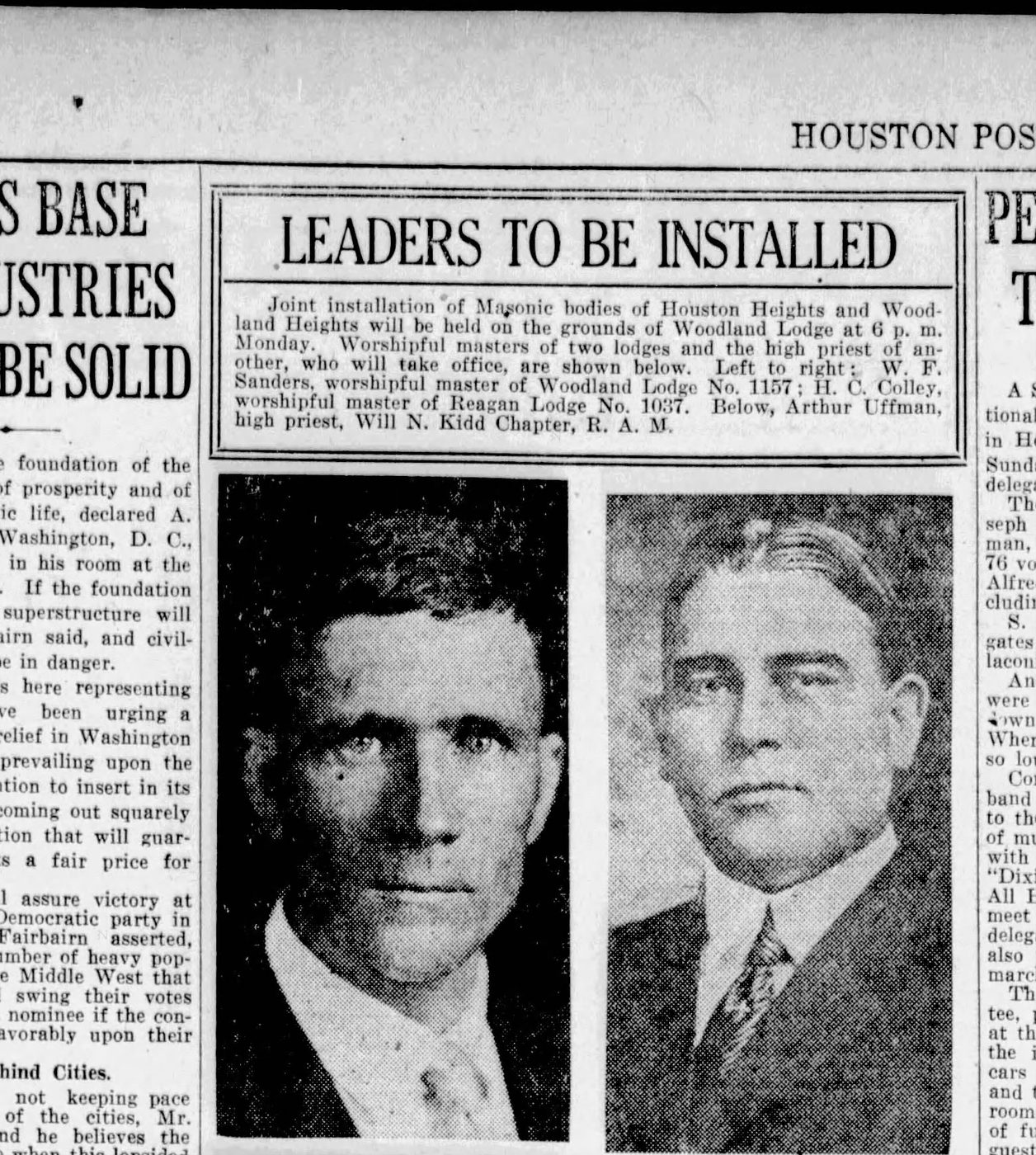
Reagan Lodge No. 1037, A.F. & A.M., was chartered by the Grand Lodge of Texas on December 12, 1910 and instituted, with its first officers installed, on December 31, 1910. J. M. French was the first Worshipful Master; the installing officer was District Deputy Grand Master O. M. Longnecker. James F. Helms carried the charter home from Waco. (Grand Lodge of Texas Proceedings, 1930, p. 1098; Sloan, Houston Heights) The lodge was named for John Henninger Reagan, Confederate Postmaster General, United States Senator, first chairman of the Texas Railroad Commission, and a Mason since 1848 in Austin Lodge No. 12, later Past Master of Palestine Lodge No. 31; he had died in 1905. Three of the founders had a shared past: French, Helms, and A. C. Bernard had served together as officers of Brenham Lodge No. 135 as early as December 1893, seventeen years before the Heights charter.
The young lodge met over the volunteer fire station at 910 Yale Street, next door to Dr. William Olive's drugstore, threw public installation picnics that drew "fully 1000 people" in a town of nine thousand (1915), and sponsored the bodies that would fill its future temple: Houston Heights Chapter No. 258 of the Order of the Eastern Star, Reagan Chapter of the Order of DeMolay (founded November 8, 1921, Houston's second chapter), and Houston Heights Assembly No. 10 of the Order of the Rainbow for Girls (instituted March 15, 1923). Membership grew from 23 at the charter to 120 in 1917 and 544 in 1924. (Grand Lodge Proceedings, 1917 and 1924 returns)
The first hall
In September 1916 a charter was filed with the Texas Secretary of State for the "Reagan Lodge Masonic Building association of Houston Heights, no capital stock." Two Austin papers reported it with different incorporator lists: C. I. Voss, Helms, A. C. Bernard, and C. W. Raper in one; Voss, Helms, and Bernard in the other. (Austin American, Sept. 30, 1916; Austin Evening Statesman, Sept. 29, 1916) The lodge's own later history and its 2010 marker date fund-raising for a permanent building to 1912; no period source confirms that year.
By the last night of 1916 the lodge had a hall of its own at the corner: "The first entertainment held by Reagan Lodge No. 1037 of Houston Heights in the new Masonic Hall, Harvard and Eleventh, was a watch party." (Houston Chronicle, Jan. 7, 1917, p. 2) Affiliated bodies were meeting there by May 1917, the lodge itself by May 1918, and from June 1918 the notices settled into the phrase they would keep for a decade: "in Masonic temple, Eleventh and Harvard, Houston Heights." (Houston Post, June 18, 1918) The word "temple" for this first hall matters: a pre-1930 reference to the "Masonic Temple at Eleventh and Harvard" means this building, not the one that stands today.
What the first hall was is the corner's least documented fact. No construction notice, cost, contractor, or architect has been found. The only period description of its fabric comes from a transcript of the March 1930 building announcement, not yet checked against the page: it put the lodge's temporary quarters on the second floor of the brick building at Eleventh and Harvard. (Houston Chronicle, Mar. 23, 1930, p. 61, in transcript; the clipping held breaks off mid-article) Later notices add a second floor where the DeMolay boys met (1924), a lawn large enough for basket picnics, an "exhibition hall" the Garden Club used for its flower shows, and, by November 1925, a street number: "the Masonic hall, 1100 Harvard Street." (Houston Post-Dispatch, Nov. 14, 1925) The City of Houston's preservation pages say "the first lodge was built in 1918 at 1100 Harvard Street"; that date is a fair memory of this hall, wrongly attached to the 1930 temple. One map does not fit. The Sanborn fire-insurance sheet for this part of the Heights, corrected to June 1919, shows the corner parcel holding a single two-story frame dwelling, and no lodge hall, store or brick building at any corner of the intersection. (Sanborn Map Co., Houston, Vol. 2, additional sheet 98, June 1919, UT Libraries) Either the hall the notices place "at Harvard and Eleventh" was a converted house the map records as a dwelling, or it stood elsewhere, or it came after June 1919, or it was already gone by then. The next Sanborn volume for the Heights, at the Harris County Archives, shows the corner as last corrected about 1937, so whether it can settle the question is unknown until someone looks.
Lodge life, 1918–1929
For eleven years the corner was the busiest civic address in the Heights. The Eastern Star chapter met there twice a month with suppers, plays, and schools of instruction; DeMolay fielded basketball and baseball teams and, with the Houston chapter, hosted the state conclave; Rainbow girls held Saturday meetings and box parties on the lawn. The lodge buried its dead from the hall, laid cornerstones for a Baptist church in 1912 (most likely the Baptist Temple at Twelfth and Rutland) and, on Monday, November 9, 1925, for John H. Reagan High School at Thirteenth and Arlington, the lodge named for a man leveling the cornerstone of the school named for the same man. (Houston Chronicle, Nov. 1, 1925, p. 61) Its Worshipful Masters can be traced nearly year by year, and its secretary from about 1916 was James F. Helms (J. Frank Helms in some notices), who had run the Heights school board for thirteen years while the town was independent and whose name is on Helms School today. In October 1930 the Chronicle called him secretary "for the past 14 years." (Houston Chronicle, Oct. 19, 1930, p. 25)
Signals of a grander building begin in 1927. On May 27 that year the lodge called a special meeting "at which time the grand master of Texas, or his deputy, will lay the cornerstone for the new Heights Masonic Temple at Eleventh and Harvard." (Houston Post-Dispatch, May 27, 1927, p. 15) No contract, permit, or building followed; whether a cornerstone was laid for a scheme later redesigned is unknown. In August 1928 the architect Lamar Q. Cato announced the contract for the two-story Cade-Rothwell Masonic Lodge building on North Main, and in November 1929 a bid notice from Cato's office sought contractors for "a two-room hall and stucco addition to the present hall," a lead that may or may not concern this corner. On December 31, 1929 the lodge held its nineteenth-anniversary watch party, the last event in the first hall.