Chapter 6 · 2000–present
The Homes Inside the Temple
- 1The Corner Before the Temple
- 2Building the Temple
- 3The Golden Age and the Loss
- 4The Legal Reserve Years and the War Apartments
- 5The Long Slide and the Condo Gamble
- 6The Homes Inside the Temple
This is the era of the people who live here now. The newspaper record thins to a renovation campaign, a decade of unit listings, and one garage sale. The Sunday ads of early 2001 settled into a form: "1100 Harvard – OPEN 2-4 PM – 14-unit mid-rise condominium development. Historical Heights building. Renovated multi-level condos. Gated complex, covered parking, swimming pool. Some units with terraces $130K's to $250K's." Units #2, #5, #8, #9, #10, #12, and #15 went through the classifieds between 2001 and 2012 at asking prices from $157,000 to $252,900; none has been matched to a recorded sale. Unit #2, three bedrooms on four levels, resembles the 1982 flagship that was asked at $318,600 nineteen years earlier, but whether it is the same home has not been established. A basement efficiency still earns its keep where the 1930 plans drew a bowling alley. On March 11, 2006 the Greensheet announced a "GIANT GARAGE Sale … 1100 Harvard @ 11th." History becomes domesticity.
The number of homes, long the one basic fact this history could not state, is settled by the record. The 1985 declaration describes fourteen units, and the county appraisal roll carries fourteen today, numbered 1 through 12, 14, and 15; there is no unit 13. The declaration also gives the association its legal name, Harvard House Condominium Association, Inc.; the listing portals say Harvard House Condominiums, and the 2019 sign on the building says Harvard Place Condominiums.
The neighborhood transformed
Heights median household income roughly doubled between 2000 and 2015. In 2013 CNN Money ranked the Houston Heights fourth among big-city neighborhoods in America. Heights voters finally repealed the 1912 dry rule, off-premise sales in 2016 and on-premise in 2017; the shop row had spent its entire working life under it.
The preservation question, stated correctly
The City of Houston designated Houston Heights Historic District East on February 20, 2008 (Resolution 2008-4), and 1100 Harvard lies inside it. The city's inventory line reads: "1100 Harvard · Harvard House Condo · 199 · 1918 · PC · Neo-Classical Masonic Lodge," under a year column headed "circa yr blt," PC meaning potentially contributing. Three things follow. First, the building is a contributing structure today. When the city rewrote its preservation ordinance in 2010, it defined a contributing structure to include "any structure that was identified as 'potentially contributing' in any historic district" (Code of Ordinances Sec. 33-201, Ord. 2010-814); the glossary of the city's Historic Preservation Manual limits that to districts "designated prior to October 13, 2010," and Heights East was designated in 2008. The city's preservation commission has applied the rule to Heights East buildings classed PC in 2008. (Houston Archaeological and Historical Commission, Item E, Apr. 21, 2022) Second, the correct date also falls inside the district's period of significance. The city's design guidelines say that "for the three Houston Heights Historic Districts, the 1940s are generally considered the end of the period of significance," which begins with the town's founding in 1891, and that a building constructed during the period "could be considered contributing." The inventory's 1918 is wrong, but a building of 1930 is not outside the period. Third, no local preservation law stood in the way of the 1982 gutting: Houston had no preservation ordinance until 1995 and no Heights district until 2007. The building has no individual National Register listing and is not among the inventoried properties of the 1983 Houston Heights Multiple Resource Area. Its survival intact was secured by market conditions and a functioning condominium regime, not by law, and the documentary record assembled here is the material an individual nomination would require.
One integrity question travels with that. The Post's 1982 story on the conversion said "the work involves retaining the ornate architecture of the original building and installing a new surface on the exterior and rebuilding the interior." (Houston Post, Aug. 8, 1982, p. 188) The 1943 photograph shows dark brick; a 2001 transcriber described "a three-story light-colored stucco/masonry building." Whether the original brick and the frieze's Square and Compass are under a later coat is answerable from the building itself and bears on any nomination.
The lodge in its tenth decade
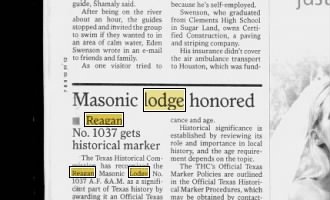
Reagan Lodge No. 1037 remains active at 1606 Heights Boulevard, half a mile north of the corner where it was built. It received an Official Texas Historical Marker there in December 2010 (marker 16433), whose text, researched by the Texas Historical Commission from the lodge's own history, states that the temple was "constructed in 1930 at the northeast corner of Harvard St. and Eleventh Ave., but was taken over by a local bank in 1935," an independent corroboration of both facts. The marker stands at the 1948 hall; there is none at 1100 Harvard. In 2004 the Houston Heights Restoration/Historical Committee held its meetings in the lodge's hall, the organization dispossessed of 1100 Harvard housing the committee whose successors drew the district lines. The Odd Fellows' 1923 hall at 115 East Fourteenth, still in fraternal use, got its marker on the building itself in 2021. The two Heights fraternal halls are each other's control group.
What remains open
The 1935 foreclosure instrument and the lender's name. A dedication account for December 31, 1930. The size of the 1930 site (225 by 132 feet in the Chronicle, against an untraced "vacant lot 100 by 150"), and the chain of title to the south half of Lot 17. The identity of the exile hall, probably at 801 Harvard. Whether J. F. Helms or J. M. French was the lodge's first Worshipful Master, and whether L. R. Hayes was Master in 1936–37 or 1937–38. Where the 1916–29 hall "at Harvard and Eleventh" stood, given a June 1919 map that shows none. The chain of title from 1939 to 1964, before the online deed index, and what the 1986 and 1987 deeds actually conveyed. The declaration's plat sheets for the upper floors, missing from the copies seen. H. C. Thomas Sr.'s "A Brief History of Reagan Lodge." The 1972–81 occupancy, and what the January 1972 cornerstone notice was for. Which building at the corner housed the Woodmen, the Odd Fellows, the school, and the armory, and which shops on Eleventh were in the temple rather than the building at 215 E. 11th. Whether George H. Jenkins of the lodge and George Howard Jenkins the banker were one man. A second period photograph.