Chapter 5 · 1965–2000
The Long Slide and the Condo Gamble
- 1The Corner Before the Temple
- 2Building the Temple
- 3The Golden Age and the Loss
- 4The Legal Reserve Years and the War Apartments
- 5The Long Slide and the Condo Gamble
- 6The Homes Inside the Temple
The corner disappears
The clearest sign of decline is negative: in the Morrison & Fourmy directory of about 1968–71 the Harvard Street numbering runs 1046, then 1101, 1105, 1107, with no 1100 or 1102 at all. The shop row held on with a pharmacy in its last years, a vacuum dealer, a Houston Post distribution station, a washateria, a barber, a resale shop, and a used-furniture store. The 1971–72 and 1980–81 directories in the project's holdings survive only as box labels, so the building's occupancy through the 1970s is the largest gap in its whole record. "The Heights was impoverished and decrepit" by 1970, a city preservation retrospective would say; the Houston Heights Association was founded in 1973 to fight demolition. Even at the bottom, the 1980 National Register nomination for the Schlesser-Burrows House at 1123 Harvard, across the street, oriented itself "adjacent to old Masonic Lodge."
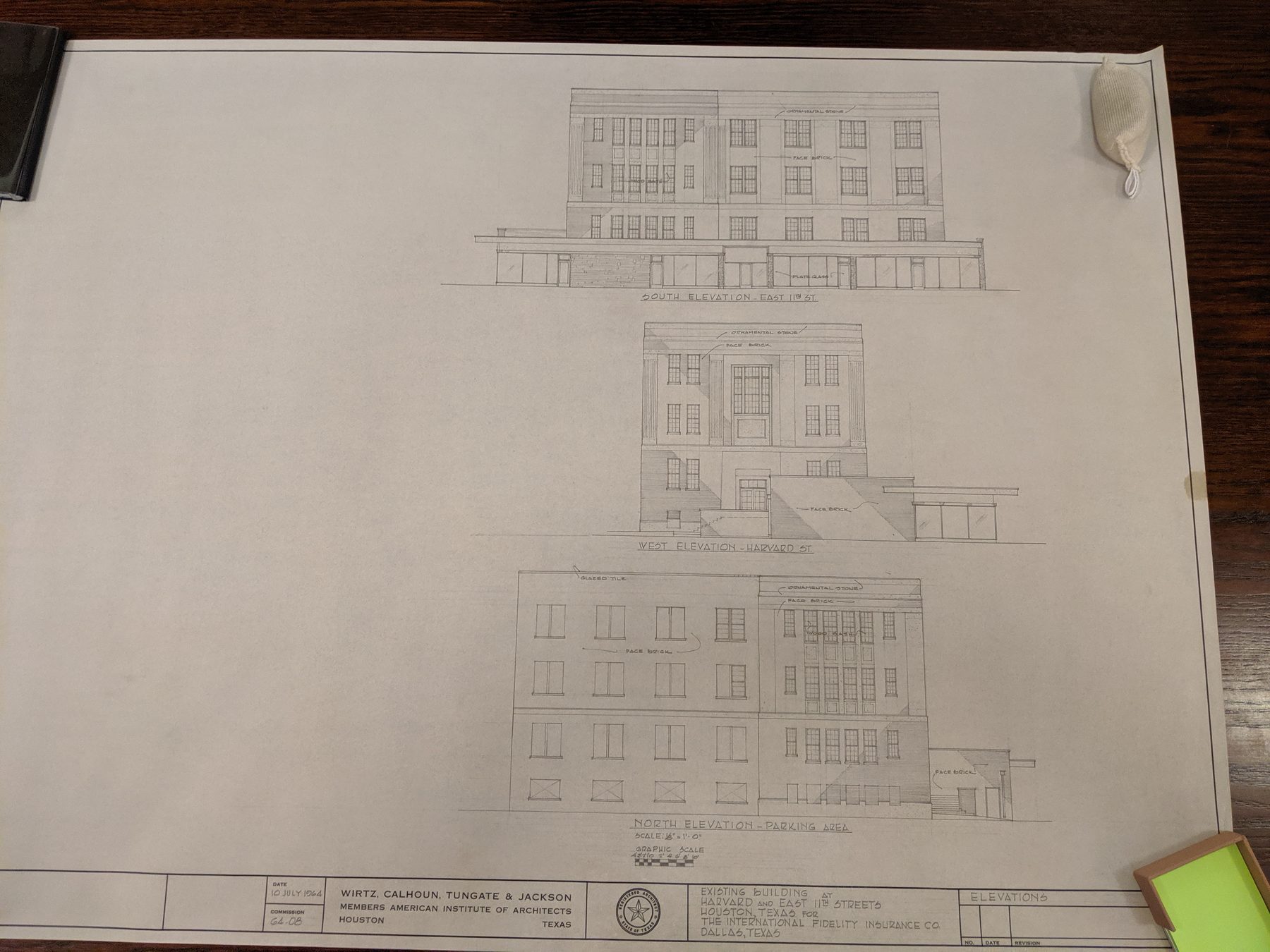
A rented Masonic hall, 1966–1983
The lodge-notice columns tell a different story from the directories, and it is offered here as the likelier reading. From 1966 into the 1980s well over a dozen Masonic bodies listed meetings at "Heights Masonic Temple, 11th & Harvard" or "Reagan Masonic Temple, 11th & Harvard": Reagan's own chapter, council, and Eastern Star chapters; Temple Lodge No. 4; S. P. Waltrip Lodge No. 1328, named for a Reagan past master; Jacques DeMolay No. 1390; Houston No. 1189; Eastgate No. 1153; Cade-Rothwell No. 1151, which had a Cato-designed hall of its own and still listed the temple as late as November 1983; and Washington Chapter No. 2. (Melrose Commandery, which had called the hall "Melrose Temple, 1100 Harvard" in 1963, was meeting on Chrisman Road by September 1977.) In January 1972 the Post announced "Cornerstone ceremonies by the Grand Lodge of Texas … on the corner of 11th and Harvard Sts."; what was being dedicated is unknown. (Houston Post, Jan. 12, 1972) Masonic cornerstone ceremonies were not reserved for lodge buildings (Reagan Lodge itself had laid the cornerstones of a Baptist church in 1912 and of Reagan High School in 1925), so the notice may concern another building at the intersection. A June 1982 notice called the building "Memorial Temple," which matches Memorial Lodge No. 1298, co-organized by a Reagan man. A lodge hall has no residential or commercial directory listing, which is exactly what the directories show. An unknown share of these notices is stale copy; the Grand Lodge's annual lodge-location pages for 1966–85 are the test that would separate the live tenancies from the fossils.
The lodge on Heights Boulevard
Half a mile north, Reagan Lodge reached its institutional summit. J. W. Chandler, raised in the lodge on October 30, 1948, two months before the Heights Boulevard hall opened, and its Worshipful Master in 1955–56, was Deputy Grand Master of Texas in 1967 and was installed Grand Master of Masons in Texas in December 1967 for the 1968 term. The lodge marched up to present him a hat: "I hope that my head hasn't gotten too big in the last few minutes, and it still fits." (Grand Lodge Proceedings, 1967, pp. 336–342; 1968, p. 4) In 1968 the lodge expected to hold two Grand Masters at once, Chandler and George Daniel of the Grand Council of Royal and Select Masons. The lodge held outdoor degrees at the Joe B. Junell ranch under dispensation through the decade. Membership, 1,762 in 1966 (the 1965 figure of 1,817 rests on a damaged table), fell to 1,625 by 1970 and, on the evidence of the obituary columns, kept falling; no Grand Lodge volume after 1970 is in the project's holdings.
Harvard House, 1979–1986
The deed index fills the quiet years with owners, if not with uses: Walter G. Cook from 1965; Eva T. Orr, probably, from 1975 (the index ties that deed to this lot only through a release Cook gave her in 1977); the Sullivan Building Co. from May 1977; then from November 1977 Terrance J. Godbold with two partners, and Martha C. and Terrance J. Godbold alone from October 1978. (Harris County deed records, files C164335, E448821, F143781, F136063, F356413, F356414, F356416 and F798538; index entries, instruments not read) A washer-service memorandum filed in July 1977 already names a "Harvard House Apt," though the index gives no legal description to tie it to this building. On April 6, 1979 the Godbolds deeded the property to a grantee indexed as "Harvard House" (Harris County deed records, file G033158; index entry, instrument not read); the joint venture that T. S. Terry managed, the declarant of 1985, bore the same name. "Harvard House Apts." was renting units by January 1981, and that September an ad promised "TOTALLY MODERN LIVING SURROUNDED BY THE BEAUTIFUL CLASSIC LINES OF A 52 YEAR OLD STEEL AND CONCRETE STRUCTURE." (Houston Chronicle, Sept. 13, 1981, p. 262) Under the tax law of the day, that age earned no credit for apartments or condominiums. The Economic Recovery Tax Act of 1981 offered rehabilitation credits of 15 and 20 percent for buildings at least thirty and forty years old, but those age-based credits excluded residential rental property; only the 25 percent credit for certified historic structures reached residential rentals, and this building was never certified. Condominium units built for sale to their occupants were not depreciable business property and qualified for no credit at all. (Internal Revenue Service, Rehabilitation Tax Credit Audit Technique Guide, 2002; Treas. Reg. §1.48-1(h)) The ads that followed sold the age itself.
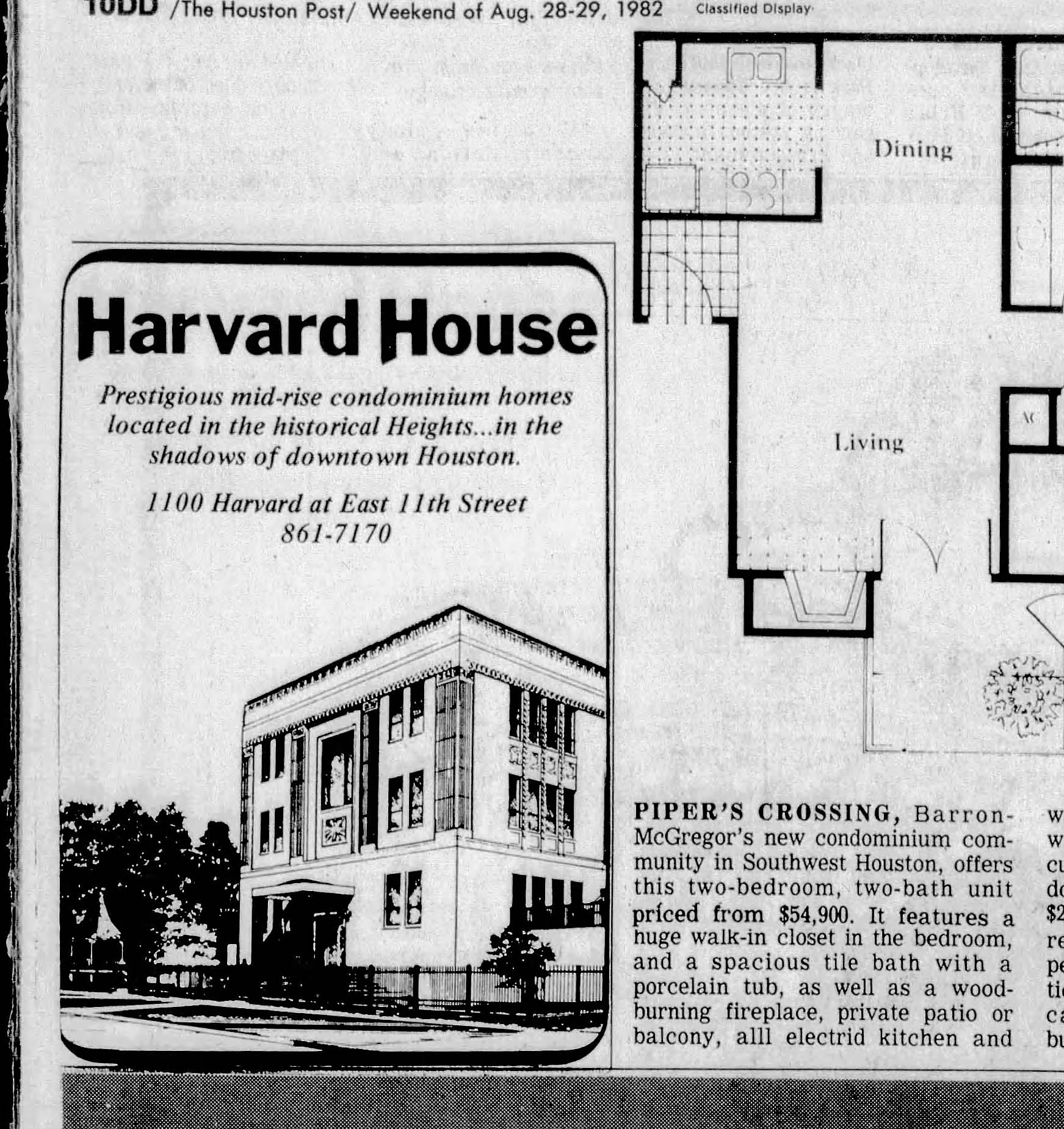
In March 1982 the flagship unit went on the market as "ANTIQUITY with modern class, and prestige. $318,600. 3-2½-½ four levels, large terrace." Within three weeks the same headline sat over a two-bedroom unit at $155,000, and by the end of the month the antiquity language was gone: "New Hi-Rise Condo 2-2, $155,000." (Houston Post, Mar. 2–31, 1982) That August the Post reported "Condo conversion under way": Terry converting the former Masonic temple into a twelve-unit condominium called Harvard House, a $3 million project financed by an interim loan from Allied American Bank, units from $157,762 to $336,256, "French doors, terraces and wine cellars." The story called the building "six-story" and said it "opened in 1928"; both are the paper's errors. (Houston Post, Aug. 8, 1982, p. 188) Display ads that fall carried a drawing of the building, "prestigious mid-rise condominium homes … in the shadows of downtown Houston," and by November Turner Owens Properties was selling two-bedroom units at $153,000. Help-wanted ads chart the bust: a painter at $8 an hour in April 1983, at $6 in August 1984.
The condominium declaration, executed on June 4, 1985 and recorded in the Condominium Records of Harris County (File No. K060751), describes Lots 13 through 16 and the south half of Lot 17, Block 199, and "one (1) four-story building which contains an aggregate of fourteen (14) individual apartment-type units." The declarant was Harvard House, a Texas joint venture whose joint venturers signed as T. S. Terry and Richard Collier, Trustee, with Terry as managing agent; UnitedBank-Houston signed as consenting lienholder; and the declaration created Harvard House Condominium Association, Inc. The county appraisal roll carries the fourteen units today as numbers 1 through 12, 14, and 15; there is no unit 13. In June and July 1985 the same building was advertised from two telephone numbers as "HARVARD HOUSE … $310 & $360" and "HARVARD PLACE … pool, security gate, W/D conn. $275 & up," and that July the Chronicle photographed a candidate for constable, Ed "Tracy" Maxon, in front of "his first major project," the Harvard House, planning to sell units for $175,000 to $250,000 "possibly to a group of foreign investors." (Houston Chronicle, July 28, 1985, Sec. 3 p. 8) By August 1986 the marketing had reversed: "HARVARD HOUSE NOW LEASING … Plush 1 & 2 bdrm homes are available with unique 2 & 4 level floor plans. Beautifully landscaped & gazebo area … $900 & up," the failed-conversion pivot arriving in the middle of the oil bust. (Houston Chronicle, Aug. 9, 1986, p. 97) The gazebo was not new: the 1982 display ad's drawing already shows one north of the building.
Failure, receivership, workout, 1987–1992
UnitedBank-Houston, which had signed the 1985 declaration as consenting lienholder, was closed by the state banking commissioner on Thursday, April 30, 1987, with $217.9 million in assets, then the largest bank failure in Houston's history; American Bank-Houston assumed its insured deposits. (FDIC; Houston Post, May 5, 1987) On March 16, 1989, MeritBanc Savings Association, the renamed Hardin Savings & Loan, failed and entered federal conservatorship; the Resolution Trust Corporation, created that August, inherited it. In October 1992 MeritBanc's former president Raymond Oshman was indicted with the developer Joe Russo for channeling thrift loans into Russo's projects. (UPI, Oct. 21, 1992) The deed index shows how the paper passed from the bank to the thrift. UnitedBank had taken over Allied American Bank's lien in January 1983. In January 1986 Harvard House, J. Richard Collier and Paul Yates deeded the property to Kent J. Allen and others and to Tompkins Capital Management, financed by Hardin Savings & Loan, and UnitedBank released its lien that February, more than a year before it failed; whether that deed carried the whole building or only the unsold units is not in the index. In April 1987 a deed passed the property to Hardin S&L itself, filed with an affidavit by Charles S. Parrish; the pattern is that of a trustee's sale after foreclosure, though the instrument has not been read. (Harris County deed records, files H792142, K351692, K351693, K426405, L073519 and L073520; index entries, instruments not read) The workout closed with a deed of April 8, 1992 from Donald L. Frame and others, MeritBanc and the Resolution Trust Corporation, as receiver, to Harvard Place Inc, which borrowed the same day from Quest Star Bank. (files N616405 and N616406; index entries, instruments not read) In the middle of the wreckage, ordinary life went on: unit 15 sold to a private buyer for $108,000 in 1989, one-bedrooms let for $250 with bills paid, and in September 1990 a film crew used the 1100 block of Harvard to stand in for California seven decades earlier.
Renovation, 2000
By June 2000 Ray Allison, Realtors was advertising "1100 Harvard / 14 units now being renovated. / Pick Colors. / Some Ready Now," and a week later reported five units sold at the "Harvard Place Lofts," from $139,900 to $255,000, crediting thirteen-inch masonry walls and one-foot concrete floors for the quiet. The builder, named only in September, was Silvestri Homes of Texas under Emilio Silvestri, and with it came a fourth marketing name, "Harvard Lofts." On October 29, 2000 the Chronicle's Design Profile ran two photographs of the building, "the look of a 1920s building in the Heights," and its four-story foyer with a chandelier. (Houston Chronicle, June 11, June 18, Sept. 17, Oct. 29, 2000)