Chapter 4 · 1935–1965
The Legal Reserve Years and the War Apartments
- 1The Corner Before the Temple
- 2Building the Temple
- 3The Golden Age and the Loss
- 4The Legal Reserve Years and the War Apartments
- 5The Long Slide and the Condo Gamble
- 6The Homes Inside the Temple
The Grand Lodge left one line about the loss. For the next thirty years the building and the lodge lived largely separate lives.
The empty temple, 1935–1939
City directories list 1100 and 1102 Harvard as vacant from 1936 through 1938. The clippings say otherwise: two men gave 1102 Harvard as their home address to police in June 1936; the electrical contractor Walter Cavender, 57, who died in November 1936, is said in one unread Chronicle page to have kept a shop in the building; and in March 1937 Reagan Lodge itself held a called meeting "at Masonic Temple, 1100 Harvard St." to bury its first master, J. M. French. (Houston Post, Mar. 29, 1937, p. 10) By 1938 the bank was marketing the property four ways at once: "HARVARD, 1100: Lower 4 rooms, nicely furnished duplex"; "HARVARD, 1102: Nice 5-room home; lot 50x135 … only $2850"; "LEASE OR RENT building, 3000 square feet"; and "EAST 11TH, 201—Modern corner, 48x63, busy street, community center, parking." (Houston Post and Chronicle, July, Sept., and Nov. 1938; the corner ad, Houston Post, Nov. 19, 1938) From September 1938 a Seventh Day Adventist School at "11th and Harvard" served as a polling place, and did so again in 1947. Which building it occupied is not settled.
Two buildings at one corner
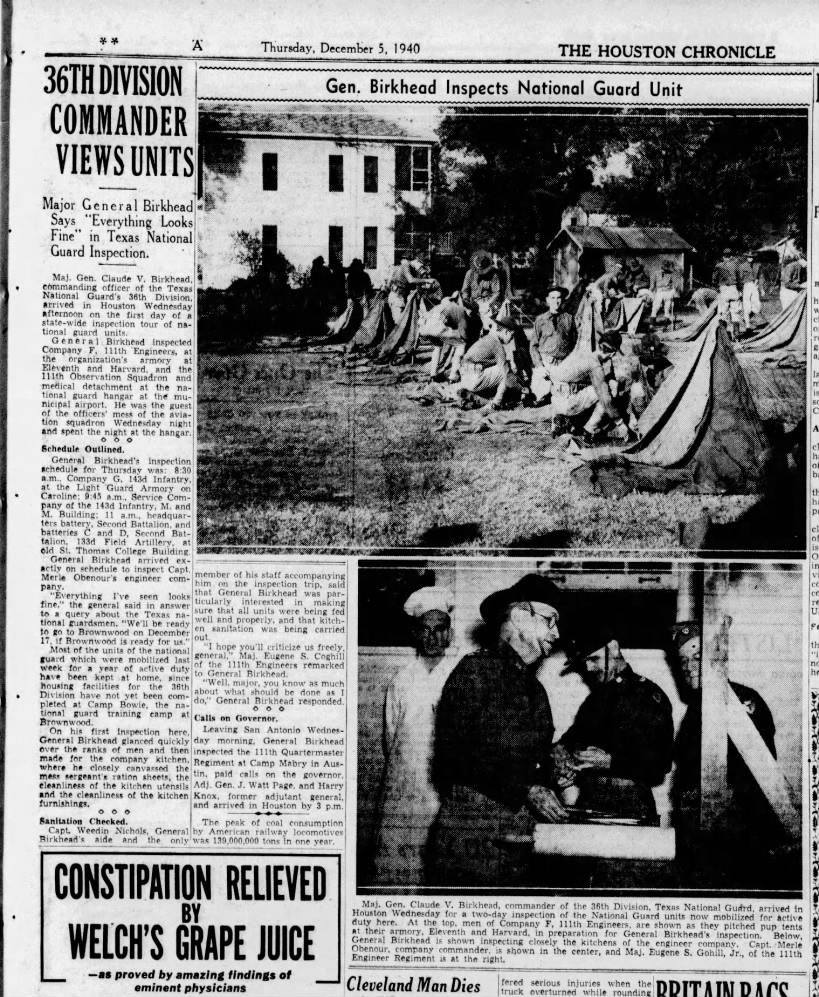
That question runs through the whole decade, and it deserves stating as a hypothesis rather than smoothing over. The record carries a "Woodmen of the World hall, corner of Eleventh and Harvard" in 1934, an "I.O.O.F. Hall, Eleventh and Harvard" in December 1939, the Adventist school of 1938–47, and the "111th Engineers' Armory" of 1940, none of which it can place inside the temple. The 1938 ads show a separate five-room house still standing at 1102. The December 5, 1940 Chronicle photograph of Company F, 111th Engineers pitching tents "at their armory, Eleventh and Harvard" shows a light-colored two-story building with plain rows of sash windows, not the pilastered brick temple. One reading is that the lodge's pre-1930 hall, or another hall beside it, stood at the corner into the 1940s and hosted the Woodmen, the Odd Fellows, the school, and the Defense Guard drills. The nearest candidates are weak ones: the county's records and the city's 2008 inventory put a separate commercial building of about 1930 at 215 E. 11th, on Lots 11 and 12 of Block 199, and another of about the same date across Eleventh at 220 E. 11th, but both stand at the Cortlandt end of the block, not at Harvard; 215 is across the alley from the temple's lots. A 1930s Sanborn sheet for Block 199 or the 1930s directories would settle it. Until then, the armory belongs to the corner, not certainly to this building; the December 1941 burglary report does place an office of the 111th Engineers inside it.
Miller, Home Life, and a new name, 1939–1944
On September 10, 1939 the Chronicle reported, under the headline "Insuranceman Buys Building on Harvard," that "Lester A. Miller, Houston insurance man, has purchased a two-story building at Harvard and Eleventh from the Houston National Bank for about $40,000. The property fronts 200 feet on Harvard by 132 feet on Eleventh. The building on the site is the former home of the Reagan Masonic Lodge." (Houston Chronicle, Sept. 10, 1939, p. 43) The last sentence settles what was sold: the purchase is this building, though the paper gave it one story fewer than it has. Heights lots are 50 by 132, so 200 by 132 is Lots 13 through 16 of Block 199. The 1930 announcement had given the lodge's site as 225 feet on Harvard, and the 1985 condominium declaration describes Lots 13 through 16 and the south half of Lot 17; why the 1939 sale left out the half lot, and when it came back, waits on the deed records.
The company that moved in was Home Life Assurance Company, certificated at Fort Worth from at least 1936 with J. L. Mistrot as president, selling family-group "old line legal reserve" burial policies and recruiting small-town agents to "1102 Harvard St., Houston." (Fort Worth Press, 1936–44; Brenham Banner-Press, Nov. 1943) Miller was its general manager: the 1943 lease story names him so. By August 1940 the building had its new public name, "the Legal Reserve Building, Eleventh and Harvard," where the Heights civic federation met (Houston Chronicle, Aug. 20, 1940, p. 23), and the 1942 directory lists "Home Life Assurance Co; Legal Reserve Life Co" at 1102. Home Life's last certificate was renewed in April 1944; after that it vanishes from the record.
The old lodge floors filled quickly. The Mary Jane Studios dance academy moved from downtown in August 1939 into "spacious new quarters at East Eleventh and Harvard with 7000 square feet of space." (Houston Post, Aug. 27, 1939, p. 40) In 1941–42 the building was the Houston headquarters of the Teamsters, Joint Council No. 58, whose president John E. Adams, "of 1102 Harvard," became the first man convicted under Governor O'Daniel's 1941 anti-strike-violence law; the morning Houston read of Pearl Harbor, an inside page reported that "yeggs" had worked over the safes in the building's offices at 1102 Harvard during the weekend, taking $25 from the 111th Engineers' safe and $316 and a check from the safe of Truck Drivers and Helpers Union No. 367; only the safe of Teamsters Joint Council No. 58 held. (The Orange Leader, Nov. 16, 1941, p. 1; Houston Chronicle, Dec. 8, 1941, known from a re-typeset copy) Other Masonic bodies kept meeting in the hall throughout: a stated meeting at the "Houston Heights Masonic Temple, 11th and Harvard" in November 1938, five Reagan and Heights bodies at "Reagan Temple" in February 1940, Rainbow Assembly No. 10 at "the Reagan Masonic Temple" in July 1941.
The lodge in exile
Reagan Lodge, meanwhile, met three blocks south. From 1936 through 1948 its notices read "Masonic temple, Eighth and Harvard streets, Houston Heights." The hall's identity has not been established, but it now has a probable street number: in June 1941 the press described P. H. Obenour, about seventy, as "building superintendent at the Reagan Masonic Temple, 801 Harvard," the 800 block, where he climbed to the roof to watch a work crew and died of a heart attack; the justice of the peace returned "a verdict of natural death." (Houston Chronicle, June 12, 1941, p. 19) The exile-era masters ran from L. R. Hayes (elected June 1936) through A. T. Moberg (1942), with J. A. Newsome as secretary throughout. In June 1940 the lodge bought the northeast corner of Heights Boulevard and East Sixteenth from Dr. T. G. Synnott for $3,600, "for a $20,000 lodge hall," with "about 700 members." (Houston Chronicle, June 9, 1940, p. 17) The war intervened. Membership climbed from 633 in 1939 to 1,278 in 1948, with 158 initiates that year alone, and on December 31, 1948, thirty-eight years to the day after its institution, the lodge dedicated its Neoclassical hall at 1606 Heights Boulevard, designed by Past Master L. R. Hayes. (Grand Lodge Proceedings, 1949, pp. 51, 66; reaganlodge1037.org)
The government leases the lodge building, 1943
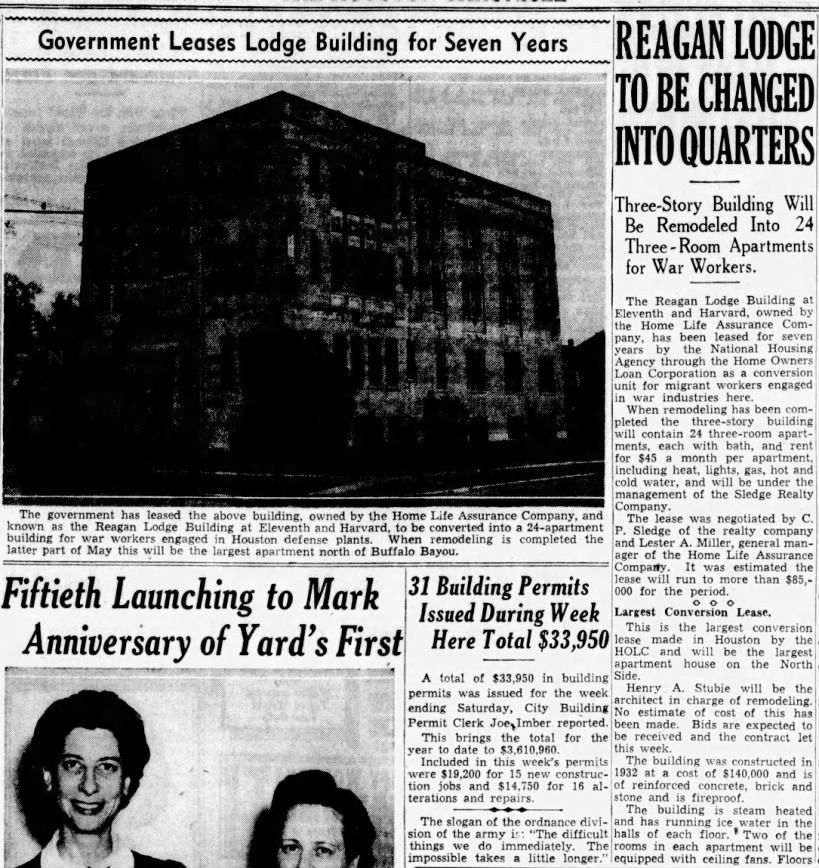
In the spring of 1943 the Chronicle ran a photograph of the building under the headline "Government Leases Lodge Building for Seven Years." The caption: "The government has leased the above building, owned by the Home Life Assurance Company, and known as the Reagan Lodge Building at Eleventh and Harvard, to be converted into a 24-apartment building for war workers engaged in Houston defense plants. When remodeling is completed the latter part of May this will be the largest apartment north of Buffalo Bayou." The companion story supplies the mechanism: a seven-year lease "by the National Housing Agency through the Home Owners Loan Corporation as a conversion unit for migrant workers engaged in war industries"; twenty-four three-room apartments with bath at $45 a month, heat, lights, gas, and water included; management by the Sledge Realty Company; the lease negotiated by C. P. Sledge and "Lester A. Miller, general manager of the Home Life Assurance Company"; an estimate that the lease would "run to more than $85,000 for the period," the seven years' rent; "the largest conversion lease made in Houston by the HOLC"; Henry A. Stubie as architect in charge of remodeling. The headline over the story said the whole "Three-Story Building Will Be Remodeled Into 24 Three-Room Apartments." The paper also said the building was "constructed in 1932 at a cost of $140,000," an error on both counts. (Houston Chronicle, c. Mar.–Apr. 1943; raw clipping in the project archive)
That photograph is the earliest known image of the finished building, thirteen years after it opened. By September 1943 someone in "Apt. 11, 1102 Harvard" was selling off a flat-top desk and a leather swivel chair, the changeover from insurance office to war housing in one classified. (Houston Chronicle, Sept. 13–16, 1943)
Twenty-four apartments
The 1946–47 directory heads the address "1102 APARTMENTS" with unit numbers running from 1 into the thirties. Those are floor codes. On April 3, 1950 the census enumerator Irene Scott Townsend recorded exactly twenty-four apartments at "1102," numbered 1–6, 11–16, 21–26, and 31–36; the numbering suggests six to a floor on four levels, though no sheet names a floor. Counting the eight households she found at home only on her call-backs, seventy-nine people lived there. (1950 Census, ED 263-139, sheets 3–5 and call-back sheets 71–74) They included a railroad special agent and a switchman, a pipe welder, a bus driver, a Marine recruiting officer, an Air Force mechanic, concrete-pipe makers working eighty-four-hour weeks, bookkeepers, beauty operators, and nurses. Twenty households were married couples and four were headed by women, one of them raising a child alone; twenty-seven of the residents were under eighteen. Only three households remained from the 1946–47 roster; that is what war-worker housing looked like once the war was over. The manager was probably Alicia D. Johanson, a widow enumerated a few streets away at 1101 Arlington, listed as a manager of rental property.
Some tenants the lodge had lost the building to were the lodge's own. George Howard Jenkins, the Houston National Bank man, died in the apartments in May 1945. C. C. Powell, retired painter, building-committee member of 1930, and presiding judge of Heights precincts for fifteen years, "of 1102 Harvard, died at 2:20 p.m. Thursday," May 22, 1947; his widow judged the precinct that voted inside the building days later, and county notices kept printing his name as presiding judge for four more years. (Houston Chronicle, May 24, 1947, p. 7) Thomas Jackson Howell, 84, a retired cotton broker "of 1102 Harvard St.," received Reagan Lodge graveside rites in 1961.
Rents ran $45 in 1943, $45 to $70 in 1951, $80 to $85 furnished by late 1953. A tenant's homemade burglar alarm, a door rigged to spill knives and forks, foiled a 2:30 a.m. break-in in September 1948; a Sunday narcotics raid in March 1954 jailed fifteen people and found no narcotics; the city's birth column for March 23, 1954 records a daughter, Rebecca, born to the Mullins of "1102 Harvard, No. 22."
The shop row, the 1951 addition, and Sammy Baugh
Along Eleventh the storefronts turned over constantly: Economy Cleaners for thirty years, the Eleventh Avenue Pharmacy and then Tlucek's, barbers, a watch repairer, the Heights Citizen's office at 215½ in 1942 beside a U.S. post office substation in the pharmacy, a frozen-food locker, a photographers' studio, Red Ortman's Mercury outboard dealership. All of it sold drugs, groceries, and haircuts and never a drink; the Heights' 1912 dry ordinance outlived the row by decades. Not every one of these shops was necessarily in the temple. The county's records and the city's 2008 inventory put 215 E. 11th on Lots 11 and 12 of Block 199, a separate commercial building of about 1930 at the Cortlandt end of the block, across the alley from the temple's lots, so the storefronts numbered 215 to 223, the Heights Citizen and the 1942 substation among them, may have stood in that building. Tlucek's Pharmacy, at least, was at 203 E. 11th in 1954, inside the temple's own frontage.
In February 1951 the Chronicle reported "$50,000 Addition Being Built To Masonic Temple": an addition "132 by 137 feet, of masonry construction," to what the paper called "the four-story masonry building, the ground floor of which is occupied by the City National Life Insurance Company. Upper floors are used as apartments." Fretz Construction was the builder, Arne G. Engberg the architect, Walter P. Moore, whose firm would later engineer the Astrodome, the structural engineer, and Howard & Johnson the mechanical engineers. (Houston Chronicle, Feb. 25, 1951, p. 62) The story does not say who commissioned the addition or who owned the building; a 1955 Chronicle item introduced Engberg as a former draftsman for Shreve, Lamb & Harmon, the Empire State Building's architects. The addition is likely the source of the storefronts numbered 203 through 211 that first appear in the 1954 directory, and of the offices that Southwestern Fidelity Life Insurance Company took at 207 East Eleventh in 1954.
Southwestern Fidelity was licensed on March 26, 1954 with Sammy Baugh, the Washington Redskins quarterback who had redefined the forward pass, as president and Linus Hardin as chairman. (Best's Insurance News, Feb. 1955) On April 4, 1954 the Post reported that the company had bought "the $675,000 Austin stone building at 3217 Montrose Blvd." for a home office. (Houston Post, Apr. 4, 1954, Sec. 4 p. 1) A Chronicle column that September, "Sammy Baugh Slings That Fountain Pen," found him in the new paneled offices; by 1956 he was "celebrating his second year as president … in spite of the fact that he coaches the Hardin-Simmons football team and keeps a weather-eye peeled on his 6400-acre ranch in Rotan." (Baytown Sun, Apr. 9, 1956, p. 2) The company's telephone line doubled as the leasing number for the apartments upstairs. In September 1956 Hardin, as chairman, announced a $600,000 four-story office building at 207 E. 11th for an affiliate, Southwestern Fidelity Investment Co., "the first building of its size in the Heights area," with 20,000 square feet and air conditioning, to designs by Smart & Whitehead; the same story said "the insurance firm will remain at 3617 Montrose," the number the Post had printed as 3217 in 1954. (Houston Chronicle, Sept. 23, 1956, p. 72) The tower was never built. In January 1957 the company advertised the 207 East 11th offices for lease, 4,700 square feet of "one of Houston's most beautiful office interiors," paneled in oak and mahogany, with wall murals and a 60-car parking lot, and printed five photographs of the entrance and rooms, the glass entrance door carrying the company's name in script. The ad does not say the company was leaving, and it still gave 207 East 11th as the company's own address, so when Southwestern Fidelity finally left the corner is not settled. (Houston Chronicle, Jan. 27, 1957, p. 32) The State Highway Department's District 12 right-of-way section took the offices in 1958. Southern Union Life of Dallas absorbed Southwestern Fidelity in March 1964.
Read together, the building's owners and tenants from 1939 to 1964 are one lineage: Home Life, the "Legal Reserve Life Co." beside it, City National Life, Southwestern Fidelity, and finally the International Fidelity Insurance Co. of Dallas, small-capital Texas stock life companies of the mid-century boom, entering and leaving by merger and stock swap. For a quarter century this was an insurance building with apartments above.
The hall the Masons never left
The tidy version has the lodge in exile while the building went secular. The notices say otherwise, though not every notice can be trusted. A Post column of March 29, 1949 lists Woodland Lodge No. 1157 and Heights Lodge No. 1324 at "Heights Masonic Temple, 11th and Harvard," but the same column still places Reagan Lodge "at Temple, 8th and Harvard," three months after Reagan dedicated its new hall on Heights Boulevard; by the stale-copy rule below, that column cannot show who was meeting where that spring. (Houston Post, Mar. 29, 1949, p. 31) The dated events with named officers are firmer. In September 1953 Reagan Commandery No. 85 worked the Order of the Red Cross at "Reagan Masonic Hall, 11th and Harvard"; in 1961 Jacques DeMolay Lodge No. 1390 met at "Reagan Hall, 1100 Harvard"; in October 1963 Melrose Commandery No. 109 called it "Melrose Temple, 1100 Harvard." Against these dated events with named officers sits a second thread that must not be read as occupancy: the papers recycled obsolete lodge templates for years, and a November 1963 notice placing Reagan Lodge at the corner is a verbatim reprint of its February 1940 slate.
The last decade of the era
The temple's architect died in July 1948. Its builder, Bace Construction, is last recorded in 1940. Membership at the lodge climbed to a plateau of about 1,750 to 1,800 through the early 1960s. In July 1964 the Houston firm Wirtz, Calhoun, Tungate & Jackson drew the building for the International Fidelity Insurance Co. of Dallas (Commission 64-08). The two sheets photographed for this history, the west and south elevations and a first-floor plan, are titled "Existing Building at Harvard and East 11th Streets." The full set, held privately, is reported to propose a renovation: a lowered basement, seven new storefronts, central-corridor offices on the first and second floors, and apartments on the third; that scheme, the set's measurements, and a note of the Square and Compass on the frieze have not been checked against the sheets themselves. Nothing was built. International Fidelity owned the building: the county's deed index records a deed to it from Certified Credit Corp. on August 10, 1964, and its warranty deed to Walter G. Cook on September 22, 1965. (Harris County deed records, files B936437 and C164335; index entries, instruments not read) How Certified Credit had come to hold the property is not in the online index; the transfer may predate 1960, where the index's images begin, or be indexed differently. In October and November 1965 the agent Joe Ridings advertised the "commercial building 1102 Harvard (corner Harvard and 11th, 1 block east Heights Blvd)": a "storearea 5,946 sq. ft. presently leased," an "office area 3842 sq. ft., recently vacated," and "3 stories 3842 sq ft each for storage or conversion to apartments." (Houston Chronicle, Oct. 19, 1965, p. 54; the ad ran into November) By November 1966 a news item placed "Reagan Masonic Temple" at 1606 Heights Boulevard. The name had followed the lodge.