Chapter 3 · 1930–1935
The Golden Age and the Loss
- 1The Corner Before the Temple
- 2Building the Temple
- 3The Golden Age and the Loss
- 4The Legal Reserve Years and the War Apartments
- 5The Long Slide and the Condo Gamble
- 6The Homes Inside the Temple
For five years the temple was what its builders intended, the civic living room of the Heights. Grand Lodge returns record 855 members in 1930 and 894 in 1931, the peak. (Grand Lodge Proceedings, 1930, p. 1098; 1931, p. 1135) Six Masonic bodies shared the address: Reagan Lodge; Woodland Lodge No. 1157, a second Blue Lodge holding stated meetings there from September 1932; Houston Heights Chapter No. 258, O.E.S.; Reagan Chapter, DeMolay; Heights Assembly No. 10, Rainbow; and, in the 1935 directory only, a Job's Daughters Bethel never mentioned anywhere else.
The record of what happened inside is rich. The Eastern Star chapter met on the first and third Mondays, gave turkey suppers in the club rooms, and in August 1932 held the first of its watermelon parties on the temple lawn. In February 1934 the state's Worthy Grand Matron convened all of Houston's Eastern Star chapters, ten or eleven depending on the clipping, under this roof. Reagan Chapter of DeMolay was "the largest and one of the most active in the state, having for the past two years won the state championship in competitive degree work," it announced on New Year's Day 1933. (Houston Post, Jan. 1, 1933, p. 2) The Rainbow girls staged an old-time style show of thirty-five vintage costumes and an August carnival on the lawn. Mrs. O. L. Morton's seventy music pupils performed a mock wedding. A Letter Carriers' auxiliary, Fulbright Methodist's young people, the Junior MacDowell Club, and the Reagan High "Red Coats" used the stage and the ballroom. In April 1933 the young people's department of Grace Methodist Church, "assisted by the Library Science Club of Reagan High School," presented "An Arizona Cowboy," a comedy-drama of the Western type, on the temple stage. (Houston Chronicle, Apr. 5, 1933, p. 19) The lodge's own rolls crossed faiths: a 1969 obituary set one member's Reagan Lodge membership beside Congregation Beth Israel. (Houston Chronicle, June 15, 1969)
The building's biggest night belongs to a debutante and a mayor. On Tuesday, December 27, 1932, in the worst year of the Depression, Mr. and Mrs. John Dunlop gave a dance for their daughter June in "the De Molay ballroom of the Heights Masonic Temple," the walls hung with smilax, spruce, and pine, the orchestra dais dressed as a small forest, the punch bowl frozen around fruit and flowers. "In the group assisting the hosts were Mayor and Mrs. Walter E. Monteith." (Houston Chronicle, Dec. 28, 1932, p. 5; Houston Post, Dec. 29, 1932, p. 5)
Congregations used it on Sundays. By November 1933 the Third Church of Christ, Scientist held services and kept a public reading room "in the church edifice" at 1102 Harvard; in March 1934 Woodland Christian Church was "holding services in the Reagan Masonic temple." (Houston Chronicle, Nov. 25, 1933, p. 5; Houston Post, Mar. 25, 1934, p. 14) A Temple Lutheran confirmation notice placed in the same building by earlier research could not be found on the page and is not counted. And the neighborhood voted here: election notices from 1934 to 1961 name the temple, under three different names, as a polling place, judged more often than not by lodge officers and their wives.
People lived in the building too. Woodward S. Logan, 53, a lodge member, was living at 1102 Harvard when he died in June 1934; Henry C. Nicholson, 55, was living at 1100 Harvard when he died in March 1935. Mrs. C. C. Powell presided over a precinct that voted at 1102 Harvard in October 1934, and her husband, a building-committee member, would die at that address in 1947.
The squeeze
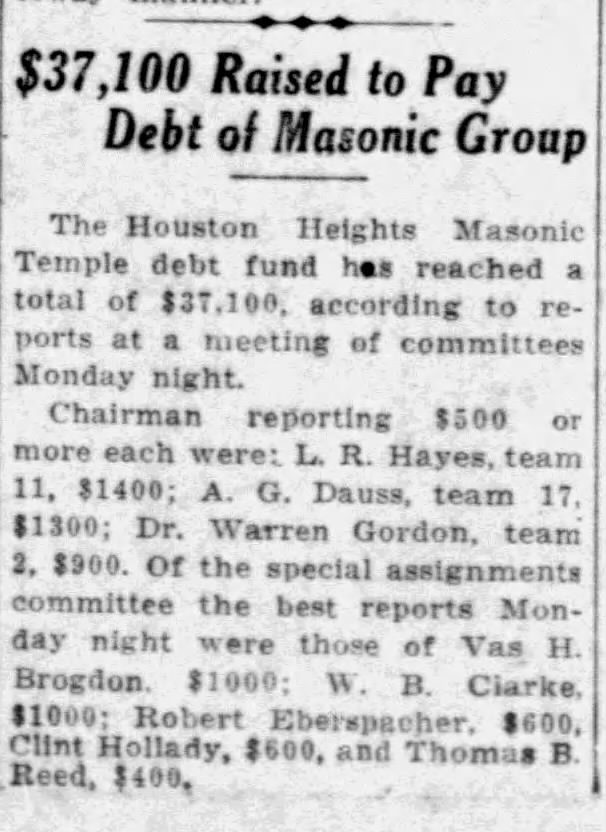
The loss can be read off three sets of numbers. Membership fell from 894 in 1931 to 797 in 1933. The lodge's charity remittance to the Grand Lodge fell from $25 a year to $5. And in May 1933 the members mounted a public campaign to clear $100,000 in obligations; a transcript of the Post's report of May 22 breaks that into a $50,000 mortgage, $17,500 in notes, and $32,500 in temple stock held largely by members themselves. Teams, a women's division, and progress dinners in the temple dining room raised $37,100 by May 15, $50,000 by May 22, and more than $57,000 by May 25. (Houston Chronicle, May 16, 1933, p. 9; Houston Post, May 22, 1933, p. 9, in transcript) It was a real achievement and not enough. The mortgage stood.
The lodge's secretary since about 1916, James Frank Helms, had died on Monday, September 12, 1932, aged 65; the Chronicle put it on page one. Two days later his body lay in state in the lodge room before a funeral in "the lodge auditorium, Eleventh and Harvard." (Houston Chronicle, Sept. 12, 1932, p. 1; Sept. 14, 1932, p. 4) The obituary called him the lodge's first Worshipful Master, which the Grand Lodge returns, naming J. M. French, do not bear out. One of the lodge's officers in these years, Senior Deacon on the 1930 cornerstone and a member of the debt drive's seven-man executive committee, was George H. Jenkins. A George Howard Jenkins who died in 1945, a Reagan Lodge member, had been "connected with the Houston National Bank 28 years." (Houston Chronicle, May 29, 1945, p. 23) Whether they are the same man has not been established. If they are, one of the lodge's officers in its crisis years had spent his career at the bank that, on the evidence below, took the building, and he would end his life as a tenant of it.
Why the foreclosure left almost no Masonic paper trail is explained by the Grand Master's address of 1932: across Texas, lodge buildings were held by separately incorporated building associations, over-leveraged in the 1920s boom, and the foreclosure suits named the association, not the lodge. (Grand Lodge Proceedings, 1932, pp. 148–149) Reagan Lodge never appears in the Grand Lodge's debt-conveyance approvals for that reason.
Leaving Harvard and Eleventh
The lodge left before the law caught up. A Post lodge listing of May 10, 1935 already has Reagan Lodge meeting at "Eighth and Harvard"; the June 1935 installation was held at Woodland Lodge's hall; and the 1935 Proceedings record, between lodges burned out of their halls in Texline and Seminole, "Reagan Lodge No. 1037 to move from 11th and Harvard Sts., to 8th and Harvard Sts." (Grand Lodge Proceedings, 1935, p. 83) On July 9, 1935 the Chronicle reported that "the old Reagan Masonic Lodge Building, Eleventh and Harvard" had been offered to the school district for Reagan High's overflow at $50,000: "The Reagan Lodge recently lost the building." (Houston Chronicle, July 9, 1935, p. 5) The lodge's own history and its marker say the building "was taken over by a local bank in 1935"; the project carries August 1935 as the date. No deed of trust, trustee's deed, or decree naming the lender has been read. Houston National Bank is the probable holder, inferred from its sale of the property four years later.
The era's last documented voice was Frank E. Anderson, 76, a lawyer with a taste for his own legend, who "just recently gave an address on John H. Reagan in the lodge rooms" and died on July 8, 1935, buried under the lodge's auspices. (Houston Chronicle, July 9, 1935, p. 1) Three weeks earlier the June election had put L. R. Hayes in the officer line as senior warden. The temple's last season was funerals, a quiet election, and a change of address slipped into the classifieds.